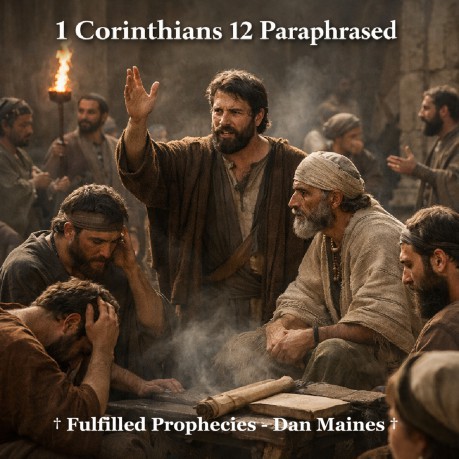
1 Corinthians 12
Paraphrased
By Dan Maines
Introduction
†
Paul wrote to the Corinthian believers because they were confused
about spiritual gifts and how they functioned in the early church.
†
These gifts operated during the apostolic age as signs confirming the
gospel message as it spread through the Roman world (Hebrews
2:3-4).
† From the fulfilled perspective,
these gifts were part of the church's foundation period before the
covenant age transition was completed in AD 70.
1
Corinthians 12:1
Brothers and sisters, concerning
spiritual gifts, I don't want you to remain uninformed.
†
Paul begins by correcting misunderstandings about spiritual gifts
that were active among believers at that time (1 Corinthians
13:8-10).
† The early church was still
receiving revelation and guidance while the gospel was spreading.
†
Irenaeus wrote that the Spirit worked powerfully in the early church
to confirm the truth of Christ.
1 Corinthians 12:2
You
know that when you were pagans you were led away to silent idols,
however you were influenced.
† Paul reminds
them of their former pagan life before they knew the living God
(Psalm 115:4-7).
† Idols had no voice or
power, unlike the living God who spoke through His Spirit.
†
Justin Martyr explained that the power of God among believers
revealed the difference between the gospel and pagan religion.
1
Corinthians 12:3
So I want you to understand that no
one speaking by God's Spirit says Jesus is cursed, and no one can say
Jesus is Lord except by the Holy Spirit.
†
The confession that Jesus is Lord was the defining declaration of
Christian faith (Romans 10:9).
† The Spirit
confirmed the truth about Christ through teaching and miraculous
signs.
† Clement of Alexandria wrote that the
Spirit guided believers to recognize Christ as Lord.
1
Corinthians 12:4
There are different kinds of gifts,
but the same Spirit gives them.
† Spiritual
gifts varied, but their source was always the same Spirit of God.
†
These gifts equipped believers to serve the church during the
apostolic era (Ephesians 4:11-12).
†
Tertullian recorded that the Spirit worked through believers in many
ways during the early church.
1 Corinthians 12:5
There
are different kinds of ministries, but the same Lord directs them.
†
Service roles in the church differed, but Christ remained the
authority over them all.
† Apostles,
teachers, and other servants worked together for the growth of the
church.
† Eusebius documented the various
ministries that developed as the church expanded.
1
Corinthians 12:6
There are different workings, but the
same God works all things in everyone.
† God
was the one energizing every ministry and gift.
†
The diversity of gifts reflected the many ways God worked among
believers.
† Early Christian writers
emphasized God's active role in guiding the church.
1
Corinthians 12:7
But to each person the manifestation
of the Spirit is given for the common good.
†
Gifts were not given for personal honor but for the benefit of the
church community.
† Each believer who
received a gift used it to strengthen the body.
†
Irenaeus wrote that the Spirit distributed gifts for the church's
growth.
1 Corinthians 12:8
To one is given
a message of wisdom through the Spirit, and to another a message of
knowledge by the same Spirit.
† Wisdom and
knowledge referred to supernatural insight given during the church's
early years.
† These gifts helped guide
believers before the completion of the New Testament writings.
†
Clement of Alexandria described the Spirit giving insight and
understanding to early Christians.
1 Corinthians 12:9
To
another faith by the same Spirit, and to another gifts of healing by
the one Spirit.
† Some believers received
extraordinary faith that empowered miracles.
†
Healings served as signs confirming the authority of the gospel (Acts
5:15-16).
† Justin Martyr testified that
miraculous healings occurred among early believers.
1
Corinthians 12:10
To another the working of miracles,
to another prophecy, to another the ability to distinguish spirits,
to another different kinds of languages, and to another the
interpretation of languages.
† These gifts
were signs confirming the message of Christ.
†
Tongues served as a prophetic sign connected to Israel's coming
judgment (Isaiah 28:11; 1 Corinthians 14:21).
†
Eusebius recorded prophetic activity and miracles in the earliest
Christian communities.
1 Corinthians 12:11
But
the same Spirit works all these things, distributing them to each
person individually just as He decides.
† The
Spirit determined who received which gift.
†
Gifts were assigned according to God's purpose for the church.
†
Irenaeus emphasized that this distribution demonstrated God's
sovereignty.
1 Corinthians 12:12
Just as
the body is one and has many parts, and all the parts of the body are
many but form one body, so also is Christ.
†
Paul compares the church to a human body made of many parts.
†
Each believer contributes to the unity of the body.
†
Early Christian teachers used this illustration frequently when
explaining church unity.
1 Corinthians 12:13
For
by one Spirit we were all baptized into one body, whether Jews or
Greeks, whether slaves or free, and we were all made to drink of one
Spirit.
† The Spirit united people from every
background into one covenant body (Ephesians 2:14-16).
†
The gospel broke down divisions between Jew and Gentile.
†
Clement of Alexandria wrote about the unity created through Christ.
1
Corinthians 12:14
For the body is not one part, but
many.
† The church consists of many
individuals working together.
† Diversity
within the body is part of God's design.
†
Early Christian writings stress cooperation among believers.
1
Corinthians 12:15
If the foot says, because I am not a
hand I am not part of the body, that does not make it any less a part
of the body.
† No believer should feel
insignificant.
† Every member of the body has
value.
† Irenaeus often used this analogy to
explain the importance of every believer.
1 Corinthians
12:16
If the ear says, because I am not an eye I am not
part of the body, that does not make it any less part of the body.
†
Different functions do not reduce importance.
†
Each part of the body serves a purpose.
† The
church depends on cooperation among its members.
1
Corinthians 12:17
If the whole body were an eye, where
would the hearing be? If the whole were hearing, where would the
sense of smell be?
† Diversity of function is
necessary for the body to work.
† A single
type of member could not accomplish everything.
†
Early teachers used this example to emphasize unity in diversity.
1
Corinthians 12:18
But now God has placed the members,
each one of them, in the body just as He wanted.
†
God determines each believer's place within the body.
†
This arrangement reflects God's wisdom and order.
†
Tertullian noted that the structure of the church reflected divine
design.
1 Corinthians 12:19
If they were
all one part, where would the body be?
† A
body made of only one part could not function.
†
Variety within the church allows it to grow and function properly.
†
Early Christians encouraged believers to appreciate each other's
roles.
1 Corinthians 12:20
But now there
are many parts, yet one body.
† Unity exists
alongside diversity.
† The church is one body
despite having many members.
† Irenaeus
emphasized this unity among believers across different regions.
1
Corinthians 12:21
The eye cannot say to the hand, I
have no need of you, nor again the head to the feet, I have no need
of you.
† No believer can claim independence
from the rest of the body.
† Pride creates
division within the church.
† Early Christian
writers warned against arrogance among believers.
1
Corinthians 12:22
On the contrary, the parts of the
body that seem weaker are necessary.
†
Members who appear less visible often play essential roles.
†
God values every part of the body.
† The
early church honored humble service.
1 Corinthians
12:23
The parts of the body we think less honorable we
treat with greater honor, and our less presentable parts are treated
with greater modesty.
† Paul uses the human
body to illustrate how believers protect and value one another.
†
Those considered less important often receive greater care.
†
Clement of Alexandria wrote about honoring every believer equally.
1
Corinthians 12:24
While our more presentable parts need
no such treatment. But God has composed the body, giving greater
honor to the part that lacked it.
† God
balances the body so that no member is neglected.
†
This design encourages mutual care and humility.
†
Early Christian teaching emphasized caring for weaker members.
1
Corinthians 12:25
So that there may be no division in
the body, but that the members may have the same care for one
another.
† Unity is the goal of this
structure.
† Believers should care for each
other equally.
† Irenaeus wrote about the
unity shared by Christians throughout the world.
1
Corinthians 12:26
If one member suffers, all suffer
with it, if one member is honored, all rejoice with it.
†
The church shares both suffering and joy together.
†
Mutual concern strengthens the community of believers.
†
Early Christians were known for their compassion toward one
another.
1 Corinthians 12:27
Now you are
the body of Christ, and individually members of it.
†
Every believer belongs to Christ's body.
†
This identity shapes the church's unity and mission.
†
Early Christian writers frequently used the phrase body of Christ
when describing the church.
1 Corinthians 12:28
God
has appointed in the church first apostles, second prophets, third
teachers, then miracles, then gifts of healing, helps,
administrations, and various kinds of languages.
†
These roles were part of the foundation of the early church
(Ephesians 2:20).
† Apostles and prophets
played key roles in establishing the gospel message.
†
Eusebius documented the work of the apostles as they spread
Christianity.
1 Corinthians 12:29
Are all
apostles? Are all prophets? Are all teachers? Are all workers of
miracles?
† Paul shows that not everyone held
the same role.
† Diversity of gifts prevented
uniformity within the church.
† Early church
leaders recognized different callings among believers.
1
Corinthians 12:30
Do all have gifts of healing? Do all
speak languages? Do all interpret?
† The
implied answer is no.
† Gifts were
distributed individually by the Spirit.
†
This confirms that miraculous gifts were not universal among
believers.
1 Corinthians 12:31
But
earnestly desire the greater gifts. And yet I show you a still more
excellent way.
† Paul transitions to the
teaching on love in the next chapter.
† Love
gives meaning and purpose to every spiritual gift.
†
Early Christian writers emphasized love as the defining mark of true
believers.
Historical References
†
Justin Martyr wrote about miracles and healings occurring among early
Christians.
† Irenaeus described spiritual
gifts functioning during the early church period.
†
Clement of Alexandria explained the Spirit's role in guiding
believers.
† Eusebius recorded the spread of
the gospel through apostolic ministry.
†
Tertullian wrote about the activity of spiritual gifts in the early
church.
How it applies to us today
†
The miraculous gifts served their purpose in establishing the church
during the apostolic era.
† Believers today
remain part of the same unified body under Christ.
†
Every Christian still has a role in serving others and strengthening
the church.
† Love continues to be the
foundation of Christian life and unity.
† The
fulfilled perspective recognizes that the church's foundation has
already been established.
Q & A Appendix
Q
Why were spiritual gifts given in the early church?
A
They confirmed the message of the gospel and the authority of the
apostles (Hebrews 2:3-4).
Q Were these gifts
given to every believer?
A No, the Spirit
distributed them individually according to His will (1 Corinthians
12:11).
Q Why did miracles occur during the
apostolic age?
A They confirmed the gospel as
it spread throughout the world (Mark 16:20).
Q
What lesson does the body illustration teach?
A
Every believer has value and a role within the church (Romans
12:4-5).
Q What is the more excellent way Paul
mentions?
A Love, which he explains fully in
the next chapter (1 Corinthians 13:1-13).
† This is
the fulfilled perspective we proclaim at Fulfilled Prophecies †
©
Fulfilled Prophecies - Dan Maines.
Source Index
†
1 Corinthians 12
† Justin Martyr, First
Apology
† Irenaeus, Against Heresies
†
Clement of Alexandria, Stromata
† Eusebius,
Ecclesiastical History
† Tertullian, On the
Soul
Links