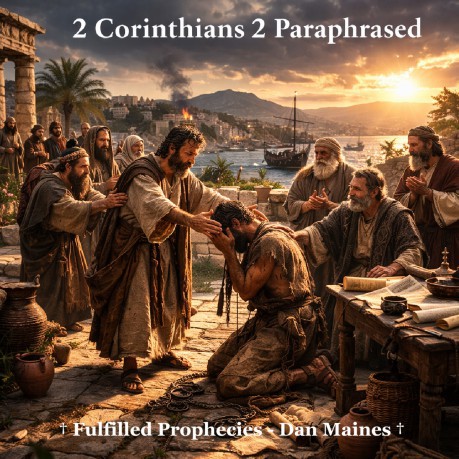
2 Corinthians 2
Paraphrased
By Dan Maines
Introduction
†
Paul continues speaking to the believers in Corinth about the sorrow
that had come between them and how it was meant to lead to
restoration, not destruction.
† The focus of
this chapter is forgiveness, restoration, and the triumph of Christ
working through His people.
† The fulfilled
perspective reminds us that these believers were living in the
closing years of the old covenant age, a time when the message of
Christ was spreading throughout the world and replacing the fading
system centered in Jerusalem (Hebrews 8:13).
2
Corinthians 2:1
So I decided within myself that I would
not come to you again in a way that would bring sorrow.
†
Paul had previously corrected the church strongly, and he didn't want
another visit to only deepen their grief.
†
His goal was restoration and unity, not repeated discipline.
†
This reflects the heart of Christ, who corrects in order to heal, not
to destroy (Hebrews 12:6).
2 Corinthians 2:2
Because
if I cause you sorrow, who is left to bring me joy except the very
ones I have made sorrowful?
† Paul shows the
deep relationship he had with the Corinthian believers. Their joy and
his joy were connected.
† A church leader
isn't meant to rule harshly but to shepherd the flock with love and
mutual encouragement (1 Peter 5:2-3).
† This
demonstrates the personal nature of the early church communities.
2
Corinthians 2:3
This is the reason I wrote to you
before, so that when I came I wouldn't have sorrow from the very
people who should bring me joy, because I am confident that my joy is
the same joy shared by all of you.
† Paul
preferred to address the issue through a letter so the church could
respond beforehand.
† His hope was that
repentance would already have taken place when he arrived.
†
This shows the early apostolic method of correction through written
instruction.
2 Corinthians 2:4
I wrote to
you out of great distress and with many tears, not to cause you pain
but so you would understand the deep love I have for you.
†
Paul's correction wasn't cold or detached, it was filled with
emotional concern.
† Real spiritual
leadership often includes grief over sin within the church.
†
This reflects the heart of Christ who wept over Jerusalem (Luke
19:41).
2 Corinthians 2:5
If anyone has
caused sorrow, he hasn't only caused sorrow to me but to all of you
to some extent, so I won't exaggerate the matter.
†
The offense within the church had affected the whole community.
†
Sin in a congregation never remains isolated, it spreads its
influence.
† Yet Paul also avoids
exaggerating the offense once repentance is happening.
2
Corinthians 2:6
The punishment that was given by the
majority of you was enough for that person.
†
Church discipline had already taken place and had achieved its
purpose.
† The goal of discipline is
correction and restoration, not endless punishment.
†
This reflects the principle of restoring a repentant believer
(Galatians 6:1).
2 Corinthians 2:7
Now
instead you should forgive him and comfort him so he isn't
overwhelmed by excessive sorrow.
† Paul now
instructs the church to move from discipline to forgiveness.
†
Without forgiveness, correction can crush a person instead of healing
them.
† The gospel always moves toward
restoration after repentance.
2 Corinthians 2:8
So
I urge you to reaffirm your love for him.
†
Public restoration was necessary so the man would know he was fully
accepted again.
† Love within the church must
be visible and sincere.
† This reflects the
mercy shown throughout the teachings of Christ (Matthew 18:21-22).
2
Corinthians 2:9
This is why I wrote to you, to test
whether you would be obedient in everything.
†
Paul's instruction also revealed whether the church would follow
apostolic teaching.
† Obedience to Christ's
instruction was a mark of genuine faith.
†
The early church often faced tests that revealed their maturity.
2
Corinthians 2:10
Anyone you forgive, I forgive also,
and if I have forgiven anything, I did it for your sake in the
presence of Christ.
† Paul aligns his
forgiveness with the church so unity is maintained.
†
Forgiveness in the church reflects Christ's authority and presence
among believers.
† The apostles often acted
as spiritual shepherds maintaining order and reconciliation.
2
Corinthians 2:11
This was done so that Satan wouldn't
take advantage of us, because we are not unaware of his schemes.
†
Unforgiveness can become a weapon used by the enemy to divide
believers.
† Satan's strategy often involves
turning discipline into bitterness or resentment.
†
Unity in forgiveness protects the church from spiritual division.
2
Corinthians 2:12
When I came to Troas to preach the
good news about Christ, a door of opportunity opened for me in the
Lord.
† Even while dealing with church
struggles, Paul continued spreading the gospel.
†
Troas became an important place where the message of Christ spread
into the wider world.
† The gospel was
rapidly moving across the Roman Empire during this time.
2
Corinthians 2:13
But I had no peace in my spirit
because I couldn't find Titus my brother there, so I said goodbye to
them and went on to Macedonia.
† Paul's
concern for the Corinthian church weighed heavily on him.
†
Titus had been sent to bring news of how the Corinthians responded.
†
This shows the relational network of the early church leaders.
2
Corinthians 2:14
But thanks be to God, who always leads
us in triumph in Christ and through us spreads the knowledge of Him
everywhere like a fragrance.
† Paul now
celebrates the victory of Christ working through believers.
†
The gospel was spreading throughout the empire like a scent that
couldn't be contained.
† This imagery
reflects Roman victory parades where incense filled the air.
2
Corinthians 2:15
Because we are the fragrance of Christ
to God among those who are being saved and among those who are
perishing.
† The same message of Christ
produces two different responses.
† Some
receive it and are saved, others reject it and remain lost.
†
The gospel reveals the true condition of the heart.
2
Corinthians 2:16
To some it is the smell of death
leading to death, but to others it is the fragrance of life leading
to life, and who is adequate for these things?
†
The message of Christ carries eternal significance.
†
The apostles recognized the immense responsibility of proclaiming
it.
† The gospel confronts every person with
the choice between life and death.
2 Corinthians
2:17
Unlike many people, we do not corrupt the word of
God for profit, but we speak sincerely as from God in Christ before
God.
† Paul contrasts true apostles with
those who were distorting the gospel for personal gain.
†
Faithful teachers handle the message of God with sincerity and
reverence.
† Even in the first century false
teachers were already appearing within the churches.
Historical
References
† Irenaeus explained that
the apostles preserved the pure message of Christ and guarded the
churches from those who tried to corrupt the teaching.
†
Eusebius recorded how the early church carefully maintained apostolic
instruction as the gospel spread across the Roman world.
†
Clement of Alexandria described the apostles as the fragrance of
Christ whose teaching filled the world with the knowledge of God.
How
It Applies To Us Today
† We are
called to restore people who repent instead of keeping them trapped
in shame.
† Forgiveness protects the unity of
the church and prevents division.
† The
message of Christ still spreads through believers just as it did in
the first century.
† Some will receive the
message with joy while others will reject it.
†
Our responsibility is to proclaim the truth sincerely without
altering it for approval or profit.
Q & A
Appendix
Q: Why did Paul avoid
visiting Corinth again with sorrow?
A: Because
he wanted their relationship restored rather than deepened in
grief.
Q: Why was forgiveness important after
discipline?
A: Without forgiveness the
disciplined believer could be crushed by sorrow instead of
restored.
Q: What does Paul mean by the
fragrance of Christ?
A: The spreading influence
of the gospel as it moves through believers across the world.
Q:
Why does the gospel produce two different reactions?
A:
Some accept the truth and receive life, while others reject it and
remain in spiritual death.
Q: What warning does
Paul give about teaching the word of God?
A:
The message must never be distorted for profit or personal
advantage.
† This is the fulfilled perspective we
proclaim at Fulfilled Prophecies †
© Fulfilled
Prophecies - Dan Maines.
Source Index
†
2 Corinthians 2
† Irenaeus, Against
Heresies
† Eusebius, Ecclesiastical History
†
Clement of Alexandria, Stromata
Links