Mark 9
Paraphrased
By Dan Maines
Introduction
†
Mark 9 continues revealing who Jesus is and what His kingdom was
about to accomplish within that generation.
†
The chapter moves from the Transfiguration to teaching about
humility, stumbling blocks, and the cost of discipleship.
†
Every event here points forward to the coming transformation of the
covenant world that Jesus said some standing there would live to see
(Matthew 16:27-28).
† Early Christians
understood these warnings as events approaching in their lifetime,
and Eusebius records that believers fled Jerusalem before its
destruction in AD 70.
Scripture
Mark
9:1
Jesus told them that some standing there wouldn't
die before they saw God's kingdom come with power.
†
Jesus placed the arrival of the kingdom power within the lifetime of
His listeners (Matthew 16:28).
† That power
was revealed through the resurrection, the outpouring of the Spirit,
and the covenant judgment on Jerusalem (Luke 21:31-32).
†
Eusebius records that the church remembered these warnings and
escaped the city before the Roman siege.
Mark 9:2
Six
days later Jesus took Peter, James, and John with Him up a high
mountain where they were alone, and His appearance changed before
them.
† The Transfiguration was a preview of
the kingdom glory the disciples were about to witness (2 Peter
1:16-18).
† Only three disciples saw it,
confirming Jesus' statement that some standing there would see the
kingdom come in power.
Mark 9:3
His
clothes became shining white, brighter than anything on earth could
make them.
† The brightness revealed divine
glory similar to prophetic visions of heavenly authority (Daniel
7:9).
† The moment confirmed that Jesus
carried the glory of God.
Mark 9:4
Then
Elijah and Moses appeared and were talking with Jesus.
†
Moses represented the Law and Elijah represented the Prophets, both
pointing forward to Christ (Luke 24:27).
†
Their appearance showed that everything written before was leading to
Him.
Mark 9:5
Peter said to Jesus, Rabbi,
it's good for us to be here. Let's make three shelters, one for you,
one for Moses, and one for Elijah.
† Peter
didn't yet understand that the Law and Prophets were giving way to
Christ's authority.
† The moment showed the
transition from the old covenant witnesses to the Son.
Mark
9:6
He said this because he didn't know what to say
since they were terrified.
† The disciples
were overwhelmed by the glory they witnessed.
†
Encounters with divine revelation often produced fear and awe (Isaiah
6:5).
Mark 9:7
Then a cloud covered them,
and a voice came from the cloud saying, This is my beloved Son.
Listen to Him.
† The voice from heaven
confirmed Jesus as the final authority above Moses and Elijah
(Hebrews 1:1-2).
† God declared that the
focus must now be on the Son alone.
Mark 9:8
Suddenly
they looked around and saw no one with them anymore except Jesus
alone.
† The disappearance of Moses and
Elijah symbolized the completion of their role.
†
Christ alone remained as the mediator of the covenant.
Mark
9:9
As they were coming down the mountain Jesus told
them not to tell anyone what they had seen until the Son of Man had
risen from the dead.
† The resurrection would
reveal the full meaning of the glory they witnessed.
†
Only after that event could the testimony be fully understood.
Mark
9:10
They kept the matter to themselves while
discussing what rising from the dead meant.
†
The disciples still struggled to understand resurrection.
†
Their confusion shows how unexpected the resurrection was to
them.
Mark 9:11
They asked Him why the
scribes say that Elijah must come first.
†
Jewish teachers expected Elijah to appear before the Messiah (Malachi
4:5).
† The disciples wanted to understand
how that prophecy fit with Jesus.
Mark 9:12
Jesus
said Elijah does come first and restores all things, but the Son of
Man must suffer greatly and be rejected.
†
Restoration came through the preparatory ministry of John the Baptist
(Luke 1:16-17).
† Yet the Messiah would first
suffer rejection.
Mark 9:13
But I tell you
that Elijah has already come, and they did to him whatever they
wanted, just as the Scriptures said about him.
†
Jesus identified John the Baptist as the promised Elijah (Matthew
11:14).
† His death revealed how Israel
treated God's prophets.
Mark 9:14
When
they returned to the other disciples they saw a large crowd around
them and scribes arguing with them.
† The
ministry of Jesus regularly created conflict with religious
leaders.
† Their arguments reflected growing
resistance to His authority.
Mark 9:15
When
the crowd saw Jesus they were amazed and ran to greet Him.
†
Jesus' presence immediately drew attention from the crowd.
†
His authority and reputation had spread widely.
Mark
9:16
He asked them what they were arguing about.
†
Jesus exposed the situation openly before addressing it.
†
This revealed the issue clearly to everyone present.
Mark
9:17
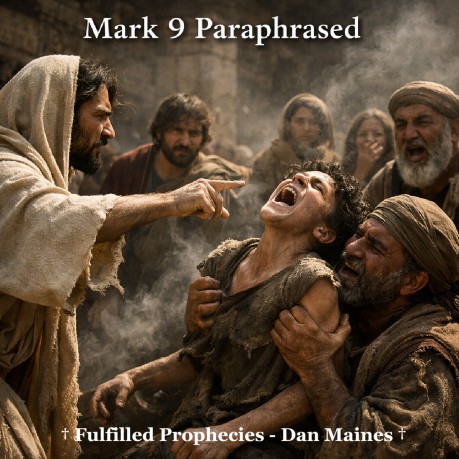
One man from the crowd said he brought his son who
was possessed by a spirit that made him unable to speak.
†
The father came in desperation seeking help for his child.
†
The story highlights Christ's compassion toward suffering.
Mark
9:18
Whenever it seized him it threw him down, he
foamed at the mouth, ground his teeth, and became rigid, and the
disciples couldn't cast it out.
† The
disciples had cast out demons before but failed here (Mark 6:13).
†
Their failure revealed their need for deeper dependence on God.
Mark
9:19
Jesus said they were a faithless generation and
asked how long He must remain with them before they believed.
†
The phrase faithless generation echoed prophetic rebukes of Israel
(Deuteronomy 32:5).
† Jesus was addressing
the unbelief surrounding Him.
Mark 9:20
They
brought the boy to Him, and when the spirit saw Jesus it immediately
threw the child into convulsions.
† The
presence of Christ provoked a violent reaction from the spirit.
†
Spiritual darkness often reacted strongly when confronted with His
authority.
Mark 9:21
Jesus asked the
father how long this had been happening, and he said since
childhood.
† The long suffering intensified
the father's desperation.
† The moment
revealed the compassion of Jesus toward human pain.
Mark
9:22
The spirit often threw him into fire or water
trying to destroy him, and the father pleaded with Jesus to help if
He could.
† The father showed both hope and
uncertainty.
† His words reflected the
struggle between belief and doubt.
Mark 9:23
Jesus
said everything is possible for the one who believes.
†
Faith places trust in God's power rather than human strength.
†
Jesus called the father to rely on Him fully.
Mark
9:24
Immediately the father cried out that he believed
and asked Jesus to help his unbelief.
† This
honest confession shows real faith mixed with weakness.
†
Christ responded with compassion rather than rejection.
Mark
9:25
When Jesus saw the crowd growing He rebuked the
spirit and commanded it to leave the boy and never return.
†
Jesus exercised absolute authority over the spirit.
†
The command revealed the power of God's kingdom.
Mark
9:26
The spirit cried out, shook the boy violently, and
left him, and the boy appeared lifeless so many thought he was
dead.
† The final resistance of the spirit
showed its defeat.
† Christ's authority
ultimately prevailed.
Mark 9:27
But Jesus
took him by the hand and lifted him up, and he stood.
†
The act symbolized restoration and healing.
†
Jesus brought life where destruction had ruled.
Mark
9:28
After entering the house the disciples asked why
they couldn't drive it out.
† The disciples
still needed instruction about spiritual dependence.
†
Their question opened the door for Jesus' teaching.
Mark
9:29
Jesus told them that this kind only comes out
through prayer.
† Prayer demonstrates
reliance on God rather than human ability.
†
The lesson emphasized dependence on the Father.
Mark
9:30
They left that place and passed through Galilee,
and Jesus didn't want anyone to know.
† Jesus
often avoided publicity while privately teaching the disciples.
†
He was preparing them for the coming events.
Mark
9:31
He taught them that the Son of Man would be
delivered into human hands, killed, and after three days rise
again.
† Jesus repeatedly foretold His death
and resurrection (Mark 8:31).
† These events
would confirm His mission.
Mark 9:32
But
they didn't understand what He meant and were afraid to ask Him.
†
The disciples still struggled to grasp the meaning of the cross.
†
Their confusion highlights how unexpected the resurrection was.
Mark
9:33
They came to Capernaum, and Jesus asked what they
had been discussing along the road.
† Jesus
knew their discussion but wanted them to confront it openly.
†
His question exposed their motives.
Mark 9:34
They
remained silent because they had argued about who was the greatest.
†
Their ambition reflected worldly expectations of power.
†
Jesus would redefine greatness.
Mark 9:35
Jesus
sat down and told them that whoever wants to be first must become
last and servant of all.
† True greatness in
God's kingdom comes through humility (Matthew 23:11).
†
Jesus reversed the world's definition of leadership.
Mark
9:36
He took a child and placed the child among them
and held him in His arms.
† Children
represented humility and low status in that culture.
†
Jesus used the child to illustrate kingdom character.
Mark
9:37
He said whoever receives one such child in His
name receives Him and the One who sent Him.
†
Serving the humble is equivalent to serving Christ (Matthew 25:40).
†
The kingdom values compassion and humility.
Mark
9:38
John said they saw someone casting out demons in
Jesus' name and tried to stop him because he wasn't part of their
group.
† The disciples thought authority
belonged only to them.
† Jesus corrected this
narrow thinking.
Mark 9:39
Jesus told them
not to stop the man because no one who performs a miracle in His name
will quickly speak against Him.
† The kingdom
work extended beyond the immediate circle of disciples.
†
Jesus encouraged openness toward those acting in His name.
Mark
9:40
He said whoever isn't against us is for us.
†
Jesus recognized those who supported His mission.
†
The kingdom gathers people who align with Christ.
Mark
9:41
Even giving a cup of water to someone because they
belong to Christ won't go unrewarded.
† Small
acts done in Christ's name matter greatly.
†
Faithfulness is measured in everyday actions.
Mark
9:42
Anyone who causes one of these little ones who
believe in Him to stumble would be better off thrown into the sea
with a heavy stone tied around the neck.
†
Jesus gave a severe warning about leading believers into sin (Matthew
18:6).
† The responsibility for influencing
others is serious.
Mark 9:43
If your hand
causes you to stumble it's better to lose it than to enter judgment
with it.
† Jesus used strong imagery to
emphasize the seriousness of sin.
†
Faithfulness requires decisive commitment.
Mark
9:44
Where their worm doesn't die and the fire isn't
quenched.
† This imagery comes from Isaiah's
prophecy describing judgment (Isaiah 66:24).
†
Jesus applied this language to covenant judgment imagery.
Mark
9:45
If your foot causes you to stumble it's better to
lose it than to face judgment with it.
†
Again Jesus stressed removing anything that leads to sin.
†
The kingdom requires wholehearted devotion.
Mark
9:46
Where their worm doesn't die and the fire isn't
quenched.
† The prophetic language repeats
the warning of judgment imagery.
† It
reflects the seriousness of rejecting God's ways.
Mark
9:47
If your eye causes you to stumble it's better to
remove it than to be thrown into Gehenna.
†
Gehenna referred to the Valley of Hinnom near Jerusalem.
†
It symbolized covenant judgment upon the rebellious city.
Mark
9:48
Where their worm doesn't die and the fire isn't
quenched.
† Jesus again quoted Isaiah
66:24.
† The imagery describes severe
covenant judgment language.
Mark 9:49
Everyone
will be salted with fire.
† Fire symbolized
purification and testing.
† Trials would
refine believers and expose unbelief.
Mark 9:50
Salt
is good, but if it loses its flavor it can't be restored. Have salt
in yourselves and live in peace with one another.
†
Salt represents preserving truth and purity (Matthew 5:13).
†
Jesus called His followers to maintain faithfulness and
unity.
Historical References
†
Eusebius recorded that Christians fled Jerusalem before the Roman
siege because they remembered Jesus' warnings.
†
Josephus described the devastation around Jerusalem during the Roman
war.
† Irenaeus wrote that the apostles
preached the fulfillment of the Law and Prophets in Christ.
†
Clement of Alexandria affirmed that Christ became the final teacher
after the Law prepared the way.
How It Applies To Us
Today
† Christ alone is the
authority believers must follow.
† True
greatness still comes through humility and serving others.
†
Faith mixed with weakness can still reach Christ.
†
Believers must avoid causing others to stumble.
†
The kingdom calls us to purity, unity, and faithfulness.
Q
& A Appendix
Q: When did the
kingdom come with power that Jesus spoke about?
A:
The kingdom power appeared through the resurrection, the Spirit's
coming, and the covenant judgment events confirming Christ's reign
(Matthew 16:27-28).
Q: Why did Moses and Elijah
appear with Jesus?
A: They represented the Law
and the Prophets pointing to Christ as their fulfillment (Luke
24:27).
Q: Who was the Elijah Jesus said had
already come?
A: Jesus identified John the
Baptist as that promised Elijah (Matthew 11:14).
Q:
What does Gehenna refer to?
A: Gehenna referred
to the Valley of Hinnom near Jerusalem and symbolized covenant
judgment (Jeremiah 7:31-34).
Q: What lesson did
Jesus teach about greatness?
A: Greatness in
the kingdom comes through humility and serving others (Matthew
23:11).
† This is the fulfilled perspective we
proclaim at Fulfilled Prophecies †
© Fulfilled
Prophecies - Dan Maines.
Source Index
†
Mark 9
† Josephus, Wars of the Jews
†
Irenaeus, Against Heresies
† Eusebius,
Ecclesiastical History
† Clement of
Alexandria, Stromata
Links