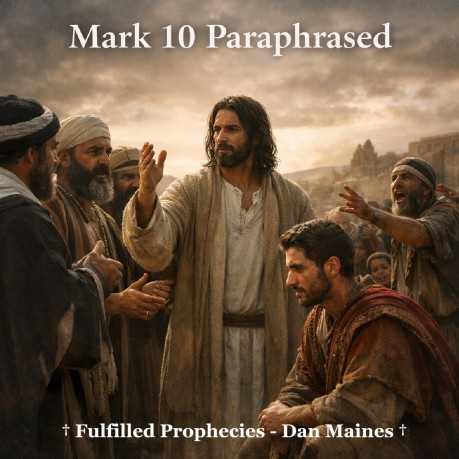
Mark 10
Paraphrased
By Dan Maines
Introduction
†
Mark 10 records Jesus continuing his journey toward Jerusalem while
teaching about marriage, humility, wealth, service, and faith.
†
The chapter shows the contrast between human pride and the humble
faith required to enter God's kingdom (Matthew 18:3).
†
Early church writers said Mark preserved the preaching of Peter,
which explains the direct and active narrative style (Eusebius,
Ecclesiastical History).
Mark 10:1
Jesus
left that region and went into the area of Judea and beyond the
Jordan, and crowds gathered around him again, and as he usually did,
he began teaching them.
† Jesus' ministry
consistently drew crowds because the people recognized authority in
his teaching (Matthew 7:28-29).
† This
movement toward Judea shows that the final approach to Jerusalem had
begun.
† Early historians record that Jesus
traveled through these regions during his final ministry period
(Josephus, Antiquities of the Jews).
Mark 10:2
Some
Pharisees came to test him by asking whether it was lawful for a man
to divorce his wife.
† The Pharisees were
attempting to trap Jesus in a debate that was already controversial
among Jewish teachers (Deuteronomy 24:1).
†
Their goal was not truth but public accusation.
†
Jewish writings from the period confirm that divorce debates were
common among the rabbis (Josephus, Antiquities).
Mark
10:3
Jesus answered them by asking what Moses
commanded.
† Jesus pointed directly back to
Scripture rather than to tradition.
† This
exposed whether their question was sincere or manipulative.
Mark
10:4
They replied that Moses allowed a man to write a
certificate of divorce and send his wife away.
†
They referred to the legal provision regulating divorce (Deuteronomy
24:1).
† However they ignored God's original
design for marriage.
Mark 10:5
Jesus told
them that Moses wrote that command because of the hardness of
people's hearts.
† The law addressed human
sinfulness rather than God's perfect design.
†
Jesus exposed the deeper issue of stubborn hearts.
†
Clement of Alexandria wrote that Christ restored the true moral
meaning of the Law (Clement of Alexandria, Stromata).
Mark
10:6
But from the beginning of creation God made them
male and female.
† Jesus pointed back to
creation to show God's original intention (Genesis 1:27).
†
Marriage was established before sin entered the world.
Mark
10:7
For this reason a man leaves his father and mother
and is joined to his wife.
† Marriage forms a
new covenant relationship (Genesis 2:24).
†
This bond establishes a new family unit.
Mark 10:8
The
two become one flesh so they are no longer two but one.
†
The unity of marriage reflects a deep covenant bond.
†
This explains why divorce was never part of God's ideal design.
Mark
10:9
Therefore what God has joined together people must
not separate.
† Marriage is ultimately
established by God himself.
† Human authority
should not casually dissolve that union.
Mark
10:10
Later in the house the disciples asked him again
about this teaching.
† The disciples often
asked private questions to understand Jesus' teachings more clearly
(Mark 4:34).
Mark 10:11
He told them that
whoever divorces his wife and marries another commits adultery
against her.
† Jesus raised the moral
seriousness of marriage beyond common cultural practices.
†
Divorce followed by remarriage outside God's design was
adultery.
Mark 10:12
If a woman divorces
her husband and marries another she commits adultery.
†
Jesus applied the same moral standard to both men and women.
†
This was significant in a culture that usually favored men in
divorce.
Mark 10:13
People were bringing
little children to Jesus so he could touch them but the disciples
tried to stop them.
† Parents believed the
blessing of a respected teacher would benefit their children.
†
The disciples mistakenly thought the children were interrupting.
Mark
10:14
When Jesus saw this he became upset and said let
the children come to me and do not stop them because the kingdom of
God belongs to people like these.
† Jesus
used children as examples of humility and simple trust.
†
The kingdom welcomes those who approach God without pride.
Mark
10:15
Anyone who does not receive the kingdom of God
like a child will never enter it.
† Childlike
faith means humility dependence and trust.
†
Pride and self reliance block entry into God's kingdom.
Mark
10:16
He took the children in his arms laid his hands
on them and blessed them.
† Jesus showed
compassion and care for the weakest members of society.
†
This moment reveals the tenderness of his ministry.
Mark
10:17
As Jesus started on the road a man ran up to him
knelt before him and asked what he must do to inherit eternal life.
†
The man showed urgency and respect in seeking spiritual answers.
†
Eternal life was a major expectation among Jews who believed in the
coming resurrection (Daniel 12:2).
Mark 10:18
Jesus
asked why he called him good saying that no one is good except God
alone.
† Jesus challenged the man's
understanding of goodness.
† The question
forced the man to think about Jesus' identity.
Mark
10:19
Jesus reminded him of the commandments against
murder adultery stealing lying and dishonoring parents.
†
Jesus pointed to the moral law governing relationships with others
(Exodus 20).
† The commandments reveal
humanity's failure to reach God's standard.
Mark
10:20
The man said he had kept all these commands since
his youth.
† Many Jews believed strict
obedience to the Law guaranteed righteousness.
†
Yet outward obedience often hides deeper heart issues.
Mark
10:21
Jesus looked at him with love and said one thing
was missing he should sell what he owned give to the poor and follow
him.
† Jesus revealed the idol controlling
the man's heart.
† True discipleship requires
surrender.
Mark 10:22
The man became sad
and went away grieving because he owned many possessions.
†
His wealth held greater power over him than obedience to God.
†
This shows how possessions can become spiritual barriers.
Mark
10:23
Jesus looked around and said how difficult it is
for the wealthy to enter the kingdom of God.
†
Wealth can create a false sense of security.
†
Many in that culture believed wealth proved divine favor.
Mark
10:24
The disciples were amazed but Jesus repeated that
it is difficult for those who trust in riches to enter God's
kingdom.
† The problem is trusting wealth
rather than trusting God.
Mark 10:25
It is
easier for a camel to pass through the eye of a needle than for a
rich person to enter God's kingdom.
† Jesus
used exaggeration to show the impossibility of salvation through
human effort.
Mark 10:26
The disciples
were shocked and asked who then could be saved.
†
They were still thinking in terms of human achievement.
Mark
10:27
Jesus said what is impossible for people is
possible for God.
† Salvation comes entirely
from God's power and grace.
Mark 10:28
Peter
said they had left everything to follow him.
†
The disciples had indeed abandoned their previous livelihoods.
Mark
10:29
Jesus said anyone who leaves family or property
for him and the good news will receive far more.
†
Following Christ brings spiritual reward beyond earthly
sacrifice.
Mark 10:30
They will receive
many times more in this life along with persecution and in the age to
come eternal life.
† The early church
experienced both blessing and suffering as the gospel spread (Acts
8:1).
Mark 10:31
Many who are first will
be last and the last will be first.
† God's
kingdom reverses human ideas about status.
Mark 10:32
As
they traveled toward Jerusalem Jesus walked ahead while the disciples
were amazed and afraid.
† Jesus knew what
awaited him yet continued forward with determination.
Mark
10:33
He said he would be delivered to the religious
leaders who would condemn him and hand him to the Gentiles.
†
This prediction pointed to the coming trial before Jewish and Roman
authorities.
Mark 10:34
They would mock
him beat him and kill him but after three days he would rise again.
†
Jesus clearly predicted the crucifixion and resurrection.
Mark
10:35
James and John approached him asking that he
grant whatever they requested.
† Their
request revealed their misunderstanding of the kingdom.
Mark
10:36
Jesus asked what they wanted him to do.
†
He allowed them to express their ambition openly.
Mark
10:37
They asked to sit at his right and left when he
came into glory.
† They desired positions of
honor.
† This shows the disciples still
expected a political kingdom.
Mark 10:38
Jesus
told them they didn't understand what they were asking and asked if
they could drink the cup he would drink.
†
The cup symbolized suffering and sacrifice.
Mark
10:39
They said they could and Jesus said they would
indeed share in suffering.
† The apostles
later faced persecution for their faith.
Mark 10:40
But
he said those positions belong to those for whom they were prepared
by the Father.
† Authority in the kingdom
belongs to God's plan.
Mark 10:41
When the
other disciples heard this they became angry with James and John.
†
Rivalry existed even among the disciples.
Mark
10:42
Jesus gathered them and explained that worldly
rulers dominate people with authority.
†
Earthly power systems rely on control and domination.
Mark
10:43
But among his followers greatness comes through
serving others.
† The kingdom reverses
worldly definitions of leadership.
Mark 10:44
Whoever
wants to be first must become the servant of all.
†
True greatness is measured by humility and service.
Mark
10:45
The Son of Man didn't come to be served but to
serve and give his life as a ransom for many.
†
Jesus defined his mission as sacrificial redemption (Isaiah 53).
†
This verse summarizes the purpose of Christ's ministry.
Mark
10:46
They came to Jericho and as Jesus left the city a
blind man named Bartimaeus was sitting beside the road begging.
†
Jericho was a major travel route for pilgrims heading to
Jerusalem.
Mark 10:47
When he heard Jesus
of Nazareth was passing by he began shouting Son of David have mercy
on me.
† The title Son of David identified
Jesus as the Messiah.
Mark 10:48
Many
people told him to be quiet but he shouted even louder asking for
mercy.
† His persistence showed deep
faith.
Mark 10:49
Jesus stopped and told
them to call him and they said take courage get up he is calling
you.
† Jesus always responded to genuine
faith.
Mark 10:50
Throwing aside his cloak
he jumped up and came to Jesus.
† Leaving the
cloak symbolized leaving his former life behind.
Mark
10:51
Jesus asked what he wanted and the man said he
wanted to see.
† The man trusted that Jesus
had the power to heal him.
Mark 10:52
Jesus
told him his faith had restored him and immediately he received his
sight and followed Jesus along the road.
†
Faith was the channel through which healing came.
†
The man became a follower after receiving his sight.
Historical
References
† Papias said Mark
recorded the preaching of Peter (Eusebius, Ecclesiastical History).
†
Josephus described debates among Jews about marriage and divorce
(Josephus, Antiquities of the Jews).
†
Irenaeus affirmed the apostolic authority of the Gospel writings
(Irenaeus, Against Heresies).
† Clement of
Alexandria wrote about Christ restoring the true intention of the Law
(Clement of Alexandria, Stromata).
How It Applies To Us
Today
† The kingdom of God belongs
to those who approach him with humble faith.
†
Wealth and ambition must never replace devotion to Christ.
†
True leadership in the kingdom is service not control.
†
Faith still brings transformation just as it did for Bartimaeus.
†
Following Jesus may involve sacrifice but it leads to eternal life.
Q
& A Appendix
Q: Why did Jesus use
creation to explain marriage?
A: Because God's
original design shows marriage as a permanent covenant (Genesis
2:24).
Q: Why did Jesus warn about wealth?
A:
Because trusting riches can replace trust in God (1 Timothy
6:9-10).
Q: What does childlike faith mean?
A:
It means humility dependence and trust before God (Matthew 18:3).
Q:
Why must leaders serve?
A: Because Christ
himself led through sacrifice and service (Philippians 2:5-8).
Q:
What does Bartimaeus teach about faith?
A:
Persistent faith calls out to Christ even when others try to silence
it (Hebrews 11:6).
† This is the fulfilled perspective
we proclaim at Fulfilled Prophecies †
© Fulfilled
Prophecies - Dan Maines.
Source Index
†
Mark 10
† Josephus, Antiquities of the Jews
†
Irenaeus, Against Heresies
† Eusebius,
Ecclesiastical History
† Clement of
Alexandria, Stromata
Links