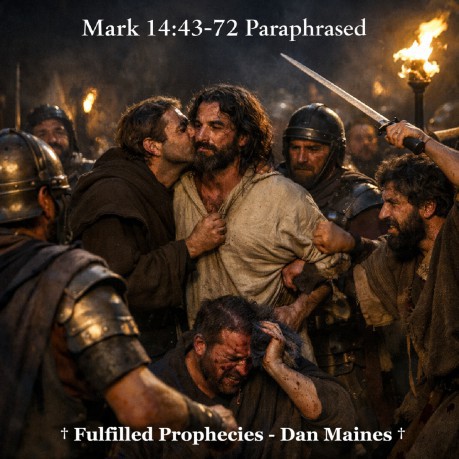
Mark 14:43-72 Paraphrased Introduction Mark 14:43 Mark 14:44 Mark 14:45 Mark 14:46 Mark 14:47 Mark 14:48 Mark 14:49 Mark 14:50 Mark 14:51 Mark 14:52 Mark 14:53 Mark 14:54 Mark 14:55 Mark 14:56 Mark 14:57 Mark 14:58 Mark 14:59 Mark 14:60 Mark 14:61 Mark 14:62 Mark 14:63 Mark 14:64 Mark 14:65 Mark 14:66 Mark 14:67 Mark 14:68 Mark 14:69 Mark 14:70 Mark 14:71 Mark 14:72 Historical References How It Applies To Us Today Q & A Appendix Q: Why did the leaders arrest Jesus at night? Q: Why did Judas use a kiss to identify Jesus? Q: What prophecy did Jesus reference when He
spoke of the Son of Man coming with the clouds? Q: Why did Peter deny Jesus three times? Q: What happened to Peter after this failure? † This is the fulfilled perspective we proclaim at
Fulfilled Prophecies † Source Index Mark 14:1-42 Paraphrased https://fulfilledprophecies.com/topics/1138.html
Mark 14:43-72 Paraphrased https://fulfilledprophecies.com/topics/1139.html
By Dan Maines
† This
section records the arrest of Jesus, His trial before the Jewish
leaders, and Peter's denial.
† It shows how
the events unfolded exactly as Jesus had already warned would happen
(Mark 14:27-31).
† The leaders of Israel
rejected their own Messiah, fulfilling what the prophets said would
happen to the righteous servant (Isaiah 53:3).
While Jesus was still speaking,
Judas, one of the twelve, arrived with a crowd carrying swords and
clubs. They had been sent by the chief priests, the scribes, and the
elders.
† Judas didn't come alone. The
religious leadership organized this arrest.
†
The swords and clubs show they expected resistance, even though Jesus
had done nothing violent (John 18:3).
†
Josephus records that the temple authorities often used armed
servants to enforce their will in Jerusalem.
The betrayer had arranged a
signal with them. He said, The one I kiss is the man. Arrest him and
take him away under guard.
† Judas used a
normal greeting to identify Jesus.
† The
hypocrisy of the religious leaders is clear. They needed a secret
arrest instead of confronting Him publicly.
†
Early Christian writer Irenaeus noted that Judas' act showed the
depth of betrayal against Christ.
As soon as Judas came up, he went
straight to Jesus and said, Rabbi, and kissed Him.
†
The greeting Rabbi means teacher. Judas still used respectful
language while betraying Him.
† The betrayal
happened with a gesture normally used for honor and friendship.
†
Clement of Alexandria wrote that Judas' kiss exposed the deceit of
false loyalty.
Then the men grabbed Jesus and
took Him into custody.
† This moment marks
the beginning of the suffering that Jesus had already predicted.
†
The arrest happened peacefully even though the crowd came armed.
†
Eusebius later described this moment as the beginning of the final
events leading to the destruction of the old covenant system.
But one of those standing nearby
drew his sword and struck the servant of the high priest, cutting off
his ear.
† John identifies this disciple as
Peter (John 18:10).
† The servant's name was
Malchus, according to John's account.
† The
reaction shows the disciples still didn't fully understand that Jesus
had to submit to this moment.
Jesus responded to them and said,
Have you come out with swords and clubs to arrest Me as if I were a
criminal?
† Jesus exposed the absurdity of
the arrest.
† He had taught openly in the
temple every day.
† Their actions revealed
fear of the people rather than a pursuit of justice.
Every day I was with you in the
temple teaching, and you didn't arrest Me. But these things are
happening so the Scriptures may be fulfilled.
†
Jesus again pointed to prophecy being fulfilled.
†
The events were not out of control. They were unfolding exactly as
written (Psalm 41:9).
† The fulfillment of
Scripture is a central theme in the Gospel accounts.
Then they all left Him and ran
away.
† The disciples fled in fear, just as
Jesus had predicted earlier that evening.
†
Zechariah 13:7 foretold that the shepherd would be struck and the
sheep scattered.
† This moment shows the
weakness of the disciples before the resurrection.
A young man was following Him,
wearing nothing but a linen cloth over his body. They tried to seize
him.
† Many believe this young man was Mark
himself, the author of the Gospel.
† The
detail appears only in this account.
† Early
church tradition preserved by Eusebius suggests Mark recorded
eyewitness memories.
But he left the linen cloth
behind and ran away naked.
† This small
detail shows the chaos of the moment.
†
Everyone was fleeing to avoid arrest.
† The
disciples were completely scattered.
They led Jesus away to the high
priest, and all the chief priests, elders, and scribes gathered
together.
† This gathering formed the
religious court known as the Sanhedrin.
† The
trial happened at night, which violated their own legal customs.
†
Josephus confirms the authority of the Sanhedrin in Jerusalem during
this period.
Peter followed at a distance
right into the courtyard of the high priest. He sat with the guards
and warmed himself by the fire.
† Peter
wanted to see what would happen but kept his distance.
†
His fear shows the tension surrounding the arrest.
†
The setting prepares for Peter's coming denial.
The chief priests and the entire
council were trying to find testimony against Jesus so they could put
Him to death, but they couldn't find any.
†
Their goal was already decided. They wanted execution.
†
Instead of seeking truth, they searched for accusations.
†
This reveals the corruption of the religious leadership.
Many people gave false testimony
against Him, but their stories didn't agree.
†
Jewish law required two witnesses whose testimony matched
(Deuteronomy 19:15).
† Their false witnesses
couldn't meet that requirement.
† This
failure exposed the weakness of their case.
Some stood up and gave false
testimony against Him.
† The accusations
continued to pile up.
† The leaders were
desperate to build a charge.
† False
witnesses had long been condemned in Israel's law.
They said, We heard Him say, I
will destroy this temple made with hands and in three days I will
build another not made with hands.
† They
twisted Jesus' words about the temple (John 2:19).
†
Jesus was speaking about His body, not the building.
†
The misunderstanding became a key accusation in the trial.
But even in this matter their
testimony didn't agree.
† Again the witnesses
failed to match their statements.
† The case
against Jesus remained weak.
† The leaders
were still determined to condemn Him.
The high priest stood up in the
center and questioned Jesus. He asked, Don't You answer? What are
these men testifying against You?
† The high
priest tried to force a response.
† Silence
in this situation fulfilled Isaiah's description of the suffering
servant (Isaiah 53:7).
† Jesus remained calm
under pressure.
But Jesus kept silent and gave no
answer. Again the high priest questioned Him and said, Are You the
Messiah, the Son of the Blessed One?
† This
question moved the trial to the central issue, Jesus' identity.
†
The title Blessed One was a respectful way of referring to God.
†
The leaders wanted a statement they could use as a charge of
blasphemy.
Jesus said, I am, and you will
see the Son of Man sitting at the right hand of power and coming with
the clouds of heaven.
† Jesus directly
affirmed His identity.
† He referenced Daniel
7:13 and Psalm 110:1.
† This statement
pointed to His authority and coming judgment upon that generation.
The high priest tore his clothes
and said, Why do we still need witnesses?
†
Tearing garments was a traditional expression of outrage.
†
The high priest interpreted Jesus' claim as blasphemy.
†
The decision against Jesus was already made.
You heard the blasphemy. What is
your verdict? They all condemned Him as deserving death.
†
The council reached its conclusion quickly.
†
Their judgment ignored the lack of consistent testimony.
†
The rejection of Jesus fulfilled the prophetic pattern of Israel
rejecting God's messengers.
Some began to spit on Him,
blindfold Him, beat Him with their fists, and say to Him, Prophesy.
The guards also took Him and struck Him.
†
This treatment shows the cruelty that followed the verdict.
†
Spitting was considered one of the greatest insults in that
culture.
† Isaiah 50:6 predicted the Messiah
would suffer this kind of abuse.
While Peter was below in the
courtyard, one of the servant girls of the high priest came by.
†
The scene now shifts from the trial to Peter outside.
†
Peter had stayed close enough to watch.
†
This sets up the moment Jesus had warned him about.
Seeing Peter warming himself, she
looked closely at him and said, You were also with Jesus the
Nazarene.
† The accusation came from a
servant girl, not a soldier.
† Even this
small confrontation frightened Peter.
† The
pressure of the situation exposed his fear.
But he denied it, saying, I don't
know or understand what you're talking about. Then he went out to the
entryway.
† This was Peter's first denial.
†
Fear led him to distance himself from Jesus.
†
The rooster crowing began the sequence Jesus had predicted.
The servant girl saw him again
and began telling the bystanders, This man is one of them.
†
The accusation spread to the people around the fire.
†
Peter's identity as a disciple was becoming obvious.
†
The pressure increased with each moment.
But again he denied it. After a
little while the bystanders said to Peter again, Surely you are one
of them, because you are a Galilean.
†
Peter's accent likely revealed where he was from.
†
Galileans were easily recognized in Jerusalem.
†
The crowd now suspected him strongly.
Then he began to curse and swear,
I don't know this man you're talking about.
†
Peter's denial intensified as he tried to convince them.
†
Fear pushed him further than he ever expected.
†
This moment shows the weakness of human resolve.
Immediately a rooster crowed a
second time. Peter remembered what Jesus had said, Before a rooster
crows twice, you will deny Me three times. And he broke down and
wept.
† The rooster confirmed Jesus'
prediction exactly.
† Peter realized what he
had done and was filled with sorrow.
† Later
restoration would come after the resurrection.
†
Josephus described the authority of the high priest and Sanhedrin in
Jerusalem during this time.
† Irenaeus wrote
about the betrayal of Judas and the rejection of Christ by Israel's
leadership.
† Clement of Alexandria discussed
Judas' betrayal as an example of false loyalty.
†
Eusebius recorded early traditions about the Gospel writers and the
historical setting of these events.
†
These events remind us that Jesus' suffering was not accidental. It
fulfilled what the prophets had written.
†
The weakness of the disciples shows that human strength alone isn't
enough.
† Peter's failure also shows that
repentance and restoration are possible after failure.
†
The rejection of Jesus by the leaders led to the judgment that came
upon Jerusalem in AD 70, exactly as Jesus warned.
A:
They feared the crowds who followed Him during the day, so they
arranged a secret arrest (Luke 22:2).
A:
A kiss was a common greeting, allowing Judas to identify Jesus
quietly among the group.
A:
He referenced Daniel's vision describing the authority given to the
Son of Man (Daniel 7:13-14).
A:
Fear overcame him during the arrest and trial, just as Jesus had
predicted (Mark 14:30).
A:
After the resurrection, Jesus restored Peter and reaffirmed his role
among the disciples (John 21:15-17).
© Fulfilled Prophecies - Dan
Maines.
† Mark 14
†
Josephus, Antiquities of the Jews
† Irenaeus,
Against Heresies
† Eusebius, Ecclesiastical
History
† Clement of Alexandria, Stromata
Links