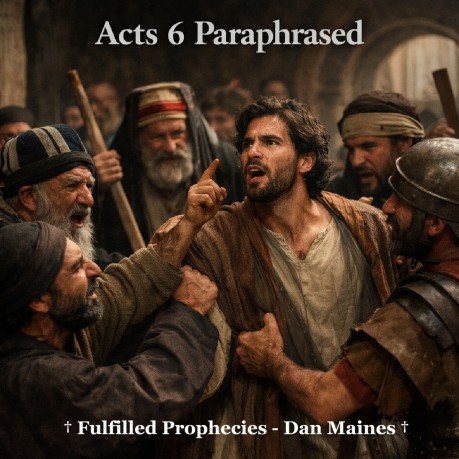
Acts 6 Paraphrased Introduction Acts 6:1 Acts 6:2 Acts 6:3 Acts 6:4 Acts 6:5 Acts 6:6 Acts 6:7 Acts 6:8 Acts 6:9 Acts 6:10 Acts 6:11 Acts 6:12 Acts 6:13 Acts 6:14 Acts 6:15 Historical References How it applies to us today Q & A Appendix Q Why didn't the apostles handle the distribution
themselves Q Who was Stephen Q Why was Stephen opposed Q What does this chapter show about leadership † This is the fulfilled perspective we proclaim at
Fulfilled Prophecies † Source Index
By Dan Maines
† The early
church was growing fast, and pressure was building from within, not
just from outside
† This chapter shows how
God structured leadership to handle real issues without losing focus
on the Word
† It also introduces Stephen,
whose bold stand shows the kingdom was already active and confronting
Israel in that generation
Now at that time, as the number of
disciples kept increasing, a complaint arose from the Greek-speaking
Jews against the native Hebrews because their widows were being
overlooked in the daily distribution
† Growth
revealed division between Hellenistic and Hebrew Jews, showing this
was still an Israel-centered community (Acts 2:5)
†
The issue wasn't doctrine but fairness, showing practical needs
matter in the body
† Josephus records similar
cultural tension among Jews, confirming this was a real historical
situation in Jerusalem
So the twelve summoned the
congregation of the disciples and said, it isn't right for us to
neglect the word of God in order to serve tables
†
The apostles didn't reject service, they protected their primary role
of preaching the Word (Luke 10:39-42)
† This
establishes order, not hierarchy, each role matters in the body
†
The Word remained central because that's how the kingdom was being
revealed and fulfilled
So brothers, select from among you
seven men of good reputation, full of the Spirit and wisdom, whom we
may put in charge of this task
† Leadership
wasn't random, it required character, Spirit, and wisdom
†
This shows the Spirit was already active, not through signs alone but
through transformed lives
† The number seven
reflects completeness, showing God was structuring His people
properly
But we will devote ourselves to
prayer and to the ministry of the word
†
Prayer and the Word remained the foundation of leadership
†
This shows the focus was never on programs but on truth and
communication with God
† Their commitment
kept the mission aligned with what Christ already began (Acts 1:8)
The statement found approval with
the whole congregation, and they chose Stephen, a man full of faith
and of the Holy Spirit, and Philip, Prochorus, Nicanor, Timon,
Parmenas, and Nicolas, a proselyte from Antioch
†
Unity was restored when truth and order were applied
†
Stephen is highlighted immediately, showing his importance in what
follows
† Nicolas being a proselyte shows
Gentile inclusion had already begun within Israel's framework
And these they brought before the
apostles, and after praying, they laid their hands on them
†
Laying on of hands confirmed appointment, not mystical transfer but
recognition of responsibility
† Prayer again
shows dependence on God in all leadership decisions
†
This reflects continuity with earlier Jewish practices of
commissioning leaders
The word of God kept spreading, and
the number of the disciples continued to increase greatly in
Jerusalem, and a great many of the priests were becoming obedient to
the faith
† The result of order was growth,
not decline
† Even priests were converting,
showing the old covenant leadership was being replaced from within
(Hebrews 8:13)
† This directly connects to
fulfillment, the old system was fading as the new was fully
established
And Stephen, full of grace and
power, was performing great wonders and signs among the people
†
Stephen stands out as a key witness against Israel
†
Signs here confirm the message during that transitional period
†
His role leads directly into confrontation with the synagogue
leadership
But some men from what was called
the Synagogue of the Freedmen, including both Cyrenians and
Alexandrians, and some from Cilicia and Asia, rose up and argued with
Stephen
† Opposition always rises where truth
is boldly spoken
† These were diaspora Jews,
showing the conflict extended beyond local Jerusalem leaders
†
This fulfills what Jesus said about persecution coming from within
Israel (Matthew 23:34)
But they were unable to cope with
the wisdom and the Spirit with which he was speaking
†
Truth backed by the Spirit cannot be defeated by argument alone
†
This mirrors Jesus confounding the religious leaders (Luke 20:26)
†
The Spirit here is seen in wisdom and clarity, not just miracles
Then they secretly induced men to
say, we have heard him speak blasphemous words against Moses and
against God
† When truth can't be defeated,
lies are introduced
† This is the same tactic
used against Jesus (Mark 14:56-59)
† Accusing
him of blasphemy shows they misunderstood fulfillment as rebellion
And they stirred up the people,
the elders, and the scribes, and they came up to him and dragged him
away and brought him before the Council
†
False accusations lead to mob action
† This
is the Sanhedrin, the same body that condemned Jesus
†
The pattern repeats because Israel hadn't repented nationally
They put forward false witnesses
who said, this man never stops speaking against this holy place and
the Law
† The charge was against the temple
and the Law, the core of the old covenant system
†
Stephen was exposing fulfillment, but they saw it as destruction
†
This directly ties to what Jesus said about the temple's coming end
(Matthew 24:2)
For we have heard him say that
this Jesus of Nazareth will destroy this place and alter the customs
which Moses handed down to us
† They twisted
truth, Jesus did speak of the temple's destruction
†
The customs were already being fulfilled and replaced in Christ
†
This accusation shows they were clinging to a system that was about
to end in AD 70
And fixing their gaze on him, all
who were sitting in the Council saw his face like the face of an
angel
† This shows divine approval, not
literal transformation
† His calm presence
reflects confidence in truth and God
† This
moment prepares for his powerful speech in the next chapter
†
Josephus, Antiquities of the Jews, records tensions among Jewish
sects and cultural divisions in Jerusalem
†
Eusebius, Ecclesiastical History, affirms the early spread of the
church and internal organization
† Irenaeus,
Against Heresies, confirms the authority and role of early church
leaders in preserving truth
† Tacitus,
Histories, acknowledges unrest and transformation within Judea during
this period
†
Growth still exposes problems, and those problems must be handled
with truth and order
† Not everyone has the
same role, but every role matters in the body
†
Truth will always face opposition, especially from religious systems
that resist change
† We stay focused on the
Word, not distractions, just like the apostles did
†
God raises bold voices like Stephen in every generation to confront
error
Q Why
was there conflict in the early church
A
Because growth exposed cultural divisions, Acts 6:1
A They prioritized the Word and
prayer, Acts 6:2-4
A A man
full of faith and the Spirit chosen to serve, Acts 6:5
A
Because he spoke truth about fulfillment and challenged the temple
system, Acts 6:13-14
A
That leadership is shared, structured, and focused on God's Word,
Acts 6:3-4
© Fulfilled Prophecies - Dan
Maines.
† Acts 6
†
Josephus, Antiquities of the Jews
† Eusebius,
Ecclesiastical History
† Irenaeus, Against
Heresies
† Tacitus, Histories
Links