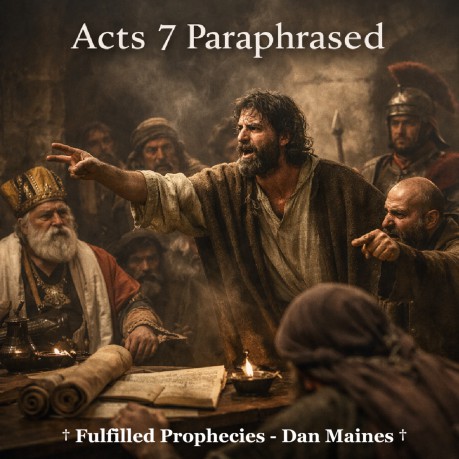
Acts 7
Paraphrased
By Dan Maines
Introduction
†
Stephen stands before the council, not defending himself, but
exposing their history and their resistance to God
†
He walks through Israel's story to show a pattern, God sends
deliverers, and they reject them
† This
builds to the truth, they did the same thing to Christ
Acts
7:1
The high priest asked Stephen, Are these
accusations true
† The trial begins, but
Stephen isn't on defense, he's about to confront them
†
This question opens the door for a full historical rebuke
†
Like the prophets before him, he speaks boldly without fear
Acts
7:2
Stephen said, Brothers and fathers, listen, the God
of glory appeared to our father Abraham while he was still in
Mesopotamia before he lived in Haran
† He
starts with Abraham, showing God initiated everything, not Israel
†
God appeared outside the land, proving His presence wasn't limited to
Jerusalem
† This directly challenges their
temple-centered thinking
Acts 7:3
God told
him to leave his country and family and go to a land He would show
him
† Abraham followed by faith, not by
possession of land or temple
† God's promise
came before Israel even existed
† Obedience,
not location, was always the focus
Acts 7:4
He
left the land of the Chaldeans and settled in Haran, after his father
died, God moved him to this land where you now live
†
The land came later, not first
† God directed
every step, not Israel's leaders
† Their
identity began with God's calling, not their system
Acts
7:5
He gave him no inheritance there, not even enough
ground to stand on, but promised it to him and his descendants though
he had no child
† The promise existed before
fulfillment
† Faith, not possession, defined
Abraham
† This exposes their misunderstanding
of covenant inheritance
Acts 7:6
God said
his descendants would be strangers in a foreign land, enslaved and
mistreated for four hundred years
† God
foretold suffering, showing control over history
†
Israel's identity includes exile, not just privilege
†
This prepares the pattern of rejection and deliverance
Acts
7:7
God said He would judge that nation, and afterward
they would come out and serve Him in this place
†
Deliverance comes by God's judgment, not man's power
†
Worship follows redemption
† God was always
the one leading the story
Acts 7:8
God
gave him the covenant of circumcision, Abraham became the father of
Isaac, Isaac of Jacob, and Jacob of the twelve patriarchs
†
Covenant signs came after promise
† The
patriarchs form the foundation of Israel's story
†
Yet even they were flawed and resistant
Acts 7:9
The
patriarchs were jealous of Joseph and sold him into Egypt, but God
was with him
† Israel's leaders rejected
God's chosen man
† Joseph is a clear type of
Christ, rejected then exalted
† God's
presence isn't stopped by rejection
Acts 7:10
God
rescued him from all his troubles and gave him favor and wisdom
before Pharaoh, who made him ruler over Egypt and his household
†
God turned rejection into authority
† Joseph
became savior to the very ones who rejected him
†
This mirrors Christ's story perfectly
Acts 7:11
A
famine came over all Egypt and Canaan, and our fathers could find no
food
† Crisis exposes dependence
†
The same ones who rejected Joseph now need him
†
God uses hardship to bring fulfillment
Acts 7:12
When
Jacob heard there was grain in Egypt, he sent our fathers there the
first time
† The first encounter didn't
reveal Joseph
† Just like Israel didn't
recognize Christ at first
† God works
progressively
Acts 7:13
On the second
visit, Joseph made himself known to his brothers, and Pharaoh learned
about Joseph's family
† Revelation comes
later, not immediately
† This points to
Christ being revealed after rejection
†
Recognition follows God's timing
Acts 7:14
Joseph
sent for his father Jacob and all his relatives, seventy-five people
in total
† Salvation extended to the whole
family
† This reflects how Christ gathers His
people
† The number shows fulfillment of
promise
Acts 7:15
Jacob went down to Egypt
and died there, as did our fathers
† The
promise didn't end in the land yet
† Death
didn't cancel God's covenant
† Fulfillment
was still coming
Acts 7:16
They were
carried back to Shechem and placed in the tomb Abraham had bought
†
Even in death, the promise remained
† Burial
in the land shows expectation of fulfillment
†
God's word continues beyond generations
Acts 7:17
As
the time drew near for God's promise, the people increased greatly in
Egypt
† Growth happened in bondage, not
freedom
† God's promise advances even in
oppression
† Fulfillment doesn't require
ideal conditions
Acts 7:18
A new king
arose who didn't know Joseph
† Forgetting
God's works leads to oppression
† Leadership
change brought persecution
† History repeats
when truth is ignored
Acts 7:19
He
mistreated our people and forced them to abandon their infants
†
Evil leadership attacks future generations
†
This echoes Herod's actions in Christ's time
†
Satan always tries to stop God's plan early
Acts 7:20
At
that time Moses was born and was beautiful in God's sight, he was
raised in his father's house for three months
†
God preserves deliverers even under threat
†
Moses, like Christ, was protected from death
†
God's plan can't be stopped
Acts 7:23
When
he was forty, Moses decided to visit his people
†
Deliverance begins with identification
†
Moses chose his people over Egypt
† Christ
likewise came to His own
Acts 7:25
He
thought his brothers would understand God was delivering them through
him, but they didn't
† Rejection of the
deliverer again
† Israel didn't recognize
Moses at first
† This is the exact pattern
repeated in Christ
Acts 7:27
The man
replied, Who made you ruler and judge over us
†
Direct rejection of God's chosen leader
†
Same accusation used against Christ
†
Authority from God was denied
Acts 7:30
After
forty years, an angel appeared to Moses in the wilderness
†
God reveals Himself outside the temple
† The
wilderness becomes holy ground
† Again,
location isn't the focus, God is
Acts 7:35
This
Moses whom they rejected is the one God sent as ruler and deliverer
†
Stephen makes the point clear
† The rejected
one becomes the savior
† This is pointing
straight to Jesus
Acts 7:39
Our fathers
refused to obey him, they rejected him and turned back to Egypt in
their hearts
† Physical movement doesn't
matter, the heart reveals truth
† They longed
for bondage instead of freedom
† This exposes
their ongoing rebellion
Acts 7:41
They
made a calf and rejoiced in what they made with their own hands
†
Idolatry replaces true worship
† They trusted
their own works
† This is what Stephen is
accusing them of again
Acts 7:44
Our
fathers had the tabernacle in the wilderness just as God instructed
†
God gave them a temporary system
† The
tabernacle pointed forward
† It was never
meant to be permanent
Acts 7:47
But it was
Solomon who built the house for Him
† The
temple was man-made
† It wasn't God's
dwelling in the ultimate sense
† Stephen is
dismantling their confidence in it
Acts 7:48
Yet
the Most High doesn't dwell in houses made by hands
†
This is the turning point
† God isn't
confined to buildings
† This strikes at their
entire system
Acts 7:51
You stiff-necked
people, uncircumcised in heart and ears, you always resist the Holy
Spirit
† Stephen applies everything
directly
† Their history is their present
condition
† They are resisting God just like
their fathers
Acts 7:52
Which of the
prophets did your fathers not persecute, they killed those who
announced the coming of the Righteous One
†
Every messenger was rejected
† Christ was the
ultimate fulfillment
† Their guilt is
undeniable
Acts 7:53
You received the law
but didn't keep it
† They boasted in the law
but broke it
† External religion without
obedience is empty
† This exposes their
hypocrisy
Acts 7:54
When they heard this,
they were furious and ground their teeth at him
†
Truth produces conviction or rage
† They
chose anger instead of repentance
† This
confirms Stephen's accusation
Acts 7:55
Stephen,
full of the Holy Spirit, looked into heaven and saw the glory of God
and Jesus standing at the right hand
† Christ
is exalted and reigning
† Stephen sees the
fulfilled reality
† Heaven confirms what
earth rejects
Acts 7:56
He said, I see the
Son of Man standing at the right hand of God
†
This is a direct claim of Christ's authority
†
It echoes Daniel 7 fulfilled
† This is what
pushes them over the edge
Acts 7:58
They
drove him out and stoned him, and the witnesses laid their garments
at the feet of a young man named Saul
†
Rejection turns into murder
† Saul will later
become Paul
† God is already working beyond
this moment
Acts 7:59
As they stoned him,
he called out to Jesus to receive his spirit
†
Stephen dies in faith, not fear
† He speaks
directly to Christ
† This shows Christ's
active reign
Acts 7:60
He fell to his
knees and said, Lord, don't hold this sin against them, and then he
fell asleep
† He mirrors Christ's
forgiveness
† His death testifies to the
truth
† The gospel continues through
sacrifice
Historical References
†
Josephus records the stubbornness and rebellion of the Jewish leaders
in the first century
† Eusebius confirms
early persecution of believers following events like Stephen's
death
† Irenaeus speaks of Israel's repeated
rejection of God's messengers
† Clement of
Alexandria highlights the continuity of this pattern from the
prophets to Christ
How it applies to us today
†
It's not enough to know history, we must respond to God now
†
God isn't confined to buildings, systems, or traditions
†
We must not repeat the same mistake of rejecting truth when it
confronts us
† Christ has already been
exalted, and we live in that fulfilled reality
†
Faith means recognizing what God has already done, not waiting for
what He's already completed
Q&A Appendix
Q
What was Stephen proving in his speech
A That
Israel had a long history of rejecting God's deliverers, culminating
in Christ (Acts 7:51-52)
Q Why did Stephen
focus on Abraham and Moses
A To show God's work
existed before the temple and law (Acts 7:2, 7:35)
Q
What was the main accusation against the leaders
A
That they resisted the Holy Spirit just like their fathers (Acts
7:51)
Q What does Stephen seeing Jesus standing
mean
A That Christ was already reigning and
vindicating His servant (Acts 7:55-56)
Q How
does this chapter fit the fulfilled perspective
A
It shows the transition from the old covenant system to Christ's
completed reign (Acts 7:48)
† This is the fulfilled
perspective we proclaim at Fulfilled Prophecies †
©
Fulfilled Prophecies - Dan Maines.
Source Index
†
Acts 7
† Josephus
†
Irenaeus, Against Heresies
† Eusebius,
Ecclesiastical History
† Clement of
Alexandria, Stromata
Links