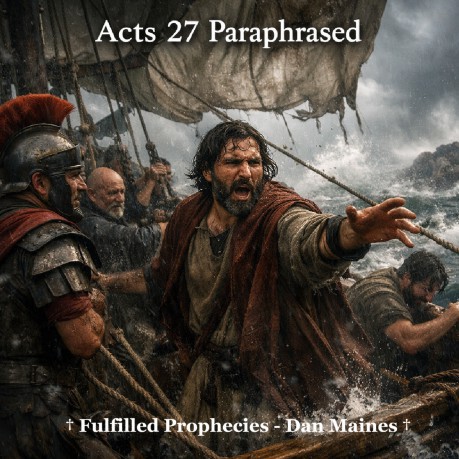
Acts 27
Paraphrased
By Dan Maines
Introduction
†
This chapter shows Paul being taken to Rome through a dangerous sea
journey, proving God's control over every circumstance
†
It reveals that even in judgment upon that generation, God preserved
His people and fulfilled His promises
† The
storm and shipwreck picture the collapsing old world while the
faithful are brought safely through
Acts 27:1
It
was decided that we would sail to Italy, so Paul and some other
prisoners were handed over to a Roman officer named Julius
†
Paul is now under Roman authority, yet God is still directing his
path (Acts 23:11)
† The mission to Rome is
not random, it's the fulfillment of Christ's word
†
Even as a prisoner, Paul is exactly where God wants him
Acts
27:2
We boarded a ship from Adramyttium that was about
to sail along the coast of Asia, and Aristarchus from Macedonia went
with us
† God provides companions in trials,
Paul is not alone
† The journey begins in
ordinary means, yet leads to extraordinary events
†
This shows the gospel spreading through real historical movement
Acts
27:3
The next day we landed at Sidon, and Julius
treated Paul kindly and allowed him to visit friends who took care of
him
† Even pagan authority shows favor, God
is working behind the scenes
† Paul receives
strength from the body of believers
† God
provides provision in the middle of uncertainty
Acts
27:4
We put out to sea again and sailed under the
shelter of Cyprus because the winds were against us
†
Opposition begins early, showing the difficulty of the journey
†
The winds symbolize resistance, yet they don't stop God's plan
†
God guides even through indirect paths
Acts 27:5
After
crossing the open sea off Cilicia and Pamphylia, we came to Myra in
Lycia
† The journey continues steadily,
though not easily
† Movement across regions
shows the spread of God's purpose
† Rome is
still the destination, nothing is stopping that
Acts
27:6
There the centurion found a ship from Alexandria
sailing to Italy and put us on board
† God
provides the exact vessel needed at the right time
†
Even logistical details are under His control
†
The mission advances through human systems
Acts 27:7
We
sailed slowly for many days and struggled to reach Cnidus, then the
wind wouldn't allow us to go further so we sailed under Crete
†
Delay is part of God's plan, not a failure
†
Resistance increases, but direction is still guided
†
God redirects paths when necessary
Acts 27:8
We
moved along the coast with difficulty and came to a place called Fair
Havens near Lasea
† The journey becomes
harder, showing growing danger
† Fair Havens
becomes a temporary place of rest
† God
allows pauses before major events
Acts 27:9
Much
time had passed and sailing had become dangerous because the Fast was
already over, so Paul warned them
† Paul
discerns the danger, showing spiritual insight
†
The timing connects to Jewish context, showing this is still that
generation
† God's servant speaks truth even
when ignored
Acts 27:10
He said the voyage
would be dangerous and bring loss of cargo, ship, and lives
†
Paul warns clearly, not vaguely
† God reveals
what is coming, but people still choose
†
This mirrors the warnings given before Jerusalem's fall
Acts
27:11
But the centurion trusted the pilot and owner of
the ship more than Paul
† Human wisdom is
preferred over God's word
† Authority doesn't
guarantee truth
† This leads directly to
disaster
Acts 27:12
Since the harbor
wasn't suitable for winter, most decided to sail on, hoping to reach
Phoenix
† Majority opinion doesn't equal
correctness
† Comfort and convenience drive
decisions
† This reflects Israel rejecting
prophetic warnings
Acts 27:13
A gentle
south wind began to blow, so they thought they had achieved their
plan and set sail
† False security often
precedes judgment
† What looks favorable can
be deceptive
† This is the calm before the
storm
Acts 27:14
But before long a violent
wind called a northeaster swept down from the island
†
Sudden judgment interrupts human plans
† The
storm represents unstoppable force
† God
overturns their confidence instantly
Acts 27:15
The
ship was caught and couldn't face the wind, so we gave way and were
driven along
† Control is lost, showing human
helplessness
† The storm dictates everything
now
† This mirrors the coming destruction of
that age
Acts 27:16
We ran under a small
island and managed to secure the lifeboat with difficulty
†
Effort continues, but struggle increases
†
Survival measures begin
† The situation is
escalating rapidly
Acts 27:17
They used
ropes to hold the ship together and lowered the gear, fearing they
would run aground
† Human attempts to hold
things together begin to fail
† Fear now
replaces confidence
† This reflects the
collapsing old covenant system
Acts 27:18
The
storm was so violent that the next day they began throwing cargo
overboard
† Loss begins, showing cost of
ignoring truth
† What was once valuable is
now discarded
† Judgment strips away
security
Acts 27:19
On the third day they
threw the ship's equipment overboard
†
Desperation increases
† Everything is
sacrificed for survival
† This shows total
breakdown
Acts 27:20
For many days no sun
or stars appeared, and the storm continued, and all hope was lost
†
Darkness represents complete despair
† Human
hope disappears without God
† This is the
lowest point before divine intervention
Acts 27:21
After
they had gone without food, Paul stood up and reminded them they
should have listened
† Truth is now
undeniable
† Paul speaks with authority
proven by events
† God's word stands
firm
Acts 27:22
He told them not to lose
heart because no one would die, only the ship would be lost
†
God preserves life even in judgment
† The
vessel perishes, but people are saved
† This
reflects the passing of the old system
Acts 27:23
He
said an angel of God stood beside him that night
†
Divine assurance enters the crisis
† God
speaks directly to His servant
† Heaven is
involved in earthly events
Acts 27:24
The
angel told him he must stand before Caesar and that God had granted
safety to all with him
† God's promise
governs the outcome
† Others are saved
because of Paul
† God's mercy extends beyond
believers
Acts 27:25
Paul told them to
take courage because he believed God and it would happen as told
†
Faith stands firm in chaos
† Confidence is
rooted in God's word
† This is the model of
trust
Acts 27:26
He said they would run
aground on an island
† Deliverance doesn't
remove hardship
† God reveals the outcome but
not every detail
† The plan includes both
loss and rescue
Acts 27:27
On the
fourteenth night they were still being driven across the sea when
sailors sensed land
† The long trial
continues
† Signs of hope begin to appear
†
God brings them closer to deliverance
Acts 27:28
They
measured the depth and found it getting shallower
†
Confirmation of approaching land
† The end of
the storm is near
† God is guiding even
unseen
Acts 27:29
Fearing rocks, they
dropped anchors and prayed for daylight
†
Fear leads to dependence
† Even unbelievers
turn to prayer
† Darkness is about to give
way to light
Acts 27:30
Some sailors tried
to escape in the lifeboat pretending to lower anchors
†
Self-preservation overrides unity
† Deception
appears in crisis
† Not all trust God's
word
Acts 27:31
Paul told the centurion
that unless the sailors stayed, no one would survive
†
Obedience to God's instruction is required
†
Human action still matters within God's plan
†
This prevents disaster
Acts 27:32
The
soldiers cut the ropes and let the lifeboat fall away
†
They act on Paul's warning
† Trust begins to
shift toward God's word
† Unity is
restored
Acts 27:33
Before daylight Paul
urged everyone to eat, saying they hadn't eaten for two weeks
†
Physical strength is needed for survival
†
God cares about practical needs
† Preparation
is part of deliverance
Acts 27:34
He told
them to eat because not a hair of their head would be lost
†
Assurance is complete
† God's promise
includes detail
† This echoes divine
protection
Acts 27:35
He took bread, gave
thanks to God, broke it, and began to eat
†
Paul leads by example
† Thanksgiving in
crisis shows true faith
† This reflects trust
in God's provision
Acts 27:36
Everyone was
encouraged and ate
† Faith spreads to
others
† Courage replaces fear
†
Leadership matters in crisis
Acts 27:37
There
were 276 people on board
† A large number
preserved by God's promise
† This shows the
scale of deliverance
† Every life
mattered
Acts 27:38
After eating enough,
they lightened the ship by throwing grain into the sea
†
Final preparation for survival
† Letting go
of cargo ensures life
† Earthly things are
secondary
Acts 27:39
When daylight came
they saw land but didn't recognize it, so they planned to run the
ship aground
† Deliverance is visible now
†
They move forward with the plan
† God brings
them to safety
Acts 27:40
They cut the
anchors, loosened the rudders, and raised the sail toward shore
†
Final action toward rescue
† They commit
fully to the plan
† Faith moves forward
Acts
27:41
The ship struck a sandbar and ran aground, the
bow stuck and the stern broke apart
† The
ship is destroyed as foretold
† The vessel
fails, but lives are preserved
† This is the
end of the journey
Acts 27:42
The soldiers
planned to kill the prisoners to prevent escape
†
Fear leads to harsh decisions
† Authority
seeks control
† Human instinct turns
destructive
Acts 27:43
But the centurion
wanted to spare Paul and stopped them, ordering everyone to swim to
shore
† God preserves His servant
†
Authority is redirected by divine influence
†
Life is protected
Acts 27:44
The rest
followed on planks or pieces of the ship, and all were brought safely
to land
† God's promise is fulfilled
completely
† Every life is saved just as
spoken
† Deliverance comes through broken
pieces
Historical References
†
Josephus records storms and shipwrecks during the Roman period,
showing the realism of these events, Antiquities of the Jews
†
Eusebius confirms Paul's journey to Rome as part of early church
history, Ecclesiastical History
† Clement of
Alexandria speaks of God's providence guiding believers through
danger, Stromata
How It Applies To Us Today
†
God is still in control even when everything looks out of control
†
His promises stand firm no matter the storm around us
†
We may lose earthly things, but He preserves what truly matters
†
Faith means trusting His word even when circumstances say otherwise
†
Deliverance often comes through hardship, not avoidance
Q
& A Appendix
Q: Why did God allow
the storm if He planned to save them?
A: The
storm revealed His power and fulfilled His word through deliverance
(Acts 27:24-25)
Q: Why was only the ship
destroyed and not the people?
A: It shows the
removal of what was temporary while preserving life (Hebrews
12:27)
Q: Why did Paul have authority in the
situation?
A: Because God had spoken through
him and confirmed it (Acts 27:23-24)
Q: What
does the storm represent spiritually?
A: It
reflects judgment and the shaking of that age (Matthew 24:29)
Q:
How does this connect to fulfilled prophecy?
A:
It shows God's faithfulness in preserving His people during the end
of that covenant age (Luke 21:18-22)
† This is the
fulfilled perspective we proclaim at Fulfilled Prophecies †
©
Fulfilled Prophecies - Dan Maines.
Source Index
†
Acts 27
† Josephus, Antiquities of the Jews
†
Eusebius, Ecclesiastical History
† Clement of
Alexandria, Stromata
Links