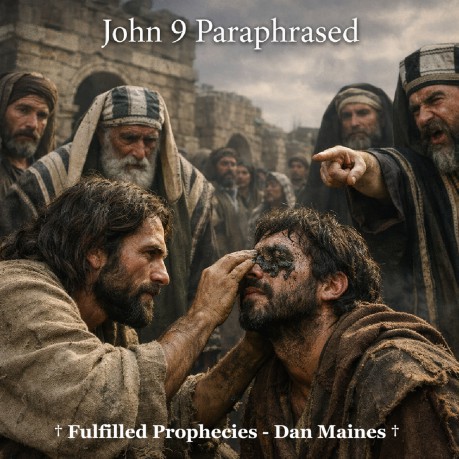
John 9
Paraphrased
By Dan Maines
Introduction
†
This chapter shows a man born blind being given sight, not just
physically but spiritually, while those who claimed to see were
exposed as blind
† It reveals the judgment
that came in that generation, light had come, and those rejecting it
were hardened
† This is about more than
healing, it is about covenant transition, old system blindness versus
new covenant sight (Isaiah 6:9-10)
John 9:1
As
Jesus passed by, he saw a man who had been blind from birth
†
This was not a random encounter, it was a divine setup to reveal
truth
† The blindness from birth represents
Israel under the old covenant, unable to truly see
†
God often uses physical conditions to reveal spiritual realities
(John 12:40)
John 9:2
His disciples asked
him, who sinned, this man or his parents, that he was born blind
†
They assumed suffering was directly tied to personal sin
†
This reflects the misunderstanding under the law system
†
It shows how people judged outwardly instead of understanding God's
purpose (Luke 13:2-3)
John 9:3
Jesus
answered, it was not that this man sinned, or his parents, but so
that the works of God might be displayed in him
†
The purpose was revelation, not punishment
†
God was about to demonstrate His authority through Christ
†
This shows God's plan unfolding through real events (John 11:4)
John
9:4
We must work the works of him who sent me while it
is day, night is coming when no one can work
†
Jesus is pointing to a limited time period before judgment
†
The night refers to the coming destruction of Jerusalem
†
The opportunity for repentance was about to close (Luke
19:42-44)
John 9:5
While I am in the
world, I am the light of the world
† Christ
is the source of truth and understanding
†
Light exposes darkness and reveals reality
†
Israel was rejecting the very light sent to them (John 1:9-11)
John
9:6
After saying this, he spat on the ground, made clay
with the saliva, and applied it to the man's eyes
†
This act shows intentional creation, like forming from dust
†
It mirrors creation language, pointing to restoration
†
Christ is re-creating sight, just as God formed man from the earth
(Genesis 2:7)
John 9:7
He said to him, go
wash in the pool of Siloam, so he went and washed and came back
seeing
† Obedience was required before
receiving sight
† The pool name means sent,
pointing to Christ
† This act represents
cleansing and response to the gospel (Titus 3:5)
John
9:8
The neighbors and those who had seen him before
said, is this not the one who used to sit and beg
†
The change was undeniable
† People struggle
to accept transformation when it challenges their assumptions
†
This shows how obvious truth is often questioned
John
9:9
Some said, this is he, others said, no but he is
like him, but he kept saying, I am the one
†
Confusion arises when truth disrupts expectations
†
The healed man stands firm in his testimony
†
Personal witness is powerful and undeniable (Acts 4:20)
John
9:10
So they said to him, how were your eyes opened
†
People focus on the method instead of the truth behind it
†
Curiosity without faith leads nowhere
† They
were investigating but not believing
John 9:11
He
answered, the man called Jesus made clay, anointed my eyes, and told
me to go wash, so I did and now I see
†
Simple testimony, no theological debate
†
Obedience led to transformation
† This shows
faith in action produces results
John 9:12
They
said to him, where is he, he said, I do not know
†
The man had limited knowledge but real experience
†
You don't need full understanding to testify truth
†
Encounter comes before full doctrine
John 9:13
They
brought the man to the Pharisees
† Religious
leaders step in to control the narrative
†
Truth is often challenged by authority structures
†
This sets up conflict between light and blindness
John
9:14
It was a Sabbath when Jesus made the clay and
opened his eyes
† The issue shifts to law
rather than miracle
† They valued tradition
over truth
† This exposes their hardened
hearts (Mark 2:27)
John 9:15
The Pharisees
asked how he received sight, he said, he put clay on my eyes, I
washed, and now I see
† The testimony remains
consistent
† Truth does not change under
pressure
† Simplicity exposes their
resistance
John 9:16
Some Pharisees said,
this man is not from God because he does not keep the Sabbath, others
said, how can a sinner do such signs, and there was division
†
Truth causes division
† Their system could
not explain what they witnessed
† When truth
conflicts with tradition, division follows
John
9:17
They said to the blind man, what do you say about
him, he said, he is a prophet
† His
understanding grows
† Light increases as one
responds
† Recognition of truth develops
progressively
John 9:18
The Jews did not
believe he had been blind until they called his parents
†
They refused to accept evidence
† Unbelief
searches for ways to deny truth
† This shows
deliberate rejection
John 9:19
They asked,
is this your son, who you say was born blind, how does he now see
†
They attempt to discredit the miracle
†
Authority seeks control through interrogation
†
Truth is being resisted, not examined
John 9:20
His
parents answered, we know this is our son and he was born blind
†
They confirm the facts
† Truth is established
by witnesses
† Yet they stop short of full
testimony
John 9:21
But how he now sees we
do not know, ask him, he is of age
† Fear
keeps them from speaking boldly
† Social
pressure silences truth
† This reflects the
cost of standing for Christ
John 9:22
They
said this because they feared being put out of the synagogue
†
Religious systems used exclusion to control people
†
Fear of man overrides truth
† This was a real
consequence in that time
John 9:23
So they
said, ask him
† They avoid responsibility
†
Truth is left to the individual witness
†
This shows the pressure environment
John 9:24
They
called the man again and said, give glory to God, we know this man is
a sinner
† They demand agreement with their
conclusion
† They reject Christ openly
†
This shows hardened blindness
John 9:25
He
answered, whether he is a sinner I do not know, one thing I know, I
was blind and now I see
† Powerful testimony
cannot be refuted
† Experience of truth
stands firm
† This is undeniable
evidence
John 9:26
They asked again how he
opened your eyes
† Repetition shows their
desperation
† They are not seeking truth,
they are resisting it
† Their blindness
deepens
John 9:27
He answered, I already
told you and you did not listen, do you want to become his disciples
too
† He exposes their unwillingness
†
Truth confronts pride
† This shifts the tone
boldly
John 9:28
They insulted him and
said, you are his disciple, we are disciples of Moses
†
They cling to the old covenant identity
†
They reject fulfillment in Christ
† This
shows their allegiance to tradition
John 9:29
We
know God spoke to Moses, but as for this man we do not know where he
is from
† They claim knowledge but reject
revelation
† They knew the law but missed its
fulfillment
† This is the core of their
blindness
John 9:30
The man answered, this
is amazing, you do not know where he is from, yet he opened my eyes
†
He exposes their inconsistency
† Truth
reveals hypocrisy
† Even the healed man sees
what they cannot
John 9:31
We know God
does not hear sinners, but if anyone worships God and does his will,
he hears him
† He uses their own logic
†
Truth is undeniable even from a simple man
†
This dismantles their argument
John 9:32
Never
since the world began has anyone opened the eyes of one born blind
†
This miracle is unique and undeniable
† It
points directly to divine authority
† This
was a clear sign of the Messiah (Isaiah 35:5)
John
9:33
If this man were not from God, he could do
nothing
† Logical conclusion based on
evidence
† Truth stands firm
†
The man now speaks with confidence
John 9:34
They
answered, you were born in sin, and they cast him out
†
They resort to insult and exclusion
† When
truth cannot be refuted, it is rejected
†
This reflects judgment against Christ followers
John
9:35
Jesus heard they cast him out and found him, do
you believe in the Son of Man
† Christ seeks
those rejected by religion
† True faith is
personal
† This shows God's care for the
faithful
John 9:36
He answered, who is he
that I may believe
† He is ready to believe
†
Light continues to grow
† Desire for truth
leads to revelation
John 9:37
Jesus said,
you have seen him, it is he speaking to you
†
Full revelation is given
† The man now sees
physically and spiritually
† This is the
moment of recognition
John 9:38
He said,
Lord I believe, and he worshiped him
† Faith
leads to worship
† This is the proper
response to Christ
† He moves from healing to
full belief
John 9:39
Jesus said, for
judgment I came into this world, that those who do not see may see,
and those who see may become blind
† This is
covenant judgment language
† The humble
receive sight, the proud are blinded
† This
was fulfilled in that generation (Matthew 13:13-15)
John
9:40
Some Pharisees asked, are we blind too
†
They question but do not repent
† Pride
prevents them from seeing
† Their blindness
is self-inflicted
John 9:41
Jesus said, if
you were blind you would have no sin, but since you say we see, your
sin remains
† Accountability comes with
claimed knowledge
† Their rejection seals
their judgment
† This is the final verdict on
that system
Historical References
†
Josephus describes the blindness of leadership and their rejection of
signs leading to Jerusalem's fall
† Irenaeus
wrote that Christ revealed truth to the humble while the proud
remained blind
† Eusebius records how early
believers saw these events as fulfillment of judgment in that
generation
† Clement of Alexandria taught
that true sight comes through Christ, not through law
How
it applies to us today
† We must
recognize that true sight comes only through Christ, not tradition
†
It's not enough to claim knowledge, we must respond to truth
†
Pride blinds, humility opens our eyes
† We've
got to stand firm in truth even when rejected
†
Spiritual sight grows as we walk in obedience
Q & A
Appendix:
Q: What does the blind man
represent
A: He represents those under
blindness who receive sight through Christ (Isaiah 35:5)
Q:
Why were the Pharisees blind
A: Because they
rejected the truth despite having knowledge (Matthew 15:14)
Q:
What is the night Jesus spoke of
A: The coming
judgment on Jerusalem (Luke 21:22)
Q: Why was
the man cast out
A: Because truth challenges
religious systems (John 16:2)
Q: What is the
main message of this chapter
A: Christ gives
true sight while exposing spiritual blindness (John 12:46)
†
This is the fulfilled perspective we proclaim at Fulfilled Prophecies
†
© Fulfilled Prophecies - Dan Maines.
Source
Index
† John 9
†
Josephus, Wars of the Jews
† Irenaeus,
Against Heresies
† Eusebius, Ecclesiastical
History
† Clement of Alexandria, Stromata
Links