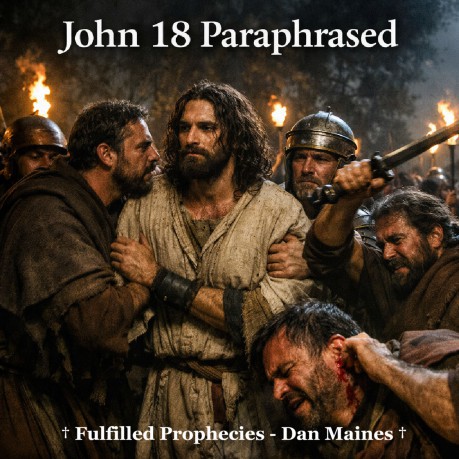
John 18 Paraphrased Introduction John 18:1 John 18:2 John 18:3 John 18:4 John 18:5 John 18:6 John 18:7 John 18:8 John 18:9 John 18:10 John 18:11 John 18:12 John 18:13 John 18:14 John 18:15 John 18:16 John 18:17 John 18:18 John 18:19 John 18:20 John 18:21 John 18:22 John 18:23 John 18:24 John 18:25 John 18:26 John 18:27 John 18:28 John 18:29 John 18:30 John 18:31 John 18:32 John 18:33 John 18:34 John 18:35 John 18:36 John 18:37 John 18:38 John 18:39 John 18:40 Historical References How it applies to us today Q & A Appendix: † This is the fulfilled perspective we proclaim at
Fulfilled Prophecies † Source Index
By Dan Maines
† Jesus now
steps into the hour He had been speaking about, not as a victim, but
as the one in control of the fulfillment
†
This chapter shows the transition from His earthly ministry to His
sacrificial role, exactly within that generation
†
Everything here unfolds according to what He had already spoken
beforehand, nothing is accidental
After saying these things, Jesus
went out with His disciples across the Kidron Valley, where there was
a garden, and He entered it with them
† This
garden setting echoes Eden, but instead of failure, this is where
obedience stands firm (Romans 5:19)
† The
Kidron was associated with judgment and cleansing, fitting the moment
Judas, who was betraying Him, also
knew the place, because Jesus often met there with His disciples
†
Judas knew exactly where to find Him, there was no hiding, this was
intentional surrender
† Jesus didn't avoid
danger, He walked straight into it
Judas then, having received the
Roman cohort and officers from the chief priests and Pharisees, came
there with lanterns and torches and weapons
†
Religion and Rome unite here, showing both systems stood against
Christ
† The light of the world is approached
with artificial light, showing their blindness (John 1:5)
So Jesus, knowing all the things
that were coming upon Him, went forward and said to them, who are you
seeking
† He steps forward first, showing
control, not fear
† This is not surprise, but
fulfillment of what He already declared
They answered Him, Jesus the
Nazarene, He said to them, I am He, and Judas also who was betraying
Him was standing with them
† I am He echoes
divine identity, tying Him to Yahweh (Exodus 3:14)
†
Judas stands with the enemy, showing his alignment
So when He said to them, I am He,
they drew back and fell to the ground
† His
presence alone overpowered them, proving authority
†
Even in arrest, He reveals His glory
Therefore He again asked them, who
are you seeking, and they said, Jesus the Nazarene
†
He repeats the question, emphasizing their intent
†
Their answer remains fixed, they reject who He truly is
Jesus answered, I told you that I
am He, so if you seek Me, let these go their way
†
He protects His disciples, fulfilling His role as shepherd (John
10:11)
† His concern is for them, even in
arrest
This was to fulfill the word which
He spoke, of those whom You have given Me I lost not one
†
Fulfillment is central, nothing is random
†
His preservation of the disciples shows His faithfulness
Simon Peter then, having a sword,
drew it and struck the high priest's slave and cut off his right ear,
and the slave's name was Malchus
† Peter acts
in the flesh, not understanding the plan
†
This shows human reaction versus divine purpose
So Jesus said to Peter, put the
sword into the sheath, the cup which the Father has given Me, shall I
not drink it
† Jesus accepts the cup,
referring to judgment (Isaiah 51:17)
† He
submits fully to the Father's will
So the Roman cohort and the
commander and the officers of the Jews arrested Jesus and bound Him
†
Binding the One who frees others shows their blindness
†
This fulfills prophetic suffering (Isaiah 53:7)
And led Him to Annas first, for
he was father-in-law of Caiaphas, who was high priest that year
†
Annas still held influence, showing corruption in leadership
†
Power was political, not spiritual
Now Caiaphas was the one who had
advised the Jews that it was expedient for one man to die on behalf
of the people
† Even their own words
testified to the truth unknowingly (John 11:50)
†
God used their intent to fulfill His plan
Simon Peter was following Jesus,
and so was another disciple, now that disciple was known to the high
priest, and entered with Jesus into the court
†
John likely had access, showing connections in leadership circles
†
Peter follows at a distance, already showing hesitation
But Peter was standing at the
door outside, so the other disciple went out and spoke to the
doorkeeper and brought Peter in
† Peter is
brought in, but still unsure
† This sets up
his coming denial
Then the slave girl who kept the
door said to Peter, you are not also one of this man's disciples, are
you, he said, I am not
† The first denial
comes quickly under pressure
† Fear begins to
dominate
Now the slaves and the officers
were standing there, having made a charcoal fire, for it was cold,
and they were warming themselves, and Peter was also with them
†
Peter stands among the enemies, symbolizing compromise
†
The setting highlights his separation from Christ
The high priest then questioned
Jesus about His disciples and about His teaching
†
They seek to trap Him, not understand Him
†
This is an unlawful trial process
Jesus answered him, I have spoken
openly to the world, I always taught in synagogues and in the temple
where all the Jews come together, and I spoke nothing in secret
†
His teaching was public, no hidden agenda
†
Truth doesn't need secrecy
Why do you question Me, question
those who have heard what I spoke to them, they know what I said
†
He exposes their unjust method
† Witnesses
should be called, not forced confession
When He had said this, one of the
officers standing nearby struck Jesus, saying, is that the way You
answer the high priest
† Violence replaces
justice
† This fulfills suffering prophecy
(Isaiah 50:6)
Jesus answered him, if I have
spoken wrongly, testify of the wrong, but if rightly, why do you
strike Me
† He calls for truth, not emotion
†
Their silence shows guilt
So Annas sent Him bound to
Caiaphas the high priest
† The process
continues in corruption
† The leadership
fails in righteousness
Now Simon Peter was standing and
warming himself, so they said to him, you are not also one of His
disciples, are you, he denied it and said, I am not
†
The second denial deepens his failure
†
Pressure exposes weakness
One of the slaves of the high
priest, being a relative of the one whose ear Peter cut off, said,
did I not see you in the garden with Him
†
The evidence increases
† Peter is cornered
Peter then denied it again, and
immediately a rooster crowed
† The third
denial fulfills Jesus' words (John 13:38)
†
The sound marks the moment of realization
Then they led Jesus from Caiaphas
into the Praetorium, and it was early, and they themselves did not
enter so that they would not be defiled
†
They avoid ritual defilement while committing injustice
†
Religion without truth is hypocrisy
Therefore Pilate went out to them
and said, what accusation do you bring against this Man
†
Pilate seeks legal grounds
† Rome requires
charges, not assumptions
They answered, if this Man were
not an evildoer, we would not have delivered Him to you
†
They avoid specifics, showing weakness
†
Their case lacks substance
So Pilate said to them, take Him
yourselves, they said, we are not permitted to put anyone to death
†
Rome held execution authority
† This fulfills
how Jesus would die, crucifixion (John 12:32-33)
This was to fulfill the word
which Jesus spoke, signifying by what kind of death He was about to
die
† Again, fulfillment is emphasized
†
Nothing here is outside God's plan
Therefore Pilate entered again
and summoned Jesus and said, are You the King of the Jews
†
The central issue is kingship
† This
challenges Roman authority
Jesus answered, are you saying
this on your own initiative, or did others tell you about Me
†
He turns the question back, exposing motive
†
Truth depends on understanding, not hearsay
Pilate answered, I am not a Jew,
am I, your own nation delivered You, what have You done
†
Pilate distances himself from Jewish matters
†
He seeks clarity, not conviction
Jesus answered, My kingdom is not
of this world, if it were, My servants would be fighting
†
His kingdom is not political or earthly
†
This refutes expectations of a physical revolt
Therefore Pilate said, so You are
a king, Jesus answered, you say correctly that I am a king, for this
I have come into the world, to testify to the truth
†
His kingship is tied to truth
† Those who
belong to truth recognize Him
Pilate said, what is truth, and
after saying this, he went out again and said, I find no guilt in
Him
† Pilate dismisses truth while standing
before it
† Even he finds no legal fault
But you have a custom that I
release someone for you at the Passover, do you wish that I release
the King of the Jews
† Passover connects to
deliverance
† The true Lamb stands before
them
So they cried out again, saying,
not this Man, but Barabbas, now Barabbas was a robber
†
They choose a criminal over the righteous one
†
This shows the complete rejection of their Messiah
†
Josephus records the corruption of the high priesthood and unlawful
trials, confirming the chaos of that time, Antiquities Book 20
†
Tacitus acknowledges Roman involvement in crucifixion under Pontius
Pilate, Annals 15.44
† Eusebius writes about
the fulfillment of Christ's words leading up to Jerusalem's
destruction, Ecclesiastical History
†
Irenaeus speaks of Christ's obedience unto death as fulfillment of
prophecy, Against Heresies
†
We see that Jesus was always in control, even in suffering, so we
trust Him in every situation
† We learn that
outward religion means nothing without truth and obedience
†
We are reminded not to follow at a distance like Peter, but to stand
firm
† We understand that truth isn't defined
by majority, but by Christ
† We see that
rejecting Christ always leads to choosing something lesser
Q: Why
did Jesus step forward to be arrested
A:
Because He knew all things and willingly fulfilled the Father's will
(John 18:4; Isaiah 53:7)
Q: What does I am He
mean
A: It reflects divine identity connected
to God Himself (Exodus 3:14; John 8:58)
Q: Why
did Peter deny Jesus
A: Fear overcame him,
showing human weakness without full understanding (John 13:38)
Q:
What does My kingdom is not of this world mean
A:
His rule is spiritual, not political or earthly (John 18:36)
Q:
Why did they choose Barabbas
A: They rejected
righteousness and chose what matched their desires (Isaiah 53:3)
© Fulfilled Prophecies - Dan
Maines.
† John 18
†
Josephus, Antiquities of the Jews
† Tacitus,
Annals
† Irenaeus, Against Heresies
†
Eusebius, Ecclesiastical History
Links