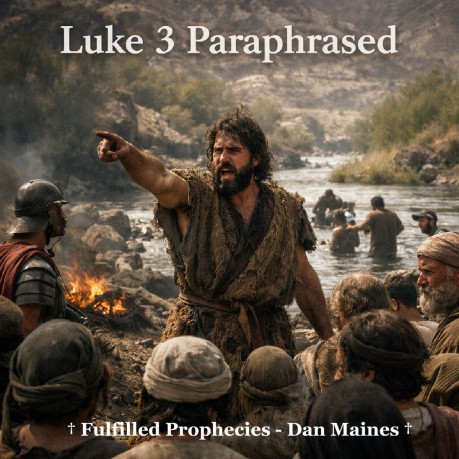
Luke 3
Paraphrased
By Dan Maines
Introduction
†
This chapter shows the voice crying in the wilderness preparing the
way for the Lord
† It reveals the call to
repentance before judgment came on that generation
†
It establishes John as the forerunner and points directly to Christ
as the One bringing fulfillment
Luke 3:1
In
the fifteenth year of Tiberius Caesar, when Pontius Pilate governed
Judea, Herod ruled Galilee, his brother Philip ruled Ituraea and
Trachonitis, and Lysanias ruled Abilene
†
This sets the exact historical moment showing these events are real
and tied to their generation (Luke 2:1)
† God
anchors prophecy in real rulers, showing fulfillment is not future
speculation but present reality
† Josephus
confirms these rulers and the political setting of Judea at that
time
Luke 3:2
During the high priesthood
of Annas and Caiaphas, the word of God came to John in the
wilderness
† God bypasses corrupt leadership
and speaks to a prophet outside the system (John 1:6)
†
This exposes the failure of the temple leadership before its coming
judgment
† Eusebius notes the corruption of
the priesthood in this period
Luke 3:3
He
went through the region around the Jordan preaching a baptism of
repentance for the forgiveness of sins
†
Repentance was the condition to escape the coming wrath (Luke 13:3)
†
This wasn't ritual cleansing but a call to change before judgment
†
Josephus records John's baptism as a call to righteousness
Luke
3:4
As written in Isaiah, a voice cries in the
wilderness, prepare the way of the Lord, make His paths straight
†
This directly identifies John as the fulfillment of Isaiah's prophecy
(Isaiah 40:3)
† The Lord coming refers to
covenant judgment and salvation
† Irenaeus
affirms John as the prophetic forerunner
Luke 3:5
Every
valley will be filled, every mountain and hill brought low, crooked
paths made straight and rough roads smooth
†
This is covenant language describing the removal of obstacles before
God's coming (Isaiah 40:4)
† It points to the
leveling of Israel's pride before judgment
†
This imagery reflects preparation for divine visitation
Luke
3:6
All flesh will see the salvation of God
†
Salvation is revealed publicly within that generation (Luke
2:30-31)
† This includes both Jews and
Gentiles in fulfillment
† Clement of
Alexandria connects this to the gospel reaching all nations
Luke
3:7
He said to the crowds coming for baptism, you brood
of vipers, who warned you to flee from the coming wrath
†
John identifies the religious crowd as corrupt and under judgment
(Matthew 23:33)
† The wrath is imminent, not
distant
† This matches the coming destruction
of Jerusalem
Luke 3:8
Produce fruit
consistent with repentance, don't say we have Abraham as our father,
God can raise children from stones
† Physical
descent means nothing without obedience (Romans 9:6-8)
†
God can replace Israel if they refuse repentance
†
This confronts covenant presumption directly
Luke
3:9
The axe is already at the root of the trees, every
tree not bearing fruit is cut down and thrown into the fire
†
Judgment is already ready, not delayed (Matthew 7:19)
†
The tree represents Israel under the covenant
†
Fire symbolizes destruction coming in AD 70
Luke
3:10
The crowds asked what should we do
†
The people recognize urgency and seek direction
†
True repentance leads to action
† This shows
the seriousness of the moment
Luke 3:11
Whoever
has two tunics must share with one who has none, whoever has food
must do the same
† Repentance produces
visible change in behavior (James 2:17)
†
This reflects covenant righteousness
† Love
for neighbor becomes evidence of true repentance
Luke
3:12
Tax collectors came and asked what they should
do
† Even those despised are included in the
call
† The gospel reaches all levels of
society
† This shows God's mercy before
judgment
Luke 3:13
He told them not to
collect more than authorized
† Repentance
includes honesty and justice
† Corruption
must be abandoned
† This reflects righteous
conduct under God's law
Luke 3:14
Soldiers
asked what they should do, he told them don't extort or accuse
falsely, be content with wages
† Power must
not be abused
† Contentment replaces greed
†
True repentance changes authority behavior
Luke
3:15
People were wondering if John might be the
Christ
† Expectation of the Messiah was high
in that generation
† They were looking for
fulfillment
† This shows prophecy was
understood as near
Luke 3:16
John said he
baptizes with water, but one stronger is coming who will baptize with
the Holy Spirit and fire
† Christ brings true
transformation and judgment (Acts 2:3-4)
†
Fire represents both purification and destruction
†
This distinguishes John from Christ
Luke 3:17
His
winnowing fork is in His hand, He will clear His threshing floor,
gather wheat and burn chaff with unquenchable fire
†
Separation is happening in that generation (Matthew 13:30)
†
The wheat are the faithful, the chaff are judged
†
This points directly to covenant separation
Luke
3:18
With many exhortations he preached the good news
†
The gospel includes warning and hope
†
Repentance and salvation go together
† This
was urgent preaching before judgment
Luke 3:19
Herod
was rebuked for his sins including taking his brother's wife
†
Truth confronts rulers as well as common people
†
Sin in leadership brings consequences
†
Josephus confirms Herod's unlawful marriage
Luke
3:20
Herod added to his sins by imprisoning John
†
Rejecting truth leads to greater sin
† This
sets up John's eventual death
† This shows
opposition to God's message
Luke 3:21
When
all were baptized, Jesus was baptized and as He prayed heaven
opened
† Jesus identifies with the people
though sinless
† Heaven opening shows divine
approval
† This marks the beginning of His
public ministry
Luke 3:22
The Holy Spirit
descended like a dove and a voice said You are My beloved Son, in You
I am well pleased
† This confirms Jesus as
the Son of God (Psalm 2:7)
† The Spirit's
presence shows divine authority
† This
reveals the unity of the Father, Son, and Spirit
Luke
3:23
Jesus began His ministry at about thirty years old
and was thought to be the son of Joseph
†
This marks the start of His mission
† The
genealogy connects Him to humanity
† This
fulfills expectations of the Messiah
Luke 3:24
son
of Matthat, son of Levi, son of Melchi, son of Jannai, son of
Joseph
† This genealogy traces legal lineage
through generations
† It confirms historical
continuity of the Messiah
† Irenaeus connects
this lineage to Christ fulfilling humanity
Luke 3:25
son
of Mattathias, son of Amos, son of Nahum, son of Esli, son of
Naggai
† Each name shows the preservation of
the line
† God kept His promise through
generations
† This affirms covenant
continuity
Luke 3:26
son of Maath, son of
Mattathias, son of Semein, son of Josech, son of Joda
†
The genealogy continues without interruption
†
This reinforces historical accuracy
† God's
plan unfolds through real people
Luke 3:27
son
of Joanan, son of Rhesa, son of Zerubbabel, son of Shealtiel, son of
Neri
† Zerubbabel ties this line to
post-exile restoration
† This connects Christ
to Israel's rebuilding
† Eusebius records
these historical connections
Luke 3:28
son
of Melchi, son of Addi, son of Cosam, son of Elmadam, son of Er
†
These names preserve the generational chain
†
God maintained the lineage faithfully
† This
confirms divine oversight
Luke 3:29
son of
Joshua, son of Eliezer, son of Jorim, son of Matthat, son of Levi
†
The repetition of names shows continuity
†
This emphasizes the legitimacy of Christ's line
†
It confirms prophetic fulfillment
Luke 3:30
son
of Simeon, son of Judah, son of Joseph, son of Jonam, son of
Eliakim
† The line continues through Judah as
promised
† This connects to the tribe of
kingship
† God fulfills His covenant
promises
Luke 3:31
son of Melea, son of
Menna, son of Mattatha, son of Nathan, son of David
†
This confirms descent from David
† Christ
fulfills the promise of David's throne (2 Samuel 7:12-13)
†
Irenaeus affirms this royal connection
Luke 3:32
son
of Jesse, son of Obed, son of Boaz, son of Salmon, son of Nahshon
†
This ties to the line preserved in Ruth
† It
shows God's providence through generations
†
The Messiah's line was never broken
Luke 3:33
son
of Amminadab, son of Admin, son of Arni, son of Hezron, son of Perez,
son of Judah
† This traces back to the
patriarchs
† It confirms fulfillment of
promises to Judah
† The line is historically
grounded
Luke 3:34
son of Jacob, son of
Isaac, son of Abraham, son of Terah, son of Nahor
†
This connects Christ to Abraham
† It fulfills
the promise to bless all nations
† Covenant
history is fulfilled in Christ
Luke 3:35
son
of Serug, son of Reu, son of Peleg, son of Eber, son of Shelah
†
The genealogy continues into early history
†
This shows the unity of mankind
† God's plan
spans all generations
Luke 3:36
son of
Cainan, son of Arphaxad, son of Shem, son of Noah, son of Lamech
†
This ties Christ to the flood narrative
† It
shows continuity from Noah
† God's covenant
with humanity continues
Luke 3:37
son of
Methuselah, son of Enoch, son of Jared, son of Mahalalel, son of
Cainan
† This connects to early righteous
men
† It shows the long preservation of the
line
† God's plan predates Israel
Luke
3:38
son of Enosh, son of Seth, son of Adam, son of
God
† This brings the line back to Adam
†
Christ is connected to all humanity
†
Irenaeus taught Christ restores what was lost from Adam
Historical
References
† Josephus, Antiquities
of the Jews, Book 18
† Irenaeus, Against
Heresies
† Eusebius, Ecclesiastical History
†
Clement of Alexandria, Stromata
How It Applies To Us
Today
† Repentance still defines
true faith
† God has already fulfilled what
He promised
† We live in the established
kingdom now
† Our lives must bear fruit
consistent with repentance
† Christ is the
fulfillment of all covenant history
Q & A
Appendix
Q: What was the coming
wrath
A: It was the judgment on that generation
(Matthew 23:36)
Q: Why is repentance
emphasized
A: Because it was required before
judgment (Luke 13:3)
Q: What does the fire
represent
A: It represents judgment and
purification (Malachi 4:1)
Q: Why include the
genealogy
A: To prove Christ fulfills all
history (Romans 5:18)
Q: What does this chapter
prove
A: That fulfillment happened in their
time (Luke 21:32)
† This is the fulfilled perspective
we proclaim at Fulfilled Prophecies †
© Fulfilled
Prophecies - Dan Maines.
Source Index
†
Luke 3
† Josephus, Antiquities of the Jews
†
Irenaeus, Against Heresies
† Eusebius,
Ecclesiastical History
† Clement of
Alexandria, Stromata
Links