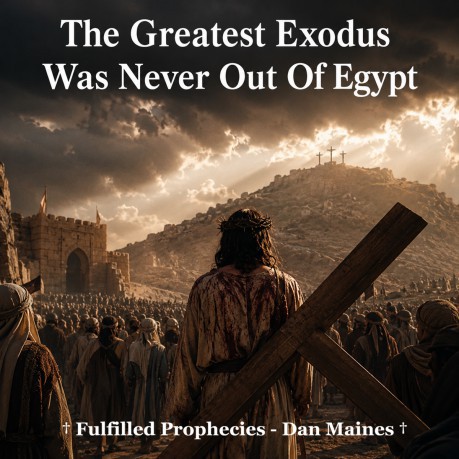
The
Greatest Exodus Was Never Out Of Egypt Introduction † The
Exodus from Egypt was one of the greatest events in Israel's history,
but it wasn't the final deliverance God had planned. Moses led Israel
out of physical slavery, while Jesus delivered His people from sin,
condemnation, and the bondage of the Old Covenant. The first Exodus
was a shadow, but Christ brought the greater reality. (Colossians
2:16-17; Hebrews 10:1) † Moses
led Israel through the sea toward an earthly land, but Jesus led His
people through death into the everlasting Kingdom of God. (1
Corinthians 10:1-4; Colossians 1:13) † The
greatest Exodus wasn't merely from one country to another. It was the
covenantal deliverance from slavery under the Law into freedom, life,
and direct access to God through Christ. (Galatians 4:4-7; Hebrews
10:19-22) Exodus
12:41-42
And at the end of 430 years, on this very day, all the multitudes of
the Lord departed from
the land of Egypt. It
is a night to be observed for the Lord,
for having brought them out of the land of Egypt; this night is for
the Lord,
to be observed by all the sons of Israel throughout their
generations. † The
first Exodus delivered Israel from slavery under Pharaoh and brought
them out of Egypt as God's covenant people. (Exodus 6:6-7) † That
physical deliverance became the pattern for the greater salvation
Christ would later accomplish. (Luke 9:31; 1 Corinthians 10:1-4) † Egypt
represented bondage, but the deeper slavery of mankind was sin,
death, and condemnation under the Law. (John 8:34; Romans 7:10-11) Exodus
14:21-22
Then
Moses reached out with his hand over the sea; and the Lord
swept the sea back by a strong east wind all night, and turned the
sea into dry land, and the waters were divided. So the sons of Israel
went through the midst of the sea on the dry land, and the waters
were like a wall to them on their right and on their left.
†
Israel
passed through the sea as God delivered them from Pharaoh's bondage.
(Exodus 14:21-22) † Paul
later identifies this crossing as a shadow pointing to Christ and the
greater deliverance. (1 Corinthians 10:1-4) † The
first Exodus began with passing through the sea, but the greater
Exodus came through the death and resurrection of Jesus Christ. (Luke
9:31; Romans 6:3-4) Deuteronomy
18:15
The Lord your God will
raise up for you a prophet like me from among you, from your
countrymen; to him you shall listen.
† Moses
promised that God would raise up another Prophet like him, but
greater than him. (Acts 3:22-23) † Like
Moses, Jesus came as a covenant mediator, but He established a better
covenant founded on better promises. (Hebrews 8:6) † Moses
led Israel out of Egypt, but Jesus led His people out of covenant
bondage and into the liberty of the sons of God. (Galatians 4:4-7;
Hebrews 3:3-6) Matthew
17:1-5
Six days later, Jesus took with Him Peter and James, and his brother
John, and led them up on a high mountain by themselves. And He was
transfigured before them; and His face shone like the sun, and His
garments became as white as light. And behold, Moses and Elijah
appeared to them, talking with Him. Peter responded and said to
Jesus, "Lord, it is good that we are here. If You want, I will
make three tabernacles here: one for You, one for Moses, and one for
Elijah." While he was still speaking, a bright cloud
overshadowed them, and behold, a voice from the cloud said, "This
is My beloved Son, with whom I am well pleased; listen to Him!"
† Moses
and Elijah appeared with Jesus because the Law and the Prophets
pointed to the Messiah and found their fulfillment in Him. (Luke
24:44) † The
Father's command, "Hear ye him," fulfilled Moses' prophecy
that God would raise up a Prophet like him to whom the people must
listen. (Deuteronomy 18:15; Acts 3:22-23) † The
Transfiguration prepares the reader for Luke's account, where Moses
and Elijah discuss the greater Exodus Christ was about to accomplish
at Jerusalem. (Luke 9:30-31) Luke
9:30-31
And behold, two men were talking with Him; and they were Moses and
Elijah, who, appearing in glory, were speaking of His departure,
which He was about to accomplish at Jerusalem.
† The
word translated "decease" is the Greek word exodos, showing
that Jesus was about to accomplish the greater Exodus at Jerusalem. † Moses,
the leader of Israel's first Exodus, appeared with Jesus and spoke
about the Exodus Christ was about to fulfill through His death,
resurrection, and covenant victory. (Luke 9:30-31) † Jesus'
Exodus wasn't an escape from Rome. It was deliverance from sin,
death, and the fading Old Covenant order. (Hebrews 2:14-15; Hebrews
8:13) 1
Corinthians 10:1-4
For I do not want you to be unaware, brothers and sisters, that our
fathers were all under the cloud and they all passed through the sea;
and they all were baptized into Moses in the cloud and in the sea;
and they all ate the same spiritual food, and all drank the same
spiritual drink, for they were drinking from a spiritual rock which
followed them; and the rock was Christ.
† Paul
explains that the Exodus itself pointed to Christ from the very
beginning. (1 Corinthians 10:4) † The
cloud, the sea, the manna, and the rock all foreshadowed the greater
work Christ would accomplish. (Colossians 2:16-17) † The
first Exodus was never the destination. It was preparing God's people
for the greater redemption found in Christ. (Hebrews 10:1) John
8:34-36
Jesus answered them, "Truly, truly I say to you, everyone who
commits sin is a slave of sin. Now the slave does not remain in the
house forever; the son does remain forever. So if the Son sets you
free, you really will be free.
† Israel's
first slavery was physical, but Jesus identified the deeper bondage
as slavery to sin. (John 8:34) † True
freedom couldn't come through Moses or the Law because the Law
exposed sin but couldn't remove it. (Romans 3:20; Hebrews 10:1-4) † Christ
brought the greater freedom because He delivered His people from
condemnation and gave them life in the New Covenant. (Romans 8:1-2;
John 8:36) Hebrews
3:3-6
For He has been counted worthy of more glory than Moses, by just so
much as the builder of the house has more honor than the house. For
every house is built by someone, but the builder of all things is
God. Now Moses was faithful in all God’s house as a servant, for a
testimony of those things which were to be spoken later; but Christ
was faithful as a Son over His house-whose house we are, if we hold
firmly to our confidence and the boast of our hope.
† Moses
was faithful as a servant, but Christ rules as the Son over God's
house. (Hebrews 3:5-6) † Moses'
ministry was a testimony pointing forward to the greater things that
would later be revealed in Christ. (Hebrews 3:5; Hebrews 10:1) † The
true house of God isn't national Israel or an earthly temple, but the
people joined to Christ under the New Covenant. (Hebrews 3:6;
Ephesians 2:19-22) Hebrews
12:18-24
For you have not come to a mountain that can be touched and to a
blazing fire, and to darkness and gloom and whirlwind, and to the
blast of a trumpet and the sound of words, which sound was such that
those who heard begged that no further word be spoken to them. For
they could not cope with the command, "If even an animal touches
the mountain, it shall be stoned." And so terrible was the
sight, that Moses said, "I am terrified and trembling." But
you have come to Mount Zion and to the city of the living God, the
heavenly Jerusalem, and to myriads of angels, to the general assembly
and church of the firstborn who are enrolled in heaven, and to God,
the Judge of all, and to the spirits of the righteous made perfect,
and to Jesus, the mediator of a new covenant, and to the sprinkled
blood, which speaks better than the blood of Abel.
† The
first Exodus brought Israel to Mount Sinai, but the greater Exodus
brought believers to Mount Zion and the heavenly Jerusalem. (Hebrews
12:18-24) † Moses
mediated the Old Covenant at Sinai, but Jesus became the Mediator of
the New Covenant. (Hebrews 8:6; Hebrews 12:24) † The
writer didn't say believers would someday come to Mount Zion. He
said, "ye are come," showing that this was already a
present covenant reality. (Hebrews 12:22-24) † The
first Exodus ended at Mount Sinai with the giving of the Law, but the
greater Exodus brings believers to Mount Zion under the New Covenant.
(Exodus 19:20; Hebrews 12:22-24)
Historical
References † Moses
recorded Israel's departure from Egypt as the foundational
deliverance of the Old Covenant nation. (Exodus 12:41-42) † Luke
deliberately used the word exodos to describe what Jesus was about to
accomplish at Jerusalem, connecting Christ's work directly to the
pattern established through Moses. (Luke 9:30-31) † The
writer of Hebrews presented Moses as the servant and Christ as the
Son, showing that the first Exodus pointed forward to the greater
covenant deliverance accomplished by Jesus. (Hebrews 3:3-6) How
It Applies To Us Today † We
don't look back to Egypt as the greatest act of deliverance because
Christ has brought us into the freedom and life of the New Covenant.
(John 8:36; Romans 8:1-2) † We
haven't come to Sinai with fear and condemnation. We've come to Mount
Zion, the heavenly Jerusalem, and Jesus the Mediator of the New
Covenant. (Hebrews 12:18-24) † Our
freedom isn't political, national, or geographical. It's freedom from
sin, condemnation, and separation from God through the finished work
of Christ. (Romans 6:17-18; Ephesians 2:13-18) Q
& A Appendix Q:
Was
the Exodus from Egypt the final deliverance God intended? A:
No.
The first Exodus was a physical shadow pointing to the greater
deliverance Christ would accomplish from sin, death, and covenant
bondage. (Luke 9:31; Hebrews 10:1) Q:
Why
does Luke call Jesus' death an Exodus? A:
Luke
used the Greek word exodos because Jesus was about to accomplish the
greater deliverance at Jerusalem through His death, resurrection, and
New Covenant victory. (Luke 9:30-31; Hebrews 2:14-15) Q:
How
is Jesus greater than Moses? A:
Moses
was a faithful servant in God's house, but Christ is the Son over the
house and the Mediator of the better covenant. (Hebrews 3:3-6;
Hebrews 8:6) Q:
Where
did the greater Exodus bring God's people? A:
It
brought them to Mount Zion, the heavenly Jerusalem, and direct access
to God through Jesus Christ. (Hebrews 12:22-24; Ephesians 2:18) Q:
Why
did Moses appear with Jesus at the Transfiguration? A:
Moses
appeared because the first Exodus pointed to the greater Exodus
Christ was about to accomplish at Jerusalem. (Luke 9:30-31;
Deuteronomy 18:15; Matthew 17:5) † This
is the fulfilled perspective we proclaim at Fulfilled Prophecies † © Fulfilled
Prophecies - Dan Maines. Source
Index † Exodus
12:41-42, Deuteronomy 18:15, Luke 9:30-31, John 8:34-36, Hebrews
3:3-6, Hebrews 12:18-24 † Moses,
Luke, John the Apostle, the writer of Hebrews
By Dan Maines
Links