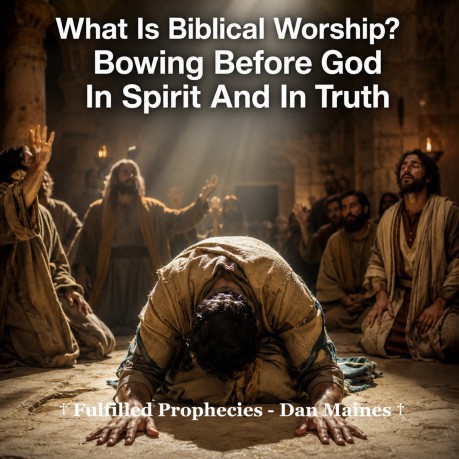
What Is Biblical Worship?
Bowing Before God In Spirit And In Truth Introduction † Worship in the Bible is much deeper than
singing songs or attending a church service. From Genesis to
Revelation, worship is the response of a heart that recognizes God's
greatness, submits to His authority, and lives in obedience to Him.
(Genesis 22:5; Psalm 95:6) † The Hebrew and Greek words translated worship
often describe bowing down, prostrating oneself, or expressing
complete reverence before God. The outward act reflected an inward
attitude of humility and surrender. (Exodus 34:8; Matthew 2:11) † Under the New Covenant, worship isn't
centered on a physical temple or a specific location. Through Christ,
God's people have become His dwelling place, and true worship flows
from a life transformed by the Holy Spirit. (John 4:21-24; Ephesians
2:19-22) The Meaning Of Worship Exodus 34:8 And Moses hurried to bow low toward the ground and worship. † The primary Hebrew word for worship is
shachah, which literally means to bow down, to prostrate oneself, or
to show deep reverence before God. (Genesis 18:2; Psalm 95:6) † Moses' response to God's presence was
immediate humility. Worship wasn't first about music but about
recognizing God's holiness and submitting to Him. (Isaiah 6:1-5) † Throughout the Old Testament, bowing before
God was the outward expression of an inward heart of surrender,
honor, and obedience. (1 Chronicles 29:20; Nehemiah 8:6) Genesis 22:5 Then Abraham said to his young men, "Stay here with the
donkey, and I and the boy will go over there; and we will worship and
return to you." † The first mention of worship in Scripture is
connected with complete trust and obedience to God rather than music
or ceremony. (Hebrews 11:17-19) † Abraham understood that worship involved
surrendering what was most precious to him because he trusted God's
promises completely. (Genesis 15:6; Romans 4:20-21) † Genuine worship has always involved a heart
willing to submit to God's will even when His commands are difficult
to understand. (James 2:21-23) Psalm 95:6-7 Come, let's worship and bow down, Let's kneel before the Lord our
Maker. For He is our God, And we are the people of His pasture and
the sheep of His hand. Today, if you will hear His voice, † The words worship, bow down, and kneel
emphasize humility before the Creator rather than exalting ourselves.
(Isaiah 66:2) † Worship acknowledges God's absolute authority
because He alone is our Creator, Shepherd, and King. (Psalm 100:3;
Revelation 4:11) † The psalm immediately connects worship with
hearing and obeying God's voice. Worship without obedience isn't
biblical worship. (1 Samuel 15:22; John 10:27) Matthew 4:10 Then Jesus said to him, "Go away, Satan! For it is written:
'You shall worship the Lord your God, and serve Him only.'" † Jesus quoted Scripture to declare that
worship belongs exclusively to God. No person, angel, object, or
institution is worthy of the worship that belongs to Him alone.
(Deuteronomy 6:13) † Worship and service are closely connected. A
person truly worships God when his life is devoted to serving Him in
faithful obedience. (Joshua 24:14-15) † Every form of idolatry begins when something
else receives the devotion that belongs only to God. (Romans 1:25; 1
John 5:21) Every Knee Shall Bow Before Christ Isaiah 45:23 I have sworn by Myself; The word has gone out from My mouth in
righteousness And will not turn back, That to Me every knee will bow,
every tongue will swear allegiance. Romans 14:11 For it is written: "As I live, says the Lord, to Me every
knee will bow, And every tongue will give praise to God." Philippians 2:10-11 so that at the name of Jesus every knee will bow, of those who are
in heaven and on earth and under the earth, and that every tongue
will confess that Jesus Christ is Lord, to the glory of God the
Father. † Isaiah declared that every knee would bow
before the Lord because He alone is the true God and Savior. This
wasn't describing forced worship but the universal recognition of His
absolute authority. (Isaiah 45:21-22)
† Paul applies Isaiah's prophecy directly to
Jesus Christ, demonstrating that the honor and worship belonging to
Jehovah are rightly given to the Son without diminishing the Father.
(John 5:22-23; Hebrews 1:6) † Bowing the knee represents complete
submission, reverence, and acknowledgment of Christ's lordship.
Whether willing or unwilling, every person will ultimately recognize
His authority. (Matthew 28:18; Revelation 5:13) † In the fulfilled New Covenant, believers
don't wait for a future day to bow before Christ. We willingly bow
before Him now by living in faithful obedience and joyful worship.
(Romans 12:1-2; Colossians 3:17) John 4:23-24 But a time is coming, and even now has arrived, when the true
worshipers will worship the Father in spirit and truth; for such
people the Father seeks to be His worshipers. God is spirit, and
those who worship Him must worship in spirit and truth." † Jesus announced that the age of worship
centered around earthly locations was coming to an end because a New
Covenant was being established. (John 4:21; Hebrews 8:13) † Worship in spirit means worship that comes
from a heart made alive by God's Spirit rather than merely performing
outward religious rituals. (Romans 8:9-16; Philippians 3:3) † Worship in truth means worship that agrees
with God's revealed Word and centers on Jesus Christ, who is the
truth. Emotion alone isn't enough if it isn't grounded in biblical
truth. (John 14:6; John 17:17) Ephesians 2:19-22 So then you are no longer strangers and foreigners, but you are
fellow citizens with the saints, and are of God's household, having
been built on the foundation of the apostles and prophets, Christ
Jesus Himself being the cornerstone, in whom the whole building,
being fitted together, is growing into a holy temple in the Lord, in
whom you also are being built together into a dwelling of God in the
Spirit. † Jesus' words about worship in Spirit and
truth were fulfilled as God's dwelling place became His people rather
than a physical temple. (John 4:21-24) † Under the New Covenant, believers
collectively became the holy temple where God dwells by His Spirit.
(1 Corinthians 3:16-17) † Because God's presence now dwells within His
people, worship is no longer tied to Jerusalem or any earthly
sanctuary. (Hebrews 12:22-24) Romans 12:1 Therefore I urge you, brothers and sisters, by the mercies of God,
to present your bodies as a living and holy sacrifice, acceptable to
God, which is your spiritual service of worship. † Paul points back to God's mercy already
explained throughout Romans. Our obedience is a response to His
grace, not an attempt to earn salvation. (Romans 5:1-2; Romans 8:1) † Under the Old Covenant, dead animals were
placed upon the altar. Under the New Covenant, believers present
themselves as living sacrifices devoted to God's service every day.
(Hebrews 10:10-14; 1 Peter 2:5) † Worship isn't limited to a weekly gathering.
Every part of our lives, our thoughts, words, actions, and service to
God, becomes an act of worship when offered to Him. (Colossians 3:17;
1 Corinthians 10:31) 1 Corinthians 6:19-20 Or do you not know that your body is a temple of the Holy Spirit
within you, whom you have from God, and that you are not your own?
For you have been bought for a price: therefore glorify God in your
body. † Paul explains why believers present their
bodies to God. Our bodies now belong to Christ because He purchased
us through His sacrifice. (Acts 20:28) † Since our bodies are God's temple, every part
of daily life becomes an opportunity to honor and glorify Him.
(Colossians 3:17) † Worship isn't confined to a meeting place. It
is demonstrated every day through a life that honors Christ. (Romans
6:13) Philippians 3:3 for we are the true circumcision, who worship in the Spirit of God
and take pride in Christ Jesus, and put no confidence in the flesh, † God's true people are identified by worship
that depends upon His Spirit rather than confidence in human
achievements or religious ceremonies. (Galatians 5:16-18) † The New Covenant removed confidence in the
flesh and directed all glory to Christ alone. (Ephesians 2:8-9) † Biblical worship always exalts Christ instead
of ourselves because He alone accomplished our redemption.
(Colossians 1:13-20) Matthew 2:11 And after they came into the house, they saw the Child with His
mother Mary; and they fell down and worshiped Him. Then they opened
their treasures and presented to Him gifts of gold, frankincense, and
myrrh. † The wise men worshiped Jesus because He is
worthy of the same honor that belongs to God. (John 5:22-23) † Their worship included humility, giving, and
recognizing Christ's kingship rather than merely speaking words of
praise. (Isaiah 60:6) † This passage demonstrates that true worship
is centered upon Christ, who alone is worthy of our complete
devotion. (Revelation 5:11-14) Hebrews 12:28-29 Therefore, since we receive a kingdom which cannot be shaken,
let's show gratitude, by which we may offer to God an acceptable
service with reverence and awe; for our God is a consuming fire. † Believers had already received the unshakable
kingdom, so their worship flowed from gratitude rather than fear of
losing God's acceptance. (Hebrews 12:22-24) † Reverence and awe don't describe terror but
deep respect for God's holiness and majesty. (Ecclesiastes 12:13) † Even under the New Covenant, God's people are
called to approach Him with humility, gratitude, and sincere
devotion. (1 Peter 1:15-17) Revelation 22:8-9 I, John, am the one who heard and saw these things. And when I
heard and saw them, I fell down to worship at the feet of the angel
who showed me these things. And he said to me, "Do not do that;
I am a fellow servant of yours and of your brothers the prophets, and
of those who keep the words of this book. Worship God!" † Even holy angels refuse worship because it
belongs to God alone. (Acts 10:25-26) † The angel immediately redirected John's
attention to God, reminding every believer that worship must never be
given to created beings. (Romans 1:25) † This passage guards believers against
idolatry by keeping Christ and the Father at the center of all
worship. (Exodus 20:3-5) Historical References † Josephus records that the temple remained the
center of Jewish worship until its destruction in AD 70, marking the
end of the Old Covenant sacrificial system exactly as Jesus foretold.
(Josephus, Wars of the Jews, Book 6) † Eusebius records that Christians understood
the passing of the temple confirmed Christ's words and the complete
transition from Old Covenant worship to New Covenant worship in
Christ. (Eusebius, Ecclesiastical History, Book 3) † Early Christians gathered as the people of
God rather than depending upon the Jerusalem temple because they
understood that believers had become God's dwelling place through
Christ. (Ephesians 2:19-22) How It Applies To Us Today † We don't travel to a physical temple because
God's dwelling is now with His people through Jesus Christ.
(Ephesians 2:19-22) † Worship isn't measured by how emotional a
service becomes but by whether our lives are surrendered to Christ in
obedience. (John 14:15; Romans 12:1) † Bowing our knees can express humility, but
God is ultimately looking for hearts that bow before His authority
every day. (Psalm 51:17; James 4:6-10) † We worship in spirit by walking in the life
given through the Holy Spirit, and we worship in truth by remaining
faithful to God's Word and His Son. (John 4:23-24; John 17:17) Q & A Appendix Q: Does worship always require physically bowing
down? A: No. Bowing was a common biblical expression of
humility and reverence, but true worship begins with a heart
submitted to God. Physical actions have meaning only when they
reflect genuine faith and obedience. (Psalm 95:6; John 4:23-24;
Romans 12:1) Q: Can singing be worship? A: Yes, but singing by itself isn't the complete
definition of worship. Singing is one expression of worship, while a
life devoted to God is the continual worship He desires. (Colossians
3:16-17; Romans 12:1) Q: What does it mean to worship in spirit and
truth? A: It means worship that comes from a heart made
alive by God's Spirit and is grounded in the truth revealed through
Jesus Christ and His Word. (John 4:23-24; John 14:6; John 17:17) Q: What is our sacrifice today? A: Christ offered the once-for-all sacrifice for
sin. Our sacrifice is presenting ourselves to God as living
sacrifices through faithful obedience and holy living. (Romans 12:1;
Hebrews 10:10-14; 1 Peter 2:5) Q: Is worship only something we do at church? A: No. Under the New Covenant, believers
themselves are God's temple. Worship is a daily life of honoring
Christ wherever we are, not something limited to a building or a
weekly gathering. (Romans 12:1; 1 Corinthians 6:19-20; Ephesians
2:19-22) Q: Why did people bow down when they worshiped? A: Bowing or prostrating oneself was the biblical
expression of humility, reverence, and submission before God. While
physical bowing can still express reverence today, God ultimately
desires hearts that are fully surrendered to Him. (Exodus 34:8; Psalm
95:6; James 4:6-10) Q: Does "every knee shall bow" mean
everyone will be saved? A: No. The passage teaches that every person will
acknowledge Christ's supreme authority, but acknowledging His
lordship isn't the same as receiving eternal life. Salvation belongs
to those who are in Christ through faith. (Philippians 2:10-11;
Romans 10:9-13; 1 John 5:11-12) This is the fulfilled perspective we proclaim at Fulfilled
Prophecies. † © Fulfilled Prophecies - Dan Maines. Source Index † Genesis 22:5; Exodus 34:8; Psalm 95:6-7;
Isaiah 45:23; Matthew 2:11; Matthew 4:10; John 4:23-24; Romans 12:1;
Romans 14:11; 1 Corinthians 6:19-20; Ephesians 2:19-22; Philippians
2:10-11; Philippians 3:3; Hebrews 12:28-29; Revelation 22:8-9
† Josephus, Wars of the Jews, Book 6; Eusebius,
Ecclesiastical History, Book 3
By Dan Maines
Links