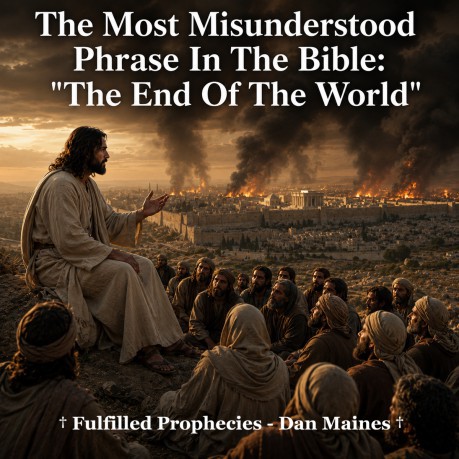
The Most Misunderstood Phrase
In The Bible: "The End Of The World" Introduction † One of the most misunderstood phrases in the
Bible is "the end of the world." Many people assume it
means the destruction of planet Earth, but the Greek text tells a
different story. In the key passages, the phrase is "the end of
the age," referring to the close of the Old Covenant age, not
the end of God's creation. (Matthew 24:3; Hebrews 9:26) † Jesus and the apostles lived during the
closing years of the Mosaic age. Their warnings concerned the end of
that covenant world, culminating in the destruction of Jerusalem and
the Temple in AD 70. (Luke 21:20-22; Hebrews 8:13) † Once we understand "the end of the age,"
dozens of difficult prophetic passages immediately become clear
because they were never describing the destruction of the planet.
(Matthew 13:39-40; Matthew 24:3) Matthew 24:3 And as He was sitting on the Mount of Olives, the disciples came
to Him privately, saying, "Tell us, when will these things
happen, and what will be the sign of Your coming, and of the end of
the age?" † The disciples asked about the destruction of
the Temple they had just been discussing, not the destruction of
planet Earth. (Matthew 24:1-3) † The KJV has it listed as "end of the
world" but the Greek word is aion, meaning "age," not
kosmos, which commonly refers to the world or created order. (Matthew
24:3; Ephesians 2:2) † Jesus answered their question by describing
the end of the Old Covenant age centered on Jerusalem and the Temple.
(Luke 21:20-22; Matthew 24:34) Matthew 24:1-2 Jesus left the temple area and was going on His way when His
disciples came up to point out the temple buildings to Him. But He
responded and said to them, "Do you not see all these things?
Truly I say to you, not one stone here will be left upon another,
which will not be torn down." † Jesus' prophecy about the Temple immediately
precedes the disciples' question about "the end of the age."
(Matthew 24:1-3) † The context isn't the destruction of planet
Earth but the destruction of the Temple they had just been admiring.
(Luke 21:5-6) † The disciples asked one continuous question
concerning the events Jesus had just described. (Matthew 24:3) Matthew 13:39-43 and the enemy who sowed them is the devil, and the harvest is the
end of the age; and the reapers are angels. So just as the weeds are
gathered up and burned with fire, so shall it be at the end of the
age. The Son of Man will send forth His angels, and they will gather
out of His kingdom all stumbling blocks, and those who commit
lawlessness, and they will throw them into the furnace of fire; in
that place there will be weeping and gnashing of teeth. Then the
righteous will shine forth like the sun in the kingdom of their
Father. The one who has ears, let him hear. † Jesus again uses the phrase "end of the
age," showing that the harvest belonged to the close of the
covenant age. (Matthew 13:39) † The separation of the wheat and tares was
connected with the coming judgment upon that generation. (Matthew
23:36; Matthew 24:34) † Nothing in the context suggests the
destruction of planet Earth. The focus is covenant judgment and the
establishment of Christ's Kingdom. (Matthew 13:41-43; Daniel 7:13-14) Hebrews 9:26 Otherwise, He would have needed to suffer often since the
foundation of the world; but now once at the consummation of the ages
He has been revealed to put away sin by the sacrifice of Himself. † The writer of Hebrews declared that Christ
appeared at "the end of the ages," proving that the end of
the age had already arrived in the first century. (Hebrews 1:1-2) † Christ didn't come at the end of planet
Earth. He came at the end of the covenant ages that pointed to Him.
(Galatians 4:4-5; Hebrews 10:1) † This statement alone destroys the idea that
"the end of the world" must always mean the end of human
history. (Hebrews 9:26; 1 Corinthians 10:11) Hebrews 8:13 When He said, "A new covenant," He has made the first
obsolete. But whatever is becoming obsolete and growing old is about
to disappear. † The Old Covenant was already growing old and
ready to disappear during the first century. (Hebrews 8:13) † This explains why the writers repeatedly
spoke of living at the end of the age. (Hebrews 9:26; 1 Corinthians
10:11) † The Old Covenant finally vanished with the
destruction of the Temple in AD 70. (Luke 21:20-22) 1 Corinthians 10:11 Now these things happened to them as an example, and they were
written for our instruction, upon whom the ends of the ages have
come. † Paul told the Corinthians that the ends of
the ages had already come upon them. (1 Corinthians 10:11) † He placed the fulfillment within the lifetime
of his first-century readers, not thousands of years in the future.
(1 Corinthians 7:29-31) † The apostolic Church understood that they
were living during the close of the Old Covenant age. (Hebrews 8:13;
James 5:8-9) Ephesians 2:2 in which you previously walked according to the course of this
world, according to the prince of the power of the air, of the spirit
that is now working in the sons of disobedience. † Paul used a different Greek word when
referring to the world's course, demonstrating that the New Testament
distinguishes between "world" and "age."
(Ephesians 2:2) † This shows why translating aion as "world"
in prophetic passages has caused centuries of confusion. (Matthew
24:3; Matthew 13:39) † Understanding the difference between "age"
and "world" removes one of the greatest obstacles to
correctly interpreting Bible prophecy. (Romans 12:2; Hebrews 9:26) † If Jesus had meant the destruction of the
planet, the Greek word kosmos was available. Instead, He used aion,
directing attention to the end of an age rather than the end of
creation. (Matthew 24:3; Ephesians 2:2)
Luke 21:20-22 But when you see Jerusalem surrounded by armies, then recognize
that her desolation is near. Then those who are in Judea must flee to
the mountains, and those who are inside the city must leave, and
those who are in the country must not enter the city; because these
are days of punishment, so that all things which have been written
will be fulfilled. † Luke identifies the event Jesus was
describing as the destruction of Jerusalem. (Luke 21:20) † Jesus called these "the days of
vengeance" in which all things written concerning that judgment
would be fulfilled. (Luke 21:22) † This historical event marks the visible end
of the Old Covenant age. (Matthew 24:34; Hebrews 8:13) Matthew 24:34 Truly I say to you, this generation will not pass away until all
these things take place. † Jesus placed the end of the age within the
lifetime of His own generation. (Matthew 24:34) † His audience had asked about the end of the
age, and Jesus answered their question directly without changing the
subject. (Matthew 24:3; Matthew 24:34) † The destruction of Jerusalem in AD 70 brought
the Old Covenant age to its complete and visible end. (Luke 21:20-22;
Hebrews 8:13) Historical References † The Greek word aion consistently refers to an
age or era, while kosmos refers to the world or created order.
Understanding this distinction is essential to interpreting Jesus'
prophetic teaching. (Matthew 24:3; Ephesians 2:2) † The destruction of Jerusalem and the Temple
in AD 70 marked the historical close of the Old Covenant age that
Jesus and His apostles repeatedly anticipated. (Matthew 24:1-3; Luke
21:20-22) † The writers of the New Testament repeatedly
stated that they were living at the end of the ages, demonstrating
that these prophecies concerned their own generation. (Hebrews 9:26;
1 Corinthians 10:11) How It Applies To Us Today † We can read Bible prophecy with confidence
because Jesus fulfilled His promises exactly when He said He would.
(Matthew 24:34) † Understanding "the end of the age"
removes unnecessary fear about passages that have often been
misunderstood as describing the destruction of planet Earth. (Hebrews
9:26; 1 Corinthians 10:11) † We now live in the New Covenant age
established by Christ, enjoying the realities that the Old Covenant
only foreshadowed. (Hebrews 12:22-24; Colossians 2:16-17) Q & A Appendix Q: Does "the end of the world" mean the
destruction of planet Earth? A: No. In the key prophetic passages, the Greek
word is aion, meaning "age," referring to the end of the
Old Covenant age rather than the end of the physical planet. (Matthew
24:3; Hebrews 9:26) Q: When did the end of the age occur? A: Jesus and the apostles placed it within their
own generation, culminating in the destruction of Jerusalem and the
Temple in AD 70. (Matthew 24:34; Luke 21:20-22) Q: Why is this distinction important? A: Understanding the difference between "age"
and "world" resolves many prophetic passages that have been
misunderstood for centuries. (Matthew 13:39; Ephesians 2:2) Q: Were the apostles living at the end of the
age? A: Yes. Both Paul and the writer of Hebrews
explicitly stated that the ends of the ages had come upon their
generation. (1 Corinthians 10:11; Hebrews 9:26) Q: Why do many English Bibles say "end of
the world"? A: Older English translations often rendered the
Greek word aion as "world," but the word means "age."
The context determines that Jesus was speaking of the end of the Old
Covenant age, not the destruction of planet Earth. (Matthew 24:3;
Hebrews 9:26) † This is the fulfilled perspective we proclaim at
Fulfilled Prophecies † © Fulfilled Prophecies - Dan Maines. Source Index † Matthew 24:1-3, Matthew 13:39-43, Hebrews
9:26, Hebrews 8:13, 1 Corinthians 10:11, Ephesians 2:2, Luke
21:20-22, Matthew 24:34 † Matthew, Luke, Paul the Apostle, the writer
of Hebrews
By Dan Maines
Links