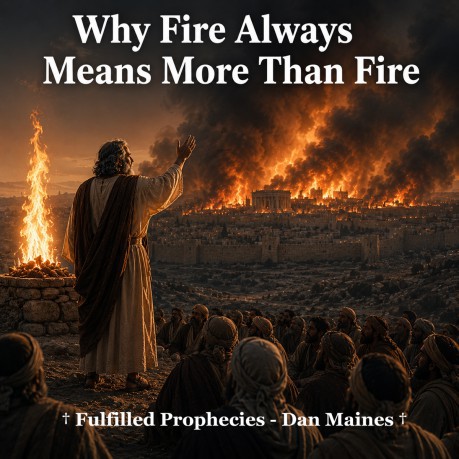
Why Fire Always Means More
Than Fire Introduction † Fire is one of the Bible's most powerful
symbols, yet it is often misunderstood. While God sometimes used
literal fire in history, Scripture consistently reveals that fire
also represents His holy presence, covenant judgment, purification,
and the removal of all that opposes His purposes. (Deuteronomy 4:24;
Hebrews 12:29) † From Genesis to Revelation, fire accompanies
God's judgments against covenant unfaithfulness and His purification
of His people. (Malachi 3:2-3; 1 Peter 4:17) † The greatest mistake is assuming every
reference to fire describes endless physical flames. The Bible
repeatedly uses fire as prophetic language for God's righteous
judgment and refining work. (Isaiah 1:25; Matthew 3:11-12) Genesis 19:24-25 Then the Lord rained brimstone and fire on Sodom and Gomorrah from
the Lord out of heaven, and He overthrew those cities, and all the
surrounding area, and all the inhabitants of the cities, and what
grew on the ground. † God used fire to bring judgment upon a wicked
society that had filled up its iniquity. (Genesis 18:20-21) † The destruction of Sodom became an enduring
example of divine judgment throughout Scripture. (Luke 17:28-30; Jude
7) † The fire revealed God's holiness against
persistent rebellion and sin. (Deuteronomy 4:24; Hebrews 12:29) Leviticus 10:1-3 Now Nadab and Abihu, the sons of Aaron, took their respective
firepans, and after putting fire in them, placed incense on the fire
and offered strange fire before the Lord, which He had not commanded
them. And fire came out from the presence of the Lord and consumed
them, and they died before the Lord. Then Moses said to Aaron, "It
is what the Lord spoke, saying, 'By those who come near Me I will be
treated as holy, And before all the people I will be honored.'"
So Aaron, therefore, kept silent. † God's fire demonstrated that He alone
determines how He is to be approached. (Leviticus 10:3) † This judgment preserved the holiness of God's
covenant worship. (Exodus 19:22) † The fire wasn't random destruction but a
declaration of God's holiness before His people. (Hebrews 12:28-29) Deuteronomy 4:23-24 So be careful yourselves, that you do not forget the covenant of
the Lord your God which He made with you, and make for yourselves a
carved image in the form of anything against which the Lord your God
has commanded you. For the Lord your God is a consuming fire, a
jealous God. † Moses connects God's fire directly to His
covenant relationship with Israel. (Deuteronomy 4:24) † Fire represents God's holiness and His
jealousy against covenant unfaithfulness. (Exodus 34:14) † This becomes the foundation for later
prophetic judgments by fire throughout Scripture. (Hebrews 12:29) 1 Kings 18:36-39 Then at the time of the offering of the evening sacrifice, Elijah
the prophet approached and said, "Lord, God of Abraham, Isaac,
and Israel, today let it be known that You are God in Israel and that
I am Your servant, and that I have done all these things at Your
word. Answer me, Lord, answer me, so that this people may know that
You, Lord, are God, and that You have turned their heart back."
Then the fire of the Lord fell and consumed the burnt offering and
the wood, and the stones and the dust; and it licked up the water
that was in the trench. When all the people saw this, they fell on
their faces; and they said, "The Lord, He is God; the Lord, He
is God!" † God's fire vindicated His covenant and
exposed the false worship of Baal. (1 Kings 18:39) † The fire called Israel back to covenant
faithfulness. (Deuteronomy 6:4-5) † It demonstrated that the Lord alone is the
true God worthy of worship. (Isaiah 45:5) Matthew 3:11-12 "As for me, I baptize you with water for repentance, but He
who is coming after me is mightier than I, and I am not fit to remove
His sandals; He will baptize you with the Holy Spirit and fire. His
winnowing fork is in His hand, and He will thoroughly clear His
threshing floor; and He will gather His wheat into the barn, but He
will burn up the chaff with unquenchable fire." † John connected fire with the separation of
the faithful from the unfaithful within Israel. (Matthew 3:12) † The unquenchable fire describes a judgment
that cannot be stopped until God's purpose is accomplished. (Jeremiah
17:27) † Fire is joined with cleansing, separating,
and covenant judgment rather than the destruction of the physical
planet. (Malachi 3:2-3; Matthew 13:40-43) Malachi 3:2-3 "But who can endure the day of His coming? And who can stand
when He appears? For He is like a refiner's fire, and like
launderer's soap. And He will sit as a smelter and purifier of
silver, and He will purify the sons of Levi and refine them like gold
and silver, so that they may present to the Lord offerings in
righteousness. † Malachi presents fire as purification before
it is destruction. (Malachi 3:2-3) † God's purpose is to refine a faithful people,
not simply to consume everything before Him. (Zechariah 13:9) † John the Baptist's message of fire builds
directly upon Malachi's prophecy. (Matthew 3:11-12) Luke 21:20-22 "But when you see Jerusalem surrounded by armies, then
recognize that her desolation is near. Then those who are in Judea
must flee to the mountains, and those who are inside the city must
leave, and those who are in the country must not enter the city;
because these are days of punishment, so that all things which have
been written will be fulfilled. † Jesus identified the destruction of Jerusalem
as the days of covenant vengeance. (Luke 21:22) † The fiery destruction of the city fulfilled
the covenant warnings given through Moses and the prophets.
(Deuteronomy 32:21-22; Matthew 23:37-38) † This judgment marked the visible end of the
Old Covenant age. (Hebrews 8:13; Matthew 24:34) Isaiah 33:14-15 Sinners in Zion are terrified; Trembling has seized the godless.
"Who among us can live with the consuming fire? Who among us can
live with everlasting burning?" One who walks righteously and
speaks with integrity, One who rejects unjust gain And shakes his
hands so that they hold no bribe; One who stops his ears from hearing
about bloodshed And shuts his eyes from looking at evil; † Isaiah answers his own question by showing
that the righteous dwell with God's everlasting fire. (Isaiah
33:14-15) † The everlasting fire is God's holy presence,
not a place where the righteous are absent. (Deuteronomy 4:24) † This demonstrates that biblical fire often
represents God's holiness rather than merely physical flames.
(Hebrews 12:29) Revelation 20:14-15 Then Death and Hades were thrown into the lake of fire. This is
the second death, the lake of fire. And if anyone's name was not
found written in the book of life, he was thrown into the lake of
fire. † The lake of fire is called the second death,
showing that John is explaining its meaning rather than describing
ordinary physical flames. (Revelation 20:14) † Throughout Revelation, fire represents God's
final covenant judgment against all that opposed His Kingdom.
(Revelation 19:20; Revelation 20:10-15) † The second death stands in complete contrast
to the eternal life found only in Christ. (John 3:16; Revelation
21:8) † John doesn't invent new imagery. He gathers
together centuries of Old Testament fire language and applies it to
God's final covenant judgment. (Isaiah 30:27-33; Malachi 4:1;
Revelation 20:14-15)
Hebrews 12:28-29 Therefore, since we receive a kingdom which cannot be shaken,
let's show gratitude, by which we may offer to God an acceptable
service with reverence and awe; for our God is a consuming fire. † God Himself is described as a consuming fire,
emphasizing His holy character. (Deuteronomy 4:24) † His fire consumes everything opposed to His
righteousness while refining those who belong to Him. (Malachi 3:2-3) † Fire throughout Scripture consistently
reveals God's holiness, judgment, and purification. (Isaiah 1:25; 1
Peter 1:7) Historical References † From Sodom to Jerusalem, fire repeatedly
marked decisive covenant judgments throughout biblical history.
(Genesis 19:24-25; Luke 21:20-22) † The prophets regularly used fire as covenant
language for judgment, cleansing, and purification rather than merely
describing literal flames. (Isaiah 1:25; Malachi 3:2-3) † Revelation continues this established
biblical imagery, drawing upon centuries of prophetic language
familiar to its first-century audience. (Revelation 20:14-15) How It Applies To Us Today † God's holiness hasn't changed. He still calls
His people to reverence, faithfulness, and holy living. (Hebrews
12:28-29) † We rejoice that Christ bore God's judgment
for all who trust in Him, bringing us into the Kingdom that cannot be
shaken. (Romans 8:1; Hebrews 12:28) † Instead of fearing symbolic prophetic
language, we should understand how consistently God used fire to
reveal His holiness, purify His people, and judge covenant
unfaithfulness. (Malachi 3:2-3; 1 Peter 4:17) Q & A Appendix Q: Does fire always mean literal flames in
Scripture? A: No. While God sometimes used literal fire,
Scripture consistently uses fire as a symbol of His holiness,
covenant judgment, and purification. (Deuteronomy 4:24; Hebrews
12:29) Q: Why did John the Baptist speak of unquenchable
fire? A: He was describing the coming covenant judgment
that would separate the faithful from the unfaithful in Israel.
(Matthew 3:11-12; Jeremiah 17:27) Q: What does the lake of fire represent? A: Revelation identifies it as the second death,
God's final judgment against all that stands opposed to His Kingdom.
(Revelation 20:14-15; Revelation 21:8) Q: What is the consistent message of fire
throughout the Bible? A: Fire reveals God's holiness, purifies His
people, and executes His righteous covenant judgments. (Malachi
3:2-3; Hebrews 12:29) Q: Is fire in Scripture always meant to be
understood literally? A: No. The Bible consistently uses fire to
represent God's holiness, covenant judgment, purification, and the
testing of His people. The context determines whether the fire is
literal, symbolic, or both. (Malachi 3:2-3; Hebrews 12:29; 1 Peter
1:7) † This is the fulfilled perspective we proclaim at
Fulfilled Prophecies † © Fulfilled Prophecies - Dan Maines. Source Index † Genesis 19:24-25, Leviticus 10:1-3,
Deuteronomy 4:23-24, 1 Kings 18:36-39, Matthew 3:11-12, Malachi
3:2-3, Luke 21:20-22, Isaiah 33:14-15, Revelation 20:14-15, Hebrews
12:28-29 † Moses, Isaiah the Prophet, Malachi the
Prophet, Elijah, Matthew, Luke, John the Apostle, the writer of
Hebrews
By Dan Maines
Links