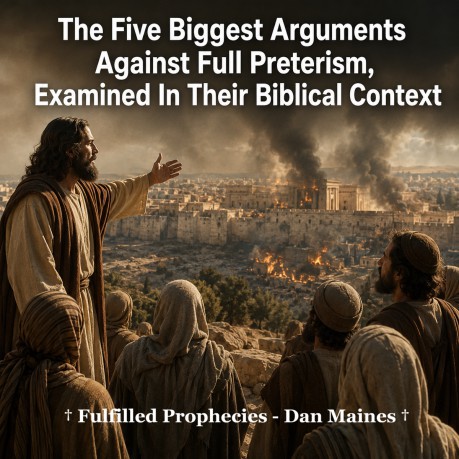
The Five Biggest Arguments
Against Full Preterism, Examined In Their Biblical Context Introduction † Critics of Full Preterism often present five
objections they believe cannot be answered. They argue for a future
bodily resurrection, a future visible return of Christ, the
destruction of the physical universe, a late date for Revelation, and
a future Antichrist. † The question isn't which argument sounds
convincing. The question is whether those arguments agree with the
context, audience, time statements, and covenant language of
Scripture. † When every passage is read in its own context
instead of through later theological traditions, the New Testament
consistently points to first-century fulfillment within the
generation Jesus addressed. The Resurrection Was According To The Scriptures, Not
Human Tradition 1 Corinthians 15:20-26 But the fact is, Christ has been raised from the dead, the first
fruits of those who are asleep. For since by a man death came, by a
Man also came the resurrection of the dead. For as in Adam all die,
so also in Christ all will be made alive. But each in his own order:
Christ the first fruits, after that those who are Christ's at His
coming, then comes the end, when He hands over the kingdom to our God
and Father, when He has abolished all rule and all authority and
power. For He must reign until He has put all His enemies under His
feet. The last enemy that will be abolished is death. † Paul never separated the resurrection from
Christ's coming or from the end that his own generation expected. (1
Thessalonians 4:15-17; Hebrews 10:37) † The death defeated here is the Adamic death
that separated mankind from God's covenant life, not biological death
that still affects believers today. (Romans 5:12-19; Ephesians 2:1-6) † Christ's resurrection guaranteed the
fulfillment of God's covenant promise to His people, bringing them
into everlasting life through the New Covenant. (John 11:25-26;
Revelation 20:4-6) Philippians 3:20-21 For our citizenship is in heaven, from which we also eagerly wait
for a Savior, the Lord Jesus Christ; who will transform the body of
our lowly condition into conformity with His glorious body, by the
exertion of the power that He has even to subject all things to
Himself. † Paul was writing to living first-century
believers who expected Christ's coming during their lifetime.
(Philippians 4:5; Hebrews 10:25, 37) † Scripture often uses the word body to
describe a covenant people collectively, not merely individual flesh.
(1 Corinthians 12:12-27; Ephesians 2:15-16) † Believers were transformed from the old
Adamic order into the glorious body of Christ through the completion
of the New Covenant. (2 Corinthians 3:7-18; Colossians 1:13) Every Eye Shall See Him Revelation 1:7 Behold, He is coming with the clouds, and every eye will see Him,
even those who pierced Him; and all the tribes of the earth will
mourn over Him. So it is to be. Amen. † John specifically identifies those who
pierced Christ, pointing directly to first-century Israel rather than
people living thousands of years later. (Matthew 23:35-36; Acts
2:22-23) † Coming with clouds was well-known Old
Testament judgment language describing God's coming against nations,
not His physical descent to earth. (Isaiah 19:1; Daniel 7:13-14) † Every eye refers to those witnessing God's
covenant judgment upon Jerusalem, fulfilling Jesus' own prophecy to
that generation. (Matthew 24:30-34; Luke 21:20-22) The Heavens And Earth That Passed Away 2 Peter 3:10-13 But the day of the Lord will come like a thief, in which the
heavens will pass away with a roar and the elements will be destroyed
with intense heat, and the earth and its works will be discovered. Since all these things are to be destroyed in this way, what sort
of people ought you to be in holy conduct and godliness, looking for
and hastening the coming of the day of God, because of which the
heavens will be destroyed by burning, and the elements will melt with
intense heat! But according to His promise we are looking for new
heavens and a new earth, in which righteousness dwells. † Peter was quoting Isaiah's promise of the New
Heavens and New Earth, where people still lived, died, built houses,
and planted vineyards, proving the language was covenantal rather
than describing the destruction of the universe. (Isaiah 65:17-25) † The Old Testament repeatedly used heaven and
earth as symbols for covenant nations and governments. (Isaiah 1:1-2;
Deuteronomy 32:1) † Peter said his readers were waiting for this
fulfillment, and he also said the end of all things was at hand. (1
Peter 4:7; Hebrews 8:13) The Time Of Revelation Revelation 1:1-3 The Revelation of Jesus Christ, which God gave Him to show to His
bond-servants, the things which must soon take place; and He sent and
communicated it by His angel to His bond-servant John, who testified
to the word of God and to the testimony of Jesus Christ, everything
that he saw. Blessed is the one who reads, and those who hear the
words of the prophecy and keep the things which are written in it;
for the time is near. † John says the events must shortly come to
pass and that the time was at hand. Those statements have their
normal meaning unless Scripture gives us a reason to redefine them.
(Revelation 22:6-10) † A late date forces the reader to ignore
John's repeated time statements and instead replace them with
thousands of years of delay. † The strongest evidence for dating Revelation
comes from Scripture itself before later historical opinions.
Internal evidence always deserves priority when interpreting God's
Word. (Matthew 24:34; Luke 21:22) Matthew 24:34 Truly I say to you, this generation will not pass away until all
these things take place. † Jesus could not have spoken any more plainly.
The generation standing before Him would witness the fulfillment of
everything He had just described. (Matthew 23:36; Luke 21:20-22) † Every prophecy connected with His coming in
the Olivet Discourse was limited by the time statement "this
generation." Any interpretation that postpones those events for
thousands of years ignores Jesus' own words. (Matthew 16:27-28; Mark
13:30) † The destruction of Jerusalem in AD 70
fulfilled Christ's covenant judgment exactly as He promised, proving
His words never failed. (Luke 21:32; John 13:19) Hebrews 10:37 For yet in a very little while, He who is coming will come, and
will not delay. † The writer encouraged first-century believers
by assuring them that Christ's coming was near, not thousands of
years in the future. (Hebrews 10:25; James 5:8-9) † The phrase very little while has its ordinary
meaning unless Scripture clearly indicates otherwise, and nothing in
the context suggests a delay of centuries. (Romans 13:11-12) † This agrees perfectly with the repeated New
Testament message that Christ's coming was approaching during the
lifetime of the apostles. (1 Peter 4:7; Revelation 22:10) Luke 21:22 because these are days of punishment, so that all things which
have been written will be fulfilled. † Jesus identified the destruction of Jerusalem
as the time when everything written concerning that covenant judgment
would reach its fulfillment. (Matthew 24:15-21) † The context leaves no room for postponing
these prophecies thousands of years beyond the generation He
addressed. (Luke 21:32) † Scripture consistently points to AD 70 as the
climax of the Old Covenant age and the fulfillment of Christ's
prophetic warnings. (Hebrews 8:13; Daniel 9:26-27) Revelation 22:10 And he said to me, Do not seal up the words of the prophecy of
this book, for the time is near. † Unlike Daniel, who was told to seal his
prophecy because its fulfillment was far away, John was commanded not
to seal Revelation because its fulfillment was near. (Daniel 12:4) † The expression the time is at hand confirms
the opening statement that these events would shortly come to pass.
Scripture interprets itself consistently. (Revelation 1:1-3) † The book begins and ends by declaring its
fulfillment was near for its original readers, making a delay of
thousands of years impossible within the text itself. (Revelation
22:6-7) The Lawless One Was A First-Century Enemy 2 Thessalonians 2:1-8 Now we ask you, brothers and sisters, regarding the coming of our
Lord Jesus Christ and our gathering together to Him, that you not be
quickly shaken from your composure or be disturbed either by a
spirit, or a message, or a letter as if from us, to the effect that
the day of the Lord has come. No one is to deceive you in any way!
For it will not come unless the apostasy comes first, and the man of
lawlessness is revealed, the son of destruction, who opposes and
exalts himself above every so-called god or object of worship, so
that he takes his seat in the temple of God, displaying himself as
being God. Do you not remember that while I was still with you, I was
telling you these things? And you know what restrains him now, so
that he will be revealed in his time. For the mystery of lawlessness
is already at work; only He who now restrains will do so until He is
removed. Then that lawless one will be revealed, whom the Lord will
eliminate with the breath of His mouth and bring to an end by the
appearance of His coming; † Paul said the mystery of lawlessness was
already working while he was writing, placing its fulfillment in the
first century. (1 John 2:18) † The lawless one was connected with the temple
still standing, not a temple rebuilt thousands of years later.
(Matthew 24:1-2; Hebrews 8:13) † Nero's personal death isn't the issue.
Christ's coming in judgment brought an end to the entire persecuting
power that opposed His church and culminated in the destruction of
Jerusalem. (Luke 21:20-22; Revelation 17:14-18) Historical References † Josephus records the horrors of the Jewish
War and the destruction of Jerusalem, confirming the fulfillment of
Jesus' warnings concerning that generation. † Tacitus records the Roman campaign against
Judea and Jerusalem, confirming the historical setting of the events
surrounding AD 70. † Eusebius records that the Christians fled
Jerusalem before its destruction, remembering and obeying the warning
Jesus had given them. † While Irenaeus is frequently cited in support
of a late date for Revelation, his statement is debated because of
its grammatical ambiguity and because internal biblical evidence
consistently points to an imminent fulfillment. How It Applies To Us Today † Our confidence rests in Christ's fulfilled
promises, not in constantly waiting for prophecies that Scripture
declared were near. † We live in the blessings of the completed New
Covenant, enjoying direct access to God through Jesus Christ. † The kingdom isn't postponed. Christ reigns
now, and every believer already belongs to His everlasting kingdom.
(Hebrews 12:22-28; Colossians 1:13) Q & A Appendix Q: Doesn't 1 Corinthians 15 require a future
physical resurrection? A: No. Paul explains the resurrection through the
victory of Christ over Adamic death and the fulfillment of God's
covenant promises. The context connects the resurrection with
Christ's first-century coming and the end of the Old Covenant age. (1
Corinthians 15:20-26, 50-57; Hebrews 10:37) Q: Doesn't Revelation 1:7 say every eye will
literally see Jesus? A: No. John combines Daniel 7 and Zechariah 12,
identifying those who pierced Christ and the tribes of the land
mourning. The language describes covenant judgment upon first-century
Israel. (Revelation 1:7; Zechariah 12:10-14; Matthew 24:30-34) Q: Doesn't 2 Peter 3 teach the destruction of the
physical universe? A: No. Peter draws directly from Isaiah's
covenant language concerning the New Heavens and New Earth. The
context concerns the passing of the Old Covenant order and the
arrival of the New Covenant creation. (2 Peter 3:10-13; Isaiah
65:17-25; Hebrews 8:13) Q: Doesn't a late date for Revelation disprove
Full Preterism? A: No. The repeated statements that the prophecy
would shortly come to pass and that the time was at hand provide the
strongest evidence that Revelation concerned events about to occur
for its original readers. (Revelation 1:1-3; Revelation 22:6-10) Q: If Nero died before AD 70, how could he be
connected with the Beast or the lawless one? A: Scripture focuses on the destruction of the
persecuting power and its covenant opposition to Christ, not merely
the biological death of one ruler. The entire first-century system
that opposed Christ came to its appointed end. (2 Thessalonians 2:8;
Revelation 17:11-18; Luke 21:20-22) Q: If every eye saw Christ, why doesn't history
record everyone literally seeing Him? A: Revelation 1:7 uses the well-established Old
Testament language of God coming with the clouds in judgment. The
focus is God's visible covenant judgment against Jerusalem, not a
physical appearance witnessed by every person on earth. (Isaiah 19:1;
Daniel 7:13-14; Matthew 24:30-34) Q: Why should Scripture's internal evidence take
priority over later opinions about the date of Revelation? A: Because inspired Scripture is our highest
authority. John repeatedly says the events would shortly come to pass
and that the time was at hand. Those inspired statements carry
greater weight than later historical traditions that remain debated.
(Revelation 1:1-3; Revelation 22:6-10) † This is the fulfilled perspective we proclaim at
Fulfilled Prophecies † © Fulfilled Prophecies - Dan Maines. Source Index † 1 Corinthians 15:20-26; Philippians 3:20-21;
Revelation 1:1-3, 7; Matthew 24:34; Hebrews 10:37; Luke 21:22;
Revelation 22:10; 2 Peter 3:10-13; 2 Thessalonians 2:1-8 † Josephus, The Wars of the Jews, Book 6,
Chapters 3-5; Tacitus, The Histories, Book 5, Chapters 11-13;
Eusebius, Ecclesiastical History, Book 3, Chapter 5; Irenaeus,
Against Heresies, Book 5, Chapter 30
By Dan Maines
Links