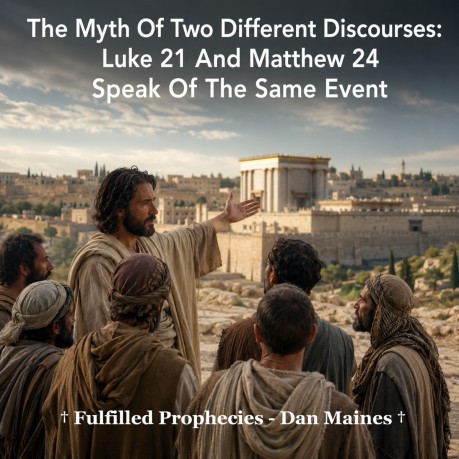
The Myth Of Two Different
Discourses: Luke 21 And Matthew 24 Speak Of The Same Event Introduction † One of the most common attempts to avoid the
fulfilled message of Matthew 24 is the claim that Luke 21 records an
entirely different discourse than Matthew 24. According to this view,
Luke speaks only about the fall of Jerusalem, while Matthew suddenly
shifts to events thousands of years later. † The problem is that the Gospel writers
themselves never make that distinction. Matthew, Mark, and Luke each
record the same disciples asking the same Lord about the same temple
after Jesus predicted its destruction. † When all three accounts are read together,
they don't contradict each other, they complement each other. Each
writer emphasizes different details, but all point to the same
first-century fulfillment that Jesus promised would occur within that
generation. Luke 21:5-7 And while some were talking about the temple, that it was
decorated with beautiful stones and vowed gifts, He said, "As
for these things which you are observing, the days will come when
there will not be left one stone upon another, which will not be torn
down." They asked Him questions, saying, "Teacher, when therefore
will these things happen? And what will be the sign when these things
are about to take place?"
† Luke begins exactly where Matthew begins,
with Jesus predicting the destruction of the temple. The subject is
not changed between the Gospels, it is the same prophecy from another
eyewitness perspective. (Matthew 24:1-3; Mark 13:1-4) † The disciples ask when these things would
happen and what sign would announce their arrival. Luke records the
same discussion that Matthew and Mark record. There is no indication
that Jesus stopped one discourse and later gave another prophecy to
answer the same question. (Matthew 24:3; Mark 13:3-4) † If Luke were describing a completely
different discourse, we would expect a different setting, different
audience, and different prophecy. Instead, all three begin with the
destruction of the same temple that stood before them. (Luke
19:41-44; Matthew 23:37-39) Matthew 24:1-3 Jesus left the temple area and was going on His way when His
disciples came up to point out the temple buildings to Him. But He
responded and said to them, "Do you not see all these things?
Truly I say to you, not one stone here will be left upon another,
which will not be torn down." And as He was sitting on the Mount of Olives, the disciples came
to Him privately, saying, "Tell us, when will these things
happen, and what will be the sign of Your coming, and of the end of
the age?" † Some claim Luke's discourse occurred inside
the temple while Matthew's occurred later on the Mount of Olives.
However, Matthew simply records where Jesus continued the same
conversation after leaving the temple. Luke never says Jesus
delivered an entirely separate prophetic discourse before leaving.
(Mark 13:1-4) † The change of location doesn't create a new
prophecy any more than moving from one room to another creates a new
conversation. The subject never changes. The disciples are still
asking about the destruction Jesus had just predicted. (Luke 21:5-7) † Matthew adds details of the disciples'
question because he records the fuller conversation. Luke summarizes
it more briefly, which is common throughout the Gospels. Different
levels of detail don't prove different events. (John 20:30-31) Mark 13:1-4 As He was going out of the temple, one of His disciples said to
Him, "Teacher, look! What wonderful stones and what wonderful
buildings!" And Jesus said to him, "Do you see these great
buildings? Not one stone will be left upon another, which will not be
torn down." As He was sitting on the Mount of Olives opposite the temple,
Peter, James, John, and Andrew were questioning Him privately, "Tell
us, when will these things come about, and what will be the sign when
all these things are going to be fulfilled?"
† Mark confirms the same sequence recorded by
Matthew. Jesus first left the temple, predicted its destruction, and
then sat on the Mount of Olives where the disciples privately
questioned Him. (Matthew 24:1-3) † Mark doesn't record a separate temple
discourse before reaching the Mount of Olives. Instead, he confirms
that the prophetic discourse took place after Jesus sat on the
mountain overlooking Jerusalem. (Luke 21:5-7) † Since Matthew, Mark, and Luke all begin with
the same prediction concerning the same temple, there is no biblical
evidence that Jesus delivered two different prophetic discourses. The
Gospel writers simply emphasize different details of the same
conversation. (John 20:30-31) Luke 21:20-22 But when you see Jerusalem surrounded by armies, then recognize
that her desolation is near. Then those who are in Judea must flee to
the mountains, and those who are inside the city must leave, and
those who are in the country must not enter the city; because these
are days of punishment, so that all things which have been written
will be fulfilled. † Luke doesn't replace Matthew's prophecy of
the abomination of desolation. He explains what the disciples would
actually see as Jerusalem's desolation approached. Scripture often
explains Scripture instead of repeating identical wording. (Matthew
24:15-16; Mark 13:14) † Jesus calls these the days of vengeance in
which all things written would be fulfilled. That language doesn't
allow the prophecy to be postponed for thousands of years because He
says the written prophecies were reaching their fulfillment in those
days. (Deuteronomy 32:35; Hosea 9:7) † Luke's account is one of the strongest proofs
that Jesus was speaking about the Roman siege of Jerusalem, the very
event that occurred in AD 70 exactly as He foretold. (Luke 19:43-44;
Matthew 24:34) Luke 21:37-38 Now during the day He was teaching in the temple, but at evening
He would go out and spend the night on the mountain that is called
Olivet. And all the people would get up very early in the morning to
come to Him in the temple to listen to Him. † These verses describe Jesus' daily pattern of
ministry, not the location where the prophecy of Luke 21 was
delivered. Luke simply explains that Jesus taught in the temple by
day and spent the nights on the Mount of Olives. (Matthew 24:3) † Nothing in this passage says that Luke 21
records a separate Temple Discourse. The passage provides background
information about Jesus' routine rather than introducing a second
prophetic message. (Mark 13:3) † Building an entirely new doctrine upon these
verses ignores their context. Luke never says Jesus gave one prophecy
in the temple and another on the Mount of Olives. The text simply
doesn't make that claim. (Luke 21:5-7) Matthew 24:15-16 Therefore when you see the abomination of desolation which was
spoken of through Daniel the prophet, standing in the holy place -
let the reader understand - then those who are in Judea must flee to
the mountains. † Matthew and Luke give the very same command,
flee to the mountains. If these were two different future events, it
would be remarkable that both warnings use the same escape
instructions for the same people living in Judea. (Luke 21:21) † Matthew identifies the prophetic language
from Daniel, while Luke explains how that prophecy would become
visible during the Roman invasion. The two accounts fit together
naturally rather than competing with each other. (Daniel 9:26-27;
Luke 21:20) † The command was directed to those living in
Judea, not to people scattered across the modern world thousands of
years later. Jesus was warning His own generation how to survive the
coming judgment. (Matthew 24:34; Luke 17:22-25) Matthew 24:21-22 For then there will be a great tribulation, such as has not
occurred since the beginning of the world until now, nor ever will
again. And if those days had not been cut short, no life would have
been saved; but for the sake of the elect those days will be cut
short. † Some argue that Matthew describes worldwide
tribulation while Luke describes only Jerusalem. Yet Matthew
repeatedly limits the audience to Judea, those on the housetop, those
in the field, and those who must flee immediately. The context
remains local even while the significance of the judgment was
covenantal. (Matthew 24:16-20) † Luke calls it great distress upon the land,
while Matthew calls it great tribulation. Different descriptions
don't create different events. The same historical catastrophe can
accurately be described from more than one perspective. (Luke 21:23) † Both Gospels point to the same Roman
destruction of Jerusalem. One emphasizes the military siege, the
other emphasizes the unparalleled covenant judgment that fell upon
apostate Israel for rejecting her Messiah. (Luke 21:22; Matthew
23:35-38) Luke 21:32 Truly I say to you, this generation will not pass away until all
things take place. † Luke ends the discourse with exactly the same
time statement found in Matthew and Mark. All three Gospels place the
fulfillment within the generation that heard Jesus speak these words.
(Matthew 24:34; Mark 13:30) † If Matthew and Luke were describing different
events separated by thousands of years, it would be impossible to
explain why both conclude with the identical time limitation given by
the same Lord. (Matthew 16:27-28) † The simplest explanation is the biblical one.
Matthew, Mark, and Luke record the same discourse, the same prophecy,
the same audience, and the same first-century fulfillment. (Luke
21:22; Matthew 24:34; Mark 13:30) Historical References † Josephus records that the Roman armies
surrounded Jerusalem, trapped the inhabitants within the city, and
destroyed both the temple and the city exactly as Jesus foretold.
(Josephus, Wars of the Jews, Book 5, Chapters 12-13; Book 6, Chapters
4-8) † Josephus describes the unprecedented famine,
internal civil war, and massive loss of life during the siege,
confirming the terrible distress Jesus warned would come upon
Jerusalem. (Josephus, Wars of the Jews, Book 5, Chapters 10-12; Book
6, Chapters 3-9) † Eusebius records that the Christians
remembered the Lord's warning and fled to Pella before Jerusalem
fell, demonstrating that the early church understood Matthew 24, Mark
13, and Luke 21 as describing the same approaching judgment.
(Eusebius, Ecclesiastical History, Book 3, Chapter 5) How It Applies To Us Today † We can trust every prophecy Jesus spoke
because every prediction concerning Jerusalem was fulfilled exactly
as He declared. † We should allow Scripture to interpret
Scripture instead of forcing differences between parallel Gospel
accounts that the writers themselves never make. † The faithfulness of Christ in fulfilling His
promises gives us confidence that we now live under the fully
established New Covenant and His present kingdom. (Hebrews 12:22-24;
Ephesians 2:19-22) Q & A Appendix Q: Did Jesus give two different prophetic
discourses? A: No. Matthew, Mark, and Luke record the same
prophecy from different perspectives. Each writer includes different
details while describing the same conversation concerning the
destruction of the temple. (Matthew 24:1-3; Mark 13:1-4; Luke 21:5-7) Q: Does Luke replace the Abomination of
Desolation? A: No. Luke explains what the disciples would see
when Jerusalem's desolation arrived. Matthew identifies the prophecy
from Daniel, while Luke identifies its historical fulfillment as
Jerusalem being surrounded by armies. (Matthew 24:15-16; Mark 13:14;
Luke 21:20-21) Q: Were Matthew 24 and Luke 21 fulfilled in
different time periods? A: No. Both conclude with Jesus declaring that
"this generation" would witness the fulfillment of all
these things. (Matthew 24:34; Mark 13:30; Luke 21:32) Q: Why do the Gospel accounts contain different
details? A: Because each inspired writer emphasizes
different aspects of the same event. This is common throughout the
Gospels and strengthens their testimony rather than weakening it.
(John 20:30-31) Q: If Luke 21 and Matthew 24 are different
prophecies, why do they both begin with the prediction of the same
temple's destruction? A: Because they aren't different prophecies. All
three Gospel writers begin with Jesus predicting the destruction of
the same temple, followed by the disciples asking when these things
would happen. Each writer records the same discourse while
emphasizing different details. (Matthew 24:1-3; Mark 13:1-4; Luke
21:5-7) Q: Doesn't Luke 21 leave out the Abomination of
Desolation? A: No. Luke explains what the disciples would see
when the Abomination brought Jerusalem's desolation. Matthew gives
Daniel's prophetic title, while Luke describes its historical
appearance as Jerusalem surrounded by armies. These are complementary
accounts of the same event, not competing prophecies. (Matthew
24:15-16; Mark 13:14; Luke 21:20-21) † This is the fulfilled perspective we proclaim at
Fulfilled Prophecies. † © Fulfilled Prophecies - Dan Maines. Source Index † Luke 21:5-7; Matthew 24:1-3; Luke 21:20-22;
Matthew 24:15-16; Matthew 24:21-22; Mark 13:1-4; Luke 21:32 † Josephus, Wars of the Jews, Book 5, Chapters
10-13; Book 6, Chapters 3-9; Eusebius, Ecclesiastical History, Book
3, Chapter 5
By Dan Maines
Links