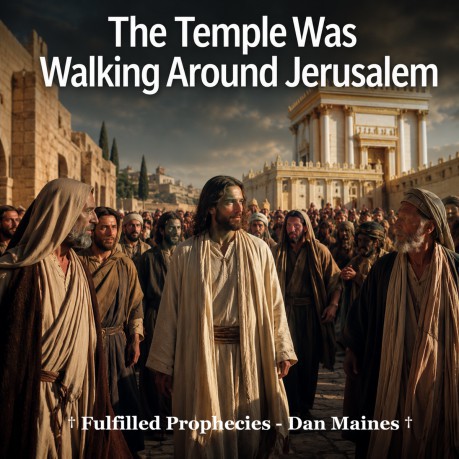
The Temple Was Walking Around
Jerusalem Introduction † One of the greatest truths hidden in plain
sight is that the true temple of God was no longer a building of
stone while Herod's temple was still standing. † Jesus Himself became the dwelling place of
God among men. While people admired the magnificent temple in
Jerusalem, the true Temple was walking its streets. † This explains why Jesus could predict the
destruction of the physical temple with complete confidence. God had
already established a greater Temple that could never be destroyed. † The New Testament repeatedly shifts our
attention away from a physical building and toward Christ and His
people as God's eternal dwelling place. The One Greater Than The Temple Matthew 12:6 But I say to you that something greater than the temple is here. † Jesus announced that Someone greater than the
temple had already arrived while the temple still stood. (Matthew
12:6) † If Christ was greater than the temple, then
God's presence was no longer centered in a building but in His Son.
(John 1:14) † This prepared Israel for the coming
transition from the Old Covenant temple to the living Temple found in
Christ. (Hebrews 8:13) The True Temple Stood Before Them John 2:19-21 Jesus answered them, "Destroy this temple, and in three days
I will raise it up." The Jews then said, "It took forty-six
years to build this temple, and yet You will raise it up in three
days?" But He was speaking about the temple of His body. † Jesus identified His own body as the true
temple, replacing the focus on the physical sanctuary. (John 1:14) † The religious leaders were standing in front
of God's true dwelling place without recognizing Him. (John 2:19-21) † Long before AD 70, God revealed that His
presence would be centered in Christ rather than in a building made
with hands. (Colossians 2:9) The Glory Had Entered A Better Temple John 1:14 And the Word became flesh, and dwelt among us; and we saw His
glory, glory as of the only Son from the Father, full of grace and
truth. † The word dwelt literally carries the idea of
tabernacling among men, showing that God's presence was now revealed
in Christ. (John 1:14) † The glory that once filled the tabernacle and
temple was now seen in the Son of God. (Exodus 40:34-35) † Jesus was everything the Old Covenant temple
pointed toward, making Him the fulfillment of God's dwelling with His
people. (Hebrews 1:1-3) The Living Temple Was Being Built Ephesians 2:19-22 So then you are no longer strangers and foreigners, but you are
fellow citizens with the saints, and are of God's household, having
been built on the foundation of the apostles and prophets, Christ
Jesus Himself being the cornerstone, in whom the whole building,
being fitted together, is growing into a holy temple in the Lord, in
whom you also are being built together into a dwelling of God in the
Spirit. † Paul never directed believers back to the
temple in Jerusalem because God was building a completely different
temple. (Ephesians 2:19-22) † This temple consisted of living people united
in Christ, not stones assembled by human hands. (1 Corinthians
3:16-17) † While the physical temple still stood, God
was already constructing His eternal dwelling through the gospel.
(Acts 2:41-47) Living Stones Replace Dead Stones 1 Peter 2:4-6 And coming to Him as to a living stone which has been rejected by
people, but is choice and precious in the sight of God, you also, as
living stones, are being built up as a spiritual house for a holy
priesthood, to offer spiritual sacrifices that are acceptable to God
through Jesus Christ. For this is contained in Scripture: "Behold, I am laying in Zion a choice stone, a precious
cornerstone, And the one who believes in Him will not be put to
shame." † Peter described Christians as living stones
because God's house was no longer constructed with lifeless material.
(1 Peter 2:4-6) † Christ became the chief cornerstone of a
spiritual house that would never need rebuilding. (Isaiah 28:16) † Every believer became part of God's holy
temple through union with Christ. (1 Peter 2:5) Christ Is Faithful Over God's House Hebrews 3:5-6 Now Moses was faithful in all God's house as a servant, for a
testimony of those things which were to be spoken later; but Christ
was faithful as a Son over His house-whose house we are, if we hold
firmly to our confidence and the boast of our hope. † Moses faithfully served within the old
covenant house, but Christ rules over God's new house. (Hebrews
3:5-6) † The writer plainly says whose house we are,
identifying believers as God's present dwelling. (Hebrews 3:6) † God's house is no longer identified by
geography but by people who belong to Christ. (Hebrews 12:22-24) The Old Temple Was Left Desolate Matthew 23:37-38 Jerusalem, Jerusalem, who kills the prophets and stones those who
have been sent to her! How often I wanted to gather your children
together, the way a hen gathers her chicks under her wings, and you
were unwilling. Behold, your house is being left to you desolate! † Jesus deliberately called it your house
instead of My Father's house because judgment was approaching.
(Matthew 23:38) † God's presence had already departed from the
unbelieving temple because the true Temple stood before them. (John
2:19-21) † Within that generation the physical temple
would fall, but God's true Temple would remain forever. (Matthew
24:1-2, 34) Not One Stone Left Upon Another Matthew 24:1-2 Jesus left the temple area and was going on His way when His
disciples came up to point out the temple buildings to Him. But He
responded and said to them, "Do you not see all these things?
Truly I say to you, not one stone here will be left upon another,
which will not be torn down." † Jesus left the temple and immediately
declared its complete destruction. (Matthew 24:1-2) † The physical temple was passing away because
God's true dwelling had already been revealed in Christ. (John
2:19-21) † The destruction of the temple publicly
confirmed what God had already established through His Son. (Hebrews
9:8-10) The Most High Does Not Dwell In Temples Made With Hands Acts 7:48-50 However, the Most High does not dwell in houses made by human
hands; as the prophet says: 'Heaven is My throne, And the earth is the footstool of My feet;
What kind of house will you build for Me?' says the Lord, 'Or what
place is there for My rest? Was it not My hand that made all these
things?' † Stephen declared that God's dwelling was
never ultimately confined to a man-made building. (Acts 7:48-50) † His message confirmed that the earthly temple
had fulfilled its purpose in God's plan. (Isaiah 66:1-2) † Shortly after preaching these words, Stephen
was martyred, but the truth remained that God's presence was found in
Christ, not in Herod's temple. (Acts 7:54-60) God Does Not Live In Temples Made With Hands Acts 17:24 The God who made the world and everything that is in it, since He
is Lord of heaven and earth, does not dwell in temples made by hands; † Paul's teaching agreed perfectly with Jesus
and Stephen that God was not confined to earthly sanctuaries. (Acts
17:24) † The New Covenant reveals God's dwelling place
to be His people through Christ. (Ephesians 2:19-22) † The gospel was announcing a kingdom whose
temple could never be destroyed by earthly armies. (Hebrews 12:28) The Eternal Temple Revelation 21:22 I saw no temple in it, for the Lord God the Almighty and the Lamb
are its temple. † The New Jerusalem has no physical temple
because God and the Lamb are its eternal dwelling. (Revelation 21:22) † What Jesus began during His earthly ministry
reached its covenant fulfillment as God's people became His
everlasting habitation. (Ephesians 2:21-22) † The Bible ends exactly where Jesus pointed
all along, God's presence is found in Christ, not in a building made
with hands. (John 2:19-21) Historical References † Josephus records the destruction of Herod's
temple by the Roman armies in AD 70, confirming Jesus' prophecy that
not one stone would be left upon another. (The Wars of the Jews, Book
6, Chapters 4-5) † Eusebius records that the Christians fled
Jerusalem before its destruction, demonstrating they understood
Jesus' warnings concerning the coming judgment upon the temple.
(Ecclesiastical History, Book 3, Chapter 5) † Tacitus records the Roman siege and
destruction of Jerusalem, confirming the historical fulfillment of
Christ's predictions. (Histories, Book 5) † Irenaeus affirmed Christ as the fulfillment
of God's redemptive plan, showing that the Old Covenant shadows found
their completion in Him. (Against Heresies, Book 4, Chapter 33) How It Applies To Us Today † We don't travel to a physical temple because
we have direct access to the Father through Jesus Christ. (Ephesians
2:18) † Our worship is centered on Christ, not on
sacred buildings or earthly locations. (John 4:21-24) † We are part of God's living temple because
His Spirit dwells within His people. (Ephesians 2:22) † Our confidence rests in the eternal house
Christ established, one that can never be destroyed by men. (Hebrews
12:28) Q & A Appendix Q: When did the true temple replace the physical
temple? A: The transition began during Jesus' earthly
ministry when He identified His own body as the true temple and was
completed through His death, resurrection, ascension, and the
establishment of the New Covenant. The destruction of the Jerusalem
temple in AD 70 publicly confirmed what God had already established
in Christ. (John 2:19-21; Ephesians 2:19-22; Hebrews 8:13) Q: Why did Jesus predict the destruction of the
temple? A: Because the physical temple had fulfilled its
purpose. God's presence was no longer centered in a building but in
Christ and His people. (Matthew 23:38; Matthew 24:1-2; Ephesians
2:21-22) Q: Where is God's temple today? A: God's temple is His people united in Christ.
Believers are God's spiritual house and His dwelling place through
the Holy Spirit. (1 Peter 2:5; Ephesians 2:19-22; Hebrews 3:6) Q: What is the great wow moment of this truth? A: While people were looking at Herod's
magnificent temple, the true Temple of God was walking around
Jerusalem in the person of Jesus Christ. The building had become
obsolete before its stones ever fell. (John 1:14; John 2:19-21) Q: If Jesus was the true Temple, why did people
continue worshiping at the temple in Jerusalem? A: Because the transition from the Old Covenant
to the New Covenant was taking place during that generation. The
apostles continued preaching in the temple until its God-appointed
destruction in AD 70, but they proclaimed that Christ was the true
dwelling place of God. (John 2:19-21; Acts 3:1; Acts 5:42; Hebrews
8:13) Q: Why didn't God destroy the temple immediately
after Jesus' resurrection? A: God gave Israel time to repent while the
gospel was first preached to Jerusalem and Judea. The temple remained
standing during this transition period until the judgment Jesus
foretold came upon that generation. (Matthew 23:37-38; Matthew 24:34;
Luke 21:20-22; Acts 2:38-40) † This is the fulfilled perspective we proclaim at
Fulfilled Prophecies † © Fulfilled Prophecies - Dan Maines. Source Index † Matthew 12:6; Matthew 23:37-38; Matthew
24:1-2, 34; John 1:14; John 2:19-21; Acts 3:1; Acts 5:42; Acts
7:48-50; Acts 17:24; Revelation 21:22; Exodus 40:34-35; Isaiah 28:16;
Isaiah 66:1-2; Ephesians 2:18-22; 1 Corinthians 3:16-17; Colossians
2:9; Hebrews 1:1-3; Hebrews 3:5-6; Hebrews 8:13; Hebrews 9:8-10;
Hebrews 12:22-24, 28; 1 Peter 2:4-6 † Josephus, The Wars of the Jews, Book 6,
Chapters 4-5; Tacitus, Histories, Book 5; Eusebius, Ecclesiastical
History, Book 3, Chapter 5; Irenaeus, Against Heresies, Book 4,
Chapter 33
By Dan Maines
Links