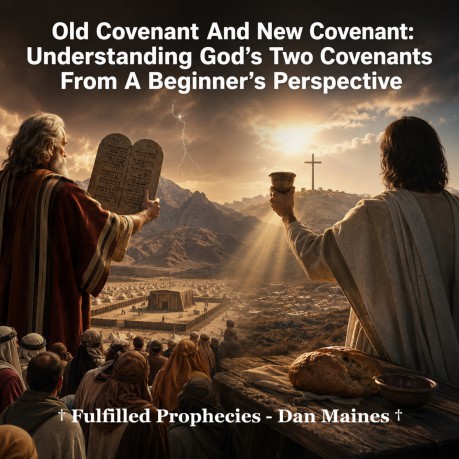
Old Covenant And New
Covenant: Understanding God's Two Covenants From A Beginner's
Perspective Introduction † One of the biggest reasons people struggle to
understand the Bible is because they don't recognize that it speaks
about two different covenants. Many verses that seem confusing become
very clear once we see whether they belong to the Old Covenant or the
New Covenant. † The Old Covenant was the agreement God made
with the nation of Israel through Moses at Mount Sinai. It governed
Israel's worship, priesthood, sacrifices, temple service, feast days,
Sabbath, and civil laws. † The New Covenant is the covenant God promised
through the prophets and established through Jesus Christ. It brought
forgiveness of sins, direct access to God, and an everlasting
relationship with Him. † The New Covenant wasn't simply an improved
version of the Old Covenant. It replaced it completely after God's
redemptive plan reached its fulfillment. † Once we understand these two covenants, many
difficult passages throughout the New Testament suddenly make sense. The Old Covenant Was Made With Israel Deuteronomy 5:2-3 The Lord our God made a covenant with us at Horeb. The Lord did
not make this covenant with our fathers, but with us, all of us who
are alive here today. † God clearly identified who received the
covenant made at Mount Sinai. It was made with Israel, not with every
nation on earth. (Deuteronomy 5:2-3) † This covenant established Israel as God's
covenant nation and governed every part of their national and
religious life. (Exodus 19:5-8) † Understanding who received the Old Covenant
helps prevent applying Israel's covenant obligations directly to
people living under the New Covenant. (Romans 9:4) The Prophets Promised A New Covenant Jeremiah 31:31-34 "Behold, days are coming," declares the Lord, "when
I will make a new covenant with the house of Israel and the house of
Judah, not like the covenant which I made with their fathers on the
day I took them by the hand to bring them out of the land of Egypt,
My covenant which they broke, although I was a husband to them,"
declares the Lord. "For this is the covenant which I will make
with the house of Israel after those days," declares the Lord:
"I will put My law within them and write it on their heart; and
I will be their God, and they shall be My people. They will not teach
again, each one his neighbor and each one his brother, saying, 'Know
the Lord,' for they will all know Me, from the least of them to the
greatest of them," declares the Lord, "for I will forgive
their wrongdoing, and their sin I will no longer remember." † Long before Jesus came, God promised that
another covenant was coming. It would not be like the covenant made
through Moses. (Jeremiah 31:31-34) † The promise of a New Covenant shows that the
Old Covenant was never intended to last forever. God Himself
announced its replacement centuries before Christ. (Jeremiah
31:31-34) † The New Covenant would provide complete
forgiveness and a personal relationship with God that the Old
Covenant could never fully accomplish. (Hebrews 10:1-18) Jesus Established The New Covenant Luke 22:20 And in the same way He took the cup after they had eaten, saying,
This cup, which is poured out for you, is the new covenant in My
blood. † Jesus didn't come merely to reform the Old
Covenant. He came to establish the New Covenant through His
sacrificial death. (Luke 22:20) † His blood accomplished what countless animal
sacrifices could never accomplish. It provided true and lasting
forgiveness of sins. (Hebrews 9:11-15) † Everything that pointed forward under the Law
found its fulfillment in Christ. The sacrifices, priesthood, and
temple all anticipated Him. (Colossians 2:16-17) The Old Covenant Was Becoming Obsolete Hebrews 8:13 When He said, "A new covenant," He has made the first
obsolete. But whatever is becoming obsolete and growing old is about
to disappear. † When the writer of Hebrews wrote these words,
the Old Covenant was already becoming obsolete. It was still standing
historically, but it was nearing its complete end. (Hebrews 8:13) † The temple was still functioning, sacrifices
were still being offered, yet God declared that covenant was ready to
disappear. (Hebrews 8:13) † This fits perfectly with the transition
period before the destruction of Jerusalem in AD 70, when the Old
Covenant system came to its complete end. (Luke 21:20-22) Christ Removed The First To Establish The Second Hebrews 10:9 then He said, "Behold, I have come to do Your will." He
takes away the first in order to establish the second. † God's purpose was never to keep both
covenants operating forever. One had to give way to the other.
(Hebrews 10:9) † Jesus fulfilled the purpose of the first
covenant and established the second through His perfect obedience.
(Matthew 5:17) † Believers today don't live under two covenant
systems. We live under the New Covenant established by Christ.
(Romans 7:4-6) The First Covenant Had To End Hebrews 8:7 For if that first covenant had been free of fault, no
circumstances would have been sought for a second. † God promised a second covenant because the
first covenant could never accomplish His complete redemptive
purpose. (Hebrews 8:7; Jeremiah 31:31-34) † The problem wasn't that God's Law was sinful.
The weakness was that the Law could not permanently remove sin or
perfect the worshiper. (Romans 8:3; Hebrews 10:1-4) † The New Covenant accomplishes what the Old
Covenant could only foreshadow through sacrifices and ceremonies.
(Hebrews 9:11-15) The Law Was A Tutor Leading To Christ Galatians 3:24-25 Therefore the Law has become our guardian to lead us to Christ, so
that we may be justified by faith. But now that faith has come, we
are no longer under a guardian. † The Law served an important purpose. It
pointed Israel toward the coming Messiah. (Galatians 3:24-25) † Once Christ came and fulfilled God's plan,
the tutor had completed its assignment. (Galatians 3:24-25) † Returning to the Law after Christ would be
like returning to elementary lessons after graduating. God's people
have moved into something greater through Christ. (Hebrews 7:18-19) The Old Covenant Was Temporary 2 Corinthians 3:11 For if that which fades away was with glory, much more that which
remains is in glory. † Paul contrasts two covenant ministries, one
that was passing away and one that remains. (2 Corinthians 3:7-11) † The glory of the Old Covenant pointed forward
to the far greater glory of the New Covenant in Christ. (2
Corinthians 3:7-11) † This explains why believers don't return to
the covenant that was passing away but continue in the covenant that
remains. (Hebrews 8:13) The New Covenant Gives Direct Access To God Hebrews 10:19-22 Therefore, brothers and sisters, since we have confidence to enter
the holy place by the blood of Jesus, by a new and living way which
He inaugurated for us through the veil, that is, through His flesh,
and since we have a great priest over the house of God, let's
approach God with a sincere heart in full assurance of faith, having
our hearts sprinkled clean from an evil conscience and our bodies
washed with pure water. † Under the Old Covenant, only the high priest
could enter the Most Holy Place, and only once each year. (Hebrews
9:6-8) † Through Jesus Christ, every believer now has
direct access to God because the true sacrifice has already been
offered. (Hebrews 10:19-22) † We don't need an earthly priest, temple, or
animal sacrifices because Christ has become our eternal High Priest.
(Hebrews 4:14-16) The New Covenant Removed The Barrier Ephesians 2:13-16 But now in Christ Jesus you who previously were far away have been
brought near by the blood of Christ. For He Himself is our peace, who
made both groups into one and broke down the barrier of the dividing
wall, by abolishing in His flesh the hostility, which is the Law
composed of commandments expressed in ordinances, so that in Himself
He might make the two one new person, in this way establishing peace;
and that He might reconcile them both in one body to God through the
cross, by it having put to death the hostility. † Under the New Covenant, believing Jews and
Gentiles became one people in Christ. (Ephesians 2:13-16) † The covenant that separated Israel from the
nations was removed through Christ's sacrifice. (Ephesians 2:14-15) † Today our identity is found in Christ rather
than in the Old Covenant distinctions that once separated people.
(Galatians 3:26-29) Believers Serve Under A Better Covenant Hebrews 8:6 But now He has obtained a more excellent ministry, to the extent
that He is also the mediator of a better covenant, which has been
enacted on better promises. † The New Covenant isn't merely newer, it is
better because it accomplishes what the Old Covenant could never
fully accomplish. (Hebrews 8:6) † Jesus is the mediator of this better
covenant, giving believers complete forgiveness and confidence before
God. (Hebrews 9:15) † Everything under the Old Covenant pointed
forward to the greater reality that believers now enjoy in Christ.
(Colossians 2:16-17) Historical References † Josephus records that the temple and its
entire sacrificial system came to a complete end when Jerusalem fell
to the Romans in AD 70, exactly as Jesus foretold. The Wars of the
Jews, Book 6. † Eusebius records that the Christians
remembered Jesus' warning and fled Jerusalem before its destruction,
demonstrating their understanding that the Old Covenant age was
coming to its end. Ecclesiastical History, Book 3, Chapter 5. † The destruction of the temple permanently
ended the Levitical priesthood, sacrifices, and temple worship,
confirming that the Old Covenant system had passed away just as
Scripture declared. How It Applies To Us Today † We should read every passage by first asking
whether it belongs to the Old Covenant or the New Covenant. † We don't seek righteousness through the Law
of Moses because our righteousness is found in Christ. † We don't look for another covenant because
God has already established the everlasting New Covenant. † We can approach God with confidence because
Jesus has already opened the new and living way. † Understanding the difference between the two
covenants removes confusion and helps us rightly divide God's Word. Q & A Appendix Q: What is a covenant? A: A covenant is a binding agreement established
by God. The Old Covenant was made with Israel through Moses, while
the New Covenant was established through Jesus Christ. (Exodus
19:5-8; Luke 22:20) Q: Was the Old Covenant given to all nations? A: No. The covenant made at Mount Sinai was given
specifically to Israel. (Deuteronomy 5:2-3; Romans 9:4) Q: Why did God give the Law? A: The Law revealed sin and served as a tutor
leading Israel to Christ until God's redemptive plan reached its
fulfillment. (Galatians 3:24-25; Romans 3:20) Q: Did Jesus abolish God's plan? A: No. Jesus fulfilled God's purpose by
establishing the New Covenant that had been promised through the
prophets. (Jeremiah 31:31-34; Luke 22:20; Hebrews 10:9) Q: Can Christians live under both covenants? A: No. Scripture teaches that Christ took away
the first covenant in order to establish the second. (Hebrews 10:9;
Hebrews 8:13) Q: Why is understanding the covenants so
important? A: Because many passages become clear once we
recognize whether they describe life under the Old Covenant or life
under the New Covenant. Understanding this distinction keeps
Scripture in its proper context. (Hebrews 8:6-13; Galatians 3:24-25) Q: When did the Old Covenant finally come to its
end? A: Jesus established the New Covenant through His
death, but there was a transition period while the temple still
stood. The Old Covenant system came to its complete end with the
destruction of Jerusalem and the temple in AD 70, just as Jesus
foretold. (Hebrews 8:13; Luke 21:20-22) This is the fulfilled perspective we proclaim at Fulfilled
Prophecies. † © Fulfilled Prophecies - Dan Maines. Source Index † Deuteronomy 5:2-3; Jeremiah 31:31-34; Luke
22:20; Hebrews 8:7, 13; Hebrews 10:9, 19-22; Galatians 3:24-25; 2
Corinthians 3:11; Ephesians 2:13-16 † Historical writers: Josephus, The Wars of the
Jews, Book 6; Eusebius, Ecclesiastical History, Book 3, Chapter 5
By Dan Maines
Links