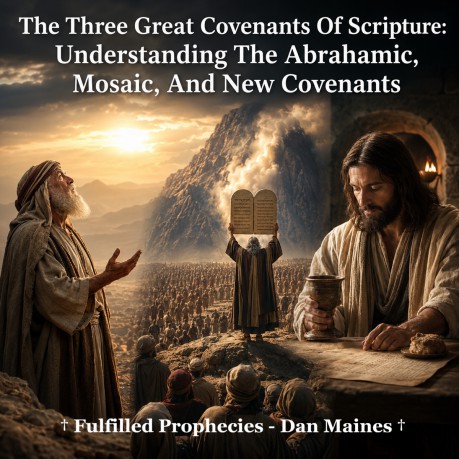
The Three Great Covenants Of
Scripture: Understanding The Abrahamic, Mosaic, And New Covenants Introduction † One of the greatest sources of confusion in
Christianity is failing to distinguish between the Abrahamic
Covenant, the Mosaic Covenant, and the New Covenant. † Many people blend the Abrahamic and Mosaic
Covenants together even though Scripture carefully separates them. † Paul devoted much of Galatians to explaining
that God's promise to Abraham was never canceled by the Law of Moses. † Understanding these three covenants helps us
see why believers today live under the New Covenant established by
Jesus Christ. Galatians 3:16-18 Now the promises were spoken to Abraham and to his seed. He does
not say, "And to seeds," as one would in referring to many,
but rather as in referring to one, "And to your seed," that
is, Christ. What I am saying is this: the Law, which came 430 years
later, does not invalidate a covenant previously ratified by God, so
as to nullify the promise. For if the inheritance is based on law, it
is no longer based on a promise; but God has granted it to Abraham by
means of a promise. † Paul clearly distinguishes the Abrahamic
Covenant from the Mosaic Covenant. The Law came 430 years after God's
promise to Abraham. (Galatians 3:16-18) † The promise was never based on keeping the
Law. It was always based on God's grace and His faithfulness. (Romans
4:13-16) † The promised Seed was Christ, not the nation
of Israel. Everything God promised Abraham ultimately pointed to
Jesus. (Galatians 3:16) Romans 4:13 For the promise to Abraham or to his descendants that he would be
heir of the world was not through the Law, but through the
righteousness of faith. † Paul again separates the promise made to
Abraham from the Law of Moses. The inheritance was never based on
keeping the Law. (Romans 4:13) † Abraham was declared righteous by faith long
before the Mosaic Covenant existed. (Romans 4:1-5) † This proves God's plan of salvation has
always been by faith, not by works of the Law. (Galatians 3:6-9) Exodus 24:7-8 Then he took the Book of the Covenant and read it as the people
listened; and they said, "All that the Lord has spoken we will
do, and we will be obedient!" So Moses took the blood and
sprinkled it on the people, and said, "Behold the blood of the
covenant, which the Lord has made with you in accordance with all
these words." † The Mosaic Covenant was made with the nation
of Israel at Mount Sinai, not with Abraham. (Exodus 24:7-8) † This covenant required Israel's obedience to
the Law and contained blessings for obedience and judgment for
disobedience. (Deuteronomy 28:1-2, 15) † Unlike the Abrahamic Covenant of promise, the
Mosaic Covenant was conditional and temporary. (Galatians 3:19) Deuteronomy 5:2-3 The Lord our God made a covenant with us at Horeb. The Lord did
not make this covenant with our fathers, but with us, all of us who
are alive here today. † Moses plainly says the covenant made at Horeb
was not the covenant made with the fathers such as Abraham.
(Deuteronomy 5:2-3) † This is one of the clearest passages proving
the Abrahamic and Mosaic Covenants are distinct covenants. (Galatians
3:17) † Confusing these two covenants creates many
doctrinal errors about the Law today. (Romans 4:13) Galatians 3:24-25 Therefore the Law has become our guardian to lead us to Christ, so
that we may be justified by faith. But now that faith has come, we
are no longer under a guardian. † The Law was never given as God's final plan
for salvation. It was a tutor preparing people for Christ. (Galatians
3:24-25) † The Law exposed sin but could never remove
sin or make anyone righteous before God. (Romans 3:20) † Once Christ came and fulfilled its purpose,
believers were no longer under the Mosaic Covenant. (Galatians 3:25) Galatians 3:19 Why the Law then? It was added on account of the violations,
having been ordered through angels at the hand of a mediator, until
the Seed would come to whom the promise had been made. † Paul explains exactly why the Law was given.
It was added because of transgressions. (Galatians 3:19) † The Law was always temporary because it
lasted only until the promised Seed, Christ, came. (Galatians 3:19) † Once Christ fulfilled His work, the purpose
of the Mosaic Covenant had been completed. (Galatians 3:24-25) Hebrews 8:13 When He said, "A new covenant," He has made the first
obsolete. But whatever is becoming obsolete and growing old is about
to disappear. † Jesus established the New Covenant, making
the Mosaic Covenant obsolete. (Hebrews 8:13) † The Old Covenant was already growing old
during the first century and was about to disappear completely.
(Hebrews 8:13) † The destruction of Jerusalem in AD 70 marked
the public end of the Old Covenant system centered on the temple,
priesthood, and sacrifices. (Luke 21:20-22) Jeremiah 31:31-33 "Behold, days are coming," declares the Lord, "when
I will make a new covenant with the house of Israel and the house of
Judah, not like the covenant which I made with their fathers on the
day I took them by the hand to bring them out of the land of Egypt,
My covenant which they broke, although I was a husband to them,"
declares the Lord. "For this is the covenant which I will make
with the house of Israel after those days," declares the Lord:
"I will put My law within them and write it on their heart; and
I will be their God, and they shall be My people. † Jeremiah foretold that God would establish a
New Covenant that would not be like the covenant made when Israel
came out of Egypt. (Jeremiah 31:31-33) † The New Covenant didn't renew the Mosaic
Covenant, it replaced it. (Hebrews 8:6-13) † Jesus fulfilled this prophecy by establishing
the New Covenant through His blood. (Luke 22:20) Galatians 3:26-29 For you are all sons and daughters of God through faith in Christ
Jesus. For all of you who were baptized into Christ have clothed
yourselves with Christ. There is neither Jew nor Greek, there is
neither slave nor free, there is neither male nor female; for you are
all one in Christ Jesus. And if you belong to Christ, then you are
Abraham's descendants, heirs according to promise. † Everyone who belongs to Christ becomes
Abraham's seed through faith, not through physical ancestry.
(Galatians 3:26-29) † The promise made to Abraham reached its
fulfillment in Christ and now includes believing Jews and Gentiles
alike. (Ephesians 2:11-19) † The inheritance comes through God's promise
fulfilled in Christ, not through the Law of Moses. (Galatians 3:29) Ephesians 2:11-16 Therefore remember that previously you, the Gentiles in the flesh,
who are called "Uncircumcision" by the so-called
"Circumcision" which is performed in the flesh by human
hands - remember that you were at that time separate from Christ,
excluded from the people of Israel, and strangers to the covenants of
the promise, having no hope and without God in the world. But now in
Christ Jesus you who previously were far away have been brought near
by the blood of Christ. For He Himself is our peace, who made both
groups into one and broke down the barrier of the dividing wall, by
abolishing in His flesh the hostility, which is the Law composed of
commandments expressed in ordinances, so that in Himself He might
make the two one new person, in this way establishing peace; and that
He might reconcile them both in one body to God through the cross, by
it having put to death the hostility. † Christ united believing Jews and Gentiles
into one people through the New Covenant. (Ephesians 2:11-16) † Gentiles became heirs of Abraham's promise
through Christ, not through becoming Jews or keeping the Law.
(Galatians 3:29) † The dividing wall created under the Mosaic
Covenant was removed through Christ's work on the cross. (Ephesians
2:14-16) Historical References † Josephus recorded the destruction of
Jerusalem and the temple in AD 70, bringing the Old Covenant
sacrificial system to its historical end. (The Jewish War, Book 6) † Eusebius recorded that the Christians
remembered Jesus' warning and fled Jerusalem before its destruction.
(Ecclesiastical History, Book 3, Chapter 5) † Irenaeus taught that Christ fulfilled the Law
and brought believers into the New Covenant. (Against Heresies, Book
4, Chapter 13) How It Applies To Us Today † We don't live under the Mosaic Covenant
because Christ fulfilled its purpose. † We rejoice that God's promise to Abraham has
reached all nations through Jesus Christ. † Our relationship with God is based on grace
through faith, not on earning righteousness by keeping the Law. † We can confidently say we are Abraham's seed
because we belong to Christ. Q & A Appendix Q: Did the Mosaic Covenant replace the Abrahamic
Covenant? A: No. Paul specifically says the Law, given 430
years later, did not cancel God's promise to Abraham. The promise
remained until it was fulfilled in Christ. (Galatians 3:17) Q: Who are Abraham's true descendants today? A: Everyone who belongs to Christ is Abraham's
seed and an heir according to the promise, whether Jew or Gentile.
(Galatians 3:29) Q: Why don't Christians live under the Law of
Moses today? A: Because Christ fulfilled the purpose of the
Law and established the New Covenant. Believers are no longer under
the tutor but under grace through faith. (Galatians 3:24-25; Hebrews
8:13) Q: Didn't God make an everlasting covenant with
Abraham? A: Yes, and that everlasting promise was
fulfilled in Christ. The Abrahamic Covenant was never replaced by the
Mosaic Covenant. Instead, it reached its fulfillment in the New
Covenant through Jesus. (Galatians 3:16-18; Galatians 3:29) Q: How many covenants are found in the Bible? A: The Bible contains many covenants, not just
two. Among the major covenants are the Noahic Covenant (Genesis
9:8-17), the Abrahamic Covenant (Genesis 12:1-3; 15:18-21; 17:1-8),
the Mosaic Covenant (Exodus 19:3-8; 24:7-8), the Davidic Covenant (2
Samuel 7:12-16), and the New Covenant (Jeremiah 31:31-34; Luke
22:20). This study focuses on the three covenants that are central to
understanding the transition from the Old Covenant to the New
Covenant. Q: If there were several covenants, why does the
Bible only speak of the Old Testament and the New Testament? A: Because the words "Old Testament"
and "New Testament" refer to the two covenant
administrations that govern the Bible's overall story, not to the
total number of covenants God made. The Old Testament contains
several covenants, including the Abrahamic, Mosaic, and Davidic
Covenants, while the New Testament reveals the fulfillment of God's
promises through the New Covenant established by Christ. (Hebrews
8:6-13) Q: If there were three major covenants, why isn't
the Bible divided into the Old Testament, a Middle Testament, and the
New Testament? A: Because the Abrahamic Covenant was never a
separate testament replacing another one. It was a covenant of
promise that continued through the Old Testament and reached its
fulfillment in Christ. The Mosaic Covenant was added 430 years later
and was temporary until Christ came. The New Covenant fulfilled God's
promise to Abraham while bringing the Mosaic Covenant to its intended
end. That's why the Bible is correctly divided into the Old Testament
and the New Testament, not three separate testaments. (Galatians
3:17-19, 24-29; Hebrews 8:13) Q: In a nutshell, what was the Abrahamic
Covenant? A: In a nutshell, the Abrahamic Covenant was
God's unconditional promise to Abraham that through his Seed, Jesus
Christ, all nations would be blessed. It was a covenant based on
God's promise, not on Abraham's ability to keep the Law. That promise
was fulfilled in Christ, and everyone who belongs to Christ is
Abraham's seed and an heir according to the promise. (Genesis 12:1-3;
Genesis 15:5-6; Galatians 3:16; Galatians 3:29) † This is the fulfilled perspective we proclaim at
Fulfilled Prophecies. † © Fulfilled Prophecies - Dan Maines. Source Index † Galatians 3:16-18, Romans 4:13, Exodus
24:7-8, Deuteronomy 5:2-3, Galatians 3:19, Galatians 3:24-25, Hebrews
8:13, Jeremiah 31:31-33, Galatians 3:26-29, Ephesians 2:11-16 † Historical Writers: Josephus, The Jewish War,
Book 6; Eusebius, Ecclesiastical History, Book 3, Chapter 5;
Irenaeus, Against Heresies, Book 4, Chapter 13
By Dan Maines
Links