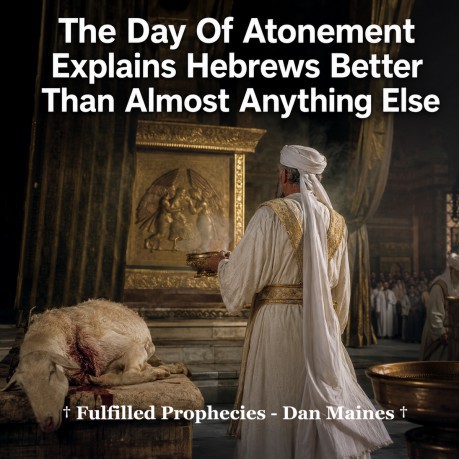
The Day Of Atonement Explains
Hebrews Better Than Almost Anything Else Introduction Leviticus 16:15-17 Leviticus 16:29-30 Hebrews 9:7-8 Hebrews 9:11-12 Hebrews 9:23-24 Hebrews 9:26-28 Hebrews 10:19-22 Hebrews 10:35-37 Hebrews 12:22-24 Historical References How It Applies To Us Today Q & A Appendix Q: Why does Hebrews describe believers as waiting
if Jesus had already died and risen? Q: Was the cross insufficient until AD 70? Q: Why is AD 70 important to the argument? Q: Are Christians today still waiting for the Day
of Atonement pattern to be completed? Q: What is the main lesson of the Day of
Atonement for understanding Hebrews? † This is the fulfilled perspective we proclaim at
Fulfilled Prophecies †
By Dan Maines
† The Day of
Atonement gives us one of the clearest Old Testament backgrounds for
understanding the book of Hebrews. The high priest, the blood, the
sanctuary, the entrance behind the veil, the appearance before God,
the cleansing of the sanctuary, and the waiting congregation all form
the framework Hebrews uses to explain the work of Jesus Christ.
†
Hebrews wasn't written in a vacuum. Its first readers knew the
temple, the priesthood, the sacrifices, and the annual Day of
Atonement. When Hebrews spoke about a High Priest entering the
sanctuary and later appearing, those words carried an entire
covenantal picture with them.
† On the Day of
Atonement, the high priest didn't simply kill a sacrifice and declare
the ceremony finished. Blood was offered, the high priest entered the
Most Holy Place, atonement was made, the sanctuary was cleansed, and
the priest came back out to the waiting people.
†
That pattern helps explain why Hebrews can speak of Christ's
sacrifice at the cross, His entrance into the heavenly sanctuary, His
appearance before God, and His later appearing for salvation. These
aren't disconnected events. They're parts of one priestly and
covenantal work.
† When this background is
ignored, Hebrews can sound as though it's describing unrelated future
events. When the Day of Atonement is placed behind the language, the
argument becomes much clearer.
Then he shall slaughter
the goat of the sin offering, which is for the people, and bring its
blood inside the veil and do with its blood as he did with the blood
of the bull, and sprinkle it on the atoning cover and in front of the
atoning cover. He shall make atonement for the Holy Place, because of
the impurities of the sons of Israel and because of their unlawful
acts regarding all their sins; and he shall do so for the tent of
meeting which remains with them in the midst of their impurities.
When he goes in to make atonement in the Holy Place, no one shall be
in the tent of meeting until he comes out, so that he may make
atonement for himself and for his household, and for all the assembly
of Israel.
† Notice the complete movement.
The sacrifice was killed, the blood was taken behind the veil,
atonement was made in the sanctuary, and the high priest eventually
came back out. The killing of the sacrifice wasn't the entire Day of
Atonement ceremony.
† This distinction
becomes extremely important in Hebrews. Jesus' death provided the
perfect sacrifice, but Hebrews continues the priestly imagery by
presenting Christ as the High Priest who entered the true sanctuary
with the value of His own blood (Hebrews 9:11-12).
†
The congregation couldn't enter with the high priest. They remained
outside while he performed his work within the sanctuary. Their
waiting ended when the priest completed his ministry and came back
out.
† Hebrews uses this same basic pattern
when it describes believers as eagerly waiting for Christ to appear a
second time for salvation (Hebrews 9:28). The imagery isn't random,
it's priestly and Day of Atonement language.
This shall be a permanent
statute for you: in the seventh month, on the tenth day of the month,
you shall humble yourselves and not do any work, whether the native,
or the stranger who resides among you; for it is on this day that
atonement shall be made for you to cleanse you; you will be clean
from all your sins before the Lord.
† The Day
of Atonement was specifically associated with cleansing. The purpose
wasn't merely the death of an animal, but the covenantal cleansing of
the people before God.
† Hebrews repeatedly
develops this cleansing theme. Christ's blood cleanses the
conscience, removes the barrier created by sin, and provides access
to God (Hebrews 9:14; 10:19-22).
† This also
explains why Hebrews speaks about salvation as something already
possessed and yet approaching its covenantal completion. The
sacrifice had been offered, Christ had entered God's presence, and
the first-century believers were waiting for the completion of that
priestly pattern (Hebrews 9:28; 10:25, 37).
but into the second, only the
high priest enters once a year, not without taking blood which he
offers for himself and for the sins of the people committed in
ignorance. The Holy Spirit is signifying this, that the way into the
holy place has not yet been disclosed while the outer tabernacle is
still standing,
† Hebrews directly connects
its argument to the Day of Atonement. The high priest entered the
inner sanctuary once each year, carrying blood on behalf of the
people.
† The writer then makes a crucial
covenantal statement. The old sanctuary represented a system in which
unrestricted access into God's presence hadn't yet been fully
manifested.
† The issue wasn't geography. The
issue was covenantal access. The earthly sanctuary, priesthood,
sacrifices, and veil represented the old order that was still
standing when Hebrews was written.
† This is
why the removal of that old covenant system matters so much in
Hebrews. The writer was living during the transition from the old
covenant age into the fully manifested new covenant order (Hebrews
8:13; 10:9).
But when Christ appeared as
a high priest of the good things having come, He entered through the
greater and more perfect tabernacle, not made by hands, that is, not
of this creation; and not through the blood of goats and calves, but
through His own blood, He entered the holy place once for all time,
having obtained eternal redemption.
† Jesus
is explicitly presented as the greater High Priest. The earthly Day
of Atonement becomes the shadow, and Christ's priestly work is the
reality.
† The Levitical high priest entered
an earthly sanctuary with animal blood. Jesus entered the true
heavenly sanctuary on the basis of His own perfect sacrifice.
†
Christ didn't need to repeat His sacrifice annually. His sacrifice
was once for all. Hebrews isn't teaching repeated sacrifices or
repeated comings of Christ, it's showing the superiority and finality
of His priestly work (Hebrews 9:25-26).
† The
cross and the heavenly entrance therefore belong together. The
sacrifice occurred on earth, while the priestly presentation is
described in terms of entrance into God's heavenly presence.
Therefore it was necessary
for the copies of the things in the heavens to be cleansed with these
things, but the heavenly things themselves with better sacrifices
than these. For Christ did not enter a holy place made by hands, a
mere copy of the true one, but into heaven itself, now to appear in
the presence of God for us;
† Here Hebrews
gives us the language of appearing that must be understood within its
priestly setting. Christ entered heaven itself to appear in God's
presence on behalf of His people.
† This is
the High Priest before God. The earthly priest disappeared from the
congregation's sight when he entered behind the veil. Christ likewise
entered the true sanctuary and appeared before God for His people.
†
Hebrews isn't describing Jesus as inactive between the cross and the
completion of the old covenant age. He was functioning as the great
High Priest, representing His people in the presence of God.
†
The language of entering, appearing, cleansing, and waiting all comes
together in this sanctuary framework.
Otherwise, He would have
needed to suffer often since the foundation of the world; but now
once at the consummation of the ages He has been revealed to put away
sin by the sacrifice of Himself. And just as it is destined for
people to die once, and after this comes judgment, so Christ also,
having been offered once to bear the sins of many, will appear a
second time for salvation without reference to sin, to those who
eagerly await Him.
† This passage contains
the entire movement. Christ was manifested to sacrifice Himself, He
was offered once to bear sins, and He would appear a second time to
those who were waiting for Him.
† The phrase
a second time must be read within the immediate High Priest and
sanctuary context. The comparison isn't simply between Jesus leaving
earth and someday returning physically to earth. Hebrews has just
described Christ entering the heavenly sanctuary and appearing before
God (Hebrews 9:24).
† The Day of Atonement
pattern helps explain the sequence. The sacrifice was offered, the
High Priest entered the sanctuary, and the waiting congregation
expected the completion of his priestly work.
†
Christ's second appearing would be apart from sin, meaning not to
offer another sacrifice. The sin offering had already been completed
once for all. His appearing concerned salvation, vindication, and the
completion of the covenantal work.
† The
people addressed by Hebrews weren't told that this completion was
thousands of years away. They were told that the Day was approaching
and that the Coming One would come in a very little while and
wouldn't delay (Hebrews 10:25, 37).
† This
places Hebrews 9:28 naturally within the approaching end of the old
covenant age, when Christ's priestly and covenantal work would be
publicly vindicated in judgment upon the system that had rejected
Him.
Therefore, brothers and
sisters, since we have confidence to enter the holy place by the
blood of Jesus, by a new and living way which He inaugurated for us
through the veil, that is, through His flesh, and since we have a
great priest over the house of God, let's approach God with a sincere
heart in full assurance of faith, having our hearts sprinkled clean
from an evil conscience and our bodies washed with pure water.
†
The result of Christ's High Priestly work is access. Under the old
covenant, the congregation remained outside while one man entered the
Most Holy Place. Under the new covenant, God's people are invited to
draw near.
† The barrier represented by the
old sanctuary system has been removed. God's people don't stand at a
distance waiting for an earthly priest to represent them year after
year.
† Jesus is the permanent High Priest
over God's house. Through Him, believers have direct covenantal
access into God's presence (Hebrews 7:24-25).
†
This is one of the great themes of Hebrews. The story moves from
restricted access to open access, from repeated sacrifices to one
perfect sacrifice, and from an earthly priesthood to the permanent
priesthood of Christ.
Therefore, do not throw
away your confidence, which has a great reward. For you have need of
endurance, so that when you have done the will of God, you may
receive what was promised. For yet in a very little while, He who is
coming will come, and will not delay.
† The
waiting congregation theme becomes impossible to miss. Hebrews wasn't
merely teaching theology about the sanctuary, it was encouraging real
first-century believers who were waiting for the promised
completion.
† They needed endurance because
the promise hadn't yet reached its historical covenantal climax. But
the writer didn't tell them that countless generations would pass
before it happened.
† He said it would happen
in a very little while. That time statement must be allowed to mean
what it meant to the original audience.
† The
High Priest had entered. The sacrifice had been accepted. The old
covenant was becoming obsolete. The Day was approaching. The
congregation was waiting. The Coming One wouldn't delay (Hebrews
8:13; 10:25).
† AD 70 brought the decisive
historical removal of the earthly temple, Levitical priesthood,
sacrificial system, and old covenant order. What Christ accomplished
became unmistakably vindicated when the competing earthly sanctuary
was removed.
But you have come to Mount
Zion and to the city of the living God, the heavenly Jerusalem, and
to myriads of angels, to the general assembly and church of the
firstborn who are enrolled in heaven, and to God, the Judge of all,
and to the spirits of the righteous made perfect, and to Jesus, the
mediator of a new covenant, and to the sprinkled blood, which speaks
better than the blood of Abel.
† Hebrews ends
its argument by telling believers where they had come. They weren't
being directed back toward earthly Jerusalem, an earthly sanctuary,
or an earthly priesthood.
† They had come to
Mount Zion, heavenly Jerusalem, God Himself, Jesus the Mediator, and
the blood of the new covenant.
† The better
blood had accomplished what the blood of bulls and goats could never
accomplish. The better High Priest had entered the better sanctuary
and established the better covenant.
† This
is why the Day of Atonement explains Hebrews so powerfully. Hebrews
isn't merely borrowing a few interesting Old Testament symbols. Its
argument is built around the movement from shadow to reality, earthly
to heavenly, temporary to permanent, restricted access to open
access, and old covenant to new covenant.
†
Josephus described the temple and priesthood as central features of
Jewish life immediately before their destruction. His account of the
Jewish War records the catastrophic destruction of Jerusalem and the
temple in AD 70, providing the historical setting for the removal of
the earthly sanctuary system that Hebrews described as becoming
obsolete. Josephus, Wars of the Jews, Books 5-6.
†
Josephus also described the burning of the temple and the devastation
surrounding Jerusalem. Whatever theological conclusions someone draws
from those events, historically the earthly sacrificial center of
Judaism was decisively removed in AD 70. Josephus, Wars of the Jews,
Book 6.
† Eusebius later connected the
destruction of Jerusalem with Jesus' warnings concerning that
generation and recorded the early Christian understanding that divine
judgment had fallen upon Jerusalem. Eusebius, Ecclesiastical History,
Book 3, Chapters 5-7.
† These historical
writers don't establish the doctrine, Scripture does. They help us
see the historical world in which the old temple order disappeared
exactly when the New Testament had been warning that judgment was
approaching.
†
We aren't a congregation still standing outside the sanctuary waiting
for our High Priest to finish the transition from the old covenant to
the new.
† We live in the reality that the
Day of Atonement foreshadowed. Christ's sacrifice doesn't need
repeating, His priesthood doesn't need replacing, and His covenant
doesn't need another earthly temple.
† We
don't need animal blood, Levitical priests, an earthly Most Holy
Place, or another Day of Atonement. Jesus fulfilled what those
shadows pictured (Hebrews 10:1-14).
† We can
draw near to God with confidence because our High Priest has opened
the new and living way (Hebrews 10:19-22).
†
This also protects us from rebuilding in our theology what Christ
fulfilled. A return to an earthly temple, animal sacrifices, and
Levitical worship would be a return to the shadows after the reality
has come.
† Our hope isn't that Jesus will
someday finish an unfinished atonement. Our confidence is that the
once-for-all sacrifice was accepted, the better covenant was
established, and access to God through Jesus Christ is now open.
†
The Day of Atonement helps us read Hebrews as its original audience
would've understood it, sacrifice, High Priest, sanctuary, blood,
appearing before God, cleansing, waiting, and covenantal
completion.
† Once that pattern is
recognized, some of the most difficult language in Hebrews becomes
remarkably clear.
Q: Does
Hebrews 9:28 necessarily teach a physical return of Jesus to
earth?
A: The immediate context is the Day of
Atonement and Christ's High Priestly ministry. Hebrews describes
Christ entering heaven to appear before God and then appearing a
second time to those waiting for Him unto salvation (Hebrews
9:24-28). The sanctuary context should determine how the appearing
language is understood.
A: Because
the sacrifice had been accomplished, but the old covenant age hadn't
yet reached its historical conclusion. Hebrews says the old covenant
was becoming obsolete, the Day was approaching, and the Coming One
would come in a very little while (Hebrews 8:13; 10:25, 37).
A:
No. Christ's sacrifice was completely sufficient and once for all.
Hebrews distinguishes between the perfect sacrifice itself and the
covenantal-historical completion associated with the removal of the
obsolete order (Hebrews 9:12, 26; 10:10-14).
A:
AD 70 permanently removed the earthly temple and sacrificial system
that represented the old covenant order. Hebrews had already declared
that covenant obsolete and ready to disappear (Hebrews 8:13).
A: No. We
live under the established new covenant with access to God through
our permanent High Priest. We've come to heavenly Jerusalem and to
Jesus, the Mediator of the new covenant (Hebrews 12:22-24).
A: Don't
isolate the sacrifice from the priestly ministry that followed it.
The biblical pattern includes sacrifice, blood, High Priest,
sanctuary, appearance before God, cleansing, waiting, and completion.
Hebrews applies that pattern to the superior and final work of Jesus
Christ.
© Fulfilled Prophecies - Dan
Maines.
Source Index
†
Leviticus 16:15-17, 29-30; Hebrews 9:7-8, 11-12, 23-24, 26-28;
10:19-22, 35-37; 12:22-24
† Josephus, Wars of
the Jews, Books 5-6; Eusebius, Ecclesiastical History, Book 3,
Chapters 5-7
Links