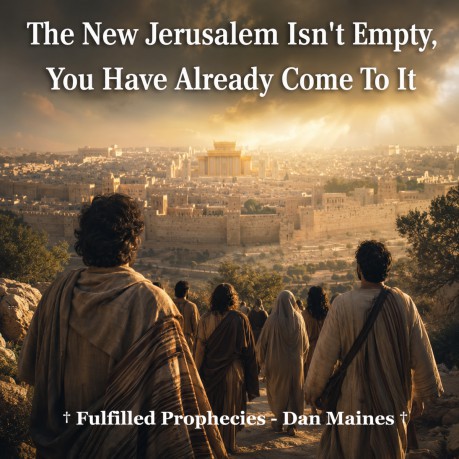
The New Jerusalem Isn't
Empty, You Have Already Come To It Introduction Hebrews 12:18-21 Hebrews 12:22-24 Galatians 4:24-26 Hebrews 12:26-28 Hebrews 13:14 Revelation 21:2-3 Revelation 21:9-10 Ephesians 2:19-22 Philippians 3:20 Historical References How It Applies To Us Today Q & A Appendix Q: Is the heavenly Jerusalem the same as earthly
Jerusalem? Q: Why does Revelation call New Jerusalem a
bride? Q: Does New Jerusalem have to be a literal
physical city descending from outer space? Q: If believers had already come to heavenly
Jerusalem, why does Hebrews 13:14 speak of a city to come? Q: Where is God's dwelling place today? Q: What should this truth mean for Christians
today? † This is the fulfilled perspective we proclaim at
Fulfilled Prophecies † Source Index
By Dan Maines
† One of the
most powerful statements in the New Testament is found in Hebrews
12:22. The writer doesn't tell believers that someday they'll come to
Mount Zion. He tells them that they have already come.
†
This changes the entire way we understand Mount Zion, the heavenly
Jerusalem, the city of the living God, and the New Jerusalem of
Revelation. The destination wasn't presented to those believers
merely as something thousands of years in their future. They were
already being brought into the heavenly reality promised through
Christ.
† Hebrews doesn't tell believers they
would someday come to Mount Zion. It says they had already come.
That's the incredible truth at the center of this study. The old
covenant world centered on earthly Jerusalem and Mount Sinai was
passing away, while God's people were entering the heavenly Jerusalem
that couldn't be shaken (Hebrews 12:26-28).
†
Revelation later shows that same holy city coming down from God, with
God dwelling with His people (Revelation 21:2-3). Galatians
identifies the Jerusalem above as our mother (Galatians 4:26). These
passages aren't describing three unrelated cities. They point us
toward the heavenly covenant reality established in Christ.
For you have not come to a
mountain that can be touched and to a blazing fire, and to darkness
and gloom and whirlwind, and to the blast of a trumpet and the sound
of words, which sound was such that those who heard begged that no
further word be spoken to them. For they could not cope with the
command, "If even an animal touches the mountain, it shall be
stoned." And so terrible was the sight, that Moses said, "I
am terrified and trembling."
† Before
telling them where they had come, Hebrews first tells them where they
hadn't come. They hadn't come to the terrifying mountain associated
with the giving of the old covenant.
† The
contrast is covenantal. Sinai represents the old covenant order,
while Zion represents the heavenly kingdom established through Christ
(Galatians 4:24-26).
† This is essential
because Hebrews isn't contrasting planet earth with a future planet.
It's contrasting two covenantal mountains, Sinai and Zion, and
telling believers which one belonged to them.
But you have come to Mount
Zion and to the city of the living God, the heavenly Jerusalem, and
to myriads of angels, to the general assembly and church of the
firstborn who are enrolled in heaven, and to God, the Judge of all,
and to the spirits of the righteous made perfect, and to Jesus, the
mediator of a new covenant, and to the sprinkled blood, which speaks
better than the blood of Abel.
† Here is the
WOW statement: they had already come. The inspired writer speaks of
Mount Zion and the heavenly Jerusalem as a present covenantal reality
for those believers.
† They hadn't
physically climbed a mountain into heaven. They had come to Zion
through their relationship with Jesus and their entrance into the new
covenant.
† Notice everything connected
together in this passage: Mount Zion, the city of the living God, the
heavenly Jerusalem, the assembly, God, Jesus, and the new covenant.
The heavenly Jerusalem can't be separated from the new covenant
because Hebrews places them together.
† Jesus
is the mediator of that new covenant. Therefore, coming to Jesus
meant coming to the covenantal city over which He reigns (Hebrews
8:6; 9:15).
† This means Christianity isn't a
religion standing outside the gates waiting for God's city to arrive.
In Christ, God's people belong to the heavenly Jerusalem.
This is speaking
allegorically, for these women are two covenants: one coming from
Mount Sinai giving birth to children who are to be slaves; she is
Hagar. Now this Hagar is Mount Sinai in Arabia and corresponds to the
present Jerusalem, for she is enslaved with her children. But the
Jerusalem above is free; she is our mother.
†
Paul makes the covenantal contrast unmistakable. He identifies two
women with two covenants and contrasts earthly Jerusalem with the
Jerusalem above.
† The Jerusalem that existed
in Paul's day was associated with bondage because the old covenant
system was still operating around its temple, priesthood, sacrifices,
and law.
† But Paul says, "the Jerusalem
that is above is free." He doesn't describe this Jerusalem as
nonexistent or as waiting to be created thousands of years later. It
was already the heavenly identity of God's new covenant people.
†
Paul calls this Jerusalem "our mother." That's family
language. Believers belonged to the Jerusalem above even while
earthly Jerusalem was still standing.
† This
also explains why the destruction of earthly Jerusalem in AD 70
didn't destroy God's true city. The heavenly Jerusalem wasn't
dependent upon the survival of the earthly city (Hebrews 13:14).
And His voice shook the
earth then, but now He has promised, saying, "Yet once more I
will shake not only the earth, but also the heaven." This
expression, "Yet once more," denotes the removing of those
things which can be shaken, as of created things, so that those
things which cannot be shaken may remain. Therefore, since we receive
a kingdom which cannot be shaken, let's show gratitude, by which we
may offer to God an acceptable service with reverence and awe;
†
The same chapter that says they had come to heavenly Jerusalem also
speaks about receiving a kingdom that can't be shaken.
†
The shaking removes what can be shaken so that what can't be shaken
remains. This fits the transition from the temporary old covenant
order to the permanent kingdom established in Christ (Hebrews
8:13).
† The earthly temple could be shaken
and removed. The earthly city could fall. The old priesthood could
disappear. But the kingdom centered in Christ couldn't be
destroyed.
† That's why the fall of Jerusalem
in AD 70 wasn't the destruction of Christ's kingdom. It publicly
demonstrated that the old covenant order had reached its end while
the unshakable kingdom remained.
For here we do not have a
lasting city, but we are seeking the city which is to come.
†
Hebrews was written during the transition between the covenants. The
believers had already come to heavenly Zion covenantally, while they
still anticipated the complete removal of the old covenant order.
†
There's no contradiction between Hebrews 12 saying, "ye are
come," and Hebrews 13 saying they sought the city to come. They
had entered the new covenant reality, but the old covenant world
hadn't yet been completely removed (Hebrews 8:13).
†
This already-but-not-yet transition reached its covenantal conclusion
when the earthly temple, priesthood, sacrifices, and
Jerusalem-centered system were removed in AD 70.
And I saw the holy city,
new Jerusalem, coming down out of heaven from God, prepared as a
bride adorned for her husband. And I heard a loud voice from the
throne, saying, Behold, the tabernacle of God is among the people,
and He will dwell among them, and they shall be His people, and God
Himself will be among them,
† Revelation
identifies the holy city as New Jerusalem and describes her as a
bride. That immediately tells us we're dealing with people and
covenant relationship, not merely architecture.
†
The city comes from God because its origin is heavenly. This agrees
perfectly with Paul's "Jerusalem that is above" and Hebrews
"heavenly Jerusalem" (Galatians 4:26; Hebrews 12:22).
†
The great promise of New Jerusalem is God's presence with His people.
The emphasis isn't on escaping the earth. It's on God dwelling with
His redeemed people.
† The bride imagery also
connects New Jerusalem with Christ's covenant people (Ephesians
5:25-27; Revelation 21:9-10).
† The New
Jerusalem isn't an empty city waiting for inhabitants. God's redeemed
people are the community in which He dwells.
Then one of the seven
angels who had the seven bowls, full of the seven last plagues, came
and spoke with me, saying, "Come here, I will show you the
bride, the wife of the Lamb." And he carried me away in the
Spirit to a great and high mountain, and showed me the holy city,
Jerusalem, coming down out of heaven from God,
†
John is told that he'll be shown "the bride, the wife of the
Lamb," and what he's shown is "the holy city Jerusalem."
The bride and the city are directly connected.
†
This is why New Jerusalem shouldn't be reduced to a gigantic physical
structure descending through the atmosphere. Revelation itself
identifies the city with the bride.
† God's
people aren't merely visitors walking around inside God's city. In
Revelation's symbolism, the redeemed covenant community is identified
with the city itself.
† Hebrews says
believers had come to heavenly Jerusalem. Revelation shows heavenly
Jerusalem as the Lamb's bride. Together they present a powerful
picture of God's people united with Christ in the new covenant.
So then you are no longer
strangers and foreigners, but you are fellow citizens with the
saints, and are of God's household, having been built on the
foundation of the apostles and prophets, Christ Jesus Himself being
the cornerstone, in whom the whole building, being fitted together,
is growing into a holy temple in the Lord, in whom you also are being
built together into a dwelling of God in the Spirit.
†
Paul tells believers that they're already fellow citizens and members
of God's household.
† He doesn't describe
God's ultimate dwelling as a future stone temple. God's people
themselves are being built together as His dwelling in the Spirit.
†
This matches Revelation 21 beautifully. God dwells with His people
because His people have become His covenant dwelling place (2
Corinthians 6:16).
† The movement of
Scripture is from a physical sanctuary toward God's presence among
His redeemed people in Christ.
For our citizenship is in
heaven, from which we also eagerly wait for a Savior, the Lord Jesus
Christ;
† Paul says their citizenship was
already in heaven. Their bodies were physically living on earth, but
their covenantal citizenship belonged to God's heavenly kingdom.
†
This is another reason heavenly Jerusalem doesn't require believers
to physically leave earth before they can belong to it.
†
If our citizenship is heavenly, and Hebrews says believers have come
to heavenly Jerusalem, then God's people can live physically on earth
while belonging spiritually and covenantally to the heavenly city.
†
Josephus recorded the catastrophic destruction of Jerusalem and the
temple by the Romans in AD 70 in The Wars of the Jews, especially
Books 5-7. His account provides historical background for the end of
the Jerusalem-centered temple system.
†
Josephus describes the burning and destruction of the temple during
the Roman siege. The earthly sanctuary that had dominated Jewish
covenant life was physically removed.
†
Eusebius later recorded the early Christian tradition that believers
in Jerusalem departed before the city's destruction and went to
Pella. His account appears in Ecclesiastical History, Book 3, Chapter
5.
† Eusebius connected Jerusalem's
catastrophe with judgment upon that generation. While historical
writers don't establish biblical doctrine, their testimony helps us
understand the first-century historical setting in which these
passages were fulfilled.
† The historical
destruction of earthly Jerusalem provides a striking background to
the New Testament contrast between the Jerusalem then existing and
the heavenly Jerusalem that belongs to Christ's people (Galatians
4:25-26).
†
We're not waiting outside New Jerusalem hoping that someday God will
let us enter. Through Christ, we belong to the heavenly Jerusalem and
the kingdom that can't be shaken (Hebrews 12:22-28).
†
We don't need an earthly temple to approach God. Jesus is our
mediator, and through Him we have access to the Father (Ephesians
2:18).
† We don't need an earthly Jerusalem
to establish our spiritual citizenship. Our citizenship is heavenly
because our life and identity are in Christ (Philippians 3:20).
†
We don't need another covenant. Jesus already mediates the better
covenant established upon better promises (Hebrews 8:6).
†
We don't need to live as though God's kingdom is empty, absent, or
postponed. Christ reigns, His people are His dwelling place, and we
belong to His kingdom now (Colossians 1:13).
†
Think about how incredible this is. Hebrews doesn't leave God's
people standing at the bottom of Mount Zion waiting for permission to
enter. They had already come to Mount Zion through Christ.
†
You've come to the city of the living God. You've come to the
heavenly Jerusalem. You've come to Jesus, the mediator of the new
covenant.
† That's why fulfilled prophecy
should produce joy, confidence, worship, and gratitude. We're not
waiting for God's promises to begin. We're living in the covenant
reality Christ established.
† The New
Jerusalem isn't empty. The King is reigning, God dwells with His
people, and everyone who belongs to Christ belongs to His heavenly
kingdom.
† The question isn't, "When
will New Jerusalem finally become our home?" The better question
is, "Are we living like people who understand where we've
already come?"
Q: Does
Hebrews 12 say Christians will someday come to Mount Zion?
A:
No. Hebrews says its original readers had already come to Mount Zion.
The statement describes a reality they had already entered through
Christ and the new covenant (Hebrews 12:22-24).
A: No. Paul directly contrasts "the
Jerusalem that now is" with "the Jerusalem that is above"
(Galatians 4:25-26). One represented bondage under the old covenant,
while the other represented freedom.
A: Because the city represents God's
covenant people in relationship with Christ. John is told that he'll
be shown the bride, the wife of the Lamb, and he's then shown the
holy city Jerusalem (Revelation 21:9-10).
A:
Revelation's own explanation points us toward covenant symbolism. The
city is identified with the bride, the wife of the Lamb, and its
central promise is God's dwelling with His people (Revelation 21:2-3,
9-10).
A:
They had already entered the new covenant reality through Christ, but
they were living during the transition while the old covenant system
was becoming obsolete and was ready to disappear (Hebrews 8:13;
12:22-28). The earthly Jerusalem and temple system were finally
removed in AD 70.
A:
God's people are built together into His dwelling in the Spirit. The
New Testament moves the focus away from a physical temple and toward
God's presence among His people in Christ (Ephesians 2:19-22).
A: It means we shouldn't live as though
Christ's kingdom and God's city are still absent. Through Christ we
have access to God, heavenly citizenship, and membership in the
kingdom that can't be shaken (Hebrews 12:22-28; Philippians 3:20).
© Fulfilled Prophecies - Dan
Maines.
† Hebrews
12:18-21; Hebrews 12:22-24; Galatians 4:24-26; Hebrews 12:26-28;
Hebrews 13:14; Revelation 21:2-3; Revelation 21:9-10; Ephesians
2:19-22; Philippians 3:20
† Historical
writers: Josephus, The Wars of the Jews, Books 5-7; Eusebius,
Ecclesiastical History, Book 3, Chapter 5
Links