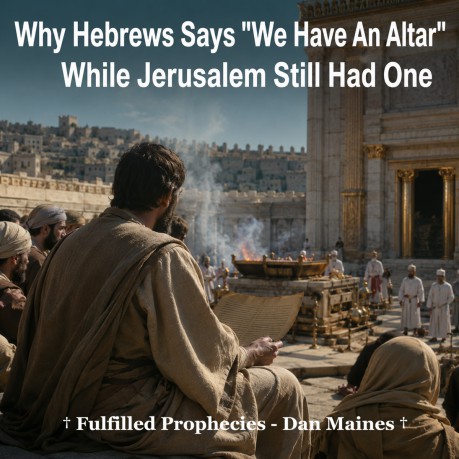
Why Hebrews Says "We
Have An Altar" While Jerusalem Still Had One Introduction Hebrews 13:10 Hebrews 8:13 Hebrews 9:8 Hebrews 10:19-22 Hebrews 13:11-13 Hebrews 13:14 Hebrews 12:22-24 Historical References How It Applies To Us Today Q & A Appendix Q: Does Hebrews show that two covenant systems
were visible at the same time? Q: Did the destruction of the temple in AD 70
make the new covenant begin? Q: Why did Hebrews tell believers to go outside
the camp? Q: Do Christians today need a rebuilt temple or
restored animal sacrifices? Q: Where is the believer's Jerusalem now? † This is the fulfilled perspective we proclaim at
Fulfilled Prophecies † Source Index
By Dan Maines
† When
Hebrews was written, the temple in Jerusalem was still standing, the
priests were still serving, sacrifices were still being offered, and
the altar of the old covenant was still operating. Yet Hebrews makes
the remarkable statement, We have an altar. The writer wasn't
pointing Christians back to Jerusalem. He was declaring that
believers already possessed the reality to which Israel's altar had
pointed.
† This is one of the clearest
pictures of the first-century covenant transition. For a time, two
covenant systems could be seen operating side by side. One was old,
growing obsolete, and ready to disappear. The other had been
established through Christ and was bringing believers into direct
access to God (Hebrews 8:13; 10:19-22).
† The
physical temple hadn't yet been destroyed, but its covenant authority
had already been surpassed by Christ. Jerusalem still had priests,
sacrifices, an altar, and a sanctuary, but believers had the better
priesthood, the better sacrifice, the better covenant, and access to
the true heavenly sanctuary (Hebrews 7:22-25; 8:1-6; 9:11-12).
†
Hebrews 13:10 therefore isn't a casual statement about Christian
worship. It's a declaration that the center of covenant life had
shifted from the earthly system to Christ.
We have an altar from which
those who serve the tabernacle have no right to eat.
†
Notice the contrast. We have an altar, but those who continued
serving the tabernacle had no right to eat from it. The writer placed
believers and the old covenant worshipers on opposite sides of a
covenant boundary.
† The point isn't that
Christians had constructed another physical altar. Christ Himself,
His sacrifice, and the benefits of His finished work are the reality
represented by the altar. Believers weren't being called back to
animal sacrifices, they had something infinitely greater (Hebrews
9:11-14; 10:10-14).
† This becomes especially
important because the Jerusalem temple was still functioning. The old
altar could still be seen, touched, and used, but outward visibility
didn't equal continuing covenant authority. The true access to God
was now found through Christ (Hebrews 10:19-22).
†
Those who remained attached to the old system couldn't obtain the
benefits of Christ while rejecting the covenant He established. The
issue wasn't geography, ethnicity, or architecture. The issue was
covenant access.
When He said, "A new
covenant," He has made the first obsolete. But whatever is
becoming obsolete and growing old is about to disappear.
†
This verse explains why both systems could still be visibly present.
The new covenant had been established, while the old covenant was
becoming obsolete and approaching its complete disappearance.
†
Hebrews doesn't describe the old covenant as waiting thousands of
years to disappear. The writer told his first-century readers that it
was aging and near its end.
† This explains
the transition period between the cross and AD 70. Christ had
established the new covenant, but the physical structures associated
with the old covenant remained until Jerusalem and the temple were
destroyed.
† The destruction of the temple
didn't make Christ's sacrifice effective. His sacrifice was already
effective. AD 70 publicly and historically removed the old covenant
system that had continued operating after its covenant purpose had
been fulfilled.
The Holy Spirit is signifying
this, that the way into the holy place has not yet been disclosed
while the outer tabernacle is still standing,
†
Hebrews connects the standing first tabernacle with the old covenant
arrangement. The earthly sanctuary represented a system of restricted
access, priests entered where ordinary Israelites couldn't go, and
only the high priest entered the Most Holy Place, once each year
(Hebrews 9:6-7).
† Christ changed that
reality. Through Him, believers received access that the old covenant
worshiper never possessed. The veil and sanctuary system had
illustrated separation, but Christ opened the way into God's presence
(Hebrews 10:19-20).
† This is why the
continued existence of the Jerusalem temple during the transition
period matters. It stood as the visible structure of a covenant order
that was passing away while Christ's people were already entering the
reality to which that structure had pointed.
†
When the temple fell in AD 70, the earthly system that symbolized
restricted covenant access disappeared. God's people weren't left
without a sanctuary or altar. They already had the greater reality in
Christ.
Therefore, brothers and
sisters, since we have confidence to enter the holy place by the
blood of Jesus, by a new and living way which He inaugurated for us
through the veil, that is, through His flesh, and since we have a
great priest over the house of God, let's approach God with a sincere
heart in full assurance of faith, having our hearts sprinkled clean
from an evil conscience and our bodies washed with pure water.
†
Under the old covenant, the people couldn't simply enter the Most
Holy Place. Access was restricted. Under Christ, believers were told
to draw near with confidence because His blood had opened the new and
living way.
† This is the contrast behind We
have an altar. Christians didn't need the Jerusalem altar because
they had access through the sacrifice of Christ.
†
The old system continually reminded Israel of separation. Christ
provided reconciliation and access. The old priesthood stood between
the people and the sanctuary, but Jesus brought His people into God's
presence (Hebrews 7:24-25).
† The temple
could remain standing physically without remaining the covenantal
doorway to God. The doorway was now Christ.
For the bodies of those
animals whose blood is brought into the Holy Place by the high priest
as an offering for sin are burned outside the camp. Therefore Jesus
also suffered outside the gate, that He might sanctify the people
through His own blood. So then, let us go out to Him outside the
camp, bearing His reproach.
† The writer
immediately explains the altar statement through the Day of Atonement
pattern. The bodies of the sacrificial animals were taken outside the
camp, and Jesus likewise suffered outside the gate.
†
Then comes the command to go out to Him outside the camp. The readers
weren't merely being taught where Jesus died. They were being told
where their covenant allegiance belonged.
†
Jerusalem still possessed the visible temple system, but believers
were being called away from dependence upon that system and toward
Christ. They weren't to retreat into the old covenant because
persecution made Christianity difficult (Hebrews 10:32-39).
†
Going outside the camp meant identifying with the rejected Messiah
rather than seeking security in the covenant order that was
approaching judgment.
For here we do not have a
lasting city, but we are seeking the city which is to come.
†
The context makes this statement powerful. The readers had just been
told to go outside the camp. Then they were reminded that they didn't
have an enduring city there.
† Earthly
Jerusalem wasn't their permanent covenant city. Hebrews had already
directed their attention toward the heavenly Jerusalem and the city
prepared by God (Hebrews 11:10, 16; 12:22-24).
†
The coming city wasn't another earthly capital with another physical
temple and another animal-sacrifice system. It represented the
completed new covenant order centered in Christ.
†
Jerusalem looked permanent because its walls, temple, priests,
sacrifices, and altar were still visible. Within that generation,
those visible structures would fall, exactly as Jesus had warned
(Matthew 24:1-2, 34).
But you have come to Mount
Zion and to the city of the living God, the heavenly Jerusalem, and
to myriads of angels, to the general assembly and church of the
firstborn who are enrolled in heaven, and to God, the Judge of all,
and to the spirits of the righteous made perfect, and to Jesus, the
mediator of a new covenant, and to the sprinkled blood, which speaks
better than the blood of Abel.
† The writer
didn't tell these believers that someday, thousands of years later,
they might come to Mount Zion. He told them they had come to Mount
Zion, the heavenly Jerusalem.
† This reveals
where the new covenant people already belonged. While earthly
Jerusalem still had its temple and altar, believers had come to the
heavenly Jerusalem through Jesus, the mediator of the new covenant.
†
The contrast couldn't be stronger. One Jerusalem represented the
covenant order that was passing away, while the heavenly Jerusalem
represented the covenant reality established through Christ
(Galatians 4:24-26).
† Hebrews therefore
moves the believer's attention away from earthly sacred geography and
places it entirely upon Christ and the heavenly reality He
established.
†
Josephus describes the temple worship, priesthood, sacrifices, and
altar continuing in Jerusalem during the years leading up to the
Jewish war. His account confirms that the physical temple system
remained active until the Roman siege brought it to an end (Josephus,
Wars of the Jews, Books 5-6).
† Josephus
records the devastation of Jerusalem and the burning and destruction
of the temple in AD 70. What Hebrews described as growing old and
approaching disappearance eventually disappeared from history as an
operating temple system (Josephus, Wars of the Jews, Book 6).
†
Tacitus also records the Roman war against Jerusalem and describes
the temple as an immense and significant sanctuary within the
fortified city. His Roman account independently confirms the
historical setting in which Jerusalem and its temple came under Roman
judgment (Tacitus, Histories, Book 5).
†
Eusebius later records the tradition that the believers in Jerusalem
departed from the city before the war and settled at Pella. Whether
every detail of that later tradition can be independently established
or not, it reflects the early Christian understanding that the
church's future wasn't tied to the doomed Jerusalem temple system
(Eusebius, Ecclesiastical History, Book 3, Chapter 5).
†
We don't need a physical altar because Christ is our once-for-all
sacrifice and our access to God isn't dependent upon an earthly
sanctuary (Hebrews 10:10-14, 19-22).
† We
don't need an earthly priesthood standing between us and God because
Jesus is our permanent High Priest and mediator (Hebrews 7:24-25;
9:15).
† We don't need to look toward
Jerusalem as though God's covenant presence is waiting to return
there. Hebrews tells believers that they've come to Mount Zion, the
heavenly Jerusalem (Hebrews 12:22-24).
† We
don't need another temple, another animal sacrifice, another
Levitical priesthood, or another earthly altar. Returning to those
shadows would move backward from the reality that has already come in
Christ (Hebrews 8:4-6; 10:1).
† Hebrews 13:10
still speaks clearly, We have an altar. Jerusalem's altar disappeared
nearly two thousand years ago, but the reality believers possess in
Christ remains.
† The lesson of the
transition period is simple. Something can still exist physically
after its covenant purpose has been fulfilled. The temple remained
standing for a time, but the new and living way had already been
opened through Jesus.
† That's why AD 70
matters. It wasn't the beginning of Christ's work, it was the
historical removal of the old covenant structure after Christ had
established the better covenant, better priesthood, better sacrifice,
better sanctuary, and better access to God.
Q: How
could Christians say We have an altar while the Jerusalem altar was
still operating?
A: Because the Christian altar
wasn't another physical altar competing with Jerusalem. Christ and
His once-for-all sacrifice were the new covenant reality to which the
old altar pointed (Hebrews 13:10; 10:10-14).
A: Yes. The new
covenant had been established while the old covenant was growing
obsolete and approaching disappearance (Hebrews 8:13).
A: No. Jesus
established the new covenant through His blood before AD 70. The
destruction of Jerusalem removed the old covenant temple system that
had continued functioning during the transition period (Hebrews 9:15;
10:19-22).
A: Because their allegiance belonged
with Christ rather than with the old covenant order centered in
Jerusalem. Jesus suffered outside the gate, and His followers were
called to identify with Him (Hebrews 13:11-13).
A: No. Christ
offered one sacrifice for sins for all time, and believers have
direct access to God through Him (Hebrews 10:12, 19-22).
A:
Hebrews identifies the believer's covenant city as Mount Zion, the
city of the living God, the heavenly Jerusalem (Hebrews 12:22-24).
© Fulfilled Prophecies - Dan
Maines.
† Hebrews
13:10; Hebrews 8:13; Hebrews 9:8; Hebrews 10:19-22; Hebrews 13:11-13;
Hebrews 13:14; Hebrews 12:22-24
† Josephus,
Wars of the Jews, Books 5-6; Tacitus, Histories, Book 5; Eusebius,
Ecclesiastical History, Book 3, Chapter 5
Links