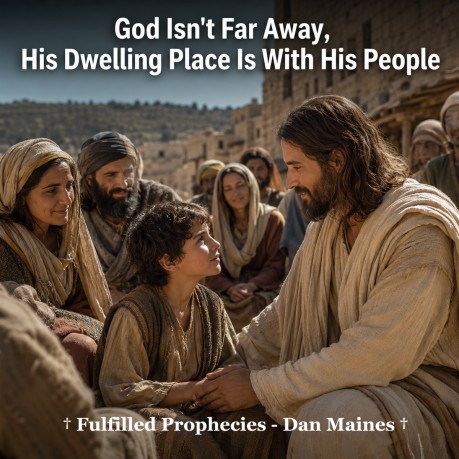
God Isn't Far Away, His
Dwelling Place Is With His People Introduction Scripture Genesis 3:8 Exodus 25:8 1 Kings 8:27 John 1:14 John 14:23 2 Corinthians 6:16 Ephesians 2:19-22 Hebrews 12:22-24 Revelation 21:2-3 Historical References How It Applies To Us Today Q & A Appendix Q: Does this mean church buildings are God's
temple? Q: Do Christians need to go to Jerusalem to
experience God's presence? Q: What happened to the temple theme after the
Jerusalem temple was destroyed? Q: Is the New Jerusalem connected with God's
people? Q: Why is there no temple in the New
Jerusalem? Q: Are believers waiting to come to Mount Zion
and the heavenly Jerusalem? Q: What does this truth mean for us
personally? † This is the fulfilled perspective we proclaim at
Fulfilled Prophecies † Source Index
By Dan Maines
† From the
beginning of Scripture, one great theme runs through the entire
biblical story, God desires to dwell with His people.
†
Eden, the tabernacle, and the temple weren't disconnected stories.
They formed a developing picture of God's presence with mankind,
pointing forward to something greater.
† The
tabernacle could be taken down. The temple could be destroyed. But
God's final dwelling place isn't a building made by human hands. God
dwells with His people through Christ.
†
Jesus didn't come merely to bring people closer to a physical
sanctuary. He brought His people into fellowship with the Father and
made them God's dwelling place (John 14:23; Ephesians 2:21-22).
†
This is why believers don't need to look toward an earthly temple, a
sacred city, or a future building to find the presence of God. In
Christ, God isn't far away. His dwelling place is with His people.
Now they heard the sound of the
Lord God walking in the garden in the cool of the day, and the man
and his wife hid themselves from the presence of the Lord God among
the trees of the garden.
† Eden introduces
the pattern of God present with mankind. Adam and Eve weren't
pictured as searching for a distant God. God was present among
them.
† Sin disrupted that fellowship, and
mankind was driven from the garden. The rest of the biblical story
develops the restoration of access to God's presence (Genesis
3:23-24).
† What was lost in Eden becomes an
important theme running through Scripture, God dwelling with mankind
without the separation caused by sin (Revelation 21:3).
Have them construct a sanctuary
for Me, so that I may dwell among them.
† The
tabernacle continued the dwelling theme. God commanded Israel to
construct a sanctuary so that His presence would be represented among
His covenant people.
† Yet the tabernacle
wasn't the final destination. It was movable, temporary, and
connected with the old covenant system that pointed beyond itself
(Hebrews 8:5; 9:8-11).
† God was teaching
Israel through visible things about a greater spiritual reality. The
sanctuary pointed toward the day when God's dwelling wouldn't be
centered in a tent or physical structure.
But will God indeed dwell on
the earth? Behold, heaven and the highest heaven cannot contain You,
how much less this house which I have built!
†
Even Solomon understood that the temple couldn't contain God. The
building represented God's covenant presence, but God was infinitely
greater than the structure.
† This prevents
us from treating the Jerusalem temple as God's ultimate dwelling
place. Solomon himself recognized the limitation of the physical
house.
† The temple had a purpose in God's
redemptive plan, but that purpose pointed beyond stone walls toward
the greater dwelling God would establish in Christ (John 2:19-21;
Ephesians 2:21-22).
And the Word became flesh, and
dwelt among us; and we saw His glory, glory as of the only Son from
the Father, full of grace and truth.
† Here
the dwelling theme takes an enormous step forward. God's presence
wasn't centered merely in a tent or temple. The Word became flesh and
lived among mankind.
† Jesus was the true
meeting place between God and man. That's why He could identify His
own body with the temple (John 2:19-21).
†
The movement of Scripture is becoming unmistakable, Eden, tabernacle,
temple, Christ. Each stage moves the story toward God's ultimate
dwelling with His redeemed people.
Jesus answered and said to him,
If anyone loves Me, he will follow My word; and My Father will love
him, and We will come to him and make Our dwelling with him.
†
Jesus didn't tell His disciples that the Father's presence would
ultimately depend upon another physical temple. He promised that the
Father and Son would make their dwelling with those who belong to
Christ.
† God's presence under the new
covenant isn't restricted to one geographical location. Jesus had
already announced that worship wouldn't remain centered in Jerusalem
(John 4:21-24).
† This means believers don't
have to travel to a sacred building to become closer to God. Through
Christ, fellowship with the Father is a present covenant reality.
Or what agreement does
the temple of God have with idols? For we are the temple of the
living God; just as God said, I will dwell among them and walk among
them; And I will be their God, and they shall be My people.
†
Paul couldn't have stated it more clearly. God's people are His
temple.
† Notice where Paul places God's
dwelling. He doesn't point believers toward a rebuilt sanctuary in
Jerusalem. He tells them that they themselves are the temple of the
living God.
† The physical temple system was
giving way to the spiritual reality it anticipated. God's covenant
presence was now identified with His people in Christ (1 Corinthians
3:16; Ephesians 2:21-22).
† This is one of
the strongest reasons Christians shouldn't be waiting for another
earthly temple to restore God's presence. God's dwelling place has
already been revealed.
So then you are no longer
strangers and foreigners, but you are fellow citizens with the
saints, and are of God's household, having been built on the
foundation of the apostles and prophets, Christ Jesus Himself being
the cornerstone, in whom the whole building, being fitted together,
is growing into a holy temple in the Lord, in whom you also are being
built together into a dwelling of God in the Spirit.
†
Paul describes believers themselves as God's holy temple and God's
dwelling in the Spirit.
† The building isn't
made from limestone, cedar, gold, or silver. Christ is the
cornerstone, the apostles and prophets form the foundation, and God's
people are being joined together into the dwelling place.
†
This also destroys the idea that God's ultimate dwelling is limited
to one nation or geographical location. Jews and Gentiles who are in
Christ belong to the same household and the same temple (Ephesians
2:14-18).
† God's dwelling place is a people
united in Christ.
But you have come to Mount
Zion and to the city of the living God, the heavenly Jerusalem, and
to myriads of angels, to the general assembly and church of the
firstborn who are enrolled in heaven, and to God, the Judge of all,
and to the spirits of the righteous made perfect, and to Jesus, the
mediator of a new covenant, and to the sprinkled blood, which speaks
better than the blood of Abel.
† The writer
doesn't tell these believers that they would someday come to Mount
Zion. He tells them that they had come to it.
†
This Zion is identified as the city of the living God and the
heavenly Jerusalem. The movement is away from earthly shadows and
into new covenant realities centered in Christ.
†
God's people don't need to return to earthly Jerusalem to find the
city where God dwells. Through Jesus, they belong to the heavenly
Jerusalem and have access to God (Hebrews 10:19-22).
†
This prepares us to understand the New Jerusalem in Revelation as the
completed covenant dwelling of God with His people.
And I saw the holy city,
new Jerusalem, coming down out of heaven from God, prepared as a
bride adorned for her husband. And I heard a loud voice from the
throne, saying, Behold, the tabernacle of God is among the people,
and He will dwell among them, and they shall be His people, and God
Himself will be among them,
† Revelation
brings the entire biblical dwelling theme to its covenant goal. The
language intentionally reaches back through Scripture to God's desire
to dwell among His people.
† The New
Jerusalem is also described as the bride. This isn't merely a
description of buildings, streets, and physical architecture. The
city represents God's covenant people in their completed relationship
with Him (Revelation 21:9-10).
† Notice the
announcement, God's tabernacle is with mankind. What was pictured in
Eden, symbolized in the tabernacle, represented in the temple,
revealed bodily in Christ, and experienced through the Spirit reaches
its full covenant expression.
† Revelation
doesn't end by directing God's people back to an earthly temple. In
fact, John specifically says that he saw no temple in the city
because the Lord God Almighty and the Lamb are its temple (Revelation
21:22).
† From a fulfilled perspective,
Revelation's New Jerusalem describes the established new covenant
order following the judgment of the old covenant city. God's people
now live in the reality toward which the earlier dwelling places
pointed.
†
Josephus described the catastrophic destruction of Jerusalem and its
temple by the Romans in AD 70. His account records the burning of the
sanctuary and the devastation that brought the old temple-centered
order to its historical end (Josephus, Wars of the Jews, Book 6).
†
Josephus' description is important because the New Testament had
already identified believers, not the Jerusalem building, as God's
temple before that physical temple was destroyed (2 Corinthians 6:16;
Ephesians 2:21-22).
† Eusebius later recorded
that the Christians in Jerusalem departed from the city before the
war and went to Pella. His account preserves an early Christian
tradition that believers didn't regard physical Jerusalem as the
place where they had to remain in order to stay near God (Eusebius,
Ecclesiastical History, Book 3, Chapter 5).
†
The destruction of the temple didn't leave God homeless. Scripture
had already revealed His new covenant dwelling place, His people in
Christ.
†
God isn't far away from His people. We don't have to wait for a
future temple, travel to Jerusalem, or enter a sacred building to
find Him.
† We can rejoice because God's
presence isn't limited by geography. Wherever His people are, they
belong to the dwelling place He established in Christ (John 14:23;
Ephesians 2:22).
† This gives tremendous
meaning to the church. Believers aren't merely people who attend a
religious meeting. Together, we're described as God's household and
His temple (Ephesians 2:19-22).
† It also
gives us confidence in prayer. We aren't trying to convince a distant
God to come near. Through Christ we already have access to the Father
(Ephesians 2:18).
† It gives us joy when we
understand Revelation. The Bible doesn't end with God's people
separated from Him and desperately waiting for access. It ends with
the declaration that God's dwelling is with mankind (Revelation
21:3).
† Eden showed God's presence with
mankind. The tabernacle pictured it. The temple represented it.
Christ embodied it. The Spirit established it among God's people. The
New Jerusalem reveals its completed covenant reality.
†
We aren't waiting for God to move back into a building. We aren't
waiting for another earthly holy place. In Christ, God's people are
His dwelling place.
† That's good news for
every believer today. God isn't far away. We have access to the
Father through Christ, we're citizens of the heavenly Jerusalem, and
we're being joined together as God's dwelling in the Spirit
(Ephesians 2:18-22; Hebrews 12:22-24).
† The
biblical story of God's dwelling doesn't end with mankind trying to
get back into Eden. It ends with God dwelling with His redeemed
people.
† We can live with confidence, peace,
gratitude, and great joy because the promise has reached its goal,
God is with His people.
Q: Is
God waiting for another physical temple before He can dwell with His
people?
A: No. Paul explicitly says that
believers are the temple of the living God and that God dwells among
them (2 Corinthians 6:16; Ephesians 2:21-22).
A: No. The New Testament identifies
God's people as His temple. A church building can be useful for
gathering, but the building itself isn't God's new covenant sanctuary
(2 Corinthians 6:16; Ephesians 2:19-22).
A: No. Jesus said
worship would no longer be centered in Jerusalem, and Hebrews says
believers had already come to the heavenly Jerusalem (John 4:21-24;
Hebrews 12:22-24).
A: It didn't
disappear. Before AD 70, the apostles had already taught that Christ
and His people were the true new covenant dwelling place of God (John
2:19-21; 2 Corinthians 6:16; Ephesians 2:21-22).
A: Yes. Revelation identifies the New
Jerusalem with the bride and then announces that God's tabernacle is
with mankind (Revelation 21:2-3, 9-10).
A: Because the old temple system
isn't needed in the completed new covenant reality. The Lord God
Almighty and the Lamb are its temple (Revelation 21:22).
A: Hebrews uses
present reality language for its original readers, saying they had
come to Mount Zion, the city of the living God, the heavenly
Jerusalem (Hebrews 12:22-24).
A: It means we don't worship a
distant God. Through Christ we have access to the Father, and
together believers are God's dwelling place in the Spirit (John
14:23; Ephesians 2:18-22).
© Fulfilled Prophecies - Dan
Maines.
† Genesis
3:8; Exodus 25:8; 1 Kings 8:27; John 1:14; John 14:23; 2 Corinthians
6:16; Ephesians 2:19-22; Hebrews 12:22-24; Revelation 21:2-3
†
Josephus, Wars of the Jews, Book 6; Eusebius, Ecclesiastical History,
Book 3, Chapter 5
Links