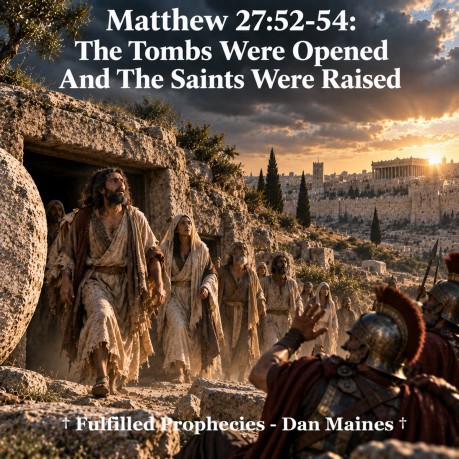
Matthew 27:52-54: The Tombs
Were Opened And The Saints Were Raised Introduction Matthew 27:52-54 Matthew 28:5-7 1 Corinthians 15:20-23 Daniel 12:1-2 John 5:25-29 Revelation 20:12-14 Historical References How It Applies To Us Today Q & A Appendix Q: Did the saints come out of their tombs before
Jesus was raised? Q: Why did these saints appear in Jerusalem? Q: Does Matthew tell us who these saints were? Q: Does Matthew tell us what eventually happened
to these saints? Q: What was the greater message behind the opened
tombs? Q: What does this mean for believers today? Q: Did the saints raised in Matthew 27 physically
die again before the later resurrection was fulfilled? Q: If these saints were physically raised, why
wasn't this the resurrection Paul later described? † This is the fulfilled perspective we proclaim at
Fulfilled Prophecies † Source Index
By Dan Maines
† Matthew
records one of the most remarkable events surrounding the death and
resurrection of Jesus. The earth shook, rocks split, tombs were
opened, and many bodies of the saints who had died were raised.
†
This wasn't an insignificant detail added to the crucifixion account.
God was showing that the death and resurrection of Christ had broken
the power of death and opened the way to resurrection life. (Hebrews
2:14-15)
† These saints weren't the final
resurrection of all the dead. Their appearance was a visible sign
pointing forward to the resurrection work that Christ would complete.
Jesus was the firstfruits, and those who belonged to Him would follow
in their appointed order. (1 Corinthians 15:20-23)
†
Matthew also carefully tells us that these saints came out of the
tombs after Jesus' resurrection. Christ remained first in
resurrection priority, and everything that followed depended upon His
victory.
Also the tombs were opened,
and many bodies of the saints who had fallen asleep were raised; and
coming out of the tombs after His resurrection, they entered the holy
city and appeared to many. Now as for the centurion and those who
were with him keeping guard over Jesus, when they saw the earthquake
and the other things that were happening, they became extremely
frightened and said, "Truly this was the Son of God!"
†
Notice the sequence. The tombs were opened, the saints were raised,
and they came out after Christ's resurrection. Jesus wasn't following
them out of death, they were following Him. (1 Corinthians 15:20)
†
These were identified as saints, people who belonged to God and had
died before these events. Their appearance in Jerusalem provided
visible testimony that something extraordinary had happened through
Christ's death and resurrection. (Romans 1:4)
†
Matthew doesn't tell us that every dead person was raised. He
specifically says many bodies of the saints were raised. This
distinguishes this event from the broader resurrection and judgment
described elsewhere in Scripture. (John 5:28-29)
†
The centurion and those with him saw the earthquake and the events
surrounding Jesus' death and confessed, Truly this was the Son of
God. Creation itself was testifying that this wasn't an ordinary
death. (Matthew 27:54)
And the angel said to the
women, "Do not be afraid; for I know that you are looking for
Jesus who has been crucified. He is not here, for He has risen, just
as He said. Come, see the place where He was lying. And go quickly
and tell His disciples that He has risen from the dead; and behold,
He is going ahead of you to Galilee. There you will see Him; behold,
I have told you."
† Everything begins
with Christ's own resurrection. The empty tomb declared that death
couldn't hold Him. (Acts 2:24)
† Matthew 27
specifically places the saints' emergence from their tombs after His
resurrection. Christ's victory came first, then came the visible
evidence of resurrection power.
† Jesus had
repeatedly told His disciples that He would be killed and raised. His
resurrection proved that His words concerning the resurrection of
others could also be trusted. (Matthew 16:21)
But the fact is,
Christ has been raised from the dead, the first fruits of those who
are asleep. For since by a man death came, by a Man also came the
resurrection of the dead. For as in Adam all die, so also in Christ
all will be made alive. But each in his own order: Christ the first
fruits, after that those who are Christ's at His coming,
†
Paul gives us the order. Christ is the firstfruits. Resurrection
doesn't begin independently of Him, it flows from Him.
†
The saints appearing in Jerusalem didn't replace the resurrection
that was still ahead when Paul wrote Corinthians. Paul still said
those who belonged to Christ would be made alive at His coming. (1
Corinthians 15:23)
† This is important
because Matthew 27 and 1 Corinthians 15 don't contradict each other.
Matthew records a miraculous resurrection sign following Christ's
resurrection, while Paul describes the larger resurrection hope that
was approaching for God's people. (Romans 13:11-12)
†
Firstfruits also carries the idea of a harvest that follows. Christ's
resurrection guaranteed the harvest. The opened tombs in Matthew
dramatically showed that His victory over death had already begun to
produce results. (James 1:18)
Now at that time Michael, the
great prince who stands guard over the sons of your people, will
arise. And there will be a time of distress such as never occurred
since there was a nation until that time; and at that time your
people, everyone who is found written in the book, will be rescued.
And many of those who sleep in the dust of the ground will awake,
these to everlasting life, but the others to disgrace and everlasting
contempt.
† Daniel connected resurrection
with an unparalleled time of trouble involving his people. Jesus used
this same language when describing the coming judgment upon that
first-century generation. (Matthew 24:21, 34)
†
Daniel wasn't shown a resurrection disconnected from Israel's
covenant history. Resurrection, deliverance, judgment, and the time
of unparalleled trouble appear together.
†
Matthew 27 occurred at the beginning of the period in which Christ's
death and resurrection established the victory that would reach its
covenantal completion in the judgment of that generation. (Matthew
24:34)
† The saints raised in Matthew 27
therefore fit within the developing resurrection story, but Matthew
never says that their appearance was the complete fulfillment of
Daniel 12.
Truly, truly, I say to you, a
time is coming and even now has arrived, when the dead will hear the
voice of the Son of God, and those who hear will live. For just as
the Father has life in Himself, so He gave to the Son also to have
life in Himself; and He gave Him authority to execute judgment,
because He is the Son of Man. Do not be amazed at this; for a time is
coming when all who are in the tombs will hear His voice, and will
come out: those who did the good deeds to a resurrection of life,
those who committed the bad deeds to a resurrection of judgment.
†
Before the cross Jesus had already announced that resurrection life
was centered in Him. The dead would hear the voice of the Son of God
and live.
† Jesus connected resurrection with
His authority to judge. Resurrection and judgment weren't unrelated
doctrines, they were parts of the same redemptive work. (John
5:27-29)
† Matthew's opened tombs gave a
dramatic physical demonstration that Jesus truly possessed authority
over death. Death didn't have the final word, Christ did.
†
Jesus spoke of an hour that was coming. The New Testament writers
later described the completion of their salvation as drawing near,
not thousands of years away from them. (Romans 13:11-12; Hebrews
10:37)
And I saw the dead, the
great and the small, standing before the throne, and books were
opened; and another book was opened, which is the book of life; and
the dead were judged from the things which were written in the books,
according to their deeds. And the sea gave up the dead who were in
it, and Death and Hades gave up the dead who were in them; and they
were judged, each one of them according to their deeds. Then Death
and Hades were thrown into the lake of fire. This is the second
death, the lake of fire.
† Revelation brings
the resurrection story to its judgment setting. Death and Hades
surrender their dead, judgment takes place, and death and Hades are
removed.
† Matthew 27 showed tombs opening.
Revelation shows death and Hades themselves losing their claim over
the dead. The first event was a sign of Christ's resurrection power,
while Revelation portrays the completed victory. (Revelation 1:18)
†
Jesus said Revelation concerned things that must shortly come to pass
and that the time was near. Its resurrection and judgment language
must be read within those inspired time statements. (Revelation
1:1-3; 22:6, 10)
† The story isn't about
Christians still waiting for Jesus to defeat death. Christ
accomplished the victory through His death, resurrection, reign, and
completed redemptive work. (Hebrews 2:14-15)
†
Josephus described extraordinary signs surrounding Jerusalem before
its destruction in AD 70, including disturbances, heavenly signs, and
a voice associated with departure from the Temple. His account
provides historical background for the generation Jesus said would
experience Jerusalem's judgment. (Josephus, Wars of the Jews 6.5.3)
†
Tacitus also recorded reports of unusual signs surrounding Jerusalem
and the Temple before the Roman destruction. Although he interpreted
them as a Roman historian, his testimony independently confirms that
extraordinary signs were associated with that period. (Tacitus,
Histories 5.13)
† Eusebius later recorded
that the believers in Jerusalem left the city before the war and went
to Pella. This fits Jesus' warning that His disciples were to flee
when they saw Jerusalem surrounded by armies. (Eusebius,
Ecclesiastical History 3.5; Luke 21:20-22)
†
These historical writers don't prove the resurrection of the saints
in Matthew 27, and they weren't eyewitness explanations of that
event. Matthew is our biblical witness for those raised saints. The
historical writers help document the later first-century judgment
setting surrounding Jerusalem.
†
Matthew 27 gives us a reason for confidence, not fear. Jesus entered
death and came out victorious. The opened tombs declared that death
couldn't stop what God was accomplishing through His Son. (Hebrews
2:14-15)
† We aren't living before the cross
waiting for redemption to begin. We live after Christ's finished
work, His resurrection, and the fulfillment of the covenantal age
that was passing away in the first century. (Hebrews 8:13)
†
Our hope is Christ Himself. He is the resurrection and the life, and
whoever believes in Him has eternal life. (John 11:25-26)
†
We don't need to look at cemeteries wondering whether Jesus has
enough power to defeat death someday. Matthew showed tombs opening
immediately in connection with His victory. Revelation showed death
and Hades defeated. Christ holds the keys of death and Hades.
(Revelation 1:18)
† Because we belong to
Christ, physical death doesn't separate us from Him. Whether we live
or die, we are the Lord's. (Romans 14:8)
Q: Were
the saints raised in Matthew 27 the complete resurrection of the
dead?
A: No. Matthew says many bodies of the
saints were raised, not all the dead. Paul later still spoke of the
resurrection of those belonging to Christ at His coming. (1
Corinthians 15:20-23)
A: Matthew specifically says
they came out of the tombs after His resurrection. Christ therefore
maintains His position as the firstfruits of those who had died. (1
Corinthians 15:20)
A:
Their appearance provided a visible testimony in the very city where
Jesus had been crucified that His death and resurrection had brought
resurrection power into history. (Matthew 27:52-54)
A:
No. Matthew calls them saints but doesn't give their names. We
shouldn't add names that Scripture doesn't provide.
A: No. Matthew tells us they
were raised, entered the holy city, and appeared to many. Scripture
doesn't tell us what happened to them afterward, so we shouldn't
build doctrine on details God didn't reveal.
A: Jesus had authority over death. His
resurrection was the firstfruits and guarantee that death wouldn't
prevent God from completing the resurrection and redemption He had
promised. (1 Corinthians 15:20-23)
A:
Our life is in Christ. We don't live waiting for Jesus to become
victorious. We live because He is victorious, and nothing, including
death, can separate us from Him. (Romans 8:38-39)
A:
Scripture doesn't tell us what physically happened to these saints
afterward. Matthew tells us they were raised, entered the holy city,
and appeared to many, but he says nothing about them ascending to
heaven or remaining physically alive. Since Paul later still
described the resurrection as something awaiting fulfillment, Matthew
27 shouldn't be treated as the completed resurrection. We shouldn't
go beyond what Scripture actually says. (Matthew 27:52-53; 1
Corinthians 15:20-23)
A:
Because Paul wrote after Christ's resurrection and still said, "then
they that are Christ's, at his coming." The raising of the
saints in Matthew 27 was a real sign of Christ's victory over death,
but the resurrection Paul described was still ahead when he wrote 1
Corinthians. (1 Corinthians 15:20-23, 51-52)
© Fulfilled Prophecies - Dan
Maines.
† Matthew
27:52-54; Matthew 28:5-7; 1 Corinthians 15:20-23; Daniel 12:1-2; John
5:25-29; Revelation 20:12-14
† Josephus, Wars
of the Jews 6.5.3; Tacitus, Histories 5.13; Eusebius, Ecclesiastical
History 3.5
Links