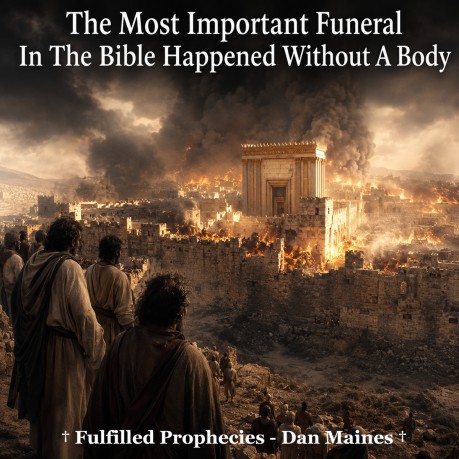
The Most Important Funeral In
The Bible Happened Without A Body Introduction Hebrews 8:13 Hebrews 9:8-10 Hebrews 10:9-10 Hebrews 12:26-28 Matthew 24:1-2 Luke 21:20-22 Galatians 4:25-26 Revelation 21:1-2 Historical References How It Applies To Us Today Q & A Appendix Q: Did the Old Covenant end at the cross or in AD
70? Q: Why did God allow the temple to remain after
Jesus died? Q: Does this mean the physical earth ended in AD
70? Q: Could the Old Covenant temple system someday
be restored by God? Q: So what was the most important funeral without
a body? † This is the fulfilled perspective we proclaim at
Fulfilled Prophecies † Source Index
By Dan Maines
† One of the
most important funerals in the Bible happened without a physical
body, without a coffin, and without a grave.
†
What died was a covenant world, the Old Covenant order centered on
the earthly sanctuary, Levitical priesthood, sacrifices, and the
earthly Jerusalem.
† Its death wasn't
instantaneous in its historical administration. Jesus established the
New Covenant through His blood, but the old system remained standing
during a period of transition until its visible removal in AD 70
(Hebrews 8:13; Hebrews 9:8).
† Hebrews
describes this transition with remarkably precise language. The Old
Covenant was becoming obsolete, growing old, and ready to
disappear.
† That language sounds almost like
an obituary written before the funeral.
† By
the time Hebrews was written, the Old Covenant world was still
physically visible, but spiritually it had already been surpassed by
something infinitely greater.
† The temple
still stood. Priests still served. Sacrifices were still offered.
Jerusalem still functioned as the center of Jewish worship.
†
Yet God had already announced that the entire covenant order was
ready to disappear.
† AD 70 was therefore
more than the destruction of buildings. It was the public, historical
removal of an obsolete covenant administration whose replacement had
already arrived in Jesus Christ.
When He said, "A new
covenant," He has made the first obsolete. But whatever is
becoming obsolete and growing old is about to disappear.
†
This verse gives us the language behind the funeral. The writer
didn't describe the Old Covenant as healthy, permanent, or waiting
for restoration. He described it as becoming obsolete, growing old,
and ready to disappear.
† Notice the
transitional language. The New Covenant had already been established,
while the Old Covenant system was still visibly present and
approaching its final removal (Hebrews 9:8-10).
†
The writer was living between the establishment of the New Covenant
through Christ and the historical disappearance of the old temple
order.
† This explains why Hebrews speaks
with both accomplished and approaching language. Christ's sacrifice
was finished, but the obsolete covenant structure was still standing
for a short time (Hebrews 10:9-14).
† The
question isn't whether the Old Covenant would disappear. Hebrews says
it was ready to disappear. The question is when that visible
disappearance occurred, and history gives us the unmistakable answer,
AD 70.
The Holy Spirit is signifying
this, that the way into the holy place has not yet been disclosed
while the outer tabernacle is still standing, which is a symbol for
the present time. Accordingly both gifts and sacrifices are offered
which cannot make the worshiper perfect in conscience, since they
relate only to food, drink, and various washings, regulations for the
body imposed until a time of reformation.
†
The first tabernacle represented more than a building. It represented
an entire covenant arrangement that was still standing when Hebrews
was written.
† The writer specifically called
it a figure for the time then present. That places his discussion
inside a first-century transition, not thousands of years in the
future.
† The old ordinances had an
expiration point. They were imposed until the time of reformation,
showing that God never intended the Mosaic covenant administration to
continue forever (Hebrews 7:11-12).
† Christ
had already entered the greater and more perfect tabernacle, so the
earthly copy had served its purpose (Hebrews 9:11-12).
†
The continued existence of the earthly temple didn't prove the Old
Covenant still possessed divine permanence. It proved the transition
hadn't yet reached its historical conclusion.
then He said, "Behold,
I have come to do Your will." He takes away the first in order
to establish the second. By this will, we have been sanctified
through the offering of the body of Jesus Christ once for all time.
†
The order couldn't be clearer. God removed the first so that He could
establish the second.
† Jesus didn't come to
repair the Mosaic covenant, extend it, or place Christianity beside
it. He brought the covenant purpose to its intended fulfillment and
established the better covenant (Hebrews 8:6).
†
The sacrifice that established this new reality wasn't another animal
sacrifice. It was the once-for-all offering of Jesus Christ.
†
The cross settled the sacrificial issue completely. There was no
theological reason for the old sacrificial system to continue because
the perfect sacrifice had already been offered (Hebrews 10:11-14).
†
What remained after the cross was a fading covenant administration
awaiting its final historical removal.
And His voice shook the
earth then, but now He has promised, saying, "Yet once more I
will shake not only the earth, but also the heaven." This
expression, "Yet once more," denotes the removing of those
things which can be shaken, as of created things, so that those
things which cannot be shaken may remain. Therefore, since we receive
a kingdom which cannot be shaken, let's show gratitude, by which we
may offer to God an acceptable service with reverence and awe;
†
Hebrews moves from something growing old to something being shaken
and removed. These aren't disconnected ideas. They describe the
passing of the temporary covenant order and the permanence of
Christ's kingdom.
† The shaking wasn't the
destruction of the physical universe. Its purpose was the removal of
things that could be shaken so that the unshakable kingdom would
remain.
† The believers weren't waiting
thousands of years to receive that kingdom. The writer says they were
receiving it.
† The contrast is between
temporary and permanent, earthly shadow and heavenly reality, Sinai
and Zion, Old Covenant and New Covenant (Hebrews 12:18-24).
†
When Jerusalem and the temple fell in AD 70, the visible center of
the Old Covenant world was shaken out of existence, but Christ's
kingdom remained untouched.
Jesus left the temple area
and was going on His way when His disciples came up to point out the
temple buildings to Him. But He responded and said to them, "Do
you not see all these things? Truly I say to you, not one stone here
will be left upon another, which will not be torn down."
†
Jesus personally announced the coming destruction of the temple. The
magnificent structure admired by the disciples had a divine sentence
hanging over it.
† This wasn't a vague
prediction about someday. The rest of the discourse identifies the
generation that would witness these events (Matthew 24:34).
†
The temple's destruction therefore belongs directly in the covenant
transition described by Hebrews.
† Hebrews
said the old order was ready to disappear. Jesus said the temple
would be completely demolished. History records both realities
converging in the same first-century catastrophe.
†
The funeral had been announced before Rome ever surrounded Jerusalem.
But when you see Jerusalem
surrounded by armies, then recognize that her desolation is near.
Then those who are in Judea must flee to the mountains, and those who
are inside the city must leave, and those who are in the country must
not enter the city; because these are days of punishment, so that all
things which have been written will be fulfilled.
†
Jesus gave His disciples a visible sign, Jerusalem surrounded by
armies.
† He called what followed the days of
vengeance and connected them with the fulfillment of what had been
written.
† This judgment wasn't disconnected
from covenant history. Jerusalem was the city of the temple,
priesthood, sacrifices, and the Old Covenant administration that
Hebrews said was ready to disappear.
† When
the armies arrived, the generation Jesus warned was facing the
covenant judgment He had repeatedly announced (Luke 19:41-44; Matthew
23:34-36).
† The disappearance described in
Hebrews wasn't an invisible abstraction. The old covenant world had a
visible center, and that center was about to be devastated.
Now this Hagar is Mount
Sinai in Arabia and corresponds to the present Jerusalem, for she is
enslaved with her children. But the Jerusalem above is free; she is
our mother.
† Paul identifies two Jerusalems
representing two covenant realities.
† The
Jerusalem then existing on earth was associated with Sinai and
bondage, while the Jerusalem above represented freedom.
†
This makes the covenant transition unmistakable. God's redemptive
movement wasn't toward preserving earthly Jerusalem as the permanent
center of His kingdom. It was toward the heavenly Jerusalem revealed
through the New Covenant (Hebrews 12:22).
†
Earthly Jerusalem could fall without destroying God's kingdom because
God's people belonged to a city that Roman armies couldn't touch.
†
The old Jerusalem could have its funeral because the Jerusalem above
was already the believer's mother.
Then I saw a new heaven
and a new earth; for the first heaven and the first earth passed
away, and there is no longer any sea. And I saw the holy city, new
Jerusalem, coming down out of heaven from God, prepared as a bride
adorned for her husband.
† Revelation
completes the covenant picture with the passing of the former world
and the revelation of the New Jerusalem.
†
This language follows the prophetic pattern of describing covenantal
transformation through cosmic imagery (Isaiah 65:17-18).
†
The disappearance of the old wasn't the annihilation of planet Earth.
It was the passing of the former covenant world and the full
manifestation of the New Covenant order.
†
This is why the Bible's most important funeral didn't need a physical
body. A covenant age was being buried.
† The
Old Covenant world grew old, became obsolete, was shaken, judged, and
finally disappeared, while the kingdom of Jesus Christ remained.
†
What disappeared wasn't God's faithfulness. Its disappearance
demonstrated God's faithfulness because the temporary shadows had
accomplished their purpose and the promised reality had come in
Christ.
†
Josephus witnessed and recorded the Jewish-Roman war that ended with
Jerusalem and the temple being destroyed in AD 70. His account
describes famine, internal violence, Roman siege operations, the
burning of the temple, and the devastation of the city, providing an
extraordinary historical witness to the world Jesus said would
fall.
† Josephus records Titus and the Roman
forces taking Jerusalem and the sanctuary being consumed during the
catastrophe. Whatever theological interpretation someone places on
those events, the historical destruction of the temple system is
beyond dispute.
† Tacitus also records the
Roman conflict with Jerusalem and confirms the historical setting of
the Jewish war and the Roman campaign against the city.
†
Eusebius later connected Jerusalem's destruction with the judgment
foretold by Jesus and preserved the early Christian tradition that
believers escaped the city before the catastrophe.
†
These writers don't establish biblical doctrine, Scripture does.
Their importance is that they provide historical testimony that the
temple, city, priestly center, and sacrificial world described in the
New Testament actually came crashing down in the first century.
†
We aren't living beside a dying Old Covenant. We're living in the
established reality of the New Covenant.
† We
don't need another earthly temple because Christ is greater than the
temple and God's people are His dwelling place (Ephesians 2:19-22).
†
We don't need another Levitical priesthood because Jesus is our
permanent High Priest (Hebrews 7:23-25).
† We
don't need another animal sacrifice because Christ offered Himself
once for all (Hebrews 10:10-14).
† We don't
need to wait for the Old Covenant world to disappear. Hebrews said it
was ready to disappear in their day, and history records exactly what
happened to its earthly center in AD 70.
† We
don't live among the shadows waiting for reality. We have Christ.
†
The funeral is over. The obsolete covenant order isn't coming back
from the grave.
† Our calling isn't to
rebuild what God removed, but to live faithfully in the unshakable
kingdom we've received through Jesus Christ (Hebrews 12:28).
Q: What
exactly died if there wasn't a physical body?
A:
The Old Covenant administration, its earthly sanctuary system,
Levitical order, sacrifices, and covenant world reached their
appointed end. Hebrews describes that order as becoming obsolete and
ready to disappear (Hebrews 8:13).
A: Christ established the New Covenant
through His sacrifice and removed the first covenant as the basis of
access to God, while Hebrews shows that the old system remained
visibly standing during a transitional period and was ready to
disappear (Hebrews 8:13; Hebrews 9:8; Hebrews 10:9-10). AD 70 brought
the historical destruction of its temple-centered administration.
A: The New Testament presents a
transition in which the finished work of Christ had already
established the new reality while the old temple system remained
temporarily visible. Hebrews specifically speaks of the first
tabernacle still standing while describing the old covenant as ready
to disappear (Hebrews 8:13; Hebrews 9:8).
A: No. The language describes covenantal
removal and renewal. Hebrews speaks of removing what could be shaken
so that the unshakable kingdom would remain, and Revelation contrasts
the passing former order with New Jerusalem (Hebrews 12:26-28;
Revelation 21:1-2).
A: A rebuilt temple
couldn't improve on Christ's finished work. Hebrews presents Jesus'
sacrifice as once for all and the former covenant as obsolete and
disappearing, not temporarily suspended until a future restoration
(Hebrews 8:13; Hebrews 10:10-14).
A: It was the disappearance of the Old
Covenant world. It grew old, became obsolete, was shaken, and its
earthly center was destroyed, while the New Covenant kingdom
established in Christ remained (Hebrews 8:13; Hebrews 12:26-28).
© Fulfilled Prophecies - Dan
Maines.
† Hebrews
8:13; Hebrews 9:8-10; Hebrews 10:9-10; Hebrews 12:26-28; Matthew
24:1-2; Luke 21:20-22; Galatians 4:25-26; Revelation 21:1-2
†
Historical writers: Josephus, The Wars of the Jews, Books 5-7;
Tacitus, Histories, Book 5; Eusebius, Ecclesiastical History, Book 3
Links