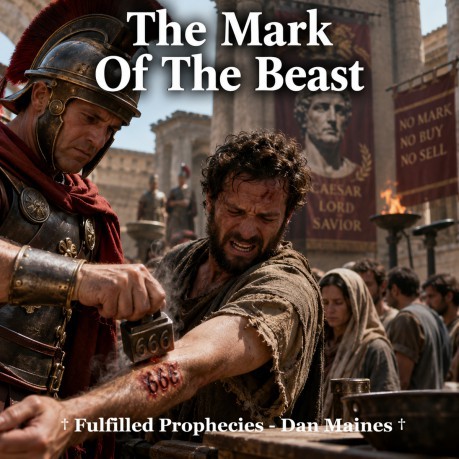
The Mark Of The Beast Introduction Revelation 1:1-3 Revelation 13:16-18 Revelation 14:9-12 Revelation 15:2 Revelation 17:9-10 Revelation 19:19-20 Revelation 20:4 Historical References How It Applies To Us Today Q & A Appendix Q: Could someone accidentally receive the
mark? Q: Why is the number 666 important? Q: Why were the forehead and hand used? Q: Does the mark of the beast still need to
happen? Q: Should Christians fear digital currency,
biometric identification, or new technology because it might be the
mark? Q: What should Christians learn from the mark of
the beast today? † This is the fulfilled perspective we proclaim at
Fulfilled Prophecies † Source Index
By Dan Maines
† There's a
lot of noise in dispensationalism about the mark of the beast. We're
repeatedly told that it's right around the corner, that a new
technology might be the mark, that a computer chip might be the mark,
that a digital identification system might be the mark, or that some
future world government will force everyone to receive 666.
†
But Revelation wasn't written to frighten Christians two thousand
years later about technology John never mentioned. It was written to
seven real churches in Asia who were facing real pressures in their
own time.
† The first thing we should ask
isn't, What modern invention could become the mark? The first
question should be, What did John tell his original readers?
†
Revelation identifies the mark with the beast's name and the number
of his name. It connects the mark with worship, allegiance, economic
pressure, persecution, and the number of a man (Revelation 13:15;
Revelation 14:9-11).
† The book also
establishes its own time frame. These things were to happen shortly,
the time was near, and the original churches were expected to
understand and obey the prophecy (Revelation 22:6, 10).
†
The mark of the beast isn't an imminent threat to Christians today.
It belonged to the first-century conflict described in Revelation.
The Revelation of Jesus
Christ, which God gave Him to show to His bond-servants, the things
which must soon take place; and He sent and communicated it by His
angel to His bond-servant John, who testified to the word of God and
to the testimony of Jesus Christ, everything that he saw. Blessed is
the one who reads, and those who hear the words of the prophecy and
keep the things which are written in it; for the time is near.
†
Before interpreting the mark, we have to respect Revelation's own
time statements. John didn't say these things would begin thousands
of years later. He said they must shortly take place.
†
John also said the time was at hand. That statement mattered to the
seven churches receiving the book. They weren't being warned about
computers, microchips, bar codes, digital currency, biometric
identification, or technology that wouldn't exist for centuries.
†
This immediately creates a serious problem for the dispensational
interpretation. If the mark belongs exclusively to our future, then
shortly and at hand lose their natural meaning (Revelation 22:6,
10).
† We don't need today's newspaper to
interpret Revelation. We need Revelation's original audience,
historical setting, Old Testament imagery, and its own inspired time
statements.
And he causes all, the
small and the great, the rich and the poor, and the free and the
slaves, to be given a mark on their right hands or on their
foreheads, and he decrees that no one will be able to buy or to sell,
except the one who has the mark, either the name of the beast or the
number of his name. Here is wisdom. Let him who has understanding
calculate the number of the beast, for the number is that of a man;
and his number is six hundred and sixty-six.
†
Notice exactly what Scripture says. The mark is connected with the
name of the beast and the number of his name. John doesn't identify
it as a computer chip, vaccine, credit card, bar code, digital
currency, or electronic implant.
† John says
the number is the number of a man. He then tells his readers to
calculate it. That means the number carried meaning that John's
original audience could understand.
† The
number 666 has long been connected with Nero Caesar. When the form
Neron Caesar is represented in Hebrew letters and those letters are
given their numerical values, the total is 666. This fits the Roman
setting of Revelation and the persecution associated with Nero.
†
The economic language is also important. Refusing allegiance to the
beast brought real social and economic consequences. Buying and
selling weren't presented as evidence of twenty-first-century
technology. Economic exclusion was part of the pressure to conform to
the beast's authority.
† Revelation isn't
warning us that we'll accidentally receive the mark while buying
groceries. Receiving the mark is connected with allegiance to the
beast and worship of his image (Revelation 14:9-11).
Then another angel, a
third one, followed them, saying with a loud voice, "If anyone
worships the beast and his image, and receives a mark on his forehead
or on his hand, he also will drink of the wine of the wrath of God,
which is mixed in full strength in the cup of His anger; and he will
be tormented with fire and brimstone in the presence of the holy
angels and in the presence of the Lamb. And the smoke of their
torment ascends forever and ever; they have no rest day and night,
those who worship the beast and his image, and whoever receives the
mark of his name." Here is the perseverance of the saints who
keep the commandments of God and their faith in Jesus.
†
Here Scripture interprets Scripture. The mark isn't separated from
worship. John repeatedly joins receiving the mark with worshiping the
beast and his image.
† This wasn't about
somebody unknowingly receiving a technological device. The issue was
loyalty. Whom would people serve? Would they submit to the beastly
power opposing God's people, or remain faithful to Christ?
†
The saints are contrasted with the worshipers of the beast. The
faithful keep God's commandments and their faith in Jesus. Revelation
presents two opposing allegiances (Revelation 7:3; Revelation
14:1).
† That's why turning the mark into
every new technology that appears misses John's point. The central
issue wasn't technology, it was worship and allegiance.
And I saw as it were a sea
of glass mingled with fire; and them that come off victorious from
the beast, and from his image, and from the number of his name,
standing by the sea of glass, having harps of God.
†
John saw people who had victory over the beast, his image, and the
number of his name. These weren't Christians living thousands of
years after the seven churches. They belonged to the conflict
Revelation was describing to its first-century audience.
†
They overcame because they refused the beast's demand for allegiance.
Revelation doesn't picture faithful believers desperately trying to
identify a future electronic device. It pictures saints remaining
faithful during persecution (Revelation 12:11).
†
The beast could persecute them, pressure them, and even kill them,
but it couldn't take away their victory in Christ.
And I saw something like
a sea of glass mixed with fire, and those who were victorious over
the beast and his image and the number of his name, standing on the
sea of glass, holding harps of God.
†
Revelation gives geographical and political clues about the beast.
The seven heads represent seven mountains and seven kings. This
points us into John's world, not ours.
† Most
importantly, John says five kings had fallen and one is. That
language places the vision within an existing sequence of rulers.
John wasn't describing a political ruler who wouldn't appear for
another two thousand years.
† Rome was
famously associated with seven hills, and the Roman imperial setting
fits the beast imagery throughout Revelation. The beast represented
persecuting imperial power, with Nero providing a compelling
historical identification for the man associated with 666.
†
John told his readers to use wisdom because the clues had meaning in
their historical world (Revelation 13:18).
And I saw the beast and
the kings of the earth and their armies, assembled to make war
against Him who sat on the horse, and against His army. And the
beast was seized, and with him the false prophet who performed the
signs in his presence, by which he deceived those who had received
the mark of the beast and those who worshiped his image; these two
were thrown alive into the lake of fire, which burns with brimstone.
† The story doesn't leave the beast
undefeated and waiting to return in our generation. Revelation shows
the beast judged.
† Notice again how
receiving the mark and worshiping the image appear together. This
consistent connection makes it impossible to reduce the mark to
modern technology.
† The beast's authority
wasn't permanent. God's judgment brought that persecuting power to
its appointed end. Revelation's message to suffering believers was
ultimately a message of victory (Revelation 12:10-11).
Then I saw thrones, and they
sat on them, and judgment was given to them. And I saw the souls of
those who had been beheaded because of their testimony of Jesus and
because of the word of God, and those who had not worshiped the beast
or his image, and had not received the mark on their foreheads and on
their hands; and they came to life and reigned with Christ for a
thousand years.
† These believers faced the
beast and refused his mark. Some paid for their faithfulness with
their lives. That makes the mark part of an actual persecution
experienced by God's people in the world Revelation addressed.
†
Their refusal to receive the mark demonstrated their loyalty to
Christ. They wouldn't worship the beast or submit spiritually to his
claims.
† Revelation honors them as victors,
not victims. Rome could kill their bodies, but it couldn't remove
them from Christ's kingdom or prevent them from reigning with Him.
†
Tacitus records Nero's brutal persecution of Christians at Rome after
the great fire in AD 64. Christians were arrested, mocked, tortured,
burned, and killed. His account confirms the violent imperial
environment in which allegiance to Christ could carry deadly
consequences.
† Suetonius also records
punishment inflicted upon Christians during Nero's reign. His
testimony independently confirms that Christians were being targeted
by Roman authority.
† The Roman world also
practiced emperor veneration, and imperial loyalty could become
intertwined with public, civic, and economic life. Revelation's
language about worship, allegiance, persecution, and economic
pressure fits that first-century environment.
†
These historical witnesses don't replace Scripture. They help confirm
that the world Revelation describes wasn't imaginary and doesn't need
to be transported into the twenty-first century to make sense.
†
Christians today don't need to live in fear that they're about to
accidentally receive the mark of the beast.
†
We don't need to label every new technology 666. Credit cards weren't
the mark. Bar codes weren't the mark. Social Security numbers weren't
the mark. Computer chips aren't the mark. Digital currency isn't
automatically the mark. Scripture never tells us to identify the mark
by watching technological developments.
†
Dispensationalism keeps moving the mark into the future because its
prophetic system requires a future beast, future tribulation, and
future fulfillment of Revelation. But Revelation itself said the
events were near and would shortly take place (Revelation 1:1, 3).
†
When each generation is told that the mark is imminent, Christians
can spend their lives fearing something Revelation's first readers
were already warned about.
† The lasting
lesson isn't fear of technology. It's faithfulness to Christ. God's
people belong to Christ, and no political power, economic system,
government, or earthly kingdom deserves the worship that belongs to
God.
† The beast didn't win. Christ did. The
persecuted saints weren't abandoned. They overcame. The kingdom
wasn't defeated. Christ reigns.
† We aren't
waiting for the beast to appear. We aren't waiting for 666 to become
a worldwide technological system. We aren't waiting for Revelation's
first-century warnings to suddenly become imminent two thousand years
later.
† The mark of the beast belongs where
John placed it, within the first-century conflict between the beastly
persecuting power and those who faithfully belonged to Christ.
Q: Is
the mark of the beast a future computer chip?
A:
Scripture never says that. The mark is identified with the beast's
name, the number of his name, and worship of the beast and his image
(Revelation 13:16-18; Revelation 14:9-11).
A: Revelation connects receiving the mark
with allegiance and worship. It isn't presented as something a
faithful Christian unknowingly receives while using technology or
participating in ordinary commerce (Revelation 14:9-12).
A:
John says it's the number of a man and tells his readers to calculate
it. The name Neron Caesar, when represented in Hebrew letters and
calculated by their numerical values, produces 666, fitting Nero and
the first-century Roman setting (Revelation 13:18).
A:
Revelation deliberately contrasts the beast's mark with God's
identification of His own people. God's servants are pictured as
sealed on their foreheads, while the beast marks those aligned with
him (Revelation 7:3; Revelation 14:1; Revelation 13:16).
A: No. Revelation announced that its
prophetic events must shortly take place and that the time was at
hand. The beast, his persecution, his mark, and his judgment belong
within that prophetic setting (Revelation 1:1-3; Revelation
19:19-20).
A: No. Christians should evaluate
technology wisely, but Revelation doesn't define the mark by
technology. It defines it through the beast's name, number, worship,
and allegiance (Revelation 13:16-18; Revelation 14:9-12).
A: Remain faithful to Christ
regardless of political, social, or economic pressure. The message of
Revelation isn't that Christians should live frightened of 666. It's
that Christ's people overcome through faithfulness to Him (Revelation
12:11; Revelation 15:2).
© Fulfilled Prophecies - Dan
Maines.
† Revelation
1:1-3; Revelation 13:16-18; Revelation 14:9-12; Revelation 15:2;
Revelation 17:9-10; Revelation 19:19-20; Revelation 20:4
†
Historical writers: Tacitus, Annals; Suetonius, The Twelve Caesars
Links