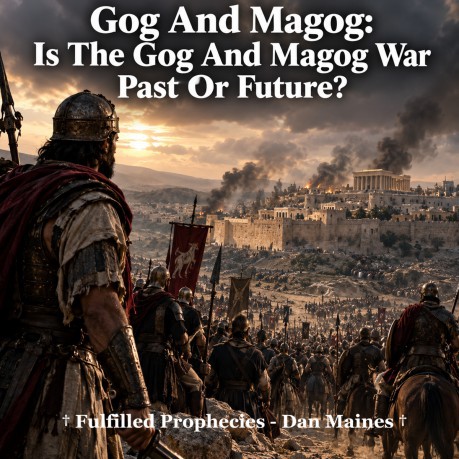
Gog And Magog: Is The Gog And
Magog War Past Or Future? Introduction Ezekiel 38:2-4 Ezekiel 38:16 Ezekiel 39:6-8 Revelation 20:7-9 Revelation 1:1-3 Revelation 22:6-7 Revelation 22:10 Revelation 20:10 Historical References How It Applies To Us Today Q & A Appendix Q: Does Gog represent modern Russia? Q: Why does Revelation use Gog and Magog if
Ezekiel had already written about them? Q: What about Satan being released after the
thousand years? Q: Should Christians be waiting for Gog and Magog
today? † This is the fulfilled perspective we proclaim at
Fulfilled Prophecies † Source Index
By Dan Maines
† Gog and
Magog are often presented as nations preparing for a massive war in
our future, but Scripture must determine the timing and meaning of
the prophecy.
† Ezekiel 38-39 introduced Gog
as the leader of a coalition that would come against God's people,
and Revelation 20 later used Gog and Magog imagery for the final
enemies surrounding God's covenant people.
†
The question isn't whether Gog and Magog appear in biblical prophecy.
They clearly do. The question is whether Revelation places that
conflict thousands of years beyond John's generation or within the
fulfillment framework that Revelation itself repeatedly says was
near.
† Revelation begins by saying its
events must shortly come to pass and that the time was at hand
(Revelation 1:1, 3). It closes by repeating that these things would
shortly come to pass and that the time was at hand (Revelation 22:6,
10).
† We shouldn't remove Gog and Magog from
those inspired time statements and place them thousands of years into
the future.
† From the fulfilled perspective,
Gog and Magog aren't describing a future Russian invasion, a modern
Middle Eastern military alliance, or another worldwide war still
waiting to happen. Revelation uses Old Testament judgment imagery to
describe the final opposition against God's covenant people before
the judgment connected with the end of the old covenant age.
Son of man, set your face
toward Gog of the land of Magog, the chief prince of Meshech and
Tubal, and prophesy against him, and say, ‘This is what the Lord
God says: Behold, I am against you, Gog, chief prince of Meshech and
Tubal. So I will turn you around and put hooks into your jaws, and I
will bring you out, and all your army, horses and horsemen, all of
them magnificently dressed, a great contingent with shield and
buckler, all of them wielding swords;
†
Ezekiel's prophecy provides the Old Testament background necessary
for understanding John's later use of Gog and Magog (Revelation
20:8).
† Gog is presented as an enemy brought
into conflict under God's sovereign control. God would judge the
enemy and demonstrate His holiness through that judgment (Ezekiel
38:16, 23).
† Nothing in Ezekiel identifies
Gog as modern Russia. That identification is imposed on the text by
attempting to match ancient prophetic names with modern political
borders.
† Ezekiel's language belongs to the
prophetic judgment vocabulary of the Old Testament, and Revelation
intentionally draws from that vocabulary when describing the enemies
of God's people.
and you will come up against
My people Israel like a cloud to cover the land. It shall come about
in the last days that I will bring you against My land, so that the
nations may know Me when I show Myself holy through you before their
eyes, Gog.
† The expression latter days
doesn't automatically mean the twenty-first century. The New
Testament identifies its own first-century period as the last days
(Hebrews 1:1-2; Acts 2:16-17; 1 Peter 1:20; 1 John 2:18).
†
Peter specifically applied Joel's last-days prophecy to what was
happening at Pentecost (Acts 2:16-17).
† John
didn't tell his readers that the last hour was thousands of years
away. He told them, it is the last hour (1 John 2:18).
†
Therefore, we can't simply read latter days in Ezekiel and assume
that Ezekiel was pointing to our modern generation.
And I will send fire upon
Magog and those who inhabit the coastlands in safety; and they will
know that I am the Lord. And I will make My holy name known in the
midst of My people Israel; and I will not allow My holy name to be
profaned anymore. But the nations will know that I am the Lord, the
Holy One in Israel. Behold, it is coming and it shall be done,"
declares the Lord God. "That is the day of which I have
spoken.
† Fire from God is established
biblical judgment language. Revelation later uses the same imagery
when fire comes down and consumes the enemies surrounding God's
people (Revelation 20:9).
† John's
first-century readers already had Ezekiel's imagery available to
them. They didn't need modern newspapers or maps of Russia, Iran,
Turkey, or Israel to understand what John was communicating.
†
Revelation repeatedly takes Old Testament images and applies them
within its own prophetic message. Gog and Magog should be interpreted
by that same method.
† Ezekiel's prophecy
supplies the pattern, enemies gather against God's people, God
intervenes, the enemies are destroyed, and God's sovereignty is
publicly demonstrated.
When the thousand years
are completed, Satan will be released from his prison, and will come
out to deceive the nations which are at the four corners of the
earth, Gog and Magog, to gather them together for the war; the number
of them is like the sand of the seashore. And they came up on the
broad plain of the earth and surrounded the camp of the saints and
the beloved city, and fire came down from heaven and devoured them.
†
John doesn't say that the ancient geographical nations of Ezekiel
literally returned. He takes the names Gog and Magog and applies them
symbolically to the gathered enemies of God's people.
†
Notice the language, four corners of the earth, sand of the sea, camp
of the saints, beloved city, and fire from heaven. Revelation is
filled with symbolic prophetic imagery rooted in the Old Testament.
†
The beloved city in this passage shouldn't automatically be
identified with the modern political state of Israel. Revelation
contrasts the earthly Jerusalem that rejected Christ with the
heavenly Jerusalem identified with God's covenant people (Revelation
11:8; 21:2).
† This conflict follows the
symbolic thousand years. A symbolic number doesn't require a literal
thousand-year calendar period.
† Satan's
binding began through Christ's kingdom ministry. Jesus spoke of
binding the strong man (Matthew 12:28-29), casting out the ruler of
this world (John 12:31), and the approaching judgment of that ruler
(John 16:11).
† Revelation 20 therefore
shouldn't be detached from the first-century redemptive story and
turned into a timetable beginning thousands of years after John wrote
it.
The Revelation of Jesus
Christ, which God gave Him to show to His bond-servants, the things
which must soon take place; and He sent and communicated it by His
angel to His bond-servant John, who testified to the word of God and
to the testimony of Jesus Christ, everything that he saw. Blessed is
the one who reads, and those who hear the words of the prophecy and
keep the things which are written in it; for the time is near.
†
These verses establish the timing framework for the entire book. The
things revealed to John must shortly come to pass, and the time was
at hand.
† John was writing to seven actual
churches in Asia (Revelation 1:4). His timing statements had meaning
for those original readers.
† If Gog and
Magog in Revelation 20 were still more than two thousand years away,
the ordinary meaning of shortly and at hand would be lost.
†
We can't accept Revelation's time statements in chapter 1 and then
abandon them when we reach chapter 20.
And he said to me, "These
words are faithful and true"; and the Lord, the God of the
spirits of the prophets, sent His angel to show His bond-servants the
things which must soon take place. "And behold, I am coming
quickly. Blessed is the one who keeps the words of the prophecy of
this book."
† Revelation closes with the
same urgency with which it opened. The things in the prophecy were to
happen shortly.
† This statement comes after
Revelation 20. Therefore, Gog and Magog are included within a book
whose concluding declaration says its prophetic events must shortly
come to pass.
† Jesus also said, I come
quickly. The original churches weren't being given a meaningless
promise whose fulfillment was actually thousands of years beyond
them.
† The inspired time statements should
control our interpretation of the symbols, rather than allowing our
interpretation of the symbols to erase the time statements.
And he said to me, Do not
seal up the words of the prophecy of this book, for the time is
near.
† This statement becomes especially
important when compared with Daniel.
† Daniel
was told to shut up and seal his prophecy because its fulfillment
wasn't yet at hand (Daniel 12:4, 9).
† John
received the opposite command. He was told not to seal Revelation
because the time was at hand.
† If
Revelation's major prophetic events, including Gog and Magog, were
thousands of years beyond John, there would be no meaningful reason
for this contrast.
† Revelation 22:10 is one
of the strongest biblical reasons we shouldn't push Revelation 20
into our future.
And the devil who deceived
them was thrown into the lake of fire and brimstone, where the beast
and the false prophet are also; and they will be tormented day and
night forever and ever.
† Gog and Magog
belong within Revelation's larger picture of the final defeat of
God's covenant enemies.
† The passage doesn't
end with Satan successfully ruling another age. It ends with his
decisive judgment.
† The New Testament
consistently described Satan's defeat as already underway and
approaching its completion. Jesus said the ruler of this world had
been judged (John 16:11), and Paul told first-century believers that
God would crush Satan under their feet shortly (Romans 16:20).
†
Hebrews explains that through His death Christ rendered powerless the
one who had the power of death, that is, the devil (Hebrews
2:14-15).
† Gog and Magog aren't evidence
that Satan must be released sometime in our future. They're part of
Revelation's symbolic presentation of the final first-century
conflict and judgment.
†
Josephus described the catastrophic Jewish-Roman War of AD 66-70,
including internal factions, armies surrounding Jerusalem, famine,
bloodshed, fire, and the destruction of the city and temple in The
Wars of the Jews, Books 5-7.
† Josephus'
account doesn't prove the interpretation by itself. Scripture
establishes the doctrine, but his history shows that the
first-century generation experienced exactly the kind of enormous
covenantal judgment Jesus had warned would come upon Jerusalem
(Matthew 23:36-38; Luke 21:20-22).
† Tacitus
also recorded the Roman campaign against Jerusalem and the
destruction associated with that period in Histories, Book 5.
†
Eusebius later connected Jerusalem's destruction with the judgment
Christ had foretold and recorded the tradition that believers escaped
from Jerusalem before the catastrophe in Ecclesiastical History,
Books 3.5-3.7.
† These historical witnesses
place an extraordinary period of war and judgment exactly where Jesus
and the New Testament writers placed it, within that first-century
generation.
†
We don't need to watch Russia, Iran, China, Turkey, or modern Israel
trying to identify the next Gog and Magog coalition.
†
We don't need to fear that Revelation 20 predicts another worldwide
satanic war waiting somewhere in our future.
†
We should read Revelation according to its own time statements. John
said the events were near, shortly to happen, and connected with
Christ's coming in judgment (Revelation 1:1, 3; 22:6-7, 10).
†
Gog and Magog belong to the fulfilled judgment story, not tomorrow's
newspaper headlines.
† Christ's kingdom isn't
waiting for victory over Gog and Magog. Christ reigns now, and
believers have already come to Mount Zion, the heavenly Jerusalem,
and the city of the living God (Hebrews 12:22-23).
†
Our message isn't that Christians should live frightened by another
prophetic world war. Our message is that Christ fulfilled His
promises, judged the old covenant world, established His everlasting
kingdom, and His people now live in the reality of His accomplished
victory.
Q: Is
the Gog and Magog war still future?
A: No. From
the fulfilled perspective, Revelation places Gog and Magog within the
prophetic events John said were shortly to happen and at hand
(Revelation 1:1, 3; 20:7-9; 22:6, 10).
A:
Scripture never identifies Gog as modern Russia. Ezekiel names Gog,
Magog, Rosh, Meshech, and Tubal within his prophetic setting, while
Revelation later uses Gog and Magog symbolically for the enemies
gathered against God's people (Ezekiel 38:2-4; Revelation 20:8-9).
A:
Revelation repeatedly draws on Old Testament prophetic imagery. John
uses Gog and Magog as recognizable biblical symbols of nations
gathered against God's covenant people and then destroyed by God's
judgment (Ezekiel 38:16; 39:6-8; Revelation 20:8-9).
A: The thousand years are
symbolic, not a literal future millennium. Revelation's own opening
and closing statements place the prophecy within events that were
near and shortly to happen (Revelation 1:1-3; 22:6, 10). Satan's
defeat was already underway through Christ and was approaching its
decisive judgment in that first-century period (John 12:31; Romans
16:20).
A: No. Christians should be living in
Christ's accomplished victory and present kingdom. We've already come
to Mount Zion and the heavenly Jerusalem, and Christ's kingdom can't
be shaken (Hebrews 12:22-28).
© Fulfilled Prophecies - Dan
Maines.
† Ezekiel
38:2-4, 16; 39:6-8; Revelation 20:7-10; 1:1-3; 22:6-7, 10
†
Josephus, The Wars of the Jews, Books 5-7; Tacitus, Histories, Book
5; Eusebius, Ecclesiastical History, Books 3.5-3.7
Links