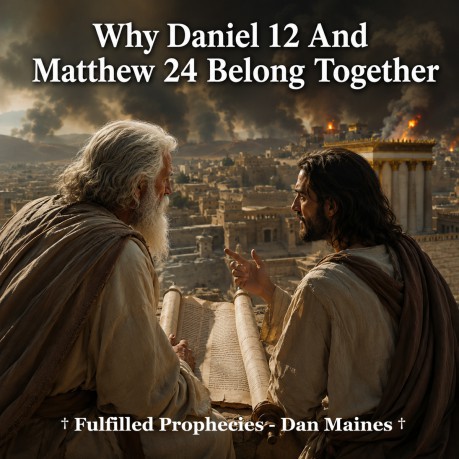
Why Daniel 12 And Matthew 24
Belong Together Introduction Daniel 12:1 Matthew 24:21 Matthew 24:15 Daniel 12:2 Daniel 12:3 Daniel 12:4 Daniel 12:7 Matthew 24:31 Matthew 24:34 Historical References How It Applies To Us Today Q & A Appendix Q: Is Daniel's time of trouble the same prophetic
setting as Jesus' great tribulation? Q: Doesn't Daniel 12:2 require Daniel 12 to be
about the end of the physical universe? Q: What does time of the end mean? Q: Did Jesus postpone Daniel's fulfillment for
thousands of years? Q: What is one of the strongest connections
between Daniel 12 and Matthew 24? Q: What should believers expect today? † This is the fulfilled perspective we proclaim at
Fulfilled Prophecies † Source Index
By Dan Maines
† Daniel 12
and Matthew 24 aren't two unrelated prophecies separated by thousands
of years. Jesus deliberately points His disciples back to Daniel when
explaining the judgment that was coming upon Jerusalem and the
temple.
† Daniel describes an unprecedented
time of trouble, the deliverance of God's people, resurrection, the
wise shining, and events belonging to the time of the end. Jesus
describes the abomination spoken of by Daniel, unprecedented
tribulation, the gathering of His elect, and the completion of those
events within His own generation.
† The
question isn't whether Jesus used Daniel. He explicitly told His
disciples to understand Daniel. The question is whether Jesus moved
Daniel's prophecy thousands of years into their future, or placed its
fulfillment within the lifetime of the generation standing before
Him.
† When Daniel 12 and Matthew 24 are
allowed to interpret each other, the time statements become
impossible to ignore. Daniel's time of the end was connected with the
end of the covenant age, and Jesus identified the generation that
would see it happen.
Now at that time Michael, the
great prince who stands guard over the sons of your people, will
arise. And there will be a time of distress such as never occurred
since there was a nation until that time; and at that time your
people, everyone who is found written in the book, will be rescued.
†
Daniel was told about a unique time of trouble involving his people.
The prophecy wasn't introduced as a worldwide disaster thousands of
years beyond Israel's covenant history. Daniel's people were at the
center of the prophecy.
† Notice the
combination of judgment and deliverance. Terrible trouble would come,
yet God's faithful people would be delivered. Jesus uses this same
pattern when He warns His disciples about Jerusalem and provides
instructions for escape (Matthew 24:16-20).
†
Daniel's language about trouble unlike anything before it becomes
especially important when we read Jesus' description of Jerusalem's
coming tribulation.
For then there will be a great
tribulation, such as has not occurred since the beginning of the
world until now, nor ever will again.
† Jesus
didn't merely speak about severe tribulation. His wording closely
reflects Daniel's prophecy of an unparalleled time of trouble.
†
Daniel said there would be a time of trouble unlike anything before
it. Jesus said there would be great tribulation unlike anything
before it. The verbal and conceptual connection is unmistakable
(Daniel 12:1).
† Jesus had already identified
the subject of the discourse, the destruction of Jerusalem's temple
(Matthew 24:1-3). The great tribulation belongs within that same
prophetic setting.
† Luke's parallel makes
the covenantal setting even clearer. Jerusalem would be surrounded by
armies, those in Judea were to flee, and Jesus called those days days
of vengeance in which all things written would be fulfilled (Luke
21:20-22).
Therefore when you see the
abomination of desolation which was spoken of through Daniel the
prophet, standing in the holy place-let the reader understand
†
Jesus removes any reasonable doubt about whether Daniel belongs in
the interpretation of the Olivet Discourse. He names Daniel directly
and commands His hearers to understand what Daniel had written.
†
Jesus wasn't introducing an unrelated prophecy. He was explaining
Daniel to disciples who had just asked about the destruction of the
temple (Matthew 24:2-3).
† The disciples were
told, when you see. That language matters. Jesus gave observable
signs to people who were actually listening to Him. When they saw the
approaching fulfillment, they were to flee (Matthew 24:16).
†
Luke identifies the practical sign in unmistakable historical
language, Jerusalem surrounded by armies (Luke 21:20). The warning
concerned Jerusalem, Judea, and the approaching destruction of that
covenant center.
And many of those who sleep in
the dust of the ground will awake, these to everlasting life, but the
others to disgrace and everlasting contempt.
†
Daniel places resurrection in the same prophetic context as the
unparalleled trouble of verse 1. We shouldn't separate the
resurrection from the time setting Daniel himself provides.
†
This resurrection language describes the great covenantal transition
from death to life that reaches its fulfillment in Christ. Jesus used
resurrection language for those passing from death into life through
hearing His voice (John 5:24-29).
† Daniel's
prophecy contains both life and judgment. That fits the New
Testament's description of the closing of the old covenant age, when
Christ's kingdom was publicly vindicated and the persecuting covenant
order came under judgment (Matthew 16:27-28, Matthew 23:34-36).
†
Daniel 12 doesn't suddenly jump thousands of years between verses 1
and 2. The trouble, deliverance, resurrection, and final vindication
belong to the same prophetic conclusion.
And those who have insight will
shine like the glow of the expanse of heaven, and those who lead the
many to righteousness, like the stars forever and ever.
†
Daniel's resurrection prophecy immediately speaks of the righteous
shining. Jesus later uses this same imagery when describing the
righteous shining in the kingdom (Matthew 13:43).
†
The wise weren't defeated by the collapse of the old covenant world.
They were vindicated as members of Christ's kingdom.
†
This is another reason Daniel 12 can't be reduced to physical bodies
coming out of graves. Daniel combines resurrection, righteousness,
wisdom, kingdom vindication, and the triumph of God's faithful
people.
But as for you, Daniel, keep
these words secret and seal up the book until the end of time; many
will roam about, and knowledge will increase.
†
Daniel was commanded to seal the prophecy because its appointed
fulfillment wasn't immediately at hand.
†
This provides an important biblical contrast with Revelation. Daniel
was told to seal his prophecy because the time was still distant,
while John was told not to seal Revelation because the time was near
(Revelation 22:10).
† Daniel says time of the
end, not end of time. Those aren't the same statement. The prophecy
concerns the conclusion of an appointed covenantal period.
†
Jesus' disciples understood that an age could end while the earth
continued. Their question concerned the destruction of the temple and
the completion of the age connected with it (Matthew 24:1-3).
And I heard the man dressed in
linen, who was above the waters of the stream, as he raised his right
hand and his left toward heaven, and swore by Him who lives forever
that it would be for a time, times, and half a time; and as soon as
they finish smashing the power of the holy people, all these events
will be completed.
† Daniel gives us another
major interpretive boundary. All these things would be finished when
the power of the holy people had been shattered.
†
That statement places Daniel's fulfillment within the historical
judgment connected with Israel's covenant nation. Jerusalem and its
temple system were destroyed in AD 70, bringing the old covenant
world to its decisive historical end.
† Jesus
uses strikingly similar comprehensive language in the Olivet
Discourse. After describing Jerusalem's coming judgment, He tells His
disciples when all these things would occur.
†
We don't have permission to move Daniel's all these things beyond the
time boundary Daniel gives us.
And He will send forth His
angels with a great trumpet blast, and they will gather together His
elect from the four winds, from one end of the sky to the other.
†
Daniel's prophecy includes both judgment and deliverance. Jesus does
the same. The destruction of the old covenant order wasn't the
destruction of God's kingdom, it demonstrated the victory and
gathering of Christ's covenant people.
† The
prophetic trumpet and gathering language belongs to the biblical
imagery of God's people being gathered into His kingdom (Isaiah
27:13).
† Jesus had already declared that the
kingdom would be taken from the unbelieving covenant leaders and
given to a people producing its fruit (Matthew 21:43). Matthew 24
describes the judgment surrounding that covenantal transfer and
vindication.
† The elect weren't waiting for
God's kingdom to begin thousands of years later. The gospel was
already gathering God's people throughout the nations in the first
century (Colossians 1:6, 23).
Truly I say to you, this
generation will not pass away until all these things take place.
†
This is the time statement that controls the entire discussion. Jesus
didn't say that generation. He said this generation.
†
The same expression is used repeatedly in Matthew for the generation
living during Jesus' earthly ministry (Matthew 11:16, Matthew
12:41-42, Matthew 23:36).
† Jesus had just
connected His prophecy directly with Daniel. He then said all these
things would be accomplished before that generation passed away.
†
Daniel said all these things would be finished when the power of the
holy people was shattered (Daniel 12:7). Jesus said all these things
would be accomplished within this generation. Those statements
reinforce each other.
† So we have to ask the
unavoidable question. Did Jesus take Daniel's prophecy and move its
fulfillment thousands of years beyond Daniel's people, Jerusalem, and
the temple, or did Jesus place Daniel's fulfillment within this
generation?
† Jesus answered the question
Himself. His disciples would see the signs, Jerusalem would
experience the tribulation, the elect would be gathered, and all
these things would be accomplished before their generation passed
away.
†
Josephus describes the Jewish-Roman War and Jerusalem's destruction
in horrifying detail. He records famine, internal violence,
slaughter, fire, and the destruction of the temple, conditions that
provide important historical background for Jesus' warning concerning
Jerusalem's great tribulation. Josephus, Wars of the Jews, Books
5-7.
† Josephus also describes people
desperately attempting to escape Jerusalem during the siege and the
terrible suffering occurring inside the city. His history shows why
Jesus' warning to flee Judea rather than enter Jerusalem was so
important. Josephus, Wars of the Jews, Books 5-6.
†
Eusebius records the early Christian tradition that believers in
Jerusalem were warned to leave the city before the war and went to
Pella. This is historically significant when compared with Jesus'
command that His followers flee when the predicted crisis arrived.
Eusebius, Ecclesiastical History, Book 3, Chapter 5.
†
Tacitus confirms the Roman campaign against Jerusalem and describes
the enormous population gathered there during the conflict. His Roman
account independently confirms the historical setting in which
Jerusalem and its temple were destroyed. Tacitus, Histories, Book 5.
†
We don't need to fear Daniel 12 and Matthew 24 as predictions of a
tribulation still waiting in our future. Jesus gave those warnings to
His first-century disciples concerning events they and their
generation were approaching.
† We can read
prophecy according to its original audience, historical setting,
covenant context, and inspired time statements instead of moving
fulfilled events thousands of years beyond the boundaries Scripture
gives them.
† Daniel's prophecy ends in
victory, not failure. God's faithful people are delivered, the wise
shine, righteousness triumphs, and Christ's kingdom remains.
†
We live after that covenantal transition. We aren't waiting for the
old covenant age to end. We belong to the kingdom that can't be
shaken (Hebrews 12:22-28).
† Daniel was told
about the time of the end. Jesus identified the generation that would
experience that end. Jerusalem fell, the temple disappeared, the old
covenant system was removed, and Christ's everlasting kingdom
remained.
† When Jesus says this generation,
we should believe Him. We don't need to stretch His words across
thousands of years to preserve a prophetic system. We need to allow
His words to determine our prophetic system.
Q: Why
should Daniel 12 and Matthew 24 be interpreted together?
A:
Because Jesus directly identifies Daniel when explaining the coming
destruction and tribulation associated with Jerusalem. He
specifically refers His disciples to the abomination of desolation
spoken through Daniel the prophet (Matthew 24:15).
A: The
language strongly connects them. Daniel describes a time of trouble
unlike anything before it, and Jesus describes great tribulation
unlike anything before it (Daniel 12:1, Matthew 24:21).
A: No.
Daniel places resurrection within the same prophecy involving his
people, their unprecedented trouble, their deliverance, and the
shattering of their power (Daniel 12:1-7). The New Testament also
uses resurrection language for the transition from death to life in
Christ (John 5:24-29).
A:
Daniel says time of the end, not end of time (Daniel 12:4). The
surrounding prophecy concerns Daniel's people and the conclusion
reached when their power was shattered (Daniel 12:7).
A: Jesus never says that.
Instead, He directly cites Daniel, describes the coming tribulation,
gives His disciples instructions about what they would see, and
declares that all these things would be accomplished within this
generation (Matthew 24:15-34).
A: Daniel
says all these things would be finished when the power of the holy
people was shattered, and Jesus says all these things would be
accomplished before this generation passed away (Daniel 12:7, Matthew
24:34). Both passages establish boundaries for fulfillment.
A:
We should live confidently in Christ's established kingdom, knowing
that we have come to the heavenly Jerusalem and received a kingdom
that can't be shaken (Hebrews 12:22-28). Daniel's time of the end
isn't our approaching future, it belonged to the covenantal
transition Jesus said His generation would witness.
© Fulfilled Prophecies - Dan
Maines.
† Daniel
12:1, 2, 3, 4, 7; Matthew 24:15, 21, 31, 34
†
Josephus, Wars of the Jews, Books 5-7; Eusebius, Ecclesiastical
History, Book 3, Chapter 5; Tacitus, Histories, Book 5
Links