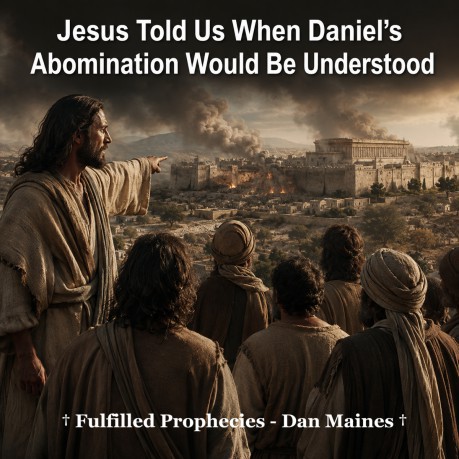
Jesus Told Us When Daniel's
Abomination Would Be Understood Introduction Daniel 9:26-27 Daniel 11:31 Daniel 12:10-11 Matthew 24:15-16 Luke 21:20-22 Matthew 24:21 Matthew 24:34 Luke 21:32 Historical References How It Applies To Us Today Q & A Appendix Q: How can we know what visible event was
connected with the approaching desolation? Q: Why were they told to flee Judea? Q: Does Daniel 12 belong with Jesus' Olivet
Discourse? Q: Could the abomination still be future to
us? Q: What is the strongest interpretive key? † This is the fulfilled perspective we proclaim at
Fulfilled Prophecies †
By Dan Maines
† Daniel
wrote about an abomination connected with desolation, the stopping of
sacrifice, unprecedented distress, and the time of the end. Jesus
later took Daniel's prophecy and placed it directly into the
experience of His own generation.
† Jesus
didn't tell His disciples to look thousands of years into their
future. He told them that when they saw the abomination of desolation
spoken of through Daniel, they were to understand what Daniel had
written and flee from Judea.
† Matthew
records Jesus referring directly to Daniel's abomination, while Luke
records the parallel warning in unmistakable historical language,
Jerusalem surrounded by armies. When the two Gospel accounts are read
together, Luke gives us a powerful interpretive key for understanding
what Jesus meant.
† Daniel, Matthew, and Luke
aren't describing unrelated events. The language, location, judgment,
distress, and escape instructions converge on Jerusalem and the
events surrounding its first-century destruction.
Then after the sixty-two
weeks, the Messiah will be cut off and have nothing, and the people
of the prince who is to come will destroy the city and the sanctuary.
And its end will come with a flood; even to the end there will be
war; desolations are determined. And he will confirm a covenant with
the many for one week, but in the middle of the week he will put a
stop to sacrifice and grain offering; and on the wing of abominations
will come the one who makes desolate, until a complete destruction,
one that is decreed, gushes forth on the one who makes desolate.
†
Daniel's prophecy specifically connects the coming desolation with
the destruction of the city and the sanctuary. That gives us the
geographical setting before we ever reach Matthew 24. The prophecy
concerns Jerusalem, its sanctuary, sacrifice, war, and determined
desolation.
† The prophecy doesn't leave the
city unidentified. The same chapter identifies Jerusalem as Daniel's
holy city (Daniel 9:16, 24). The coming destruction therefore belongs
to the covenant judgment centered on Jerusalem.
†
Jesus later takes Daniel's language and applies it to events His
disciples would be able to see. Daniel gives the prophecy, and Jesus
gives His disciples the sign connected with its fulfillment (Matthew
24:15-16).
Forces from him will arise,
desecrate the sanctuary fortress, and do away with the regular
sacrifice. And they will set up the abomination of desolation.
†
Daniel again connects the abomination with military forces, the
sanctuary, its profanation, and desolation. The pattern isn't a
peaceful event somewhere far removed from Jerusalem. It's covenantal
judgment involving armed power and the sanctuary.
†
This becomes especially important when we reach Luke's account. Luke
doesn't use the exact phrase abomination of desolation. Instead, he
tells his readers what Jesus said they would actually see, Jerusalem
surrounded by armies (Luke 21:20).
† The
connection between forces, sanctuary, abomination, and desolation in
Daniel prepares us for Jesus' warning concerning Jerusalem. Luke then
gives the visible military sign that announced that Jerusalem's
desolation had drawn near (Luke 21:20).
Many will be purged,
cleansed, and refined, but the wicked will act wickedly; and none of
the wicked will understand, but those who have insight will
understand. And from the time that the regular sacrifice is abolished
and the abomination of desolation is set up, there will be 1,290
days.
† Daniel was told that the wise would
understand. Jesus later uses remarkably significant language when He
brings Daniel's prophecy before His disciples, let him that readeth
understand (Matthew 24:15).
† Daniel's
prophecy therefore wasn't intended to remain permanently
incomprehensible. A time would come when those living near its
fulfillment could recognize what Daniel had described.
†
Daniel connects understanding with the time surrounding the
abomination and the removal of the continual offering. Jesus then
tells His first-century hearers what to do when they see the Danielic
sign, flee from Judea (Matthew 24:15-16).
Therefore when you see the
abomination of desolation which was spoken of through Daniel the
prophet, standing in the holy place-let the reader understand-then
those who are in Judea must flee to the mountains.
†
Jesus identifies Daniel by name. We don't have to guess which
prophetic framework He expects His disciples to understand. He
specifically directs them back to Daniel.
†
Notice the words when therefore you see. Jesus is speaking to the
disciples in front of Him and describing a sign that could be
recognized. When that sign appeared, those in Judea were to flee.
†
The command to flee Judea anchors the prophecy geographically. Jesus
isn't describing an invisible worldwide event. The warning concerns
people who could physically leave Judea when the sign appeared.
†
Jesus also says let him that readeth understand. Daniel had written
that the wise would understand, and Jesus now calls His hearers and
readers to understand Daniel in connection with the approaching
events (Daniel 12:10).
† The question is then
obvious, what would they see that told them the desolation was near?
Luke's parallel account answers it.
But when you see Jerusalem
surrounded by armies, then recognize that her desolation is near.
Then those who are in Judea must flee to the mountains, and those who
are inside the city must leave, and those who are in the country must
not enter the city; because these are days of punishment, so that all
things which have been written will be fulfilled.
†
Here is the interpretive key. Matthew says when you see the
abomination of desolation and then flee Judea. Luke says when you see
Jerusalem surrounded by armies and then flee Judea. The same warning,
the same location, the same flight, and the same approaching
desolation point to the same judgment.
† Luke
couldn't make the setting much clearer. Jerusalem is named. Armies
are named. Desolation is named. Judea is named. The people are told
to flee. These aren't clues pointing to a distant modern event.
They're instructions that made sense to people living in
first-century Judea.
† Luke says then know
that her desolation is at hand. Jesus wasn't telling them that
Jerusalem's desolation would follow thousands of years later. Seeing
the armies meant the desolation had drawn near.
†
Jesus then calls these the days of vengeance in which all things
written would be fulfilled. This places the approaching judgment
within the fulfillment of Israel's prophetic Scriptures, exactly
where Daniel belongs.
† Matthew gives
Daniel's prophetic terminology. Luke gives the historical
description. Matthew says abomination of desolation. Luke says
Jerusalem surrounded by armies. Reading them together removes the
need to move Daniel's prophecy into our future.
For then there will be a great
tribulation, such as has not occurred since the beginning of the
world until now, nor ever will again.
† Jesus
places the great tribulation in the same sequence as the abomination,
the flight from Judea, and Jerusalem's approaching desolation
(Matthew 24:15-20, Luke 21:20-24).
† Daniel
had also described an unparalleled time of trouble associated with
the closing events of his prophecy (Daniel 12:1). Jesus uses the same
prophetic pattern while speaking about the judgment approaching
Jerusalem.
† This is another reason Daniel 12
shouldn't be detached from Matthew 24 and Luke 21. Jesus brings
Daniel's language into His own prophecy and identifies the generation
that would experience these events (Matthew 24:34).
Truly I say to you, this
generation will not pass away until all these things take place.
†
Jesus gives the time boundary. All these things includes the signs He
had just described, including the abomination, the flight from Judea,
and the great tribulation.
† Jesus didn't say
that generation would merely begin the process. He said it wouldn't
pass away until all these things were accomplished.
†
Daniel supplied the prophetic language, Jesus identified the sign,
Luke identified Jerusalem and the surrounding armies, and Matthew
identified the generation. Together they form one coherent
first-century fulfillment.
Truly I say to you, this
generation will not pass away until all things take place.
†
Luke confirms Matthew's time statement. The Jerusalem surrounded by
armies prophecy belongs to this generation.
†
This is especially powerful because Luke has already identified
Jerusalem's desolation and the days of vengeance. He then says that
this generation wouldn't pass away until all things were
accomplished.
† We don't need to separate
Daniel's abomination from Jerusalem's desolation and move one event
thousands of years beyond the other. Jesus joined the prophecy, the
sign, the city, the flight, the judgment, and the generation
together.
†
Josephus describes the Roman war, Jerusalem's internal bloodshed, the
surrounding Roman forces, the siege, the destruction of the temple,
and the devastation of the city. His account provides an important
first-century historical witness to the conditions surrounding
Jerusalem's fall. (Josephus, Wars of the Jews, Books 5-7)
†
Josephus also records events involving the temple precincts, armed
factions, profanation, famine, slaughter, and finally Roman conquest.
These historical details strongly match the setting Jesus described,
Jerusalem, armies, tribulation, and desolation. (Josephus, Wars of
the Jews, Books 5-6)
† Eusebius later wrote
that the church at Jerusalem left the city before the war and went to
Pella. Whatever questions remain concerning the precise chronology of
that tradition, it preserves an early Christian memory of believers
escaping Jerusalem before its destruction. (Eusebius, Ecclesiastical
History 3.5)
† Tacitus also describes the
Roman campaign against Jerusalem, the strength of the city, the
temple, the conflict, and the circumstances surrounding the Jewish
war. His Roman perspective independently confirms the historical
setting in which Jerusalem faced Roman military destruction.
(Tacitus, Histories 5)
†
We should allow Scripture to interpret Scripture. When Matthew gives
symbolic prophetic language and Luke gives a clearer parallel
description, we shouldn't ignore the clearer passage.
†
We don't need to fear a future abomination of desolation as though
Jesus failed to tell His disciples when Daniel's prophecy would be
understood. Jesus connected Daniel directly with Jerusalem, Judea,
armies, desolation, and His own generation.
†
This changes how we read prophecy. Instead of taking first-century
warnings and turning them into twenty-first-century predictions, we
read them within the audience, geography, covenant, and historical
setting Jesus Himself provided.
† Fulfilled
prophecy isn't about weakening Jesus' words. It's about taking His
time statements seriously. When He said this generation, we believe
Him. When He said Jerusalem, we believe Him. When He said flee Judea,
we believe Him. When He pointed to Daniel, we follow Him back to
Daniel.
† Daniel was told that the wise would
understand. Jesus said let the reader understand. Luke showed what
they were to recognize. Jerusalem surrounded by armies meant her
desolation was near. The interpretive key was given by Jesus Himself.
Q: Was
Jesus specifically referring to Daniel when He spoke about the
abomination of desolation?
A: Yes. Matthew
explicitly says the abomination of desolation was spoken of through
Daniel the prophet (Matthew 24:15).
A:
Luke's parallel account says, when you see Jerusalem surrounded by
armies, know that her desolation is near (Luke 21:20).
A:
Because the warning concerned judgment coming upon Jerusalem and
Judea. Both Matthew and Luke immediately command those in Judea to
flee to the mountains (Matthew 24:16, Luke 21:21).
A: Yes. Daniel speaks of
understanding, the abomination that causes desolation, and an
unparalleled time of trouble. Jesus explicitly names Daniel, calls
for understanding, speaks of the abomination and unparalleled
tribulation, and applies these things to His generation (Daniel 12:1,
10-11, Matthew 24:15, 21, 34).
A: Jesus placed His warning within the
lifetime of His generation. Matthew says this generation wouldn't
pass away until all these things were accomplished, and Luke says the
same after describing Jerusalem surrounded by armies (Matthew 24:34,
Luke 21:20, 32).
A:
Compare the parallel accounts. Matthew says the abomination of
desolation followed by flight from Judea. Luke says Jerusalem
surrounded by armies followed by flight from Judea. Luke identifies
the approaching desolation in plain historical terms (Matthew
24:15-16, Luke 21:20-21).
© Fulfilled Prophecies - Dan
Maines.
Source Index
†
Daniel 9:26-27, Daniel 11:31, Daniel 12:10-11, Matthew 24:15-16,
Matthew 24:21, Matthew 24:34, Luke 21:20-22, Luke 21:32
†
Josephus, Wars of the Jews, Books 5-7, Eusebius, Ecclesiastical
History 3.5, Tacitus, Histories 5
Links