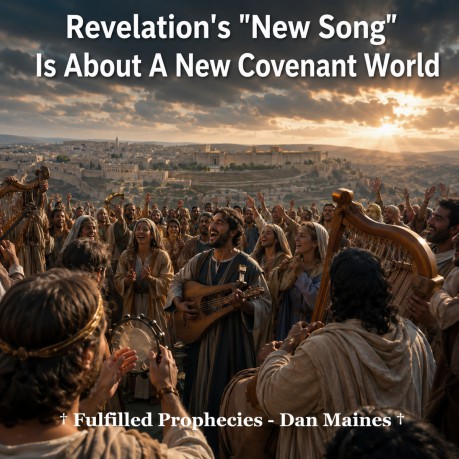
Revelation's "New Song"
Is About A New Covenant World Introduction Exodus 15:1-2 Psalm 96:1-3 Isaiah 42:9-12 Revelation 5:8-10 Revelation 14:1-3 Revelation 15:2-4 Revelation 19:1-2 Historical References How It Applies To Us Today Q & A Appendix Q: Does the new song mean God created a new
physical universe? Q: Why does Revelation connect the song of Moses
with the song of the Lamb? Q: What does Mount Zion have to do with the new
song? Q: Are believers still waiting for this New
Covenant world? † This is the fulfilled perspective we proclaim at
Fulfilled Prophecies †
By Dan Maines
† Scripture
repeatedly connects singing with God's acts of redemption,
deliverance, judgment, and covenant renewal.
†
Israel sang after God delivered them from Egypt, the prophets
described new songs connected with God's coming salvation, and
Revelation presents new songs surrounding the victory of the Lamb.
†
These songs aren't random worship interludes. They announce what God
has accomplished and celebrate the new redemptive reality created by
His victory.
† Revelation's "new song"
belongs to this biblical pattern. The Lamb has accomplished a greater
exodus, established the New Covenant, redeemed His people, and
brought them into a kingdom that can't be shaken (Hebrews 8:6-13;
Hebrews 12:22-28).
† The new song is
therefore the music of a new covenant world. The old order was
passing away, the Lamb was reigning, redemption had been
accomplished, and God's people were entering the reality promised by
the prophets.
Then Moses and the sons of
Israel sang this song to the Lord, saying: I will sing to the Lord,
for He is highly exalted; The horse and its rider He has hurled into
the sea. The Lord is my strength and song, And He has become my
salvation; This is my God, and I will praise Him; My father's God,
and I will exalt Him.
† The first great
redemption song in Scripture follows the exodus. Israel didn't sing
this song while still enslaved in Egypt. They sang because God had
defeated their oppressor and brought His covenant people through the
waters of deliverance.
† The sequence
matters. God acted, God judged the enemy, God delivered His people,
and then His people sang. The song interpreted what God had
accomplished (Exodus 14:30-31).
† Revelation
follows this same pattern. God's people sing because the Lamb has
conquered, redeemed, and established His reign. The new song
announces a greater deliverance accomplished through Christ
(Revelation 5:9-10).
Sing to the Lord a new song;
Sing to the Lord, all the earth. Sing to the Lord, bless His name;
Proclaim the good news of His salvation from day to day. Tell of His
glory among the nations, His wonderful deeds among all the peoples.
†
The new song is directly connected with proclaiming God's salvation.
Something God has accomplished becomes the reason His people sing.
†
Notice that the vision expands beyond Israel. The earth and the
nations are called to hear about God's salvation and glory. This
anticipates the worldwide proclamation of the gospel under the New
Covenant (Matthew 28:18-20; Romans 16:25-26).
†
Revelation doesn't invent the expression "new song." It
draws from an established prophetic vocabulary in which a new song
celebrates a new manifestation of God's saving rule (Revelation 5:9).
Behold, the former things
have come to pass, Now I declare new things; Before they sprout I
proclaim them to you. Sing to the Lord a new song, Sing His praise
from the end of the earth! You who go down to the sea, and all that
is in it; You islands, and those who live on them. Let the wilderness
and its cities raise their voices, The settlements which Kedar
inhabits. Let the inhabitants of Sela sing aloud, Let them shout for
joy from the tops of the mountains. Let them give glory to the Lord
And declare His praise in the coastlands.
†
Isaiah gives us one of the clearest explanations of why a new song
appears. God declares "new things," and immediately the
people are commanded to sing a "new song."
†
The song changes because God is bringing about something new in
redemptive history. The former things have reached their appointed
purpose, and God's promised salvation is being revealed.
†
Isaiah's surrounding prophecy identifies God's Servant as the One who
brings justice to the nations and becomes a covenant for the people
and a light to the nations (Isaiah 42:1-7). Revelation's new song
celebrates the fulfillment of that mission through the Lamb.
†
This is covenant language. Revelation's new song isn't primarily
about God replacing the physical universe. It's about celebrating the
redemptive order established through the victorious Messiah.
When He had taken the
scroll, the four living creatures and the twenty-four elders fell
down before the Lamb, each one holding a harp and golden bowls full
of incense, which are the prayers of the saints. And they sang a new
song, saying, "Worthy are You to take the scroll and to break
its seals; for You were slaughtered, and You purchased people for God
with Your blood from every tribe, language, people, and nation. You
have made them into a kingdom and priests to our God, and they will
reign upon the earth."
† Revelation
tells us exactly why the new song is being sung. The Lamb was slain,
people were purchased by His blood, and they were made a kingdom and
priests.
† That's New Covenant reality. Jesus
didn't merely rescue individuals from personal guilt. His sacrifice
created a covenant people who have direct access to God through Him
and participate in His kingdom (Hebrews 10:19-22; 1 Peter 2:5, 9).
†
The song reaches beyond ethnic Israel because the Lamb purchased
people from every tribe, language, people, and nation. The boundaries
of the old covenant order no longer define the people of God
(Galatians 3:26-29; Ephesians 2:13-19).
† The
Lamb's blood is the foundation of the song. A new covenant
established by His blood produces a new covenant people, and that
redeemed people sings a new song (Luke 22:20; Hebrews 9:15).
Then I looked, and behold,
the Lamb was standing on Mount Zion, and with Him 144,000 who had His
name and the name of His Father written on their foreheads. And I
heard a voice from heaven, like the sound of many waters and like the
sound of loud thunder, and the voice which I heard was like the sound
of harpists playing on their harps. And they sang a new song before
the throne and before the four living creatures and the elders; and
no one was able to learn the song except the 144,000 who had been
purchased from the earth.
† The new song
appears again with the Lamb standing on Mount Zion. Revelation's Zion
must be read alongside the New Testament's identification of the
heavenly Zion to which believers had already come (Hebrews
12:22-24).
† These redeemed people belong to
the Lamb. His name marks them as His covenant people, in deliberate
contrast with those identified with the beast (Revelation
13:16-17).
† The song belongs to the redeemed
because they understand the deliverance being accomplished through
the Lamb. Just as Israel sang after Egypt, the redeemed community
sings around the Lamb who has accomplished the greater redemption.
And I saw something like a
sea of glass mixed with fire, and those who were victorious over the
beast and his image and the number of his name, standing on the sea
of glass, holding harps of God. And they sang the song of Moses, the
bond-servant of God, and the song of the Lamb, saying, "Great
and marvelous are Your works, Lord God, the Almighty; Righteous and
true are Your ways, King of the nations! Who will not fear You, Lord,
and glorify Your name? For You alone are holy; For all the nations
will come and worship before You, For Your righteous acts have been
revealed."
† Here Revelation makes the
exodus connection unmistakable. The victorious saints sing "the
song of Moses" and "the song of the Lamb."
†
Moses and the Lamb aren't two unrelated stories. Revelation
deliberately places the first exodus beside the greater redemption
accomplished through Christ.
† In Exodus,
God's people came through the sea while the oppressing power was
judged. In Revelation, God's redeemed people stand victorious while
God's covenant judgments are being revealed against the persecuting
world that opposed the Lamb and His people (Exodus 14:26-31;
Revelation 15:1).
† The first exodus produced
the song of Moses. The greater covenant deliverance produces the song
of the Lamb. The pattern is deliverance, judgment, victory, kingdom,
and song.
After these things I heard
something like a loud voice of a great multitude in heaven, saying,
"Hallelujah! Salvation, glory, and power belong to our God,
because His judgments are true and righteous; for He has judged the
great prostitute who was corrupting the earth with her sexual
immorality, and He has avenged the blood of His bond-servants on
her."
† Revelation's songs reach a
climax when the harlot is judged. Heaven celebrates because God's
covenant judgment has vindicated His servants.
†
The fall of the harlot prepares the way for the marriage celebration
that immediately follows (Revelation 19:6-9). Judgment upon the
unfaithful order and the public vindication of the bride belong to
the same covenant transition.
† This is why
Revelation moves from judgment to marriage and ultimately to New
Jerusalem. The book is showing the removal of the old covenant world
and the full establishment of the New Covenant order in Christ
(Revelation 21:1-3).
†
Josephus described the destruction of Jerusalem and the temple in AD
70 as an overwhelming national catastrophe, including famine,
internal violence, Roman conquest, the burning of the sanctuary, and
the devastation of the city. His account gives historical background
for understanding the covenant judgment imagery surrounding
Jerusalem's fall (Josephus, Wars of the Jews, Books 5-7).
†
Tacitus also recorded the Roman siege of Jerusalem under Titus and
described the city's immense strength, population, religious
significance, and desperate resistance during the war (Tacitus,
Histories, Book 5).
† Eusebius later
connected Jerusalem's destruction with divine judgment and preserved
the early Christian tradition that believers in Jerusalem escaped to
Pella before the city's catastrophe (Eusebius, Ecclesiastical
History, Book 3, chapters 5-7).
† These
writers don't establish our doctrine, Scripture does. Their value is
historical. They confirm that the first-century generation
experienced the catastrophic end of Jerusalem and its temple order
that forms the historical setting for fulfilled prophecy.
†
We're not waiting for the Lamb to establish another covenant. Jesus
has already established the New Covenant through His blood (Luke
22:20; Hebrews 8:6).
† We're not waiting to
become citizens of His kingdom. Believers have already been
transferred into the kingdom of God's beloved Son (Colossians
1:13).
† We're not standing at Sinai waiting
for another Moses. We've come to Mount Zion, the heavenly Jerusalem,
and to Jesus, the mediator of the New Covenant (Hebrews 12:22-24).
†
The new song reminds us that Christianity isn't an unfinished version
of the old covenant system. Christ accomplished the redemption toward
which that system pointed.
† We live on the
fulfilled side of the greater exodus. Our worship celebrates a Lamb
who has conquered, a sacrifice that has been completed, a covenant
that has been established, and a kingdom that can't be shaken
(Hebrews 12:28).
† Revelation begins with
conflict and judgment, but it moves toward a redeemed people dwelling
with God in New Jerusalem. That's the new covenant world created
through the Lamb's victory (Revelation 21:2-3).
†
The Bible's pattern is beautiful. Moses sang after deliverance from
Egypt. The prophets anticipated a new song when God's promised
salvation arrived. Revelation's redeemed people sing because the Lamb
accomplished the greater deliverance. Scripture sings when God
creates a new redemptive order.
Q: Why
does Revelation call it a "new song"?
A:
Because the song celebrates the new redemptive reality accomplished
by the Lamb. He was slain, purchased a people by His blood, and made
them a kingdom and priests (Revelation 5:9-10).
A: No. The immediate
explanation of the song concerns redemption, covenant identity,
priesthood, and kingdom. The Lamb purchased people by His blood and
created a redeemed covenant community (Revelation 5:9-10; Hebrews
9:15).
A: Because the
exodus from Egypt provided the pattern for the greater redemption
accomplished through Christ. Moses led Israel out of Egyptian
bondage, while Jesus accomplished the greater covenant deliverance
through His death, resurrection, reign, and judgment (Exodus 15:1-2;
Revelation 15:2-4).
A: Revelation places the Lamb and His
redeemed people on Mount Zion, while Hebrews says believers had come
to Mount Zion and the heavenly Jerusalem. This identifies Zion with
the New Covenant reality centered in Christ (Revelation 14:1-3;
Hebrews 12:22-24).
A: No. Jesus is already the
mediator of the New Covenant, believers have already come to heavenly
Jerusalem, and they've already received a kingdom that can't be
shaken (Hebrews 12:22-24, 28).
© Fulfilled Prophecies - Dan
Maines.
Source Index
†
Exodus 15:1-2; Psalm 96:1-3; Isaiah 42:9-12; Revelation 5:8-10;
Revelation 14:1-3; Revelation 15:2-4; Revelation 19:1-2
†
Josephus, Wars of the Jews, Books 5-7; Tacitus, Histories, Book 5;
Eusebius, Ecclesiastical History, Book 3, chapters 5-7
Links