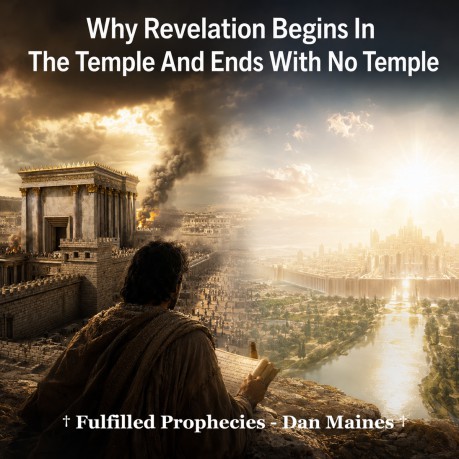
Why Revelation Begins In The
Temple And Ends With No Temple Introduction Revelation 1:12-13 Revelation 6:9-11 Revelation 8:3-5 Revelation 11:1-2 Revelation 11:19 Revelation 15:5-8 Revelation 21:22-23 Historical References How It Applies To Us Today Q & A Appendex Q: Why does Revelation use so much temple imagery
if the book ends without a temple? Q: Was the destruction of Jerusalem's temple
predicted by Jesus? Q: Does no temple mean there is no worship? Q: Are believers waiting to enter God's covenant
presence someday? Q: Why is Revelation 21:22 so important to
understanding the entire book? † This is the fulfilled perspective we proclaim at
Fulfilled Prophecies † Source Index
By Dan Maines
† Revelation
doesn't move randomly from one vision to another. Its imagery
develops toward a conclusion. Early in the book, John sees
lampstands, an altar, incense, priests, the ark of the covenant, and
the heavenly sanctuary. As the visions progress, the temple becomes
increasingly associated with judgment. By the time John reaches the
New Jerusalem, he makes one of the most important statements in the
entire book, there is no temple in the city.
†
That progression tells the story of the transition from the old
covenant order centered around a physical sanctuary to the completed
new covenant order centered entirely in God and the Lamb. The book
moves from sanctuary imagery to judgment upon the old order, and
finally to a city where a temple is no longer necessary.
†
Revelation's conclusion isn't about God eventually rebuilding another
physical temple. It's exactly the opposite. John's vision reaches its
climax when the temple disappears because everything the temple
represented has reached its fulfillment in God and the Lamb.
Then I turned to see the
voice that was speaking with me. And after turning I saw seven golden
lampstands; and in the middle of the lampstands I saw one like a son
of man, clothed in a robe reaching to the feet, and wrapped around
the chest with a golden sash.
† Revelation
opens with sanctuary imagery. The golden lampstands immediately bring
temple imagery into John's vision, but Christ is standing in their
midst. The focus has already begun shifting from a physical sanctuary
to the presence of Christ among His people.
†
Under the old covenant, lampstands belonged to the sanctuary and were
associated with priestly service (Exodus 25:31-40). In Revelation,
Jesus stands among the lampstands, showing that access to God's
presence is being understood through Christ rather than through
Jerusalem's physical temple.
† This prepares
us for the direction Revelation will take. The symbols of the
sanctuary remain, but their meaning is being centered in Christ and
His covenant people.
When the Lamb broke the
fifth seal, I saw underneath the altar the souls of those who had
been killed because of the word of God, and because of the testimony
which they had maintained; and they cried out with a loud voice,
saying, "How long, O Lord, holy and true, will You refrain from
judging and avenging our blood on those who live on the earth?"
And a white robe was given to each of them; and they were told that
they were to rest for a little while longer, until the number of
their fellow servants and their brothers and sisters who were to be
killed even as they had been, was completed also.
†
John now sees an altar, but the altar is connected with martyrs
crying for vindication. Temple imagery has become judgment imagery.
†
Their question is about timing, How long? The answer isn't thousands
of years. They're told to rest for a little time until the remaining
martyrdom is completed. Revelation itself places this judgment within
an approaching time frame (Revelation 1:1, 3).
†
Jesus had already connected the judgment for righteous blood with
first-century Jerusalem and said that all these things would come
upon that generation (Matthew 23:34-36). Revelation's altar scene
continues that same covenant lawsuit.
Another angel came and
stood at the altar, holding a golden censer; and much incense was
given to him, so that he might add it to the prayers of all the
saints on the golden altar which was before the throne. And the smoke
of the incense ascended from the angel's hand with the prayers of the
saints before God. Then the angel took the censer and filled it with
the fire of the altar, and hurled it to the earth; and there were
peals of thunder and sounds, and flashes of lightning and an
earthquake.
† The sanctuary imagery becomes
even more directly connected with judgment. Incense and the altar
first represent the prayers of the saints, then fire from that same
altar is thrown out in judgment.
† The
message is powerful. The prayers of God's persecuted people aren't
forgotten. The sanctuary itself becomes the setting from which
judgment proceeds.
† Revelation isn't merely
describing worship in heaven. It's showing the covenantal process by
which the cries of the saints are answered and their persecutors are
judged (Luke 18:7-8).
Then there was given to me
a measuring rod like a staff; and someone said, Get up and measure
the temple of God and the altar, and those who worship in it. Leave
out the courtyard which is outside the temple and do not measure it,
because it has been given to the nations; and they will trample the
holy city for forty-two months.
† Here
Revelation brings the temple, altar, worshipers, nations, holy city,
and coming trampling together in one vision.
†
The holy city being trampled by the nations reflects Jesus' warning
that Jerusalem would be surrounded by armies and trampled by the
Gentiles (Luke 21:20-24). Revelation's temple vision belongs
naturally within that first-century judgment setting.
†
This is especially significant because the temple isn't presented as
something that must be rebuilt thousands of years later. John sees
temple imagery while describing the judgment of the holy city that
Jesus had already predicted.
And the temple of God which
is in heaven was opened; and the ark of His covenant appeared in His
temple, and there were flashes of lightning and sounds and peals of
thunder, and an earthquake, and a great hailstorm.
†
The earthly sanctuary had claimed covenant significance, but John
sees the true covenant reality opened in heaven. The earthly
structure wasn't the final destination of God's redemptive plan.
†
Hebrews teaches the same movement. The earthly sanctuary belonged to
the first covenant and served as a figure pointing beyond itself
(Hebrews 9:1-9). Revelation uses the same covenant framework.
†
Once again, the opening of the temple is followed by judgment
imagery. Lightnings, voices, thunder, earthquake, and hail
communicate divine judgment. Revelation keeps bringing sanctuary and
judgment together because the old covenant world was reaching its
appointed conclusion.
After these things I
looked, and the temple of the tabernacle of testimony in heaven was
opened, and the seven angels who had the seven plagues came out of
the temple, clothed in linen, clean and bright, and their chests
wrapped with golden sashes. And one of the four living creatures gave
the seven angels seven golden bowls full of the wrath of God, who
lives forever and ever. And the temple was filled with smoke from the
glory of God and from His power; and no one was able to enter the
temple until the seven plagues of the seven angels were finished.
†
By this point, Revelation's temple imagery has become unmistakably
connected with covenant judgment. The angels carrying the final
plagues come directly out of the temple.
†
The bowls aren't disconnected disasters randomly occurring in world
history. They belong to the book's developing judgment scene, which
began with the cries of the martyrs and continues until God's
judgment is completed.
† Notice the word
finished. Revelation is moving toward completion. Judgment proceeds
from the temple until the plagues have accomplished their purpose.
The sanctuary imagery is approaching its conclusion.
I saw no temple in it,
for the Lord God the Almighty and the Lamb are its temple. And the
city has no need of the sun or of the moon to shine on it, for the
glory of God has illuminated it, and its lamp is the Lamb.
†
Here is the destination toward which Revelation has been moving. John
doesn't see a bigger temple, a restored temple, or a third temple. He
sees no temple.
† John even tells us why. The
Lord God Almighty and the Lamb are its temple. What the physical
sanctuary represented has reached its covenantal reality. God's
people don't approach Him through a physical building, priesthood,
altar, or animal sacrifice. They approach Him through Christ.
†
This is why Revelation can't end with the restoration of the old
covenant temple system. That would reverse the entire direction of
the book. Revelation moves from temple symbols, through temple
judgment imagery, to a New Jerusalem where God and the Lamb
themselves are the temple.
† The
disappearance of the temple isn't a minor detail. It's one of
Revelation's clearest declarations that the old covenant sanctuary
order wasn't God's final plan. The shadow has given way to the
reality (Hebrews 8:5, 13; 10:1).
† Jesus had
already announced this transformation when He told the Samaritan
woman that the hour was coming when worship wouldn't be centered in
Jerusalem, but true worshipers would worship the Father in spirit and
truth (John 4:21-24). Revelation 21 shows the completed covenant
world toward which those words pointed.
†
Josephus described the catastrophic destruction of Jerusalem and its
temple by the Romans in AD 70. His account records the burning of the
sanctuary and the devastation that brought Jerusalem's
temple-centered national order to its historical end. Josephus, The
Wars of the Jews, Book 6.
† Josephus'
description is important because Revelation repeatedly joins the holy
city, temple imagery, persecution, bloodshed, and judgment. The
historical destruction of Jerusalem provides the first-century
setting in which those themes reached their devastating climax.
†
Eusebius later recorded the early Christian understanding that
Jerusalem's disasters followed the rejection and persecution of
Christ and His messengers. He also preserved the tradition that
believers in Jerusalem departed before the city's destruction.
Eusebius, Ecclesiastical History, Book 3, Chapters 5-7.
†
These historical witnesses don't establish the interpretation by
themselves. Scripture establishes the doctrine. History shows that
the first-century world actually experienced the destruction Jesus
had warned His generation was coming (Matthew 23:36-38; 24:1-2, 34).
†
We aren't waiting for another physical temple to become the center of
God's redemptive program. Revelation ends by telling us that God and
the Lamb are the temple.
† We don't need an
earthly priesthood to bring us into God's presence. Through Christ we
have direct access to the Father (Ephesians 2:18).
†
We don't need animal sacrifices because Christ's sacrifice
accomplished what the old covenant sacrifices could never accomplish
permanently (Hebrews 10:10-14).
† We don't
need to travel to Jerusalem to find the dwelling place of God. God's
people have come to the heavenly Jerusalem and belong to His covenant
city now (Hebrews 12:22-24).
† Revelation
begins surrounded by sanctuary imagery because it tells the story of
covenant transition and judgment. It ends with no temple because the
transition is complete. God isn't calling His people backward into
shadows. He's brought them into the reality those shadows
anticipated.
† The question shouldn't be,
When will another temple be built? Revelation's final answer is far
greater, I saw no temple in it. God and the Lamb are the temple.
Q: Does
Revelation teach that Christians should expect another physical
temple to become the center of God's worship?
A:
No. Revelation's final picture of the New Jerusalem specifically says
that John saw no temple because God and the Lamb are its temple
(Revelation 21:22).
A: Because
the temple symbols help explain the covenant transition. Revelation
uses lampstands, altars, incense, the ark, sanctuary imagery, and
priestly imagery while moving toward the completed reality found in
God and the Lamb (Revelation 1:12-13; 8:3-5; 11:19; 15:5-8; 21:22).
A: Yes. Jesus said the
temple buildings would be thrown down, and He placed the fulfillment
of His judgment prophecy within that generation (Matthew 24:1-2, 34).
A:
No. It means worship is no longer dependent upon a physical
sanctuary. Jesus had already said worship wouldn't remain centered in
Jerusalem, but would be in spirit and truth (John 4:21-24).
A: No. The New Testament says
believers have access to the Father through Christ and have come to
Mount Zion and the heavenly Jerusalem (Ephesians 2:18; Hebrews
12:22-24).
A: Because it
reveals where Revelation's temple imagery was heading. The book
doesn't end by rebuilding the old system. It ends with God and the
Lamb as the temple, showing that the old covenant shadows have
reached their fulfillment in the new covenant reality (Hebrews 8:5,
13; 10:1).
© Fulfilled Prophecies - Dan
Maines.
† Revelation
1:12-13; Revelation 6:9-11; Revelation 8:3-5; Revelation 11:1-2;
Revelation 11:19; Revelation 15:5-8; Revelation 21:22-23
†
Josephus, The Wars of the Jews, Book 6; Eusebius, Ecclesiastical
History, Book 3, Chapters 5-7
Links