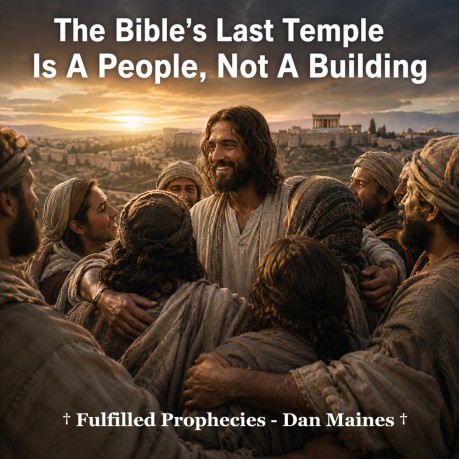
The Bible's Last Temple Is A
People, Not A Building Introduction Exodus 25:8 1 Kings 8:10-11 John 2:19-21 John 4:21-24 1 Corinthians 3:16-17 2 Corinthians 6:16 Ephesians 2:19-22 1 Peter 2:4-5 Hebrews 3:5-6 Revelation 21:2-3 Revelation 21:22-23 Historical References How It Applies To Us Today Q & A Appendix Q: Why did God command Israel to build the
tabernacle? Q: Was Solomon's Temple God's permanent dwelling
place? Q: If believers are God's temple, when did that
begin? Q: What are the stones in God's New Covenant
temple? Q: Why does Revelation say there is no temple in
the New Jerusalem? Q: Would rebuilding a temple restore something
Christianity is missing? Q: What is God's dwelling place now? † This is the fulfilled perspective we proclaim at
Fulfilled Prophecies † Source Index
By Dan Maines
† From
Genesis to Revelation, one of the great themes of Scripture is the
dwelling place of God. God dwelt among Israel in the tabernacle, then
His glory filled the Temple, then the Word became flesh and dwelt
among His people, and finally the apostles declared that God's people
themselves were His temple.
† This
progression matters because the Bible doesn't end with God returning
to a stone building in Jerusalem. It ends with God dwelling with His
people, with no physical temple needed in the New Jerusalem because
the Lord God Almighty and the Lamb are its temple (Revelation 21:3,
22).
† The old covenant sanctuary was never
God's final destination. It was a shadow pointing toward Christ and
the greater spiritual house He would build (Hebrews 8:5; 9:11).
†
Follow the dwelling place through Scripture and the pattern becomes
unmistakable, tabernacle, Temple, Christ, His people, New Jerusalem.
The Bible's last temple isn't a rebuilt building. It's a redeemed
people living in the presence of God.
Have them construct a sanctuary
for Me, so that I may dwell among them.
† The
purpose of the tabernacle was God's dwelling among Israel. The
sanctuary wasn't important merely because of its materials,
furniture, sacrifices, or priesthood. Its significance came from the
presence of God among His covenant people.
†
This established a pattern that runs throughout Scripture. God
desired to dwell with His people, but under the old covenant His
presence was represented through a physical sanctuary separated by
curtains, priests, sacrifices, and restricted access (Exodus
26:31-33).
† The tabernacle therefore wasn't
the final dwelling place of God. It was an earthly representation
pointing toward something greater, where God's presence wouldn't be
confined behind a veil in a physical sanctuary (Hebrews 9:8-9).
And it happened that when
the priests came from the holy place, the cloud filled the house of
the Lord, so that the priests could not stand to minister because of
the cloud, for the glory of the Lord filled the house of the Lord.
†
When Solomon's Temple was dedicated, the glory of God filled the
house. The portable tabernacle had given way to a permanent structure
in Jerusalem, but the underlying purpose remained the same, God
dwelling among His covenant people.
† Yet
Solomon understood that the building couldn't literally contain the
infinite God. He immediately acknowledged that even heaven and the
highest heaven couldn't contain Him, much less the house Solomon had
built (1 Kings 8:27).
† This is critical.
Scripture itself never presents the stone Temple as God's ultimate
dwelling place. The building served a covenant purpose for a limited
period while God's redemptive plan moved toward Christ.
Jesus answered them, "Destroy
this temple, and in three days I will raise it up." The Jews
then said, "It took forty-six years to build this temple, and
yet You will raise it up in three days?" But He was speaking
about the temple of His body.
† Jesus made a
revolutionary shift in the biblical temple theme. Standing in the
shadow of Jerusalem's magnificent sanctuary, He identified His own
body as the true temple.
† The religious
leaders were thinking about stones, construction, and Herod's Temple.
Jesus was speaking about Himself. God's presence among humanity was
no longer centered ultimately in a building, it was centered in
Christ.
† This explains why John's Gospel had
already declared that the Word became flesh and dwelt among them
(John 1:14). Jesus was God's presence among His people in a way the
tabernacle and Temple could only anticipate.
†
Once Christ became the true temple, rebuilding another physical
sanctuary could never represent progress in God's redemptive plan. It
would be a return to the shadow after the reality had arrived
(Colossians 2:16-17).
Jesus said to her, "Believe
Me, woman, that a time is coming when you will worship the Father
neither on this mountain nor in Jerusalem. You Samaritans worship
what you do not know; we worship what we do know, because salvation
is from the Jews. But a time is coming, and even now has arrived,
when the true worshipers will worship the Father in spirit and truth;
for such people the Father seeks to be His worshipers. God is spirit,
and those who worship Him must worship in spirit and truth."
†
Jesus directly announced the end of geographical worship centered in
Jerusalem. He didn't tell the woman that Jerusalem would temporarily
lose its importance only to become the center of worship again
thousands of years later.
† He contrasted
location-based worship with worship in spirit and truth. The movement
was away from sacred geography and toward the spiritual reality
accomplished through Him.
† This destroys the
idea that God's redemptive plan requires another physical temple in
Jerusalem. Jesus said the hour was coming when worship wouldn't be
centered there. The New Covenant doesn't move God's people back to
Jerusalem, it brings them into direct access to the Father through
Christ (Ephesians 2:18).
Do you not know that
you are a temple of God and that the Spirit of God dwells in you? If
anyone destroys the temple of God, God will destroy that person; for
the temple of God is holy, and that is what you are.
†
Paul couldn't have made the transition clearer. God's people are His
temple because God's Spirit dwells in them.
†
The church at Corinth wasn't standing in a future rebuilt sanctuary.
They themselves were the sanctuary. The defining characteristic of
God's temple had always been His presence, and now His Spirit dwelt
within His people.
† Notice that Paul doesn't
describe believers as temporary substitutes until God returns His
attention to a stone building. He identifies them as God's holy
temple. The dwelling place has moved from architecture to people.
†
This wasn't merely language about individual spirituality. Paul was
addressing the gathered body of believers. Together they formed God's
temple, anticipating his even fuller explanation of this truth to the
Ephesians (Ephesians 2:21-22).
Or what agreement does
the temple of God have with idols? For we are the temple of the
living God; just as God said, I will dwell among them and walk among
them; And I will be their God, and they shall be My people.
†
Paul again says, we are a temple of the living God. He then connects
the church directly with the ancient covenant promise that God would
dwell among His people.
† The promise wasn't
ultimately fulfilled by constructing a larger building. It was
fulfilled by God dwelling in His redeemed people.
†
The language, I will be their God, and they shall be my people,
reaches its climax in Revelation's description of the New Jerusalem
(Revelation 21:3). Paul and Revelation are describing the same
covenant reality, God dwelling with His people.
So then you are no longer
strangers and foreigners, but you are fellow citizens with the
saints, and are of God's household, having been built on the
foundation of the apostles and prophets, Christ Jesus Himself being
the cornerstone, in whom the whole building, being fitted together,
is growing into a holy temple in the Lord, in whom you also are being
built together into a dwelling of God in the Spirit.
†
Paul brings the entire temple theme together. Believers aren't
traveling toward a future physical temple. They're being built
together into a holy temple in the Lord.
†
Christ is the cornerstone, the apostles and prophets form the
foundation, and believers are the living structure. This temple isn't
made with limestone, cedar, gold, or marble. It's made from people
joined together in Christ.
† Paul
specifically calls this temple a habitation of God in the Spirit.
That's the purpose first announced in the tabernacle, that God would
dwell among His people, now brought into its New Covenant reality.
†
This also explains why Jew and Gentile are included in the same
building. The dividing wall has been removed, and both have access to
the Father through one Spirit (Ephesians 2:14, 18). God's final
temple isn't national or geographical. It's covenantal and spiritual.
And coming to Him as to a
living stone which has been rejected by people, but is choice and
precious in the sight of God, you also, as living stones, are being
built up as a spiritual house for a holy priesthood, to offer
spiritual sacrifices that are acceptable to God through Jesus
Christ.
† Peter uses the same temple imagery
as Paul. Jesus is the living stone, and believers are living stones
being built into a spiritual house.
† The
language couldn't be further removed from the expectation of another
physical temple. Peter doesn't describe believers gathering stones
for a future sanctuary. He says they are the stones.
†
The priesthood also changes with the house. God's people are a holy
priesthood offering spiritual sacrifices through Jesus Christ.
Physical temple, physical priesthood, and animal sacrifices give way
to their New Covenant realities (Hebrews 13:15).
†
Peter was writing while the Jerusalem Temple was still standing, yet
he identified believers in Christ as God's spiritual house. The old
structure was still physically present, but God's redemptive purpose
had already moved beyond it.
Now Moses was faithful in all
God's house as a servant, for a testimony of those things which were
to be spoken later; but Christ was faithful as a Son over His
house-whose house we are, if we hold firmly to our confidence and the
boast of our hope.
† Hebrews says whose house
are we. God's house is identified with His people under the authority
of Christ.
† Moses served within the old
covenant house, but Christ rules as Son over the greater house. The
movement of Scripture isn't toward restoring Moses' system. It's
toward the completed house established through Christ.
†
This is consistent with Hebrews' larger argument. The old sanctuary,
priesthood, sacrifices, and covenant were shadows pointing toward
better realities in Christ (Hebrews 8:6; 9:11; 10:1).
And I saw the holy city,
new Jerusalem, coming down out of heaven from God, prepared as a
bride adorned for her husband. And I heard a loud voice from the
throne, saying, Behold, the tabernacle of God is among the people,
and He will dwell among them, and they shall be His people, and God
Himself will be among them,
† Revelation
brings the biblical dwelling-place theme to its climax. The New
Jerusalem is described as both a city and a bride. This isn't
ordinary architectural language. It's covenant language describing
God's redeemed people.
† The announcement
deliberately echoes the purpose of the original tabernacle, God
dwelling among His people. What began with a tent in the wilderness
reaches fulfillment in God's permanent presence with His covenant
people.
† The movement is complete, from God
dwelling among Israel through a sanctuary, to God dwelling in Christ,
to God dwelling in His people, to the New Jerusalem where His
presence defines the entire city.
I saw no temple in it,
for the Lord God the Almighty and the Lamb are its temple. And the
city has no need of the sun or of the moon to shine on it, for the
glory of God has illuminated it, and its lamp is the Lamb.
†
This is the decisive conclusion. The Bible ends its temple story by
explicitly saying that John saw no temple in the New Jerusalem.
†
Why isn't there a physical temple? Because the Lord God Almighty and
the Lamb are its temple. The symbol has disappeared because God's
immediate presence has become the reality.
†
Revelation doesn't end by rebuilding what Jesus and the apostles
moved beyond. It ends with the complete fulfillment of everything the
tabernacle and Temple represented, God dwelling with His people
through the Lamb.
† A future return to an
earthly temple, Levitical priesthood, and sacrificial system would
reverse the entire direction of the New Testament. Scripture moves
from shadow to reality, from physical sanctuary to Christ, and from
restricted access to God's dwelling among His people (Hebrews
10:19-22).
† The Bible's last temple isn't a
building in Jerusalem. The Bible's last temple is the fulfilled
dwelling of God with His people in Christ.
†
Josephus described the Jerusalem Temple as an extraordinary and
magnificent structure before its destruction, and he recorded its
devastation by the Romans in AD 70. Its physical greatness couldn't
prevent the judgment Jesus had announced against Jerusalem and its
house (Josephus, Wars of the Jews, Books 5-6; Matthew 23:37-38;
24:1-2).
† Josephus recorded the burning and
destruction of the Temple during the Roman siege. The sanctuary that
had dominated Jewish religious life was physically removed, exactly
within the generation to which Jesus had spoken (Josephus, Wars of
the Jews 6.4; Matthew 24:34).
† Tacitus also
described the Roman siege of Jerusalem and the Temple within the
city, providing an independent Roman witness to the historical
setting of Jerusalem's destruction (Tacitus, Histories, Book 5).
†
Eusebius later connected Jerusalem's catastrophe with the judgment
that followed the rejection of Christ and recorded the tradition that
believers escaped from Jerusalem before the war (Eusebius,
Ecclesiastical History, Book 3, Chapters 5-7).
†
These historical witnesses don't establish the theology, Scripture
does. They confirm the historical destruction of the old sanctuary
while the apostolic writings identify Christ and His people as God's
New Covenant dwelling place.
†
We don't need a rebuilt temple in Jerusalem to experience the
presence of God. In Christ, believers already belong to the dwelling
place God promised to establish.
† We don't
need an earthly priesthood standing between us and God. Through
Christ we have access to the Father by the Spirit (Ephesians 2:18).
†
We don't need animal sacrifices because Christ's sacrifice
accomplished what those sacrifices could only anticipate (Hebrews
10:10-14).
† We don't need sacred geography
because Jesus moved worship beyond Jerusalem and declared that true
worship would be in spirit and truth (John 4:21-24).
†
We aren't waiting for God to move back into a building. God's people
are His spiritual house, His holy temple, and His dwelling place in
the Spirit (1 Corinthians 3:16; Ephesians 2:21-22; 1 Peter 2:5).
†
The New Jerusalem isn't calling believers back to the old Jerusalem.
It reveals the completed New Covenant reality where God dwells with
His people and the Lamb is the light of the city (Revelation 21:2-3,
22-23).
† The story that began with Make me a
sanctuary, that I may dwell among them ends with Behold, the
tabernacle of God is with men. That's the Bible's temple story from
beginning to fulfillment.
Q: Does
Bible prophecy require a third physical temple to be built in
Jerusalem?
A: No. The New Testament moves in
the opposite direction. Jesus identified His body as the temple, Paul
called believers God's temple, Peter called believers a spiritual
house, and Revelation's New Jerusalem explicitly has no physical
temple because God and the Lamb are its temple (John 2:19-21; 1
Corinthians 3:16-17; 1 Peter 2:4-5; Revelation 21:22).
A: It represented His dwelling
among His covenant people and anticipated the greater dwelling that
would come through Christ (Exodus 25:8; Hebrews 9:8-9).
A: No. Solomon himself acknowledged that
even heaven couldn't contain God, much less the house he had built (1
Kings 8:27). The Temple served its purpose within the old covenant
until the greater reality came through Christ.
A: The apostles were already teaching
this before Jerusalem's Temple was destroyed. Paul told first-century
Christians that they were God's temple and God's dwelling place in
the Spirit (1 Corinthians 3:16; Ephesians 2:21-22).
A: God's people are the living stones,
with Jesus Christ as the foundational living stone and cornerstone (1
Peter 2:4-5; Ephesians 2:20).
A: Because the Lord God
Almighty and the Lamb are its temple. God's presence is no longer
represented through a separate physical sanctuary (Revelation 21:22).
A: No. Christianity
isn't waiting for the restoration of old covenant shadows. Christ
provided direct access to God, established the spiritual house, and
brought His people into the greater New Covenant reality (Hebrews
10:19-22; Ephesians 2:18-22).
A:
God's dwelling place is His people in Christ. The apostles call
believers God's temple, God's spiritual house, and God's habitation
in the Spirit (1 Corinthians 3:16-17; Ephesians 2:21-22; 1 Peter
2:5).
© Fulfilled Prophecies - Dan
Maines.
† Exodus
25:8; 1 Kings 8:10-11; John 2:19-21; John 4:21-24; 1 Corinthians
3:16-17; 2 Corinthians 6:16; Ephesians 2:19-22; 1 Peter 2:4-5;
Hebrews 3:5-6; Revelation 21:2-3; Revelation 21:22-23
†
Josephus, Wars of the Jews, Books 5-6; Tacitus, Histories, Book 5;
Eusebius, Ecclesiastical History, Book 3, Chapters 5-7
Links