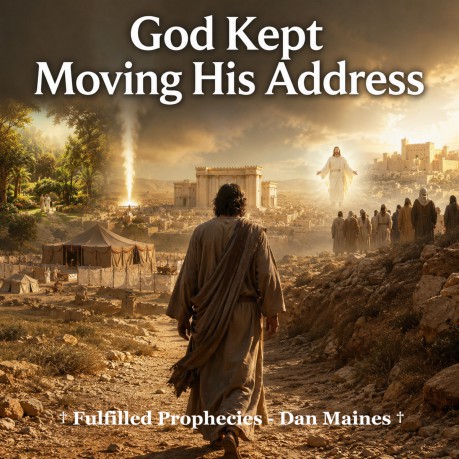
God Kept Moving His Address Introduction Genesis 3:8 Exodus 25:8 Exodus 40:34 1 Kings 8:10-13 John 1:14 John 2:19-21 1 Corinthians 3:16 Ephesians 2:21-22 Revelation 21:2-3 Revelation 21:22 Historical References How It Applies To Us Today Q & A Appendix Q: Was Solomon's Temple God's final dwelling
place? Q: Did Jesus identify Himself with the Temple? Q: Where does God dwell under the New
Covenant? Q: Does the New Jerusalem contain another
physical Temple? Q: Why is New Jerusalem called both a city and a
bride? Q: Are Christians waiting for God to return to a
rebuilt Temple in Jerusalem? Q: What is the great message connecting Eden to
New Jerusalem? † This is the fulfilled perspective we proclaim at
Fulfilled Prophecies † Source Index
By Dan Maines
† From
Genesis to Revelation, one of the greatest themes in the Bible is the
dwelling place of God. The story begins with God dwelling with
humanity in Eden, moves to the tabernacle in the wilderness, then to
the Temple in Jerusalem, then to Jesus Christ, then to His people as
the living temple, and finally to the New Jerusalem.
†
God's presence wasn't permanently tied to geography, stone, curtains,
altars, or buildings. Each dwelling place pointed forward to
something greater.
† The movement is
unmistakable. Eden, tabernacle, Temple, Christ, Church, New
Jerusalem. God kept moving His address until His dwelling with His
redeemed people was fully established.
† This
is why the Bible ends very differently from the way it begins.
Humanity was driven from God's presence in Eden, but Revelation ends
with God's people dwelling permanently in His presence.
†
The entire biblical story can be followed by asking one simple
question: Where does God dwell with His people?
Now they heard the sound of the
Lord God walking in the garden in the cool of the day, and the man
and his wife hid themselves from the presence of the Lord God among
the trees of the garden.
† Eden presents the
earliest picture of humanity living in the presence of God. Sin
shattered that fellowship, and humanity was driven from the garden
and barred from the tree of life (Genesis 3:22-24).
†
The problem introduced in Genesis wasn't merely that humanity lost
beautiful surroundings. Humanity lost unhindered access to God's
presence.
† From that point forward,
Scripture develops the story of God restoring His dwelling among His
people. Revelation deliberately returns to Eden imagery when the tree
of life appears again in the New Jerusalem (Revelation 22:1-3).
Have
them construct a sanctuary for Me, so that I may dwell among them.
†
God brought Israel out of Egypt and commanded them to construct a
sanctuary. The purpose is stated plainly, God intended to dwell among
them.
† The tabernacle was portable because
Israel was traveling toward the promised land. God's dwelling was
represented in the middle of His covenant people as they moved
through the wilderness.
† Yet the tabernacle
wasn't the final goal. It was a copy and shadow of heavenly realities
and pointed beyond itself to something greater (Hebrews 8:5; 9:8-11).
Then the cloud covered the tent
of meeting, and the glory of the Lord filled the tabernacle.
†
When the tabernacle was completed, God's glory filled it. The
dwelling promised in Exodus 25 became visibly associated with the
sanctuary.
† Notice the pattern. God wasn't
asking Israel merely to construct a religious building. The central
issue was His presence among His covenant people.
†
The cloud and glory demonstrated that the tabernacle had become the
recognized dwelling place of God's covenant presence, but Scripture
would soon move that address again.
And it happened that when
the priests came from the holy place, the cloud filled the house of
the Lord, so that the priests could not stand to minister because of
the cloud, for the glory of the Lord filled the house of the Lord.
†
The imagery deliberately resembles the dedication of the tabernacle.
Once again the cloud appeared and God's glory filled the sanctuary.
†
The portable tabernacle had given way to Solomon's Temple. Jerusalem
became the center of Israel's covenant worship, sacrifices,
priesthood, and national life.
† Yet Solomon
himself understood that the Creator couldn't literally be contained
inside a building. He immediately acknowledged that even heaven and
the highest heaven couldn't contain God (1 Kings 8:27).
†
The Temple was therefore never God's final destination. It belonged
to a covenant system that was preparing the way for Christ.
And the Word became flesh, and
dwelt among us; and we saw His glory, glory as of the only Son from
the Father, full of grace and truth.
† This
is one of the greatest movements of God's dwelling place in the
entire Bible. God's presence was no longer centered in a tent or
stone building. The Word became flesh and dwelt among humanity.
†
Jesus was Emmanuel, God with us (Matthew 1:23). What the tabernacle
and Temple represented through symbols, Jesus embodied personally.
†
God's glory wasn't ultimately found behind a Temple curtain. God's
glory was revealed in His Son.
† This is why
Jesus could speak about Himself using Temple language. The true
meeting place between God and humanity had arrived.
Jesus answered them, "Destroy
this temple, and in three days I will raise it up." The Jews
then said, "It took forty-six years to build this temple, and
yet You will raise it up in three days?" But He was speaking
about the temple of His body.
† Jesus
couldn't have made the transition much clearer. His opponents were
thinking about Herod's physical Temple, but Jesus was speaking about
His own body.
† The old Temple was standing
when Jesus said this, yet the greater Temple was standing directly in
front of them.
† The Temple building was
approaching judgment, while Christ was establishing the reality
toward which the old sanctuary had always pointed (Matthew 24:1-2).
†
Jesus didn't come to preserve Jerusalem's Temple forever. He became
the true Temple and opened access to the Father through Himself (John
14:6).
Do you not know that you
are a temple of God and that the Spirit of God dwells in you?
†
After Christ's resurrection and the outpouring of the Holy Spirit,
the dwelling language moves again. God's people themselves are called
His temple.
† Paul wasn't telling believers
that they needed another physical sanctuary where God could dwell. He
told them that they were God's temple because God's Spirit dwelled
among them.
† This was revolutionary in a
world where the Jerusalem Temple was still standing. The apostles
were already identifying the New Covenant community as God's dwelling
place.
† The Church isn't merely a group that
visits God's house. In Christ, God's people are His house (1 Timothy
3:15; Hebrews 3:6).
in whom the whole
building, being fitted together, is growing into a holy temple in the
Lord, in whom you also are being built together into a dwelling of
God in the Spirit.
† Paul describes Jews and
Gentiles being joined together in Christ as one growing holy
temple.
† Notice the language, habitation of
God in the Spirit. God's address wasn't returning to a rebuilt stone
Temple in Jerusalem. His dwelling was His redeemed covenant people.
†
The stones of this Temple are living people joined together in Christ
(1 Peter 2:4-5).
† This explains why the
destruction of Jerusalem's Temple in AD 70 didn't leave God homeless.
The old covenant house had completed its purpose, while the greater
spiritual house had already been established.
And I saw the holy city,
new Jerusalem, coming down out of heaven from God, prepared as a
bride adorned for her husband. And I heard a loud voice from the
throne, saying, Behold, the tabernacle of God is among the people,
and He will dwell among them, and they shall be His people, and God
Himself will be among them,
† Revelation
brings the entire biblical dwelling theme to its climax. The language
that began in Eden and continued through the tabernacle and Temple
now reaches its covenant fulfillment in the New Jerusalem.
†
The city is also the bride. This immediately tells us that John isn't
describing ordinary architecture. The imagery represents God's
redeemed covenant people (Revelation 21:9-10).
†
The declaration is the answer to the problem introduced in Genesis,
the tabernacle of God is with humanity. God's dwelling and His people
have become inseparable.
† From the fulfilled
perspective, this is the New Covenant reality established through
Christ and fully revealed with the passing of the old covenant age.
I saw no temple in it, for
the Lord God the Almighty and the Lamb are its temple.
†
This may be the most powerful ending possible to the Temple story.
The Bible ends with no physical Temple in the New Jerusalem.
†
Why isn't there a Temple? Because the symbols have given way to the
reality. God and the Lamb are its Temple.
†
Eden pointed toward restored fellowship. The tabernacle pictured
God's dwelling. Solomon's Temple localized covenant worship. Christ
became the true Temple. His people became the Spirit-filled Temple.
New Jerusalem reveals the completed reality of God dwelling with His
people.
† A future return to animal
sacrifices and a physical Temple wouldn't advance this story, it
would reverse it. The biblical movement is from shadow to substance,
from physical copies to spiritual reality, and from restricted access
to permanent access through Christ (Hebrews 10:19-22).
†
God kept moving His address, not because His plan kept changing, but
because every earlier dwelling place was moving history toward the
reality God intended from the beginning.
†
Josephus described the Jerusalem Temple as the center of Jewish
worship and recorded its catastrophic destruction by the Romans in AD
70. His account preserves the historical end of the Temple that had
dominated Jewish covenant life in the first century (Josephus, Wars
of the Jews, Books 5-6).
† Josephus records
the burning and destruction of the Temple during the Roman siege,
giving historical context to Jesus' prediction that the magnificent
Temple buildings would be thrown down (Josephus, Wars of the Jews
6.4).
† Eusebius later connected Jerusalem's
devastation with the judgments announced by Jesus and recorded that
the believers in Jerusalem had departed before the city's destruction
(Eusebius, Ecclesiastical History 3.5-7).
†
These historical witnesses don't establish the theology by
themselves. Scripture establishes the theology, while history
confirms that the first-century Temple system actually came to the
catastrophic end Jesus had predicted.
†
We don't need to travel to Jerusalem to find the dwelling place of
God. Through Christ, believers have access to the Father by one
Spirit (Ephesians 2:18).
† We aren't waiting
for another physical Temple to restore something God removed. We
belong to the greater Temple that Christ established.
†
God's presence isn't confined to a church building. The people of God
are His dwelling through the Spirit.
† This
changes the way we think about worship. Jesus moved worship away from
dependence upon a sacred geographical location and declared that true
worshipers worship the Father in spirit and truth (John 4:21-24).
†
The Bible begins with humanity outside Eden and separated from the
tree of life. It ends with God's servants in the New Jerusalem, the
tree of life restored, God's presence established, and the curse
removed (Revelation 22:1-3).
† We aren't
waiting for God to move back into a building. In the New Covenant,
God has made His dwelling with His people.
†
God kept moving His address until the address wasn't a garden, a
tent, or a stone building. His dwelling is with His people in Christ.
Q: Why
did God command Israel to build the tabernacle?
A:
God explicitly said that the sanctuary was constructed so He could
dwell among them (Exodus 25:8).
A: No. Even Solomon acknowledged that
heaven itself couldn't contain God, much less the Temple he had built
(1 Kings 8:27).
A:
Yes. When Jesus spoke about destroying the Temple and raising it in
three days, John specifically explains that He was speaking about the
Temple of His body (John 2:19-21).
A: God's people are His temple, and
they're being built together as His dwelling in the Spirit (1
Corinthians 3:16; Ephesians 2:21-22).
A: No. John explicitly says he
saw no Temple in the city because God Almighty and the Lamb are its
Temple (Revelation 21:22).
A: Revelation identifies the bride, the
wife of the Lamb, and then shows John the holy city, Jerusalem. The
city represents God's covenant people rather than merely physical
architecture (Revelation 21:9-10).
A: No. The New
Testament moves God's dwelling from the old Temple system to Christ
and His people. Going back to a physical sanctuary as God's covenant
dwelling would move backward from the reality to the shadow (John
2:19-21; Ephesians 2:21-22; Revelation 21:22).
A: God's presence with humanity.
Genesis shows fellowship broken through sin, while Revelation shows
God's dwelling with His people and the tree of life accessible again
(Genesis 3:22-24; Revelation 21:3; 22:1-3).
© Fulfilled Prophecies - Dan
Maines.
† Genesis
3:8; Exodus 25:8; Exodus 40:34; 1 Kings 8:10-13; John 1:14; John
2:19-21; 1 Corinthians 3:16; Ephesians 2:21-22; Revelation 21:2-3;
Revelation 21:22
† Josephus, Wars of the
Jews, Books 5-6; Eusebius, Ecclesiastical History 3.5-7
Links