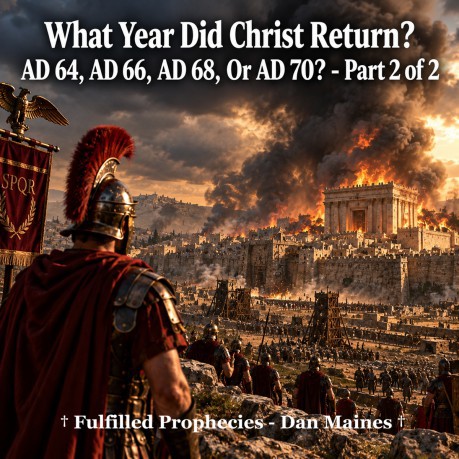
What Year Did Christ
Return? Introduction Why Not AD 68? What About Nero Dying In AD 68 And The Beast Being Cast
Into The Lake Of Fire? If Believers Had Already Come To New Jerusalem, How Could
The Resurrection And Coming Still Be In AD 70? If They Were Already In The Kingdom, How Could Christ's
Coming Still Be In AD 70? Why AD 70? Historical References How It Applies To Us Today Q & A Appendix Q: If believers had already come to New Jerusalem
before AD 70, doesn't that prove the resurrection had already
happened? Q: How does Daniel 12 fit an AD 70 resurrection
if Christians were already in New Jerusalem? Q: If believers were already in Christ's kingdom,
doesn't Matthew 16:27-28 have to occur before AD 70? Q: Did the kingdom begin in AD 70? Q: Why identify AD 70 as the year of Christ's
return? Q: Was Christ's AD 70 coming a physical return to
stand bodily on the earth? Q: Does saying AD 70 mean nothing happened
prophetically between AD 30 and AD 70? Q: Are Christians today still waiting for the
Second Coming described in Matthew 24 and Luke 21? † This is the fulfilled perspective we proclaim at
Fulfilled Prophecies † Source Index
By Dan Maines
AD 64, AD 66, AD 68, Or AD 70? - Part 2 of 2
† In Part 1,
we established that Scripture places Christ's coming within the
lifetime of His first-century generation. We also examined why AD 64
doesn't satisfy the specific judgment Jesus predicted and why the
events beginning around AD 66, including Jerusalem being threatened
by Roman armies, point toward an approaching desolation rather than
proving that the entire judgment was already completed (Matthew
16:27-28; Matthew 24:2, 30-34; Luke 21:20-28).
†
Now we need to examine AD 68 and answer two important objections. If
believers had already come to heavenly Jerusalem and were already in
Christ's kingdom before AD 70, how could the resurrection and coming
still reach their consummation in AD 70? Scripture itself gives us
the answer (Colossians 1:13; Hebrews 8:13; Hebrews 10:37; Hebrews
12:22-28).
† AD 68 is
historically significant because of Nero's death, but Jesus never
identified Nero's death as the determining sign of His coming. He
repeatedly identified Jerusalem, the temple, and His generation
(Matthew 23:36-38; Matthew 24:1-3, 34).
† The
biblical prophecy centers on Jerusalem's judgment rather than on the
death of a Roman emperor (Luke 19:41-44; Luke 21:20-24).
†
Revelation likewise directs attention toward the holy city, the
temple, and the city where the Lord was crucified (Revelation 11:1-2,
8).
† Nero belongs to the historical setting
surrounding the persecution and judgment period, but his death
doesn't provide the strongest biblical marker for the completion of
Jesus' prophecy (Matthew 24:2; Luke 21:20-24).
† Nero's
death in AD 68 doesn't require Christ's coming to have occurred in AD
68. Revelation also presents the Beast as the Roman imperial power
represented through its rulers. The Beast has multiple heads
identified with kings, showing that the Beast can't be limited to the
physical life of one emperor. An individual ruler such as Nero could
represent that larger beastly power without exhausting everything
represented by the Beast (Revelation 13:1-8; Revelation 17:9-11).
†
Nero fits important features of the Beast, including the numerical
identification associated with 666, but Nero's personal death doesn't
mean every prophetic judgment associated with the Beast had to be
completed at the moment he died (Revelation 13:18; Revelation
17:9-11).
† Revelation says the Beast and
false prophet were cast into the lake of fire in connection with
Christ's victorious judgment. This is judgment imagery describing the
decisive defeat of the powers opposing Christ, not a statement
requiring Nero's physical body to remain alive until AD 70
(Revelation 19:11-21).
† Daniel helps
establish this principle because prophetic beasts represent kingdoms
while also being expressed through individual kings. Daniel
specifically says the four beasts are kings and then identifies the
fourth beast as a kingdom, showing the close prophetic relationship
between a ruler and the kingdom he represents (Daniel 7:17, 23).
†
Nero could therefore die physically in AD 68 while the Roman imperial
Beast he represented continued beyond his personal death. Rome
continued its war against Jerusalem, and the judgment Jesus had
predicted hadn't yet reached its climax because Jerusalem and its
temple were still standing (Matthew 24:1-2; Luke 21:20-24; Revelation
11:1-2).
† The question isn't simply, "When
did Nero die?" The question is, "When did the prophetic
judgment reach its covenantal climax?" Nero died in AD 68, but
Jerusalem and its temple remained until their destruction in AD 70,
exactly where Jesus had focused His prophecy (Matthew 23:36-38;
Matthew 24:1-3, 30-34; Luke 21:20-32).
†
Some argue that the resurrection and coming must have occurred before
AD 70 because believers had already come to heavenly Jerusalem. But
entering New Jerusalem and reaching the completed resurrection
weren't identical events. Believers already possessed new covenant
realities while other promised events were still approaching their
consummation (Hebrews 8:13; Hebrews 10:25, 37; Hebrews 12:22-28).
†
Hebrews says believers had already come to Mount Zion and the
heavenly Jerusalem, yet the same chapter describes a shaking that was
still ahead and the removal of things that could be shaken. They had
already entered the heavenly city covenantally while the old covenant
world was still approaching its final removal (Hebrews 12:22-28).
†
This already-but-not-yet pattern appears throughout the New
Testament. Believers already had redemption, yet Jesus told His
disciples that their redemption would draw near as Jerusalem's
judgment unfolded. They already possessed salvation, yet Peter spoke
of salvation ready to be revealed in the last time (Colossians
1:13-14; Luke 21:28; Ephesians 2:8; 1 Peter 1:5).
†
Daniel connects the resurrection with the time of unparalleled
trouble and then asks when these wonders would reach their
completion. The answer points to the breaking of the power of the
holy people, showing that Daniel's resurrection prophecy belongs to
the same covenantal crisis Jesus later placed within His generation
(Daniel 12:1-2, 6-7; Matthew 24:21, 34).
†
Daniel himself was told that he would rest and then stand in his
allotted place at the end of the days. This shows that Daniel's
resurrection hope still awaited its appointed consummation even
though living New Testament believers had already entered the
blessings of heavenly Jerusalem (Daniel 12:13; Hebrews 12:22-23).
†
Paul likewise spoke of a resurrection that was still ahead of him. He
said there would be a resurrection of both the righteous and the
wicked, and he continued pressing toward the resurrection rather than
teaching that it had already been completed (Acts 24:15; Philippians
3:10-14).
† This is why being in New
Jerusalem before AD 70 doesn't move the completed resurrection to an
earlier date. The new covenant had already been established through
Christ, believers had already entered its heavenly realities, and yet
the old covenant age was still approaching its final removal and the
promised coming was still near (Hebrews 8:13; Hebrews 10:37; Hebrews
12:22-28).
† AD 70 was therefore not the
beginning of New Jerusalem or the beginning of salvation. It was the
consummation of the first-century covenant transition, when the old
temple order was finally removed and the resurrection and coming
promises connected with the end of that age reached their fulfillment
(Daniel 12:1-7, 13; Matthew 24:2-3, 21, 30-34).
† Another
objection is that believers were already in Christ's kingdom long
before AD 70. That's absolutely true. Paul said God had already
rescued believers from the authority of darkness and transferred them
into the kingdom of His beloved Son (Colossians 1:13).
†
Jesus also taught that the kingdom was already present through His
ministry. He said that if He cast out demons by the Spirit of God,
then the kingdom of God had come upon them. The kingdom therefore
didn't suddenly begin in AD 70 (Matthew 12:28; Luke 17:20-21).
†
Matthew 16:27-28 doesn't contradict this. Jesus didn't say, "Some
standing here won't die until the kingdom begins." He said some
standing there wouldn't taste death until they saw the Son of Man
coming in His kingdom. The emphasis is upon His coming in kingdom
authority, glory, and judgment, not upon the first existence of the
kingdom (Matthew 16:27-28; Matthew 24:30).
†
This distinction is critical. The kingdom could already be present
while Christ's promised coming in kingdom judgment was still future.
Paul could therefore say believers were already in the kingdom while
Jesus' promised first-century coming was still approaching
(Colossians 1:13; Hebrews 10:37).
† Jesus
Himself shows this progression. He proclaimed the kingdom during His
ministry, established His covenant through His death and
resurrection, and then promised a coming in judgment that some
standing before Him would live to see (Matthew 4:17; Matthew 12:28;
Matthew 16:27-28).
† AD 70 therefore wasn't
the birthday of the kingdom. It was the climactic public vindication
of the King's authority against the old covenant order that had
rejected Him. Jesus had already received all authority before AD 70,
yet His enemies were still being brought under His rule (Matthew
28:18; Acts 2:34-36; 1 Corinthians 15:25).
†
This is the same pattern we see with New Jerusalem. Believers had
already come to heavenly Jerusalem and were already citizens of the
kingdom, while the old covenant order was still approaching its final
removal (Colossians 1:13; Hebrews 8:13; Hebrews 12:22-28).
†
Being in the kingdom before AD 70 therefore doesn't prove that the
Second Coming had already occurred. It proves that the kingdom was
already present before its first-century judgment and covenantal
consummation. The kingdom came through Christ, while AD 70
demonstrated His reigning authority in the judgment He had promised
His generation (Matthew 16:27-28; Matthew 23:36-38; Matthew
24:30-34).
† AD 70 brings
the prophetic evidence together because it marks Jerusalem's
catastrophic desolation and the destruction of the temple Jesus
specifically said would be demolished (Matthew 24:1-2; Luke
21:5-6).
† Jesus said Jerusalem would be
surrounded and desolated, identified those events as days of
vengeance, described the Son of Man coming in a cloud, and placed the
entire prophecy within His generation (Luke 21:20-32).
†
Jesus had already pronounced that generation guilty and declared
their house desolate before giving the Olivet Discourse (Matthew
23:35-38).
† AD 66 can properly be understood
as a major beginning of the war and warning period, while AD 70
provides the clearest historical climax corresponding to Jerusalem's
predicted destruction (Matthew 24:15-22; Luke 21:20-24).
†
This doesn't require every prophetic event to happen during one
twenty-four-hour period. Biblical days of divine judgment could
describe historical judgments unfolding through military events
(Isaiah 13:6-13; Isaiah 19:1-4).
† When we're
asking which year best identifies the completed coming of Christ in
judgment upon Jerusalem, AD 70 has the strongest combined biblical
case because the identifying city and temple finally experienced the
judgment Jesus predicted (Matthew 23:36-38; Matthew 24:2, 30-34; Luke
21:20-32).
† We can identify AD 70 as the
climactic year of Christ's coming in judgment, but Scripture doesn't
identify an exact calendar day. The judgment unfolded through events
surrounding Jerusalem's siege and destruction, so we shouldn't claim
greater precision than Scripture gives us (Matthew 24:15-34; Luke
21:20-32).
† Although Scripture doesn't give
us the exact calendar day of Christ's coming, Josephus gives us
specific dates for the historical events surrounding Jerusalem's
destruction. He records that the temple was burned on the tenth day
of the month Lous, or Ab, in AD 70. He also notes that this was the
same month and day on which the earlier temple had been burned by the
Babylonians. Josephus, The Wars of the Jews, Book 6, Chapter 4,
Section 5.
† Josephus separately records that
Jerusalem was taken in the second year of Vespasian on the eighth day
of the month Gorpieus, or Elul, in AD 70. This gives us documented
historical dates for the destruction of the temple and the fall of
Jerusalem, the very city and temple Jesus identified in His prophecy
(Matthew 24:1-2; Luke 21:5-6, 20-24). Josephus, The Wars of the Jews,
Book 6, Chapter 10, Section 1.
† These
historical dates strengthen the identification of AD 70 as the
climactic year, but we shouldn't turn either date into the exact day
of Christ's coming because Scripture doesn't make that
identification. What we can say with confidence is that the temple
Jesus said would be destroyed and the Jerusalem He said would be
desolated experienced those events in AD 70 (Matthew 24:1-2, 30-34;
Luke 21:20-32).
†
Josephus was an eyewitness to the Jewish War and described the Roman
siege, terrible famine, slaughter, burning of the temple, and
destruction of Jerusalem. His account provides important historical
confirmation of the first-century setting in which Jesus' warnings
concerning Jerusalem were fulfilled (Matthew 24:2; Luke 19:41-44;
Luke 21:20-24). Josephus, The Wars of the Jews, Book 5, Chapters
10-13; Book 6, Chapters 4-9; Book 7, Chapter 1.
†
Josephus also recorded extraordinary signs before Jerusalem's
destruction, including a star resembling a sword, a comet, a strange
light around the altar and temple, the eastern temple gate opening by
itself, heavenly armies and chariots reportedly seen in the clouds,
and a voice from the temple saying they were departing. These
accounts are historically interesting alongside Jesus' warning
concerning fearful sights and great signs (Luke 21:11, 25-26).
Josephus, The Wars of the Jews, Book 6, Chapter 5, Section 3.
†
Tacitus recorded the Roman campaign against Jerusalem under Titus and
described prodigies associated with the period, including armies
appearing in the sky, weapons seeming to flash, the temple
illuminated by sudden fire, doors opening, and a supernatural voice
announcing departure. His Roman account independently places these
extraordinary reports within the period of Jerusalem's destruction
(Matthew 24:29-30; Luke 21:25-27). Tacitus, Histories, Book 5,
Chapters 10-13.
† Eusebius recorded the early
Christian tradition that the believers in Jerusalem were instructed
to leave the city before the war and moved to Pella. This is
consistent with Jesus' command that His disciples flee when they
recognized Jerusalem's approaching judgment (Matthew 24:15-20; Luke
21:20-21). Eusebius, Ecclesiastical History, Book 3, Chapter 5,
Sections 2-3.
† Eusebius also connected the
disasters that came upon the Jewish nation with the crimes committed
against Christ and His apostles and then described the calamities
surrounding Jerusalem's destruction. This provides an important early
Christian historical witness to how Jerusalem's catastrophe was
understood (Matthew 23:34-38; Luke 19:41-44). Eusebius,
Ecclesiastical History, Book 3, Chapters 5-7.
†
These historical writers don't establish our doctrine, Scripture
does. Their testimony provides historical confirmation that
Jerusalem, the temple, the Roman armies, the flight from the city,
and the catastrophic destruction occurred within the first-century
setting Jesus identified (Matthew 24:2, 15-21, 34; Luke 21:20-24,
32).
†
We're not waiting for Jerusalem to be surrounded again. Jesus gave
that sign to His first-century disciples concerning the Jerusalem
they knew and told them personally to flee when they saw it happening
(Matthew 24:15-20; Luke 21:20-21).
† We're
not waiting for another destruction of the temple in Matthew 24.
Jesus and His disciples were discussing the physical temple standing
before them when He said its stones would be thrown down (Matthew
24:1-3; Luke 21:5-7).
† We're not living in
the last days of the old covenant age. The New Testament writers said
they themselves were living in the last days and at the end of the
ages (Acts 2:16-17; Hebrews 1:1-2; Hebrews 9:26; 1 Peter 1:20).
†
We're living in the kingdom that can't be shaken, the heavenly
Jerusalem to which believers have already come through Christ
(Hebrews 12:22-28).
† Understanding AD 70
removes the fear created when first-century judgment passages are
pushed into our future. Jesus said His disciples would recognize
these events and that their generation wouldn't pass away until
everything He described was fulfilled (Matthew 24:33-34; Luke
21:28-32).
† Christ kept His word. He
promised to come within the lifetime of His contemporaries, He
pronounced judgment upon Jerusalem, and He said His generation would
see the fulfillment (Matthew 16:27-28; Matthew 23:36-38; Matthew
24:30-34).
† The debate over AD 64, AD 66, AD
68, and AD 70 shouldn't distract us from the larger truth. Christ's
coming wasn't postponed for thousands of years. The biblical time
statements place it in the first century, and the biblical event
markers point most clearly to AD 70 as its climactic fulfillment
(Matthew 10:23; Matthew 16:27-28; Hebrews 10:37; Revelation 1:1-3).
Q: Could
AD 68 be the year because Nero died?
A: Nero's
death was historically significant, but Jesus didn't make Nero's
death the identifying marker. His prophecy centered on Jerusalem, its
temple, its desolation, and His own generation (Matthew 23:36-38;
Matthew 24:1-3, 34; Luke 21:20-24).
A: No. Believers had already entered
the blessings of heavenly Jerusalem while Scripture still described
the old covenant order as approaching its removal, Christ's coming as
near, and the resurrection as still ahead. Possessing New Jerusalem
covenantally didn't mean every aspect of the first-century
consummation had already been completed (Acts 24:15; Hebrews 8:13;
Hebrews 10:37; Hebrews 12:22-28).
A:
Daniel connects the resurrection with the time of unparalleled
trouble and the breaking of the power of the holy people. Jesus used
Daniel's tribulation language and placed its fulfillment within His
generation. Daniel was also told that he would rest and stand in his
allotted place at the end of the days (Daniel 12:1-2, 6-7, 13;
Matthew 24:21, 34).
A:
No. Jesus didn't say some standing there would live until the kingdom
began. He said they would live to see the Son of Man coming in His
kingdom. Believers could already be citizens of Christ's kingdom
while His promised coming in kingdom judgment was still approaching
(Matthew 16:27-28; Colossians 1:13; Hebrews 10:37).
A:
No. Jesus said the kingdom had already come upon them during His
ministry, and Paul said believers had already been transferred into
Christ's kingdom. AD 70 wasn't the beginning of the kingdom, it was
the climactic vindication of Christ's reigning authority in judgment
against the old covenant order that rejected Him (Matthew 12:28;
Colossians 1:13; Matthew 23:36-38).
A: Because AD 70 is the year that best
matches the specific events Jesus identified. Jerusalem was desolated
and the temple He said would be demolished was destroyed. Jesus
connected that judgment with the coming of the Son of Man and placed
it within His generation (Matthew 24:2, 30-34; Luke 21:20-32).
A: No. Scripture had
already used cloud-coming language for divine judgment upon nations.
Jesus used that established prophetic language when describing His
judgment upon Jerusalem (Isaiah 19:1; Matthew 24:30; Luke 21:27).
A: No.
The New Testament shows an unfolding covenant transition. Christ
established the new covenant through His sacrifice, while the old
order was aging and approaching its disappearance (Hebrews 8:6-13;
Hebrews 9:8-15; Hebrews 10:9-18, 37).
A:
No. Jesus placed those events within His generation and directly
connected them with Jerusalem's destruction. He said all these things
would be fulfilled before that generation passed away (Matthew 24:34;
Luke 21:20-32).
© Fulfilled Prophecies - Dan
Maines.
† No full
Scripture passages are separately quoted as Scripture titles in Part
2.
† Josephus, The Wars of the Jews, Book 5,
Chapters 10-13; Book 6, Chapters 4-9; Book 6, Chapter 5, Section 3;
Book 7, Chapter 1
† Tacitus, Histories, Book
5, Chapters 10-13
† Eusebius, Ecclesiastical
History, Book 3, Chapter 5, Sections 2-3; Book 3, Chapters 5-7
Links