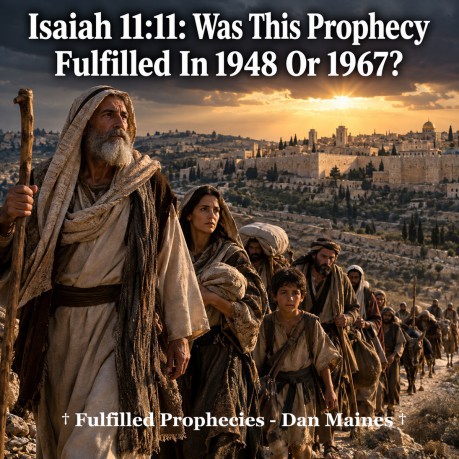
Isaiah 11:11: Was This
Prophecy Fulfilled In 1948 Or 1967? Introduction Isaiah 11:1-2 Isaiah 11:10 Isaiah 11:11 Isaiah 11:12 Romans 15:8-12 Romans 11:5-7 Ephesians 2:13-18 Historical References How It Applies To Us Today Q & A Appendix Q: Doesn't the list of countries prove this must
be a worldwide modern return to the land? Q: What does remnant mean in the New
Testament? Q: Did Paul expect Isaiah 11 to wait for a modern
State of Israel? Q: Does rejecting 1948 or 1967 as the fulfillment
of Isaiah 11 mean denying that those events happened? † This is the fulfilled perspective we proclaim at
Fulfilled Prophecies †
By Dan Maines
† Isaiah
11:11 is sometimes presented as a can't-fail proof text that the
establishment of the modern State of Israel in 1948, or Israel's
capture of Jerusalem in 1967, fulfilled biblical prophecy.
†
The problem is that Isaiah 11:11 doesn't mention 1948, 1967, or a
modern political state. The interpretation must come from the
biblical context, not from starting with a twentieth-century event
and then reading that event back into Isaiah.
†
Isaiah identifies where the remnant was scattered, but the chapter
also identifies the One through whom the gathering takes place. The
central figure of Isaiah 11 isn't a twentieth-century nation. It is
the Messiah, the root of Jesse (Isaiah 11:1, 10).
†
Isaiah 11 must also be read alongside the New Testament writers who
applied Isaiah's prophecy to Jesus Christ and the gathering of Jews
and Gentiles into one people (Romans 15:8-12; Ephesians 2:13-18).
†
When Scripture interprets Scripture, Isaiah 11:11 isn't waiting for
1948 or 1967. Its fulfillment belongs to the messianic work of Christ
and the first-century gathering of God's remnant.
Then a shoot will spring from
the stem of Jesse, And a Branch from his roots will bear fruit. The
Spirit of the Lord will rest on Him, The spirit of wisdom and
understanding, The spirit of counsel and strength, The spirit of
knowledge and the fear of the Lord.
† Isaiah
begins the chapter with Jesse, the father of David. Before we ever
reach verse 11, the prophecy has already established its messianic
foundation.
† The promised Branch is Jesus
Christ. The New Testament presents Jesus as the promised descendant
of David and the One upon whom the Spirit rested (Matthew 1:1;
3:16-17; Luke 4:16-21).
† This means verse 11
can't be separated from verses 1 and 2 and treated as an independent
prediction about a modern political nation. The entire chapter
develops from the coming and reign of the Messiah.
Then on that day The nations
will resort to the root of Jesse, Who will stand as a signal flag for
the peoples; And His resting place will be glorious.
†
Isaiah tells us that the nations would seek the root of Jesse. This
is bigger than ethnic Israel returning to geographical territory.
†
Paul directly quoted this verse while explaining Christ's ministry to
Israel and the inclusion of the Gentiles (Romans 15:8-12). Paul
didn't point his readers toward a twentieth-century restoration. He
pointed them to Christ.
† This is one of the
strongest controls on how Isaiah 11 should be interpreted. An
inspired apostle placed Isaiah 11 within the messianic gathering
already taking place through the gospel.
†
The prophecy concerns one Messiah drawing people from Israel and the
nations to Himself, not two unrelated fulfillments separated by
thousands of years.
Then it will happen on that day
that the Lord Will again recover with His hand the second time The
remnant of His people who will remain, From Assyria, Egypt, Pathros,
Cush, Elam, Shinar, Hamath, And from the islands of the sea.
†
This is the verse often treated as the decisive argument for 1948 or
1967, but notice the opening words, in that day. Verse 11 belongs to
the same messianic setting described immediately before it.
†
Isaiah doesn't suddenly jump from the Messiah in verse 10 to the
twentieth century in verse 11 and then return to the same prophetic
theme afterward. The gathering of the remnant occurs in the day of
the root of Jesse.
† The places named in this
verse identify the widespread locations from which the remnant would
be recovered. The geographical list demonstrates dispersion. It
doesn't establish 1948 or 1967 as the date of fulfillment.
†
The key word is remnant. Isaiah doesn't say that every physical
descendant of Israel would return to Palestine. God promised to
recover His remnant.
† Paul later used
Isaiah's remnant language when explaining what God was doing among
Israel in his own generation. He wrote that although Israel's number
might be like the sand of the sea, it was the remnant that would be
saved (Romans 9:27).
† Paul then made the
timing unmistakable when he said, in his own first-century present,
that there was a remnant according to God's gracious choice (Romans
11:5).
† Isaiah 11:11 therefore fits the New
Testament's first-century remnant theology. God's faithful remnant
was being gathered to the Messiah while the gospel was also going to
the Gentiles.
And He will lift up a flag for
the nations And assemble the banished ones of Israel, And will gather
the dispersed of Judah From the four corners of the earth.
†
Verse 12 continues the same thought. The ensign isn't raised for
Israel alone. It is raised for the nations.
†
Isaiah combines the gathering of Israel with God's purpose among the
nations. This is exactly what Paul saw fulfilled through Christ as
Jews and Gentiles were brought together in Him (Romans 15:8-12).
†
The New Testament describes Christ creating one people from Jew and
Gentile, reconciling both to God in one body (Ephesians 2:13-18).
†
This gathering isn't defined by possession of national borders. It is
defined by belonging to the Messiah.
For I say that Christ has
become a servant to the circumcision in behalf of the truth of God,
to confirm the promises given to the fathers, and for the Gentiles to
glorify God for His mercy; as it is written:
"Therefore I
will give praise to You among the Gentiles, And I will sing praises
to Your name." Again he says, "Rejoice, you Gentiles, with
His people." And again, "Praise the Lord all you Gentiles,
And let all the peoples praise Him." Again Isaiah says, "There
shall come the root of Jesse, And He who arises to rule over the
Gentiles, In Him will the Gentiles hope."
†
Paul's inspired interpretation is extremely important. He quoted
Isaiah 11:10 and identified the root of Jesse with Christ.
†
Paul wasn't discussing the creation of a political State of Israel.
He was explaining how God's promises were being confirmed through
Christ and how the Gentiles were being brought into God's redemptive
purpose.
† Isaiah 11:10 and Isaiah 11:11
can't reasonably be torn apart when Isaiah himself connected them
with in that day. Paul's use of verse 10 establishes the messianic
setting surrounding verse 11.
† The gathering
Isaiah foresaw had arrived in Christ. Israel's remnant and believing
Gentiles were coming under the reign of the root of Jesse.
In the same way then, there
has also come to be at the present time a remnant according to God's
gracious choice. But if it is by grace, it is no longer on the basis
of works, since otherwise grace is no longer grace. What then? What
Israel is seeking, it has not obtained, but those who were chosen
obtained it, and the rest were hardened;
†
Paul didn't tell his readers that Israel's promised remnant would
appear nearly two thousand years later. He said, at this present
time, there is a remnant.
† That statement
gives us an inspired first-century framework for Isaiah's language
about the remnant. God's promises hadn't failed because not every
Israelite believed. The elect remnant had received what Israel as a
whole hadn't obtained.
† The gathering wasn't
determined by ethnicity alone, national citizenship, military control
of Jerusalem, or geographical residence. It was according to God's
grace through Christ.
† This is why using
Isaiah 11:11 as an automatic proof of 1948 or 1967 overlooks Paul's
explanation of the remnant in his own generation.
But now in Christ Jesus
you who previously were far away have been brought near by the blood
of Christ. For He Himself is our peace, who made both groups into one
and broke down the barrier of the dividing wall, by abolishing in His
flesh the hostility, which is the Law composed of commandments
expressed in ordinances, so that in Himself He might make the two one
new person, in this way establishing peace; and that He might
reconcile them both in one body to God through the cross, by it
having put to death the hostility. And He came and preached peace to
you who were far away, and peace to those who were near; for through
Him we both have our access in one Spirit to the Father.
†
Isaiah's vision of the root of Jesse drawing the nations finds its
covenant reality in Christ. Those who were far off and those who were
near were brought together.
† Paul doesn't
describe two separate peoples of God with two separate prophetic
destinations. Christ made both one.
† The
great biblical gathering isn't centered on returning people to a
piece of land. It is centered on reconciling people to God through
Christ.
† This is the greater restoration
promised by the prophets, access to the Father through the Messiah.
†
Josephus described Jewish communities spread far beyond Judea in the
first century. In the preface to The Wars of the Jews, he referred to
Jews among the Parthians, Babylonians, Arabians, those beyond the
Euphrates, and the Adiabeni or Assyrians. The Jewish dispersion was
already a first-century reality.
† Josephus
also recorded the catastrophic destruction surrounding Jerusalem and
the Jewish-Roman War. His history shows that AD 70 wasn't the
beginning of a modern national restoration, but the devastating end
of the old Jerusalem-centered order.
†
Eusebius later recorded that the believers in Jerusalem left the city
and went to Pella before Jerusalem's destruction. His account
preserves the early Christian understanding that Christ's warnings
concerning Jerusalem had direct first-century consequences.
†
These historical witnesses don't establish the meaning of Scripture,
Scripture does that. They do, however, confirm the first-century
historical world in which the New Testament's remnant, dispersion,
gathering, and judgment language operated.
†
We shouldn't begin with 1948 or 1967 and then search the Old
Testament for verses that can be attached to those dates. We should
begin with Scripture and allow the apostles to explain how the
prophets were fulfilled.
† Isaiah 11 points
us to Jesus Christ. The root of Jesse is the center of the chapter,
the nations come to Him, and the remnant is gathered in His day.
†
Modern political events can be historically important without being
the fulfillment of biblical prophecy. Historical importance and
prophetic fulfillment aren't the same thing.
†
Our hope isn't in another geographical gathering, another temple,
another national restoration, or another prophetic timetable. Our
hope is in the Messiah who accomplished what the prophets promised.
†
The question Isaiah 11 ultimately places before us isn't whether
someone lives inside particular national borders. The question is
whether that person belongs to the root of Jesse, Jesus Christ.
†
God's people aren't waiting for Isaiah 11 to begin. Christ came, the
gospel went to Israel and the nations, the remnant was gathered, and
Jew and Gentile were made one in Him.
Q:
Doesn't Isaiah 11:11 plainly say that God would gather Israel
again?
A: Yes, but the question is when and
through whom. The surrounding verses place that gathering in the day
of the root of Jesse, and Paul identifies the root of Jesse as Christ
(Isaiah 11:10-11; Romans 15:8-12).
A:
No. The list tells us where the scattered remnant was found. It
doesn't give the date 1948 or 1967. Isaiah's own context connects the
gathering with the Messiah and the nations coming to Him (Isaiah
11:10-12).
A: Paul tells us directly that there
was a remnant according to God's gracious choice in his own present
time (Romans 11:5-7). He also quoted Isaiah when explaining that the
remnant would be saved (Romans 9:27).
A: Paul quoted Isaiah 11:10
and applied the prophecy to Christ and the Gentiles coming to hope in
Him (Romans 15:8-12). His application is messianic and first-century,
not twentieth-century.
A:
No. Those are historical events. The issue is whether Scripture
identifies them as the fulfillment of Isaiah 11. Isaiah points to the
Messiah, and the New Testament applies that prophecy to Christ, the
remnant, and the gathering of Jews and Gentiles into God's people
(Romans 11:5-7; Romans 15:8-12; Ephesians 2:13-18).
© Fulfilled Prophecies - Dan
Maines.
Source Index
†
Isaiah 11:1-2, 10-12; Romans 15:8-12; Romans 11:5-7; Ephesians
2:13-18
† Josephus, The Wars of the Jews;
Eusebius, Ecclesiastical History
Links