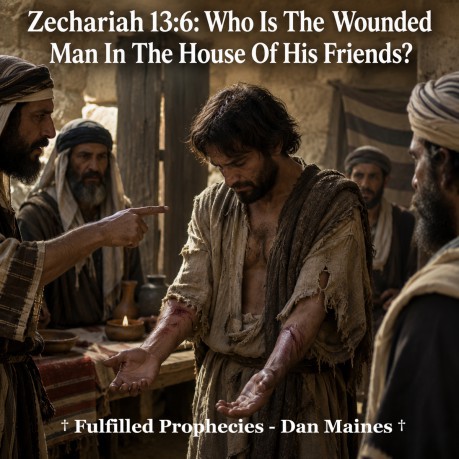
Zechariah 13:6: Who Is The
Wounded Man In The House Of His Friends? Introduction Zechariah 13:2 Zechariah 13:3 Zechariah 13:4 Zechariah 13:5 Zechariah 13:6 1 Kings 18:28 Matthew 24:11 Matthew 24:24 Zechariah 12:10 Historical References How It Applies To Us Today Q & A Appendix Q: Why does the man have wounds? Q: Why does he say he was wounded in the house of
his friends? Q: Doesn't Zechariah prophesy about Jesus being
pierced? Q: What does this passage teach us about
interpreting prophecy? Q: Was false prophecy important during the first
century? † This is the fulfilled perspective we proclaim at
Fulfilled Prophecies †
By Dan Maines
† Zechariah
13:6 is sometimes quoted as though it were a direct prophecy about
the wounds of Jesus at the crucifixion. However, the immediate
context tells us who the wounded man is. Zechariah is describing the
removal of idols, false prophets, and the unclean spirit from the
land.
† We can't isolate verse 6 from verses
2-5 and then assign the wounded man a completely different identity.
The man in verse 6 belongs to the same discussion about false
prophecy that begins in verse 2.
† The key is
to let Scripture interpret Scripture. Zechariah describes a false
prophet who becomes ashamed of his prophetic claims, denies being a
prophet, and is questioned about the wounds on his body.
†
This passage isn't describing the wounds of Christ from the cross.
It's describing the disgrace and exposure of false prophecy during
the covenant judgment and cleansing associated with that generation.
"And it will come about
on that day," declares the Lord of armies, "that I will
eliminate the names of the idols from the land, and they will no
longer be remembered; and I will also remove the prophets and the
unclean spirit from the land.
† The context
begins with God's promise to remove idols, prophets, and the unclean
spirit from the land. Everything that follows must be read within
that setting.
† Zechariah repeatedly uses in
that day for events connected with Jerusalem and the coming messianic
age. The prophecy isn't suddenly changing subjects in verse 6 without
telling us.
† Jesus later warned that false
prophets would arise before Jerusalem's judgment, showing that false
prophecy remained an important issue during that generation (Matthew
24:11, 24).
And if anyone still
prophesies, then his father and mother who gave birth to him will say
to him, 'You shall not live, because you have spoken falsely in the
name of the Lord'; and his father and mother who gave birth to him
shall pierce him through when he prophesies.
†
Zechariah now describes the severity with which false prophecy would
be rejected. The subject is still false prophets, not the Messiah.
†
This language reflects the covenant law given to Israel concerning
someone who attempted to lead God's people away from Him through
false religious claims (Deuteronomy 13:1-5).
†
The passage presents false prophecy as something shameful and
deserving judgment. That prepares us for verses 4-6, where the false
prophet tries to conceal what he has been.
Also it will come about on
that day that the prophets will each be ashamed of his vision when he
prophesies, and they will not put on a hairy robe in order to
deceive;
† Verse 4 couldn't be clearer about
the identity of the people under discussion. These prophets are
ashamed because their visions are false.
†
Their prophetic clothing had helped identify them as prophets, but
now they wouldn't want that identification because their deception
had been exposed.
† This isn't a description
of Jesus. Jesus wasn't ashamed of a false vision, He didn't prophesy
falsely, and He didn't disguise Himself because His prophetic claims
had failed.
but he will say, 'I am not a
prophet; I am a cultivator of the ground, because a man sold me as a
slave in my youth.'
† The same individual now
denies being a prophet. He claims instead that he's a worker of the
ground.
† Notice the progression. The
prophets are removed, the false prophet becomes ashamed, he abandons
the appearance of a prophet, and finally he denies that he was ever a
prophet.
† This makes the identity of the
wounded man in the next verse much easier to understand. Verse 6
continues the same conversation about this disgraced prophet.
And someone will say to him,
'What are these wounds between your arms?' Then he will say, 'Those
with which I was wounded at the house of my friends.'
†
The question is asked of the man who has just said, I am no prophet.
There isn't any indication that Zechariah has suddenly changed the
subject to Jesus.
† The wounds expose
something about this man's former religious activity. Self-inflicted
cutting was associated with pagan prophetic practices in Scripture,
as seen when the prophets of Baal cut themselves during their
confrontation with Elijah (1 Kings 18:28).
†
The phrase house of my friends describes the setting in which he
received the wounds. In context, his answer is part of his attempt to
explain the marks found on his body after denying that he's a
prophet.
† Jesus was wounded by His enemies
at the crucifixion. Zechariah 13:6 describes a man who has just
denied being a prophet after false prophets have become ashamed of
their visions. The immediate context shouldn't be ignored.
So they cried out with a loud
voice, and cut themselves according to their custom with swords and
lances until blood gushed out on them.
†
Scripture itself gives us an example of false prophets deliberately
cutting their bodies as part of pagan religious practice.
†
This provides important biblical background for understanding why
wounds could expose the previous religious activity of the man in
Zechariah 13.
† We don't need to invent an
explanation disconnected from Zechariah's context when Scripture
already shows false prophets receiving wounds through pagan prophetic
practices.
And many false prophets will
rise up and mislead many people.
† Jesus
warned His disciples that many false prophets would appear during the
events leading toward the judgment He described.
†
False prophecy wasn't an insignificant first-century issue. Jesus
specifically included it among the signs His disciples would
encounter.
† Zechariah's prophecy concerning
the removal of false prophecy therefore fits naturally within the
first-century covenant transition and judgment upon that generation
(Matthew 24:34).
For false christs and false
prophets will arise and will provide great signs and wonders, so as
to mislead, if possible, even the elect.
†
Jesus again emphasized the appearance of false prophets before the
events of that generation reached their conclusion.
†
Zechariah described false prophets becoming ashamed and their
prophetic claims being removed. Jesus described false prophets
operating during the closing period of the old covenant age.
†
These passages work together without requiring Zechariah 13:6 to
become a prediction of Jesus' crucifixion wounds.
And I will pour out on the
house of David and on the inhabitants of Jerusalem the Spirit of
grace and of pleading, so that they will look at Me whom they
pierced; and they will mourn for Him, like one mourning for an only
son, and they will weep bitterly over Him like the bitter weeping
over a firstborn.
† Zechariah does contain a
genuine prophecy connected with Christ being pierced. John directly
applies this language to Jesus (John 19:37).
†
This distinction is important. We don't deny that Zechariah
prophesied about Christ's suffering. We recognize the passages where
the New Testament itself makes that connection.
†
Zechariah 12:10 concerns the pierced one and mourning. Zechariah
13:2-6 concerns the removal and disgrace of false prophets. Keeping
each passage in its own context strengthens rather than weakens the
messianic prophecies.
†
Jerome, writing in his Commentary on Zechariah, preserved discussion
of Zechariah 13 within the larger prophetic context and recognized
that the surrounding verses concern prophets, deception, and the
removal of false prophetic activity.
† Cyril
of Alexandria, in his commentary on the Minor Prophets, also treated
Zechariah's surrounding prophecy within the themes of purification,
rejection of false worship, and God's work among His covenant
people.
† Historical Christian interpretation
hasn't been completely uniform concerning Zechariah 13:6. Some
Christian interpreters have connected the wounds with Christ, while
others have emphasized that verses 2-6 describe false prophets. The
immediate grammatical and biblical context must determine our
interpretation.
† Josephus recorded that the
period surrounding Jerusalem's final years was filled with deceivers
and false prophetic claims that contributed to the confusion among
the people. His historical account provides useful background for
Jesus' warnings concerning deceivers and false prophets before
Jerusalem's destruction.
†
We should never build doctrine by removing one verse from the
paragraph surrounding it. Context matters.
†
Zechariah 13:6 demonstrates why we must read what comes before and
after a verse instead of beginning with a traditional interpretation
and forcing it into the text.
† We don't need
to make Zechariah 13:6 about Jesus to defend His crucifixion.
Scripture clearly tells us that Jesus was pierced and wounded, and
Zechariah 12:10 is specifically connected with Him in the New
Testament (John 19:37).
† Fulfilled prophecy
becomes clearer when we allow the Bible to establish its own time
statements, audience, context, and fulfillment.
†
False prophecy belonged to the covenant world that was approaching
judgment. Jesus warned His own disciples about false prophets before
the end of that age, and Zechariah had already spoken of the removal
of false prophetic activity.
† We live on
this side of that completed covenant transition. Our faith rests in
Jesus Christ and the completed revelation preserved for us in
Scripture, not in people claiming new revelation from God.
Q: Is
Zechariah 13:6 a prophecy about the wounds Jesus received on the
cross?
A: The immediate context points to the
false prophet described in Zechariah 13:2-5. The man questioned in
verse 6 is the same man who has just denied being a prophet.
Zechariah 12:10, however, is directly connected with Jesus being
pierced in John 19:37.
A:
The passage doesn't explicitly describe how every wound was produced,
but Scripture shows that pagan prophets cut themselves as part of
their religious practices (1 Kings 18:28). In context, the wounds
expose the background of a man who is attempting to distance himself
from prophecy.
A: His statement explains the
wounds after he has denied being a prophet. Whatever specific
circumstances produced those wounds, the surrounding verses identify
him with the discussion of disgraced prophetic activity, not with a
sudden change of subject to the crucifixion.
A: Yes. Zechariah 12:10 speaks of the
one who was pierced, and John applies that Scripture to Jesus in John
19:37. Recognizing that fulfillment doesn't require us to make
Zechariah 13:6 say the same thing.
A: It teaches us to
respect context. We shouldn't isolate a single sentence from the
verses surrounding it. Zechariah 13:2-6 develops one continuous
discussion about removing false prophecy from the land.
A: Yes. Jesus specifically warned His
disciples that many false prophets would arise before the events He
said would occur within that generation (Matthew 24:11, 24, 34).
© Fulfilled Prophecies - Dan
Maines.
Source Index
†
Zechariah 13:2; Zechariah 13:3; Zechariah 13:4; Zechariah 13:5;
Zechariah 13:6; 1 Kings 18:28; Matthew 24:11; Matthew 24:24;
Zechariah 12:10
† Jerome, Commentary on
Zechariah; Cyril of Alexandria, Commentary on the Minor Prophets;
Josephus, The Wars of the Jews
Links