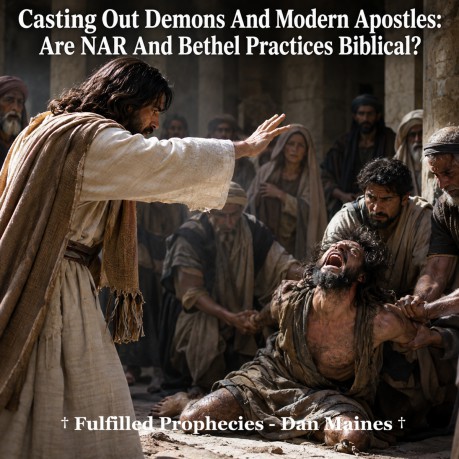
Casting Out Demons And Modern
Apostles: Are NAR And Bethel Practices Biblical? Introduction Matthew 10:1 Luke 10:17-20 Matthew 12:28-29 Acts 8:6-7 Acts 19:11-12 Acts 19:13-16 2 Corinthians 12:12 Ephesians 2:19-20 Hebrews 2:3-4 1 Corinthians 13:8-10 Historical References How It Applies To Us Today Q & A Appendix Q: Did Jesus give His disciples authority to cast
out demons? Q: Does the fact that apostles cast out demons
prove there must be apostles today? Q: Should Christians believe everyone who claims
to cast out demons? Q: Do we need modern apostles or prophets to
receive new revelation from God? Q: What should believers focus on instead of
modern claims of apostleship and deliverance ministries? † This is the fulfilled perspective we proclaim at
Fulfilled Prophecies †
By Dan Maines
† Casting
out demons was a real part of the ministry of Jesus and the apostles,
but we must ask when, why, and to whom that authority was given.
†
Modern movements associated with the New Apostolic Reformation,
commonly called NAR, and ministries such as Bethel often teach that
supernatural gifts, apostles, prophecy, healing, and deliverance
ministries continue today.
† The question
isn't whether demons and demonic activity appear in Scripture. They
clearly do. The question is whether Christians today have been
commissioned as apostles with the same miraculous authority Christ
gave His first-century messengers.
† We can't
build doctrine from testimonies, experiences, feelings, supposed
revelations, or claims that God told someone something. Scripture
must interpret Scripture (Acts 17:11; 2 Timothy 3:16-17).
†
The miraculous signs of casting out demons belonged to the
first-century ministry of Christ and His authorized messengers as the
kingdom was being revealed and the gospel was being confirmed.
Jesus summoned His twelve
disciples and gave them authority over unclean spirits, to cast them
out, and to heal every disease and every sickness.
†
Jesus specifically gave His twelve disciples authority over unclean
spirits. They didn't appoint themselves, attend a deliverance school,
or learn a technique. Christ gave them the authority.
†
This authority accompanied their mission to proclaim that the kingdom
of heaven was at hand (Matthew 10:5-8).
† The
signs confirmed that God's kingdom was breaking into the old covenant
age through the ministry of Christ and those whom He personally
commissioned (Hebrews 2:3-4).
Now the seventy-two returned
with joy, saying, "Lord, even the demons are subject to us in
Your name!" And He said to them, "I watched Satan fall from
heaven like lightning. Behold, I have given you authority to walk on
snakes and scorpions, and authority over all the power of the enemy,
and nothing will injure you. Nevertheless, do not rejoice in this,
that the spirits are subject to you, but rejoice that your names are
recorded in heaven."
† Jesus again
connected authority over demons with a specific group whom He
personally sent. Their authority came from Him, not from a modern
apostolic movement.
† Notice that Jesus
immediately connected their ministry with Satan's downfall. The
casting out of demons was a visible sign that Satan's kingdom was
being invaded and defeated (Matthew 12:28-29).
†
Jesus even redirected their excitement. Their greatest reason for
rejoicing wasn't supernatural power, but that their names were
written in heaven.
But if I cast out the
demons by the Spirit of God, then the kingdom of God has come upon
you. Or, how can anyone enter the strong man's house and carry off
his property, unless he first ties up the strong man? And then he
will plunder his house.
† Jesus explained
what His casting out of demons meant. It was evidence that the
kingdom of God had come upon that generation.
†
Demon casting wasn't presented as an endless Christian program. It
was connected directly with Christ binding the strong man and
plundering his house.
† This fits the larger
first-century story of Satan's defeat, from Christ's ministry through
the approaching consummation of that covenant age (John 12:31; Romans
16:20; Revelation 20:1-3).
The crowds were paying attention
with one mind to what was being said by Philip, as they heard and saw
the signs which he was performing. For in the case of many who had
unclean spirits, they were coming out of them shouting with a loud
voice; and many who had been paralyzed or limped on crutches were
healed.
† The signs performed through Philip
accompanied the message he preached. The people heard his words and
saw the confirming signs.
† Biblical miracles
weren't vague claims that couldn't be verified. Unclean spirits came
out, paralyzed people were restored, and lame people were healed.
†
This pattern agrees with the purpose of signs described elsewhere in
the New Testament, God confirmed the gospel message through
miraculous works during its foundational proclamation (Mark 16:20;
Hebrews 2:3-4).
God was performing
extraordinary miracles by the hands of Paul, so that handkerchiefs or
aprons were even carried from his body to the sick, and the diseases
left them and the evil spirits went out.
†
Scripture doesn't say Paul developed supernatural power through
training. It says God performed extraordinary miracles through Paul's
hands.
† Paul's apostolic ministry included
unmistakable signs that confirmed his God-given authority (2
Corinthians 12:12).
† If someone claims the
same apostolic authority today, the biblical standard shouldn't be
lowered. Paul's ministry involved extraordinary, observable works,
not unverifiable claims or carefully staged demonstrations.
But also some of the Jewish
exorcists, who went from place to place, attempted to use the name of
the Lord Jesus over those who had the evil spirits, saying, "I
order you in the name of Jesus whom Paul preaches!" Now there
were seven sons of Sceva, a Jewish chief priest, doing this. But the
evil spirit responded and said to them, "I recognize Jesus, and
I know of Paul, but who are you?" And the man in whom was the
evil spirit, pounced on them and subdued all of them and overpowered
them, so that they fled out of that house naked and wounded.
†
This passage gives a serious warning against assuming supernatural
authority that God hasn't given.
† The sons
of Sceva used Jesus' name, but using the right words didn't give them
apostolic authority.
† Scripture doesn't
teach believers to imitate formulas, rituals, commands, or techniques
in an attempt to reproduce apostolic signs. Authority comes from God,
not from claiming a title.
The distinguishing marks
of a true apostle were performed among you with all perseverance, by
signs, wonders, and miracles.
† Paul called
miraculous works the signs of an apostle. That language matters.
†
If everyone throughout church history was intended to possess the
same miraculous authority, signs couldn't function as distinguishing
signs of an apostle.
† Modern claims of
apostleship must therefore be tested against the apostolic pattern
found in Scripture, not against modern testimonies, conferences,
schools, titles, or claimed supernatural experiences.
So then you are no longer
strangers and foreigners, but you are fellow citizens with the
saints, and are of God's household, having been built on the
foundation of the apostles and prophets, Christ Jesus Himself being
the cornerstone,
† Paul describes the
apostles and prophets as foundational to God's household. A
foundation is established as the building begins, it isn't repeatedly
laid in every generation.
† Jesus Christ is
the cornerstone, and the apostles and prophets belong to the
foundational period through which the New Covenant church was
established.
† We stand upon that apostolic
foundation today. We don't need new apostles giving new revelations,
new prophecies, or new authoritative words from God.
how will we escape if we
neglect so great a salvation? After it was at first spoken through
the Lord, it was confirmed to us by those who heard, God also
testifying with them, both by signs and wonders, and by various
miracles and by gifts of the Holy Spirit according to His own will.
†
Hebrews tells us why signs, wonders, miracles, and gifts accompanied
the early proclamation. God was bearing witness to the message being
confirmed through those who had heard the Lord.
†
The signs weren't entertainment and they weren't the center of
Christianity. They confirmed God's revelation during the foundational
period of the gospel.
† We now possess the
apostolic testimony in Scripture. Christians don't need a modern
apostle or prophet to give additional revelation from God (Jude 3).
Love never fails; but
if there are gifts of prophecy, they will be done away with; if there
are tongues, they will cease; if there is knowledge, it will be done
away with. For we know in part and prophesy in part; but when the
perfect comes, the partial will be done away with.
†
Paul plainly said that prophecy, tongues, and revelatory knowledge
wouldn't continue forever.
† These partial
revelatory gifts belonged to the period when God's New Covenant
revelation was being delivered and the old covenant age was passing
away (Hebrews 8:13).
† From the fulfilled
perspective, the completion of that covenant transition by AD 70
explains why Christians today don't need continuing apostles,
prophets, tongues, or new revelation from God.
†
Josephus described the first-century Jewish world as filled with
extraordinary claims, false prophets, deceivers, and people promising
signs connected with deliverance during the years leading to
Jerusalem's destruction. His account provides historical background
consistent with Jesus' warnings about deception before the end of
that age.
† Eusebius later preserved early
Christian traditions concerning the apostolic generation and the
events surrounding Jerusalem's destruction. His writings distinguish
the foundational apostolic period from later generations of the
church.
† These historical writers don't
establish doctrine. Scripture establishes doctrine. Their writings
are useful because they help us understand the historical world in
which the New Testament events occurred.
†
Christians shouldn't be frightened into believing that every
struggle, illness, addiction, emotional problem, or sinful behavior
requires a demon to be cast out.
† We
shouldn't accept someone's claim to be an apostle simply because that
person claims visions, miracles, healings, prophecy, supernatural
encounters, or authority over demons.
† We
don't need modern apostles to complete Christ's work. We don't need
new revelation to complete Scripture. We don't need deliverance
ministries to complete the victory Christ accomplished.
†
Our responsibility is to test teaching by Scripture rather than
allowing experiences to interpret Scripture for us (Acts 17:11; 1
John 4:1).
† Christ's victory over Satan is
something believers can rest in. Jesus came to destroy the works of
the devil, judged the ruler of that world, and accomplished the
victory promised through the gospel (John 12:31; John 16:11; Hebrews
2:14-15).
† The answer to modern deception
isn't fear. It's knowing Scripture well enough to recognize when
someone is claiming authority that Scripture doesn't give them.
Q: Were
demons real in the New Testament?
A: Yes. Jesus
and His authorized messengers genuinely cast out demons, and
Scripture presents these events as real manifestations of Christ's
authority over the enemy (Matthew 12:28-29; Luke 10:17-20).
A: Yes. Jesus specifically gave
that authority to those He commissioned during His first-century
ministry (Matthew 10:1; Luke 10:17-20).
A: No.
Scripture identifies signs and wonders as signs associated with
apostolic ministry and describes the apostles and prophets as
foundational to God's household (2 Corinthians 12:12; Ephesians
2:19-20).
A: No. Claims must be
tested by Scripture. Even in the first century there were people
attempting to use Jesus' name without possessing the authority
demonstrated through His authorized messengers (Acts 19:13-16; 1 John
4:1).
A: No. We have
the apostolic testimony preserved in Scripture, and believers are
called to remain faithful to the faith delivered to the saints rather
than searching for additional revelation (Jude 3; 2 Timothy 3:16-17).
A:
We should focus on Christ, His completed victory, the gospel, and the
apostolic teaching preserved for us in Scripture (Hebrews 2:3-4;
Ephesians 2:19-20).
© Fulfilled Prophecies - Dan
Maines.
Source Index
†
Matthew 10:1; Luke 10:17-20; Matthew 12:28-29; Acts 8:6-7; Acts
19:11-12; Acts 19:13-16; 2 Corinthians 12:12; Ephesians 2:19-20;
Hebrews 2:3-4; 1 Corinthians 13:8-10
†
Josephus, The Wars of the Jews; Eusebius, Ecclesiastical History
Links