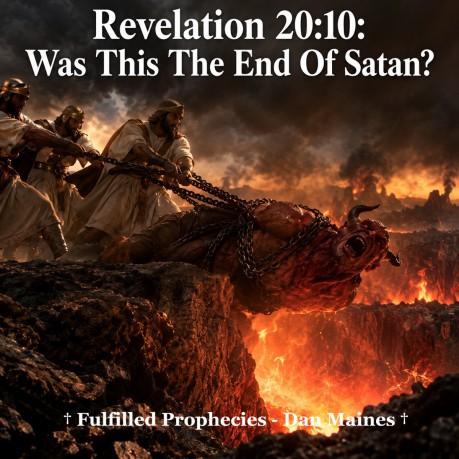
Revelation 20:10: Was This
The End Of Satan? Introduction Revelation 20:10 Revelation 20:7-9 Revelation 12:9-10 John 12:31 John 16:11 Hebrews 2:14-15 Romans 16:20 1 John 3:8 Revelation 21:3-4 Historical References How It Applies To Us Today Q & A Appendix Q: Does Revelation teach another little season
after Satan is cast into the lake of fire? Q: If Satan's judgment is fulfilled, why does
evil still exist? Q: Didn't Paul say Satan was still active when
Romans was written? Q: What did Jesus say about Satan's judgment? Q: Does Revelation ever describe Satan escaping
the lake of fire? Q: What should Christians focus on now? † This is the fulfilled perspective we proclaim at
Fulfilled Prophecies †
By Dan Maines
† Revelation
20:10 gives one of Scripture's strongest statements concerning the
final judgment of the devil. The question is simple: Was this the end
of Satan, or was Satan released again sometime afterward?
†
Revelation doesn't say Satan escaped from the lake of fire. It
doesn't describe another release, another little season, or another
period of satanic activity after Revelation 20:10.
†
The New Testament presents Satan's defeat as something already
underway through Christ's ministry, death, resurrection, reign, and
the approaching judgment that the first-century believers were
expecting (John 12:31; Hebrews 2:14; Romans 16:20).
†
Revelation 20:10 is the climax of that story. Satan's judgment wasn't
temporary. The enemy who deceived the nations was finally judged, and
Scripture never describes him returning after this judgment.
And the devil who deceived
them was thrown into the lake of fire and brimstone, where the beast
and the false prophet are also; and they will be tormented day and
night forever and ever.
† Notice the finality
of the language. The devil was cast into the lake of fire. John
doesn't say he was temporarily restrained, imprisoned for another
period, or released again.
† Earlier in
Revelation 20 Satan was bound and later released for the little
season (Revelation 20:1-3, 7). Revelation 20:10 comes after that
release. This means the little season can't logically be placed after
Revelation 20:10.
† The progression is clear.
Satan was bound, Satan was released, Satan deceived the nations, and
Satan was finally cast into the lake of fire. There is no second
release after that judgment (Revelation 20:1-10).
When the thousand years
are completed, Satan will be released from his prison, and will come
out to deceive the nations which are at the four corners of the
earth, Gog and Magog, to gather them together for the war; the number
of them is like the sand of the seashore. And they came up on the
broad plain of the earth and surrounded the camp of the saints and
the beloved city, and fire came down from heaven and devoured them.
†
This passage places Satan's little season before his judgment in the
lake of fire, not after it. Satan is released in verse 7 and cast
into the lake of fire in verse 10.
† Any
interpretation that places another little season after Revelation
20:10 reverses the order John actually gave. The release comes first,
then the final judgment (Revelation 20:7-10).
†
Revelation doesn't restart the cycle after verse 10. Satan's final
deception leads directly into his final judgment.
And the great dragon was
thrown down, the serpent of old who is called the devil and Satan,
who deceives the whole world; he was thrown down to the earth, and
his angels were thrown down with him. Then I heard a loud voice in
heaven, saying, "Now the salvation, and the power, and the
kingdom of our God and the authority of His Christ have come, for the
accuser of our brothers and sisters has been thrown down, the one who
accuses them before our God day and night.
†
Revelation identifies the dragon directly as the Devil and Satan. We
don't have to speculate about the identity of the enemy being
judged.
† Satan is also called the deceiver
of the whole world. Revelation 20:10 deliberately returns to this
same description when it speaks of the devil who deceived them
(Revelation 20:3, 8, 10).
† Revelation 12 and
Revelation 20 belong to the same larger biblical story of Satan's
defeat. His authority was being overthrown as Christ's kingdom was
established and the accuser was cast down.
Now judgment is upon this world;
now the ruler of this world will be cast out.
†
Jesus didn't place Satan's defeat thousands of years beyond His
generation. He said, Now is the judgment of this world, and now the
ruler of that world would be cast out.
† The
cross began the decisive overthrow of Satan's rule. Revelation shows
the completion of the judgment that Jesus announced during His
earthly ministry (Colossians 2:15; Revelation 12:9-10).
†
Jesus wasn't mistaken when He said now. Satan's defeat was connected
directly with Christ's redemptive work and the judgment of that
covenant age.
and regarding judgment, because
the ruler of this world has been judged.
†
Jesus didn't say the ruler of that world might eventually be judged.
He spoke of Satan's judgment as established reality.
†
Christ's approaching death and resurrection guaranteed the enemy's
defeat. The judgment pronounced upon Satan couldn't fail (John 12:31;
Colossians 2:15).
† Revelation 20:10
shouldn't be separated from these statements of Jesus. Revelation
shows the final outcome of the judgment Christ had already announced.
Therefore, since the
children share in flesh and blood, He Himself likewise also partook
of the same, so that through death He might destroy the one who has
the power of death, that is, the devil, and free those who through
fear of death were subject to slavery all their lives.
†
The purpose of Christ's death included bringing to nothing the one
who had the power of death, identified plainly as the devil.
†
Christ didn't die to leave Satan permanently ruling over God's
people. He came to destroy the devil's power and deliver His people
from bondage (1 John 3:8).
† Revelation 20:10
agrees perfectly with Hebrews. What Christ accomplished through His
death reached its appointed judgment and covenantal completion.
The God of peace will soon
crush Satan under your feet. The grace of our Lord Jesus be with
you.
† Paul wrote to first-century Christians
and told them that God would crush Satan under their feet shortly.
The timing belongs to Paul's audience, not to believers thousands of
years later.
† Paul didn't say Satan would be
crushed and then return repeatedly throughout history. He gave those
believers an expectation of an approaching victory over Satan.
†
Revelation's time statements agree with Paul's expectation. The
things revealed to John were shortly to come to pass, because the
time was at hand (Revelation 1:1-3; 22:6, 10).
the one who practices sin is of
the devil; for the devil has been sinning from the beginning. The Son
of God appeared for this purpose, to destroy the works of the
devil.
† John tells us directly why the Son
of God appeared, to destroy the works of the devil.
†
Christ accomplished the mission the Father gave Him. Satan's defeat
isn't evidence that evil people no longer exist. Human beings remain
capable of sin, temptation, deception, violence, and rebellion from
their own hearts (James 1:14-15).
† We don't
need a living Satan to explain every act of evil today. Scripture
itself teaches that sinful desires can arise from within people (Mark
7:21-23).
And I heard a loud voice
from the throne, saying, "Behold, the tabernacle of God is among
the people, and He will dwell among them, and they shall be His
people, and God Himself will be among them, and He will wipe away
every tear from their eyes; and there will no longer be any death;
there will no longer be any mourning, or crying, or pain; the first
things have passed away."
† After
Satan's judgment, Revelation turns our attention toward God's
dwelling with His covenant people. The emphasis isn't upon another
future satanic rebellion. It's upon the completed victory of Christ
and the blessings of the New Jerusalem.
†
Revelation moves from the destruction of the enemies of God's
covenant people to the new creation and the New Jerusalem (Revelation
20:10-15; 21:1-3).
† The story doesn't end
with Satan victorious or temporarily defeated. It ends with Christ
reigning and God's people dwelling in His presence.
†
Josephus described the catastrophic Jewish-Roman War, the siege of
Jerusalem, the burning of the temple, and Jerusalem's destruction in
AD 70. His history provides important first-century background for
understanding the judgment setting surrounding Jerusalem, although
Josephus wasn't writing an inspired interpretation of Revelation.
†
Josephus recorded famine, internal violence, Roman armies, the
destruction of the temple, and the devastation of Jerusalem in The
Wars of the Jews, especially Books 5 through 7.
†
Eusebius later reported the tradition that the believers in Jerusalem
departed for Pella before the war overtook the city. His account is
found in Ecclesiastical History, Book 3, Chapter 5.
†
These historical writers don't establish doctrine. Scripture
establishes doctrine. Their writings provide historical testimony
concerning the first-century events surrounding Jerusalem's
destruction.
†
Christians don't need to live as though Satan is still waiting for
another little season. Revelation places the little season before
Revelation 20:10, not after it.
† We don't
need to blame Satan for every temptation or evil action. Scripture
teaches that people can be drawn away by their own desires and that
evil comes from the human heart (James 1:14-15; Mark 7:21-23).
†
Christ accomplished what He came to accomplish. He judged the ruler
of that world, destroyed the works of the devil, delivered His people
from bondage, and established His kingdom.
†
Our message today isn't that Satan is about to be released. Our
message is that Jesus Christ reigns, His kingdom stands, and His
victory isn't waiting to be completed by another battle with Satan
(Hebrews 12:28; Colossians 1:13).
†
Revelation 20:10 was the end of Satan's little season and the final
judgment of the devil. Scripture gives no release of Satan after the
lake of fire.
Q: Was
Revelation 20:10 the end of Satan?
A: Yes.
Within the sequence John gives, Satan's final release occurs in
Revelation 20:7, his final deception follows in verses 8-9, and then
he is cast into the lake of fire in verse 10. Scripture never
describes another release after that judgment.
A:
No. The little season belongs before Revelation 20:10. Satan is
released after the thousand years and then receives his final
judgment (Revelation 20:7-10).
A: Because Scripture doesn't
teach that Satan is the source of every sinful act. James says a
person is tempted when carried away by his own desire, and Jesus
taught that evil things proceed from within the human heart (James
1:14-15; Mark 7:21-23).
A: Yes, but Paul also told
those same first-century believers that God would crush Satan under
their feet shortly (Romans 16:20). Satan's activity during the
apostolic period doesn't prove that his final judgment remained
thousands of years away.
A:
Jesus said the ruler of that world would be cast out and that the
ruler of that world had been judged (John 12:31; 16:11). Revelation
shows the completion of that victory.
A: No. Revelation describes
his release from the abyss before his final judgment, but after
Revelation 20:10 there is no passage describing Satan being released
again (Revelation 20:7-10).
A:
Christ and His kingdom. God's people have received a kingdom that
can't be shaken, and believers have been transferred into the kingdom
of God's beloved Son (Hebrews 12:28; Colossians 1:13).
© Fulfilled Prophecies - Dan
Maines.
Source Index
†
Revelation 20:10; Revelation 20:7-9; Revelation 12:9-10; John 12:31;
John 16:11; Hebrews 2:14-15; Romans 16:20; 1 John 3:8; Revelation
21:3-4
† Historical writers: Josephus, The
Wars of the Jews, Books 5-7; Eusebius, Ecclesiastical History, Book
3, Chapter 5
Links