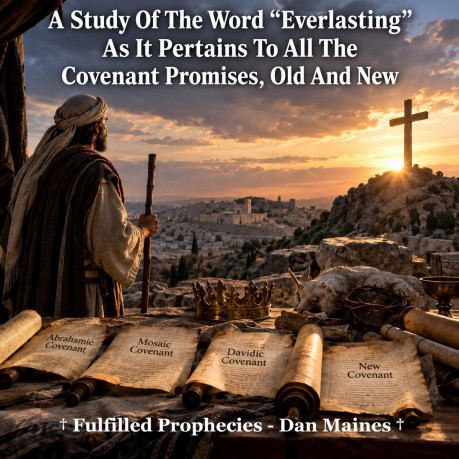
A Study Of The Word
"Everlasting" As It Pertains To All The Covenant Promises,
Old And New Introduction Genesis 17:7 Genesis 17:13 Exodus 31:16-17 Exodus 40:15 Jeremiah 31:31-33 Jeremiah 32:40 Isaiah 55:3 Ezekiel 37:26-27 Hebrews 13:20-21 2 Corinthians 1:20 Historical References How It Applies To Us Today Q & A Appendix Q: If the Sabbath was called a perpetual covenant
and a sign forever, why isn't the old covenant Sabbath still
binding? Q: If the Aaronic priesthood was called
everlasting, how could it end? Q: Does this mean God's everlasting promises
failed? Q: What is the everlasting covenant for believers
today? Q: Are we waiting for the old covenant promises
to be restarted in the future? Q: What does "everlasting" teach us
when we're studying covenant promises? † This is the fulfilled perspective we proclaim at
Fulfilled Prophecies † Source Index
By Dan Maines
† The word
"everlasting" appears throughout Scripture in connection
with covenants, promises, statutes, priesthood, possession,
salvation, and God's kingdom. The important question isn't whether
the word means something significant and enduring, but how Scripture
itself shows us what is everlasting and how those promises reach
their intended fulfillment. (The everlasting purpose remained while
the temporary covenant arrangement lasted.)
†
We can't assume that every covenant arrangement called "everlasting"
was intended to continue forever in exactly the same outward form.
Scripture calls circumcision an everlasting covenant, the Sabbath an
everlasting covenant, and the Levitical priesthood an everlasting
priesthood, yet the New Testament clearly teaches that these covenant
signs and institutions reached their fulfillment in Christ (Galatians
5:6; Colossians 2:16-17; Hebrews 7:11-12).
†
The everlasting purpose of God didn't fail when the old covenant
passed away. The old covenant was moving toward its promised goal.
What was temporary gave way to what it pictured, and what God
promised found its fulfillment in Christ (2 Corinthians 1:20; Hebrews
8:6-13).
I will establish My covenant
between Me and you and your descendants after you throughout their
generations as an everlasting covenant, to be God to you and to your
descendants after you.
† God called His
covenant with Abraham an everlasting covenant. Yet Paul explains that
the promised Seed ultimately points to Christ, not simply to an
endless succession of physical descendants (Galatians 3:16).
†
The Abrahamic promise didn't fail when the old covenant age ended. It
reached its intended fulfillment in Christ, and those who belong to
Christ are Abraham's seed according to promise (Galatians 3:26-29).
†
This shows us an important biblical principle. "Everlasting"
doesn't require every outward covenant form associated with a promise
to continue unchanged forever. God's everlasting purpose continues
through the fulfillment of His promise.
A slave who is born in your
house or who is bought with your money shall certainly be
circumcised; so My covenant shall be in your flesh as an everlasting
covenant.
† Physical circumcision was
specifically called an everlasting covenant. Yet the apostles didn't
require Gentile believers to receive physical circumcision (Acts
15:1-29).
† Paul said that neither
circumcision nor uncircumcision is anything in Christ, but faith
working through love is what matters (Galatians 5:6). He also
described the true circumcision in terms that aren't dependent upon
physical circumcision (Philippians 3:3).
† If
"everlasting" always meant that the outward covenant
ordinance could never reach fulfillment or cease to be binding,
physical circumcision would still be required of every believer. The
New Testament shows that this isn't how covenant language works.
So the sons of Israel shall
keep the Sabbath, to celebrate the Sabbath throughout their
generations as a permanent covenant. It is a sign between Me and the
sons of Israel forever; for in six days the Lord made heaven and
earth, but on the seventh day He ceased from labor, and was
refreshed.
† The Sabbath was a covenant sign
specifically given between God and the children of Israel. It was
described as a perpetual covenant and a sign "for ever."
†
Yet Paul told believers not to allow anyone to judge them concerning
a Sabbath day because these things were a shadow, while the substance
belongs to Christ (Colossians 2:16-17).
†
Hebrews takes the Sabbath theme beyond the weekly covenant sign and
points to God's greater rest (Hebrews 4:1-11). The shadow served its
covenant purpose, but the reality to which it pointed is greater than
the sign.
and you shall anoint them just
as you have anointed their father, so that they may serve as priests
to Me; and their anointing will qualify them for a permanent
priesthood throughout their generations.
†
Aaron's descendants were given what Scripture calls an everlasting
priesthood. Yet Hebrews explicitly teaches that a change of
priesthood required a change of law (Hebrews 7:11-12).
†
Jesus didn't become a priest according to the Levitical order. His
priesthood is according to the order of Melchizedek, and because He
continues forever, His priesthood doesn't pass to another (Hebrews
7:17, 23-25).
† The Levitical priesthood
therefore couldn't have meant an institution that would operate
without end in its original form. Its purpose was fulfilled when the
greater and permanent priesthood of Christ was established.
"Behold, days are
coming," declares the Lord, "when I will make a new
covenant with the house of Israel and the house of Judah, not like
the covenant which I made with their fathers on the day I took them
by the hand to bring them out of the land of Egypt, My covenant which
they broke, although I was a husband to them," declares the
Lord. "For this is the covenant which I will make with the house
of Israel after those days," declares the Lord: I will put My
law within them and write it on their heart; and I will be their God,
and they shall be My people.
† Jeremiah
didn't predict the endless continuation of the Mosaic covenant. He
predicted a new covenant that would specifically be "not
according to" the covenant God made when Israel came out of
Egypt.
† Hebrews quotes this prophecy and
explains that by calling it a new covenant, God made the first
covenant old, and what was becoming old and growing aged was near to
disappearing (Hebrews 8:6-13).
† This is
decisive. An old covenant containing ordinances described with
everlasting language could reach its appointed end without God's
promises failing. The promises were being fulfilled through the
better covenant established in Christ.
I will make an everlasting
covenant with them that I will not turn away from them, to do them
good; and I will put the fear of Me in their hearts, so that they
will not turn away from Me.
† Jeremiah moves
from the covenant that would become old to the promise of an
everlasting covenant. God's purpose wasn't to leave His people
permanently under the Mosaic administration, but to bring them into
something better.
† The new covenant changes
the emphasis from external covenant regulations to God's work within
His people (Jeremiah 31:33; Ezekiel 36:26-27).
†
The everlasting promise finds its strength in God's faithfulness. The
new covenant isn't another temporary shadow waiting for a greater
covenant to replace it.
Incline your ear and come to Me.
Listen, that you may live; And I will make an everlasting covenant
with you, According to the faithful mercies shown to David.
†
Isaiah connected the everlasting covenant with the sure mercies
promised to David. The New Testament applies this promise directly to
the resurrection of Jesus (Acts 13:32-34).
†
This means the everlasting Davidic promise isn't waiting for the
restoration of an earthly throne in national Israel. The apostles
proclaimed its fulfillment in the risen Christ (Acts 2:29-36).
†
Jesus possesses the promised kingdom and reigns as the promised Son
of David. The everlasting character of the promise is secured in Him.
And I will make a covenant
of peace with them; it will be an everlasting covenant with them. And
I will place them and multiply them, and set My sanctuary in their
midst forever. My dwelling place also will be among them; and I will
be their God, and they will be My people.
†
Ezekiel's everlasting covenant includes God's sanctuary and His
dwelling among His people. Revelation uses this same covenant
language when describing God's dwelling with His people (Revelation
21:2-3).
† The New Testament identifies God's
people themselves as His temple and dwelling place through the Spirit
(Ephesians 2:19-22; 1 Peter 2:5).
† The
promise therefore moves beyond a physical sanctuary. God's
everlasting dwelling is with His covenant people in Christ.
Now may the God of peace,
who brought up from the dead the great Shepherd of the sheep through
the blood of the eternal covenant, that is, Jesus our Lord, equip you
in every good thing to do His will, working in us that which is
pleasing in His sight, through Jesus Christ, to whom be the glory
forever and ever. Amen.
† Hebrews brings the
covenant story directly to Jesus and calls His covenant an eternal
covenant. The blood of Christ established what the blood of bulls and
goats could never accomplish permanently (Hebrews 9:11-15;
10:1-14).
† The old covenant had sacrifices,
priests, a sanctuary, and regulations that repeatedly pointed
forward. Christ brought the reality those shadows anticipated.
†
The everlasting covenant isn't the endless continuation of the Mosaic
covenant. It's the completed covenant work established through Jesus
Christ.
For as many as the
promises of God are, in Him they are yes; therefore through Him also
is our Amen to the glory of God through us.
†
Paul gives us the key for understanding God's covenant promises.
Their answer is found in Christ.
† God's
promises don't require the endless survival of every old covenant
shadow. Their faithfulness is demonstrated by their fulfillment in
the One to whom they pointed (Galatians 3:16; Colossians 2:16-17).
†
The old covenant wasn't God's final destination. Christ is the
fulfillment toward which the promises were moving.
†
Josephus described circumcision, the Sabbath, sacrifices, the
priesthood, and the temple as central institutions of the Jewish
nation. His writings provide historical evidence of how deeply these
covenant practices were connected with Israel and the temple system
before its destruction in AD 70.
† Josephus
recorded the destruction of the temple and the collapse of its
sacrificial system in AD 70 in Wars of the Jews, Book 6. The
historical end of temple sacrifice agrees with the New Testament's
theological argument that the old covenant system was becoming
obsolete and was near to disappearing (Hebrews 8:13).
†
Eusebius later argued in Demonstratio Evangelica that the promises
concerning Christ extended beyond the old national and ceremonial
arrangement and were being realized among the nations through
Christ.
† These historical writers don't
establish the meaning of Scripture. Scripture interprets Scripture,
but history confirms that the old temple, priesthood, and sacrificial
order didn't continue after AD 70.
†
We don't need to return to physical circumcision, Levitical priests,
animal sacrifices, an earthly sanctuary, or old covenant Sabbath
regulations to receive God's everlasting promises.
†
We have something better. We've come to Jesus, the mediator of the
new covenant, and to the heavenly Jerusalem (Hebrews 12:22-24).
†
God's covenant promises didn't fail. They reached their goal in
Christ.
† The shadows weren't everlasting
because the shadows themselves had to remain forever. God's covenant
purpose was everlasting because what He promised was brought to its
intended reality in Christ.
† This protects
us from rebuilding what Christ fulfilled. We don't look backward for
another old covenant age, and we don't look forward for God to
restart a covenant system that Scripture says became obsolete.
†
We live under the everlasting covenant established through the blood
of Christ. His kingdom remains, His priesthood remains, His salvation
remains, and His presence with His people remains (Hebrews 7:24-25;
12:28).
† The Bible's covenant story moves
from promise to fulfillment, from shadow to reality, from the
temporary administration to the everlasting kingdom of Christ.
Q: If
the Bible called circumcision an everlasting covenant, why aren't
Christians required to be circumcised?
A:
Because the New Testament explains how the promise reached its
fulfillment in Christ. Physical circumcision isn't the basis of
membership in God's new covenant people (Galatians 5:6; 6:15;
Philippians 3:3).
A: Because it was specifically a
covenant sign between God and Israel, and Paul identifies Sabbath
observance as a shadow whose substance is Christ (Exodus 31:16-17;
Colossians 2:16-17).
A: Hebrews says
plainly that the priesthood changed, and with that change came a
change of law. Christ's superior priesthood according to the order of
Melchizedek is permanent (Hebrews 7:11-12, 17, 23-25).
A: No. Their fulfillment proves God's
faithfulness. All the promises of God find their "Yes" in
Christ (2 Corinthians 1:20).
A: Hebrews identifies the covenant
established through the blood of Jesus as the eternal covenant
(Hebrews 13:20-21). It's the new covenant promised by the prophets
and established through Christ.
A: No. The New
Testament directs believers to Christ as the fulfillment of God's
promises and says we've already come to Mount Zion, the heavenly
Jerusalem, and Jesus the mediator of the new covenant (Hebrews
12:22-24).
A: We
must allow the whole Bible to define the covenant context. Something
described with everlasting language can have an enduring divine
purpose while its temporary outward form reaches fulfillment.
Circumcision, Sabbath observance, and the Levitical priesthood
demonstrate this clearly (Genesis 17:13; Exodus 31:16-17; Exodus
40:15; Hebrews 7:11-12).
© Fulfilled Prophecies - Dan
Maines.
† Genesis
17:7, 13; Exodus 31:16-17; Exodus 40:15; Jeremiah 31:31-33; Jeremiah
32:40; Isaiah 55:3; Ezekiel 37:26-27; Hebrews 13:20-21; 2 Corinthians
1:20
† Historical writers: Flavius Josephus,
Wars of the Jews, Book 6; Eusebius, Demonstratio Evangelica
Links