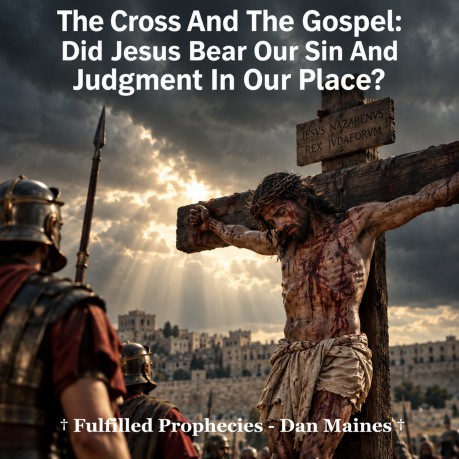
The Cross And The Gospel: Did
Jesus Bear Our Sin And Judgment In Our Place? Introduction Isaiah 53:4-6 Romans 3:23-26 Romans 5:6-9 2 Corinthians 5:19-21 Galatians 3:10, 13-14 1 Peter 2:21-24 1 Peter 3:18 1 Corinthians 15:1-4 Hebrews 9:26-28 The Cross, Covenant Judgment, And The Gospel Historical References How It Applies To Us Today Q & A Appendix Q: Did Jesus become a sinner when He bore our
sins? Q: Does the Bible actually teach substitution
even though the phrase penal substitution isn't found in
Scripture? Q: Is penal substitution the entire Gospel? Q: How does penal substitution relate to
fulfilled prophecy? Q: Are believers still waiting for Christ to deal
with the sin problem? Q: What is the simplest biblical statement of
substitution? † This is the fulfilled perspective we proclaim at
Fulfilled Prophecies † Source Index
By Dan Maines
† Penal
substitution is the teaching that Jesus Christ stood in the place of
sinners, bore our sins, and suffered the judgment that sin deserved
so that those who are in Him could receive forgiveness,
reconciliation, and life.
† The word penal
refers to judgment or penalty, while substitution means that Christ
acted on behalf of others. The important issue isn't the theological
label, but whether Scripture teaches the truth represented by those
words.
† Scripture repeatedly uses the
language of substitution. Christ died for our sins, bore our sins,
was wounded for our transgressions, became a curse for us, and died
for the ungodly (1 Corinthians 15:3; 1 Peter 2:24; Isaiah 53:5;
Galatians 3:13; Romans 5:6).
† Penal
substitution shouldn't be presented as an angry Father punishing an
unwilling Son. The Father sent the Son in love, and the Son willingly
gave Himself for us (John 3:16; John 10:17-18; Galatians 2:20).
†
The cross stands at the center of the Gospel because God's justice
against sin and God's love toward sinners meet in the saving work of
Jesus Christ.
However, it was our sicknesses
that He Himself bore, And our pains that He carried; Yet we ourselves
assumed that He had been afflicted, Struck down by God, and
humiliated. But He was pierced for our offenses, He was crushed for
our wrongdoings; The punishment for our well-being was laid upon Him,
And by His wounds we are healed. All of us, like sheep, have gone
astray, Each of us has turned to his own way; But the Lord has caused
the wrongdoing of us all
† Isaiah couldn't
make the substitutionary nature of Christ's suffering much clearer.
He was wounded for our transgressions, bruised for our iniquities,
and the iniquity of others was placed upon Him.
†
The Servant suffers because of the sins of others. The judgment
connected with their wrongdoing falls upon Him, and peace comes to
them through His suffering (Isaiah 53:8, 11-12).
†
The New Testament directly applies Isaiah 53 to Jesus and His saving
work, showing that this wasn't simply an unfortunate death at the
hands of Rome (Acts 8:32-35; 1 Peter 2:22-25).
for all have sinned and fall
short of the glory of God, being justified as a gift by His grace
through the redemption which is in Christ Jesus, whom God displayed
publicly as a propitiation in His blood through faith. This was to
demonstrate His righteousness, because in God's merciful restraint He
let the sins previously committed go unpunished; for the
demonstration, that is, of His righteousness at the present time, so
that He would be just and the justifier of the one who has faith in
Jesus.
† Paul connects the Gospel with sin,
grace, redemption, blood, righteousness, and justification. God
doesn't simply ignore sin. The cross demonstrates His righteousness
while providing justification for the believer.
†
This is essential to understanding penal substitution. God remains
just while justifying sinners because redemption has been
accomplished through Christ.
† The cross
reveals both God's justice and God's grace. Forgiveness isn't based
on pretending sin doesn't matter, it's grounded in what Christ
accomplished on behalf of sinners (Romans 5:8-9).
For while we were still
helpless, at the right time Christ died for the ungodly. For one will
hardly die for a righteous person; though perhaps for the good person
someone would even dare to die. But God demonstrates His own love
toward us, in that while we were still sinners, Christ died for us.
Much more then, having now been justified by His blood, we shall be
saved from the wrath of God through Him.
†
Christ died for the ungodly and for sinners. The words for us express
the substitutionary character of His death.
†
Paul directly connects Christ's blood with justification and
deliverance from wrath. His death wasn't separated from God's
judgment against sin.
† Penal substitution
isn't opposed to God's love. Paul presents Christ's substitutionary
death as the demonstration of God's love toward sinners (Ephesians
5:2).
namely, that God was
in Christ reconciling the world to Himself, not counting their
wrongdoings against them, and He has committed to us the word of
reconciliation. Therefore, we are ambassadors for Christ, as though
God were making an appeal through us; we beg you on behalf of Christ,
be reconciled to God. He made Him who knew no sin to be sin in our
behalf, so that we might become the righteousness of God in Him.
†
Jesus knew no sin, yet He was made to be sin on our behalf. Paul
places the sinless Christ in direct relationship to the guilt and
reconciliation of sinners.
† This doesn't
mean Jesus became morally sinful. He remained the spotless Son of
God, but He bore sin in His sacrificial work (Hebrews 4:15; 1 Peter
1:18-19).
† Reconciliation is possible
because God acted in Christ. The cross isn't the Son trying to
convince an unwilling Father to love humanity. God Himself initiated
reconciliation through Christ (Romans 5:10-11).
For all who are of
works of the Law are under a curse; for it is written: "Cursed
is everyone who does not abide by all the things written in the book
of the Law, to do them." Christ redeemed us from the curse of
the Law, having become a curse for us-for it is written: "Cursed
is everyone who hangs on a tree" - in order that in Christ Jesus
the blessing of Abraham would come to the Gentiles, so that we would
receive the promise of the Spirit through faith.
†
Paul doesn't say the curse simply disappeared. Christ redeemed those
under the curse by becoming a curse for them.
†
This is substitutionary judgment in unmistakable covenant language.
The curse belonged to the lawbreaker, yet Christ took the position of
the cursed one to accomplish redemption.
†
The result reaches beyond judgment to blessing. Through Christ, the
promised blessing of Abraham comes to the Gentiles, demonstrating
that the cross opens the way to the covenant blessings found in
Christ (Genesis 12:3; Galatians 3:26-29).
For you have been called for
this purpose, because Christ also suffered for you, leaving you an
example, so that you would follow in His steps, He who committed no
sin, nor was any deceit found in His mouth; and while being abusively
insulted, He did not insult in return; while suffering, He did not
threaten, but kept entrusting Himself to Him who judges righteously;
and He Himself brought our sins in His body up on the cross, so that
we might die to sin and live for righteousness; by His wounds you
were healed.
† Peter directly identifies
Jesus as the sinless One who bore our sins in His body on the
cross.
† The language comes directly from
Isaiah 53 and confirms that the suffering Servant prophecy finds its
fulfillment in Christ.
† Jesus didn't simply
provide an example of sacrificial love. Peter says He bore our sins,
and that saving work produces a people who die to sin and live to
righteousness (1 Peter 3:18).
For Christ also suffered for
sins once for all time, the just for the unjust, so that He might
bring us to God, having been put to death in the flesh, but made
alive in the spirit;
† The righteous One
suffered for the unrighteous. That is substitution stated in
remarkably simple language.
† Notice the
purpose, that He might bring us to God. Penal substitution isn't only
about what we're saved from, it's about reconciliation and restored
fellowship with God.
† Christ's sacrifice was
once for all. The Gospel doesn't require another sacrifice, another
mediator, or another payment for sin (Hebrews 9:26-28).
Now I make known to
you, brothers and sisters, the gospel which I preached to you, which
you also received, in which you also stand, by which you also are
saved, if you hold firmly to the word which I preached to you, unless
you believed in vain. For I handed down to you as of first
importance what I also received, that Christ died for our sins
according to the Scriptures, and that He was buried, and that He was
raised on the third day according to the Scriptures,
†
Paul gives us the heart of the Gospel, Christ died for our sins, He
was buried, and He was raised.
† The phrase
for our sins is essential. Jesus didn't simply die. His death dealt
directly with the problem of human sin.
† The
resurrection demonstrates that death didn't have the final word. The
crucified Christ was raised, and the Gospel announces His completed
victory (Romans 6:9-10).
Otherwise, He would have
needed to suffer often since the foundation of the world; but now
once at the consummation of the ages He has been revealed to put away
sin by the sacrifice of Himself. And just as it is destined for
people to die once, and after this comes judgment, so Christ also,
having been offered once to bear the sins of many, will appear a
second time for salvation without reference to sin, to those who
eagerly await Him.
† Hebrews says Christ
appeared at the end of the ages to put away sin through the sacrifice
of Himself. The biblical timing places His sacrificial work within
the closing period of the old covenant age (Hebrews 1:1-2; Hebrews
8:13).
† Christ was offered once to bear the
sins of many. Again, Scripture uses substitutionary language, He
bears what belonged to others.
† From the
fulfilled perspective, Christ's sacrificial death can't be separated
from the covenant transition that reached its completion when the
obsolete old covenant order disappeared (Hebrews 8:13; Hebrews
10:9-18).
†
Penal substitution is strongest when it's kept within the whole
biblical story. Sin brought death and separation, the law exposed
transgression, covenant judgment stood against the guilty, and Christ
entered history as the faithful and sinless Son who bore sin and
accomplished redemption (Romans 5:12-19).
†
Jesus bore the curse associated with the law, fulfilled the
sacrificial shadows, and established the new covenant through His
blood (Luke 22:20; Hebrews 9:15).
† The cross
and AD 70 shouldn't be confused as though they were the same event.
The sacrifice occurred at the cross. The old covenant world reached
its judicial and historical conclusion in the judgment upon Jerusalem
and the removal of the temple system (Matthew 23:34-38; Hebrews
8:13).
† The Gospel therefore isn't a message
that Jesus still needs to accomplish redemption. His sacrifice was
completed, His victory was accomplished, and believers now live in
the blessings of the new covenant that His blood established (Hebrews
10:10-18).
†
Justin Martyr, writing in the second century, repeatedly connected
Isaiah 53 with Christ's suffering and taught that Christ endured
suffering for humanity.
† Irenaeus emphasized
Christ's representative work, presenting Christ as the obedient
Second Adam who reversed the disobedience introduced through Adam.
†
Athanasius explained Christ's death in terms of humanity's liability
to death and presented Christ as giving His body over to death on
behalf of all.
† The language used by early
Christian writers wasn't always identical to later theological
formulations called penal substitution, but substitution, sacrifice,
judgment, redemption, and Christ's death on behalf of sinners were
present throughout early Christian reflection on the cross.
†
The final authority isn't a later theological system or historical
writer. Scripture must determine what we believe about the meaning of
Christ's death.
†
We don't need to wonder whether enough has been done for our
redemption. Christ offered Himself once, and His sacrifice doesn't
need to be repeated (Hebrews 10:10-14).
† We
don't approach God through the old covenant priesthood, temple,
animal sacrifices, or repeated offerings. Jesus accomplished what
those shadows anticipated (Hebrews 9:11-12).
†
The Gospel announces accomplished redemption. Christ died for sins,
was raised from the dead, and brought reconciliation to those who are
in Him (Romans 5:10-11).
† God's justice and
God's love aren't enemies at the cross. The same God who judges sin
provided the sacrifice through which sinners are reconciled to Him
(Romans 3:25-26).
† Our response isn't to
attempt to pay God back. We trust Christ, live in gratitude, walk in
righteousness, forgive others, love one another, and proclaim the
reconciliation God accomplished through His Son (Ephesians 4:32; 2
Corinthians 5:18-20).
† Penal substitution
doesn't contain everything Scripture says about the cross. Scripture
also speaks of redemption, reconciliation, sacrifice, victory,
covenant, forgiveness, and the defeat of death. These truths work
together rather than against one another (Colossians 2:13-15).
†
At the center of them all stands Jesus Christ, the righteous One who
suffered for the unrighteous to bring us to God.
Q: Does
penal substitution mean the Father hated Jesus and punished an
unwilling Son?
A: No. The Father loved the Son,
the Father sent the Son because of His love for the world, and Jesus
willingly laid down His life (John 3:16; John 10:17-18).
A: No. Jesus remained without sin. He
bore our sins sacrificially while remaining the righteous and
spotless One (2 Corinthians 5:21; Hebrews 4:15; 1 Peter 1:18-19).
A: Yes. Scripture says Christ died
for our sins, bore our sins, became a curse for us, and the righteous
One suffered for the unrighteous (1 Corinthians 15:3; 1 Peter 2:24;
Galatians 3:13; 1 Peter 3:18).
A:
No. It's an important explanation of what Christ accomplished through
His death, but the Gospel includes His death for sins, burial,
resurrection, reign, reconciliation, redemption, and the new covenant
blessings accomplished through Him (1 Corinthians 15:1-4; Romans
5:10-11).
A: Christ's sacrifice was
accomplished at the cross within the last days of the old covenant
age. His sacrifice established the new covenant, and the obsolete old
covenant order reached its historical end when Jerusalem and the
temple were judged in AD 70 (Hebrews 1:1-2; Hebrews 8:13; Hebrews
9:26).
A: No. Christ appeared
once to put away sin through the sacrifice of Himself, and by one
offering He perfected those who are sanctified (Hebrews 9:26; Hebrews
10:14).
A: Christ also suffered for sins
once, the righteous for the unrighteous, that He might bring us to
God (1 Peter 3:18).
© Fulfilled Prophecies - Dan
Maines.
† Isaiah
53:4-6; Romans 3:23-26; Romans 5:6-9; 2 Corinthians 5:19-21;
Galatians 3:10, 13-14; 1 Peter 2:21-24; 1 Peter 3:18; 1 Corinthians
15:1-4; Hebrews 9:26-28
† Justin Martyr;
Irenaeus; Athanasius
Links