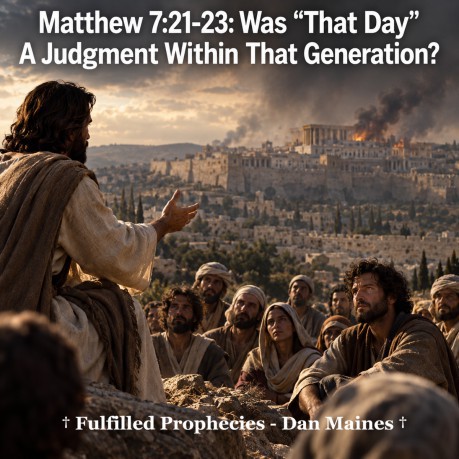
Matthew 7:21-23: Was "That
Day" A Judgment Within That Generation? Introduction Matthew 7:21-23 Matthew 16:27-28 Matthew 10:23 Matthew 23:35-36 Matthew 23:37-39 Matthew 24:30-34 Matthew 26:63-64 Revelation 1:1-3 Historical References How It Applies To Us Today Q & A Appendix Q: Was Jesus talking about judgment in Matthew
7:21-23? Q: Why is Matthew 16:27-28 important? Q: How does Matthew 23 help identify the
timeframe? Q: Doesn't Matthew 24 describe the coming of the
Son of Man? Q: Does fulfilled judgment mean Matthew 7 has
nothing to teach us today? † This is the fulfilled perspective we proclaim at
Fulfilled Prophecies † Source Index
By Dan Maines
† Matthew
7:21-23 is often read as though Jesus immediately transported His
audience thousands of years into the future, but the surrounding
teaching doesn't require that conclusion.
†
Jesus spoke about a coming day of judgment, and elsewhere in Matthew
He identified the generation that would experience His coming in
judgment (Matthew 16:27-28; Matthew 23:36; Matthew 24:34).
†
The phrase "that day" must be understood within Jesus'
larger message to His first-century audience, rather than
automatically being assigned to the end of human history.
†
Matthew repeatedly connects judgment, the coming of the Son of Man,
the kingdom, Jerusalem, and that generation.
†
When these passages are allowed to interpret one another, Matthew
7:21-23 fits naturally within the first-century judgment that reached
its covenantal climax in AD 70.
Not everyone who says to Me,
'Lord, Lord,' will enter the kingdom of heaven, but the one who does
the will of My Father who is in heaven will enter. Many will say to
Me on that day, 'Lord, Lord, did we not prophesy in Your name, and in
Your name cast out demons, and in Your name perform many miracles?'
And then I will declare to them, 'I never knew you; leave Me, you who
practice lawlessness.'
† Jesus specifically
spoke of "that day." The expression points to a
recognizable time of judgment, and Matthew provides additional
statements that help identify its historical setting.
†
Jesus was warning people who claimed allegiance to Him while failing
to obey His Father. Their religious claims wouldn't protect them when
judgment arrived (Matthew 7:15-20, 24-27).
†
Notice that these people claimed prophecy, casting out demons, and
mighty works in Jesus' name. These signs belong naturally within the
apostolic first-century setting described in the New Testament (Acts
8:9-24; Acts 19:13-17; 1 Corinthians 12:7-11).
†
The passage doesn't say that "that day" would occur
thousands of years later. That timing has to be brought into the
passage from somewhere else.
For the Son of Man is going
to come in the glory of His Father with His angels, and will then
repay every person according to his deeds. "Truly I say to you,
there are some of those who are standing here who will not taste
death until they see the Son of Man coming in His kingdom."
†
Here Jesus connects His coming with judgment because He said He would
repay each person according to his deeds.
†
Jesus then gave His audience a time limitation. Some standing there
wouldn't die before seeing the Son of Man coming in His kingdom.
†
This is important for understanding Matthew 7 because the same Gospel
that records "that day" also records Jesus placing His
coming in judgment within the lifetime of some who were physically
standing before Him.
† We shouldn't separate
verse 28 from verse 27 when Jesus connected His coming, judgment,
kingdom, and the lifetime of His hearers.
"But whenever they
persecute you in one city, flee to the next; for truly I say to you,
you will not finish going through the cities of Israel until the Son
of Man comes.
† Jesus was speaking directly
to His disciples about persecution they would personally
experience.
† They were instructed to flee
from one city to another, and Jesus said their mission through the
cities of Israel wouldn't be completed before the Son of Man came.
†
This again places the coming of the Son of Man within the historical
world of Jesus' disciples, not thousands of years beyond their
lives.
† Matthew therefore gives repeated
audience-specific statements that help establish the timeframe for
Jesus' judgment language (Matthew 16:27-28; Matthew 24:30-34).
so that upon you will fall
the guilt of all the righteous blood shed on earth, from the blood of
righteous Abel to the blood of Zechariah, the son of Berechiah, whom
you murdered between the temple and the altar. Truly I say to you,
all these things will come upon this generation.
†
Jesus couldn't have been clearer about the generation upon whom this
covenant judgment would fall.
† He said "upon
you" and then declared, "All these things shall come upon
this generation."
† This judgment
involved accumulated covenant bloodguilt, reaching from Abel to the
blood being shed by the generation standing before Jesus (Matthew
23:29-34).
† Matthew 23 leads directly into
Matthew 24. The chapter division shouldn't cause us to disconnect
Jesus' condemnation of Jerusalem from the judgment discourse that
immediately follows.
"Jerusalem, Jerusalem,
who kills the prophets and stones those who have been sent to her!
How often I wanted to gather your children together, the way a hen
gathers her chicks under her wings, and you were unwilling. Behold,
your house is being left to you desolate! For I say to you, from now
on you will not see Me until you say, 'Blessed is the One who comes
in the name of the Lord!'"
† Jesus
identified Jerusalem as the covenant city responsible for killing the
prophets and rejecting those God sent to her.
†
His declaration that their house was being left desolate prepares the
reader for the disciples' immediate discussion with Him concerning
the temple (Matthew 24:1-3).
† Matthew's
progression is consistent, judgment upon that generation, Jerusalem's
house left desolate, the temple's destruction, the coming of the Son
of Man, and fulfillment within that generation.
†
Matthew 7:21-23 shouldn't be isolated from this repeated judgment
framework.
And then the sign of the
Son of Man will appear in the sky, and then all the tribes of the
earth will mourn, and they will see the Son of Man coming on the
clouds of the sky with power and great glory. And He will send forth
His angels with a great trumpet blast, and they will gather together
His elect from the four winds, from one end of the sky to the other.
"Now learn the parable from the fig tree: as soon as its branch
has become tender and sprouts its leaves, you know that summer is
near; so you too, when you see all these things, recognize that He is
near, right at the door. Truly I say to you, this generation will not
pass away until all these things take place.
†
Jesus again spoke about the coming of the Son of Man and then gave
the timeframe for the things He had described.
†
He told His disciples, "when ye (them) see all these things,"
because they were the audience expected to recognize the signs as
they occurred.
† Jesus then said that "this
generation" wouldn't pass away until all these things were
accomplished.
† Matthew 23:36 says judgment
would come upon "this generation," and Matthew 24:34 says
"this generation" wouldn't pass away until all these things
were accomplished. The statements reinforce one another.
†
Reading Matthew 7's "that day" within this same
first-century judgment framework respects the time statements Jesus
Himself repeatedly supplied.
But Jesus kept silent. And
the high priest said to Him, "I place You under oath by the
living God, to tell us whether You are the Christ, the Son of God."
Jesus said to him, "You have said it yourself. But I tell you,
from now on you will see the Son of Man sitting at the right hand of
power, and coming on the clouds of heaven."
†
Jesus spoke directly to the high priest and those participating in
His trial.
† He told them they would see the
Son of Man seated at God's right hand and coming on the clouds of
heaven.
† This draws from Daniel's judgment
imagery and again places Jesus' vindication and coming in judgment in
relation to the generation that rejected Him (Daniel 7:13-14).
†
The people condemning Jesus would witness the historical vindication
of the One they rejected when judgment came upon Jerusalem.
The Revelation of Jesus
Christ, which God gave Him to show to His bond-servants, the things
which must soon take place; and He sent and communicated it by His
angel to His bond-servant John, who testified to the word of God and
to the testimony of Jesus Christ, everything that he saw. Blessed is
the one who reads, and those who hear the words of the prophecy and
keep the things which are written in it; for the time is near.
†
Revelation uses the same themes of Christ's coming, judgment,
vindication, and kingdom while explicitly declaring that the events
must shortly take place.
† John didn't tell
his original readers that the time was thousands of years away. He
said, "the time is at hand."
† This
agrees with Jesus' first-century time statements rather than
overturning them (Matthew 16:27-28; Matthew 24:34).
†
Scripture consistently directs the reader toward an approaching
first-century covenant judgment.
†
Josephus described the Jewish War and the catastrophic destruction of
Jerusalem and the temple by the Romans in AD 70. His account records
famine, internal violence, siege warfare, fire, death, and the
destruction of the city and sanctuary.
†
Josephus wasn't interpreting Matthew 7 for Christians, but his
history provides an important eyewitness-era record of the judgment
that overtook Jerusalem within the generation Jesus addressed.
†
Tacitus also recorded the Roman war against Jerusalem and the
destruction associated with the conflict, providing a non-Christian
Roman historical witness to the events.
†
Eusebius later connected Jesus' warnings concerning Jerusalem with
the calamities that came upon the city and recorded the tradition
that believers left Jerusalem before the final destruction.
†
These historical writers don't establish the meaning of Scripture.
Scripture establishes the doctrine, while historical testimony
confirms that an extraordinary judgment actually fell upon Jerusalem
in the first century exactly where Jesus had repeatedly warned that
judgment was approaching.
†
Matthew 7:21-23 still carries a powerful warning even though the
judgment setting was first century. Calling Jesus "Lord"
has never been a substitute for genuinely belonging to Him.
†
We don't need to move "that day" thousands of years beyond
Jesus' audience for His words to have meaning for believers today.
†
Fulfilled prophecy strengthens confidence in Christ because what He
said would happen within that generation happened within that
generation.
† We live on the fulfilled side
of that covenant judgment, in the kingdom Christ established and the
New Covenant relationship His work secured (Hebrews 12:22-24;
Colossians 1:13).
† Our message isn't that
we're waiting for Matthew 7, Matthew 16, Matthew 23, or Matthew 24 to
finally become true. Our message is that Jesus kept His word.
†
The fulfillment of judgment doesn't remove our responsibility to
follow Christ. It gives us confidence that the King who promised
judgment and kingdom fulfillment was faithful to everything He said.
Q: Does
"that day" in Matthew 7:22 automatically mean the end of
the physical world?
A: No. Matthew 7:22 itself
doesn't say that. The timeframe must be determined from Jesus' larger
teaching, and Matthew repeatedly places His coming in judgment within
the lifetime of His first-century audience (Matthew 16:27-28; Matthew
23:36; Matthew 24:34).
A: Yes. People appear before Him
claiming religious works in His name, and He rejects those who
practiced lawlessness. The passage clearly contains judgment language
(Matthew 7:21-23).
A:
Because Jesus connected His coming with repaying each person
according to his deeds and then said some standing there wouldn't
taste death before seeing the Son of Man coming in His kingdom
(Matthew 16:27-28).
A: Jesus directly said the
accumulated covenant judgment He described would come upon "this
generation" (Matthew 23:35-36). He then pronounced Jerusalem's
house desolate before discussing the temple's destruction (Matthew
23:37-39; Matthew 24:1-3).
A: Yes, and Jesus placed the events
He described within "this generation." He told His
disciples they would see the signs and declared that their generation
wouldn't pass away until all these things were accomplished (Matthew
24:30-34).
A: No. The
prophecy's historical fulfillment doesn't eliminate its spiritual
instruction. Jesus' warning against empty profession remains
instructive, and His fulfillment of His promises gives us confidence
in His faithfulness (Matthew 7:21-27; Hebrews 12:22-24).
© Fulfilled Prophecies - Dan
Maines.
† Matthew
7:21-23; Matthew 16:27-28; Matthew 10:23; Matthew 23:35-36; Matthew
23:37-39; Matthew 24:30-34; Matthew 26:63-64; Revelation 1:1-3
†
Josephus, The Wars of the Jews; Tacitus, Histories; Eusebius,
Ecclesiastical History
Links