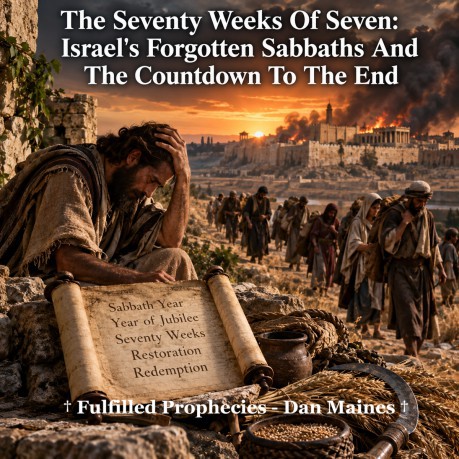
The Seventy Weeks Of Seven:
Israel's Forgotten Sabbaths And The Countdown To The End Introduction Leviticus 25:2-4 Leviticus 25:8-10 Leviticus 26:33-35 2 Chronicles 36:20-21 Daniel 9:2-3 Daniel 9:24 Daniel 9:25-26 Daniel 9:27 Deuteronomy 32:18-20 Deuteronomy 32:28-29 Historical References How It Applies To Us Today Q & A Appendix Q: Does seventy weeks mean seventy groups of
seven? Q: Is there a relationship between the
forty-nine-year Jubilee structure and Daniel's seventy sevens? Q: Did Israel forget their Rock? Q: Did Daniel's seventy weeks end with a future
seven-year tribulation thousands of years later? Q: What was the ultimate answer to Israel's
covenant problem? † This is the fulfilled perspective we proclaim at
Fulfilled Prophecies † Source Index
By Dan Maines
† Daniel's
prophecy of seventy weeks didn't appear in a vacuum. Daniel had been
reading Jeremiah's prophecy concerning the seventy years of
Jerusalem's desolation when he began praying about Israel's covenant
unfaithfulness (Daniel 9:2-5).
† The Law had
already warned Israel that the land itself was to receive a Sabbath
every seventh year. If Israel refused to obey, God warned that exile
would follow and the land would enjoy the Sabbaths Israel had denied
it (Leviticus 25:1-7; 26:33-35).
† Second
Chronicles makes the connection explicit. Judah's exile allowed the
land to enjoy its Sabbaths, fulfilling the word spoken through
Jeremiah (2 Chronicles 36:20-21).
† Daniel
then received a prophecy structured around another period of sevens,
seventy weeks, or seventy sevens. The relationship is striking.
Israel's history of broken covenant Sabbaths stood behind the
seventy-year exile, and Daniel's seventy sevens carried the covenant
countdown forward to Messiah, atonement, Jerusalem's desolation, and
the end determined upon the city and sanctuary (Daniel 9:24-27).
†
Deuteronomy 32 provides the covenant framework for understanding why
Israel's story reached that end. Israel forgot the Rock who gave them
birth, provoked God through covenant unfaithfulness, and was warned
that their latter end would come upon them (Deuteronomy 32:18-20,
28-29).
† The seventy weeks weren't an
isolated prophetic clock. They belonged to the covenant history that
began in the Law and moved toward Israel's appointed judgment and the
accomplishment of redemption in Christ.
Speak to the sons of Israel
and say to them, When you come into the land which I am going to give
you, then the land shall have a Sabbath to the Lord. For six years
you shall sow your field, and for six years you shall prune your
vineyard and gather in its produce, but during the seventh year the
land shall have a Sabbath rest, a Sabbath to the Lord; you shall not
sow your field nor prune your vineyard.
† The
Sabbath principle wasn't limited to the seventh day. Israel's
covenant included a Sabbath year for the land every seventh year.
†
Israel possessed the land under covenant obligations. The land
belonged to God, and Israel's continued enjoyment of it was connected
with covenant faithfulness (Leviticus 25:18-23).
†
Every seventh year therefore testified that Israel's life in the land
depended upon God rather than upon Israel's agricultural strength.
You are also to count off
seven Sabbaths of years for yourself, seven times seven years, so
that you have the time of the seven Sabbaths of years, that is,
forty-nine years. You shall then sound a ram's horn abroad on the
tenth day of the seventh month; on the Day of Atonement you shall
sound a horn all through your land. So you shall consecrate the
fiftieth year and proclaim a release throughout the land to all its
inhabitants. It shall be a jubilee for you, and each of you shall
return to his own property, and each of you shall return to his
family.
† God specifically commanded Israel
to count seven Sabbaths of years, seven times seven, producing
forty-nine years.
† This makes the language
of Daniel's seventy sevens especially significant. Israel's covenant
calendar was already structured around groups of seven years long
before Gabriel announced the seventy sevens (Daniel 9:24).
†
The forty-nine-year cycle led to Jubilee, liberty, restoration, and
release. Daniel's seventy sevens likewise moved toward something
greater, the accomplishment of redemption through Messiah and the
conclusion of the old covenant age (Daniel 9:24-27).
You, however, I will
scatter among the nations, and I will draw out a sword after you, as
your land becomes desolate and your cities become ruins. 'Then the
land will restore its Sabbaths all the days of the desolation, while
you are in your enemies' land; then the land will rest and restore
its Sabbaths. All the days of its desolation it will have the rest
which it did not have on your Sabbaths, while you were living on it.
† God warned Israel beforehand that covenant
rebellion would eventually result in removal from the land.
†
The exile wasn't disconnected from Israel's neglected land Sabbaths.
God specifically said that while Israel was removed, the land would
receive the Sabbath rest it hadn't received while they lived there.
†
This establishes an important covenant connection between Israel's
failure concerning the Sabbath years and the judgment of exile.
He took into exile
those who had escaped from the sword to Babylon; and they were
servants to him and to his sons until the rule of the kingdom of
Persia, to fulfill the word of the Lord by the mouth of Jeremiah,
until the land had enjoyed its Sabbaths. All the days of its
desolation it kept the Sabbath until seventy years were complete.
†
Scripture itself explains the seventy-year Babylonian captivity in
terms of the land enjoying its neglected Sabbaths.
†
This doesn't require us to reconstruct every individual missed
Sabbath year. The inspired writer gives the theological explanation,
the seventy-year desolation fulfilled Jeremiah's prophecy while
allowing the land to receive its Sabbath rest.
†
Daniel knew Jeremiah's seventy-year prophecy, and Daniel 9 begins
precisely with Daniel recognizing that those seventy years were
reaching their appointed completion (Jeremiah 25:11-12; 29:10).
in the first year of his reign,
I, Daniel, observed in the books the number of the years which was
revealed as the word of the Lord to Jeremiah the prophet for the
completion of the desolations of Jerusalem, namely, seventy years. So
I gave my attention to the Lord God, to seek Him by prayer and
pleading, with fasting, sackcloth, and ashes.
†
Daniel's seventy-weeks prophecy must be read in the context in which
God gave it. Daniel was thinking about Jeremiah's seventy years when
Gabriel revealed the seventy sevens.
† Daniel
wasn't asking about events thousands of years beyond Israel's
covenant story. His concern was Jerusalem, Israel's sins, the
sanctuary, the covenant, and the promised restoration (Daniel
9:4-19).
† The movement from seventy years to
seventy sevens isn't accidental. The seventy years addressed
Babylonian desolation, while the seventy sevens carried the prophetic
timetable forward to the greater covenant resolution involving
Messiah and Jerusalem.
Seventy weeks have been decreed
for your people and your holy city, to finish the wrongdoing, to make
an end of sin, to make atonement for guilt, to bring in everlasting
righteousness, to seal up vision and prophecy, and to anoint the Most
Holy Place.
† The seventy weeks were
specifically decreed upon Daniel's people and Daniel's holy city.
That identifies Israel and Jerusalem as the covenant setting of the
prophecy.
† Seventy sevens equal 490 units in
the prophecy's sabbatical structure. The repeated pattern of seven
strongly recalls the covenant calendar of Sabbath years and the
seven-times-seven Jubilee cycle (Leviticus 25:8-10).
†
The goals of the prophecy move beyond the return from Babylon. They
include dealing with transgression and sin, reconciliation for
iniquity, everlasting righteousness, the completion of vision and
prophecy, and the anointing of the most holy.
†
These themes bring the prophecy directly to the work of Christ and
the completion of Israel's prophetic covenant story (Luke 24:44-47;
Hebrews 9:26).
So you are to know and
understand that from the issuing of a decree to restore and rebuild
Jerusalem, until Messiah the Prince, there will be seven weeks and
sixty-two weeks; it will be built again, with streets and moat, even
in times of distress. Then after the sixty-two weeks, the Messiah
will be cut off and have nothing, and the people of the prince who is
to come will destroy the city and the sanctuary. And its end will
come with a flood; even to the end there will be war; desolations are
determined.
† The seventy sevens moved toward
the Anointed One. Messiah wasn't a side issue in Daniel's prophecy,
He was central to its fulfillment.
† The
Anointed One would be cut off, and afterward the city and sanctuary
would be destroyed. The prophecy therefore joins Messiah's redemptive
work with the approaching judgment upon Jerusalem.
†
The sequence doesn't require inserting an undefined prophetic age
between Messiah and Jerusalem's destruction. The prophecy moves from
restoration, to Messiah, to His being cut off, and then to the
determined destruction of the city and sanctuary.
And he will confirm a covenant
with the many for one week, but in the middle of the week he will put
a stop to sacrifice and grain offering; and on the wing of
abominations will come the one who makes desolate, until a complete
destruction, one that is decreed, gushes forth on the one who makes
desolate.
† The final seven completes the
seventy-seven structure. The prophecy doesn't announce a separate
future seven-year period detached from the previous sixty-nine
sevens.
† Christ's sacrifice brought the
sacrificial system to its covenant purpose. Animal sacrifices could
never finally remove sin, but Christ offered the effective sacrifice
once for all (Hebrews 10:1-14).
† Jerusalem's
temple sacrifices continued outwardly until the city's destruction,
but their covenant significance had been surpassed by Christ's
completed sacrifice. The physical temple system was then removed in
the judgment Daniel had foretold (Matthew 24:1-2, 15-16).
You forgot the Rock who
fathered you, And forgot the God who gave you birth. The Lord saw
this, and spurned them Because of the provocation by His sons and
daughters. Then He said, I will hide My face from them, I will see
what their end will be; For they are a perverse generation, Sons in
whom there is no faithfulness.
† Moses
described Israel's covenant problem with devastating simplicity, they
forgot their Rock.
† Their failure to keep
God's covenant requirements, including the Sabbath laws of the land,
wasn't an isolated agricultural mistake. It was part of a larger
pattern of forgetting the God who established them as His covenant
nation.
† Moses connected that rebellion with
their end. The covenant that established Israel also contained the
warnings concerning what persistent rebellion would eventually bring
upon them (Deuteronomy 28:15-68).
For they are a nation
destitute of counsel, And there is no understanding in them. If only
they were wise and they understood this; If only they would discern
their future!
† Moses called Israel to
consider their latter end. Daniel later received a measured timetable
concerning Daniel's people, Jerusalem, Messiah, and the determined
desolation.
† This doesn't mean Deuteronomy
32 by itself supplies the mathematical calculation of Daniel's
seventy weeks. It provides the covenant framework, Israel's rebellion
would eventually reach its appointed covenant judgment.
†
Jesus later applied the language of Deuteronomy's corrupt generation
to the generation facing Jerusalem's judgment, declaring that all
these things would come upon that generation (Matthew 23:32-36).
†
Josephus described the catastrophic destruction of Jerusalem and the
temple by the Romans in AD 70. His account provides historical
testimony concerning the war, famine, siege, destruction, and
desolation that overtook the city.
† Eusebius
later connected Jerusalem's calamities with the judgments Christ had
announced concerning that generation and recorded that believers
escaped the city before the war.
† These
historical witnesses don't establish the meaning of prophecy.
Scripture interprets Scripture. They provide historical testimony
that Jerusalem and its sanctuary were destroyed within the generation
to which Jesus gave His warnings (Matthew 24:2, 34).
†
Israel's neglected Sabbaths teach us that God's covenant words
weren't empty threats. What God warned would happen eventually
happened.
† The seventy years of exile and
Daniel's seventy sevens shouldn't be separated from their covenant
setting. The Law, the Prophets, Daniel, and Christ tell one unfolding
story.
† The Sabbath-year pattern pointed to
dependence upon God, while Jubilee proclaimed liberty and
restoration. Those covenant shadows find their greater reality in
Christ, who proclaimed liberty and accomplished redemption (Luke
4:18-21).
† We aren't waiting for another
seventy weeks or another final seven-year prophetic countdown.
Daniel's timetable centered upon Messiah and Daniel's people and holy
city, and Jerusalem's old covenant sanctuary was destroyed in AD 70
just as the prophecy declared.
† The lesson
isn't that Christians today must calculate neglected land Sabbaths.
The lesson is that God faithfully accomplished what He promised,
Christ completed the redemptive work toward which Israel's covenant
history was moving, and we now live in the reality of what those
covenant shadows anticipated (Colossians 2:16-17).
Q: Were
Israel's neglected land Sabbaths a major reason for the Babylonian
exile?
A: Yes. Scripture explicitly connects
the exile with the land receiving the Sabbath rest Israel had failed
to give it (Leviticus 26:33-35; 2 Chronicles 36:20-21). Israel's
larger problem, however, was covenant rebellion against God, of which
the neglected Sabbaths were one important expression.
A: Yes. Daniel 9:24 announces seventy
sevens. In the context of Israel's covenant history and its
established sabbatical-year structure, this forms a period of 490 in
the prophetic timetable (Leviticus 25:8-10; Daniel 9:24).
A:
There is a strong covenant and literary relationship in the repeated
seven-year structure. Leviticus specifically establishes seven
Sabbaths of years, seven times seven years, while Daniel's prophecy
uses seventy sevens. We shouldn't claim that Daniel explicitly says
every detail of the Jubilee law is being mathematically reproduced,
but the sabbatical background helps explain why a prophecy concerning
Israel's covenant history is expressed in sevens (Leviticus 25:8-10;
Daniel 9:24).
A:
Yes. Moses explicitly said Israel forgot the Rock who gave them birth
and connected their rebellion with their coming end (Deuteronomy
32:18-20, 28-29).
A:
The text presents seventy consecutive sevens decreed upon Daniel's
people and holy city. It moves toward Messiah, His being cut off, and
the determined destruction of Jerusalem and the sanctuary. The
passage itself doesn't state that the seventieth seven is removed
from the first sixty-nine and transferred thousands of years into the
future (Daniel 9:24-27).
A: Jesus Christ. Daniel's
prophecy moves directly toward the Anointed One, reconciliation for
iniquity, everlasting righteousness, and the completion of the
prophetic program. Christ accomplished the sacrifice for sin that the
old covenant sacrifices could never accomplish (Daniel 9:24-27;
Hebrews 9:26; 10:10-14).
© Fulfilled Prophecies - Dan
Maines.
† Leviticus
25:2-4; Leviticus 25:8-10; Leviticus 26:33-35; 2 Chronicles 36:20-21;
Daniel 9:2-3; Daniel 9:24; Daniel 9:25-26; Daniel 9:27; Deuteronomy
32:18-20; Deuteronomy 32:28-29
† Josephus;
Eusebius
Links