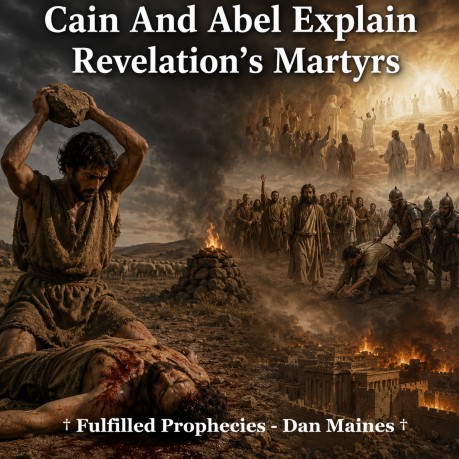
Cain And Abel Explain
Revelation's Martyrs Introduction Genesis 4:10 Matthew 23:35-36 Luke 11:49-51 Revelation 6:9-11 Revelation 18:20 Revelation 18:24 Revelation 19:1-2 Hebrews 12:24 Historical References How It Applies To Us Today Q & A Appendix Q: Who did Jesus say would answer for the
accumulated righteous blood? Q: How does Revelation 6 connect with Jesus'
words? Q: How do we know Revelation's martyrs didn't
have to wait thousands of years? Q: What city did Jesus associate with killing the
prophets? Q: Does Revelation use the same accusation? Q: Was the martyrs' prayer for vengeance ever
answered? Q: What is the complete blood-guilt pattern? † This is the fulfilled perspective we proclaim at
Fulfilled Prophecies † Source Index
By Dan Maines
† The
Bible's blood-guilt theme begins near the opening of Genesis and
reaches its covenantal climax near the end of Revelation. Abel's
blood cried from the ground, Jesus identified Abel as the beginning
point in a long history of righteous bloodshed, and Revelation
portrays the martyrs crying out for judgment.
†
These aren't disconnected stories. Scripture develops one continuous
pattern, righteous servants are murdered, their blood demands
justice, the guilt accumulates, and eventually God brings judgment
upon the guilty persecuting power.
† Jesus
gives us the key to identifying where that accumulated blood-guilt
would finally be judged. He said the blood from righteous Abel onward
would be required of His own generation, and He spoke those words
while announcing judgment upon Jerusalem (Matthew 23:35-38).
†
Revelation doesn't abandon that theme. It brings it to its climax.
The martyrs cry for vindication, Babylon is charged with the blood of
prophets and saints, and God judges the city responsible for that
blood (Revelation 6:9-11; 18:20, 24; 19:2).
Then He said, "What have
you done? The voice of your brother's blood is crying out to Me from
the ground.
† Abel's murder establishes a
biblical principle that continues throughout Scripture, innocent
blood cries out to God for justice. Cain couldn't bury the evidence
of his crime because God Himself heard the testimony of Abel's
blood.
† The language isn't teaching that
literal blood had a voice. It's judicial imagery. Abel's unjust death
stood before God as a demand for righteous judgment (Hebrews
12:24).
† This becomes extremely important
when we reach Revelation because the slain martyrs are pictured doing
exactly what Abel's blood did, crying to God for justice against
those who murdered them (Revelation 6:9-10).
so that upon you will fall
the guilt of all the righteous blood shed on earth, from the blood of
righteous Abel to the blood of Zechariah, the son of Berechiah, whom
you murdered between the temple and the altar. Truly I say to you,
all these things will come upon this generation.
†
Jesus deliberately reaches all the way back to Abel. He gathers the
history of righteous bloodshed into one enormous covenant lawsuit and
tells His first-century enemies that the accumulated judgment was
coming upon them.
† Notice the time
statement. Jesus didn't say this blood-guilt would be punished
thousands of years later. He said, All these things shall come upon
this generation. The generation standing before Him was approaching
the climax of Israel's covenantal blood-guilt.
†
This is one of the strongest interpretive connections to Revelation's
martyrs. If Jesus said the blood of the righteous would be required
of that generation, we shouldn't move Revelation's cry for vengeance
into an unrelated generation thousands of years later (Matthew
23:32-36; Revelation 6:9-11).
† Jesus then
immediately identifies Jerusalem as the persecuting city in the same
discourse, Jerusalem, Jerusalem, that killed the prophets, and
stoneth them that are sent unto her (Matthew 23:37). The blood-guilt
theme and Jerusalem's coming judgment are inseparable.
For this reason also, the
wisdom of God said, 'I will send them prophets and apostles, and some
of them they will kill, and some they will persecute, so that the
blood of all the prophets, shed since the foundation of the world,
may be charged against this generation, from the blood of Abel to the
blood of Zechariah, who was killed between the altar and the house of
God; yes, I tell you, it shall be charged against this generation.'
†
Luke makes the connection even more explicit. Jesus says prophets and
apostles would be sent to that generation, some would be killed and
persecuted, and the blood of the prophets would be required of that
same generation.
† This means the martyrdom
wasn't merely ancient history. Jesus predicted that His own
messengers would soon join the long line of murdered prophets
(Matthew 23:34; Acts 7:52, 58-60; 12:1-2).
†
The language of Revelation therefore fits the world Jesus described
perfectly. Prophets, apostles, and faithful witnesses were being
persecuted, their blood was awaiting vindication, and Jesus had
already declared which generation would face the reckoning.
†
The phrase from the foundation of the world connects the murder of
Abel to the persecution occurring in the first century. The entire
history of righteous blood was moving toward a covenantal day of
accountability.
When the Lamb broke the
fifth seal, I saw underneath the altar the souls of those who had
been killed because of the word of God, and because of the testimony
which they had maintained; and they cried out with a loud voice,
saying, "How long, O Lord, holy and true, will You refrain from
judging and avenging our blood on those who live on the earth?"
And a white robe was given to each of them; and they were told that
they were to rest for a little while longer, until the number of
their fellow servants and their brothers and sisters who were to be
killed even as they had been, was completed also.
†
Here Revelation deliberately returns us to the blood-cry theme.
Abel's blood cried from the ground, and now the blood of God's
murdered witnesses is represented by the martyrs crying beneath the
altar.
† Their question is How long? The
answer isn't thousands of years. They're told to rest for a little
time. Their vindication belonged to the approaching judgment
described throughout Revelation (Revelation 1:1, 3; 22:6, 10).
†
Their cry specifically asks God to judge and avenge our blood. That
closely matches Jesus' declaration that the blood of the righteous
would be required of His generation (Matthew 23:35-36; Luke
11:50-51).
† More martyrs would die before
the judgment arrived. This agrees with Jesus' warning that His
messengers would continue to be killed, crucified, scourged, and
persecuted before judgment fell (Matthew 23:34).
Rejoice over her, O heaven,
and you saints and apostles and prophets, because God has pronounced
judgment for you against her.
† The cry of
Revelation 6 receives its answer. The martyrs asked God to judge
their persecutors, and Revelation 18 announces that God had judged
their judgment upon the guilty city.
† Notice
who is specifically told to rejoice, saints, apostles, and prophets.
These are the same categories of people Jesus said would be
persecuted and killed before Jerusalem's judgment (Matthew 23:34;
Luke 11:49).
† This isn't random language.
Jesus predicted the persecution of prophets and apostles, promised
judgment upon that generation, and Revelation celebrates God's
judgment on the persecuting city.
And in her was found the
blood of prophets and of saints, and of all who have been slaughtered
on the earth.
† This statement sounds
remarkably like Jesus' indictment in Matthew 23. Jesus said all the
righteous blood shed upon the earth would come upon His generation,
and Revelation says the guilty city contained the blood of prophets,
saints, and all who had been slain upon the earth (Matthew
23:35-36).
† The verbal and theological
connection is powerful. Jesus identifies Jerusalem as the city that
kills the prophets, and Revelation condemns its symbolic Babylon for
the blood of prophets and saints (Matthew 23:37; Revelation 11:8).
†
Revelation itself had already identified the great city spiritually
as the place where their Lord was crucified (Revelation 11:8). That
geographical marker points directly to Jerusalem.
†
The blood that began crying in Genesis reaches its covenantal
judgment here. Abel's blood cried, the prophets' blood accumulated,
Jesus' messengers were persecuted, the martyrs cried for vengeance,
and the guilty city was finally judged.
After these things I heard
something like a loud voice of a great multitude in heaven, saying,
"Hallelujah! Salvation, glory, and power belong to our God,
because His judgments are true and righteous; for He has judged the
great prostitute who was corrupting the earth with her sexual
immorality, and He has avenged the blood of His bond-servants on
her."
† Revelation now gives the
explicit answer to the martyrs' prayer. They asked God to avenge our
blood, and after the judgment of the great harlot heaven declares
that God hath avenged the blood of his servants at her hand
(Revelation 6:10).
† The literary movement is
complete. Revelation 6 contains the request, Revelation 18 identifies
the blood-guilty city, and Revelation 19 announces that the requested
vengeance has occurred.
† This matches Jesus'
prophecy exactly. The blood-guilt accumulated from Abel through the
prophets and continued through the persecution of Christ's
messengers. Jesus said the reckoning would fall upon this generation,
and Revelation depicts that reckoning arriving.
and to Jesus, the mediator of
a new covenant, and to the sprinkled blood, which speaks better than
the blood of Abel.
† Hebrews brings Abel's
blood into direct contrast with the blood of Jesus. Abel's blood
cried for justice, while Christ's blood speaks the superior message
of the New Covenant.
† This contrast helps us
understand the larger biblical movement. The old world of
blood-guilt, persecution, and covenant judgment was giving way to the
completed New Covenant order centered entirely in Jesus (Hebrews
8:13; 12:22-24).
† The persecutors could shed
the blood of God's people, but they couldn't stop the kingdom. The
blood of Christ established something greater than the system that
was passing away.
†
Josephus describes Jerusalem during the Jewish War as consumed by
internal violence, factional murder, bloodshed, famine, and
destruction before the Romans finally took the city. His account
provides an eyewitness historical background for the horrifying
judgment that overtook Jerusalem in AD 70 (Josephus, Wars of the
Jews, Books 5-6).
† Josephus repeatedly
describes bloodshed within Jerusalem itself, including killings
around sacred areas. His history doesn't establish the theology,
Scripture does, but it provides powerful historical testimony
concerning the generation upon which Jerusalem's catastrophe actually
fell (Josephus, Wars of the Jews, Book 5).
†
Eusebius records the early Christian tradition that believers in
Jerusalem were warned to leave the city before the war and went to
Pella. This corresponds with Jesus' instructions that His disciples
flee when they recognized the approaching judgment (Eusebius,
Ecclesiastical History, 3.5; Luke 21:20-22).
†
These historical witnesses don't determine the meaning of prophecy.
They confirm that the first-century setting described by Jesus ended
in an extraordinary historical judgment upon Jerusalem within the
generation He addressed.
†
We don't need to wait for Revelation's martyrs to be avenged.
Revelation itself announces that their blood was avenged when God
judged the blood-guilty persecuting city (Revelation 18:20, 24;
19:2).
† We shouldn't take a judgment Jesus
explicitly assigned to His generation and relocate it thousands of
years into our future. His time statements tell us when the
blood-guilt reckoning would occur (Matthew 23:35-36; Luke
11:50-51).
† This also means Revelation
should be read through the story Scripture itself develops. Genesis
introduces Abel's crying blood, Jesus identifies the generation
responsible for the accumulated blood-guilt, Revelation shows the
martyrs crying for vindication, and Revelation finally announces that
their blood has been avenged.
† For believers
today, the message isn't that we're waiting for ancient martyrs to
receive justice. The message is that God keeps His covenant promises,
vindicates His servants, judges persecuting powers, and has
established the kingdom of His Son.
† We live
on the completed side of that covenantal judgment. Our calling isn't
to fear an approaching destruction of Jerusalem, but to live
faithfully in the everlasting kingdom established through Jesus
Christ (Hebrews 12:22-28).
Q: Why
begin Revelation's martyr theme with Cain and Abel?
A:
Because Scripture itself begins the righteous blood theme with Abel.
His blood cried from the ground, and Jesus specifically traced the
history of righteous bloodshed back to Abel (Genesis 4:10; Matthew
23:35).
A: Jesus said, All
these things shall come upon this generation. Luke records the same
declaration, saying the blood from Abel onward would be required of
this generation (Matthew 23:35-36; Luke 11:50-51).
A: Revelation's martyrs cry for God to
judge and avenge their blood. Jesus had already declared that the
blood of the righteous would be required of His generation
(Revelation 6:9-11; Matthew 23:35-36).
A: They were
told to rest for a little time, and Revelation repeatedly describes
its events as soon and near (Revelation 6:11; 1:1, 3; 22:6, 10).
A: Jerusalem. Jesus directly
lamented, Jerusalem, Jerusalem, that killeth the prophets, and
stoneth them that are sent unto her (Matthew 23:37).
A:
Yes. Revelation says the blood of prophets and saints was found in
the guilty city, and earlier identifies the great city spiritually as
the place where the Lord was crucified (Revelation 18:24; 11:8).
A: Yes. Revelation explicitly
announces that God judged the great harlot and avenged the blood of
His servants at her hand (Revelation 19:2).
A:
Abel's blood cries, righteous blood accumulates, Jesus announces that
the reckoning will fall upon His generation, the martyrs cry for
vengeance, the blood-guilty city is judged, and heaven announces that
God has avenged His servants (Genesis 4:10; Matthew 23:35-36;
Revelation 6:9-11; 18:24; 19:2).
© Fulfilled Prophecies - Dan
Maines.
† Genesis
4:10; Matthew 23:35-36; Luke 11:49-51; Revelation 6:9-11; Revelation
18:20; Revelation 18:24; Revelation 19:1-2; Hebrews 12:24
†
Josephus, Wars of the Jews, Books 5-6; Eusebius, Ecclesiastical
History, 3.5
Links