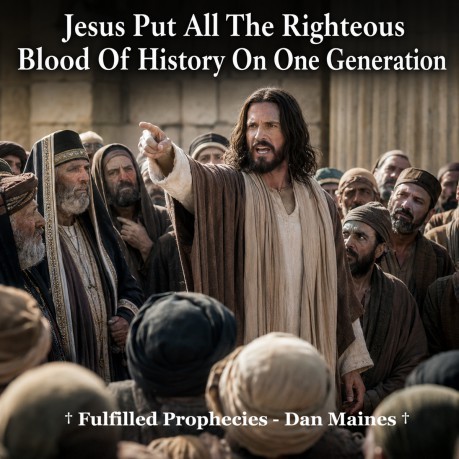
Jesus Put All The Righteous
Blood Of History On One Generation Introduction Matthew 23:29-32 Matthew 23:33-36 Genesis 4:8-10 2 Chronicles 24:20-22 Luke 11:47-51 Matthew 21:33-41 Matthew 23:37-38 Matthew 24:1-2 Matthew 24:34 Historical References How It Applies To Us Today Q & A Appendix † This is the fulfilled perspective we proclaim at
Fulfilled Prophecies † Source Index
By Dan Maines
† Matthew 23
contains one of the strongest time statements Jesus ever gave
concerning judgment. Jesus didn't scatter the guilt He described
across thousands of years of future history. He gathered the history
of righteous bloodshed, from Abel onward, and announced that the
reckoning would fall upon one specific generation.
†
This matters because Jesus identified both the people being judged
and the generation that would experience the judgment. His words
don't require us to guess when these things would happen. He said,
All these things shall come upon this generation (Matthew 23:36).
†
The setting is also critical. Jesus was speaking directly to the
scribes and Pharisees, condemning the covenant leadership of
Jerusalem immediately before announcing the coming desolation of
their house (Matthew 23:37-38).
† Matthew 23
therefore gives us a powerful interpretive key for Matthew 24. Before
Jesus ever said this generation shall not pass away in the Olivet
Discourse, He had already identified that generation as the
generation upon whom accumulated covenant judgment would fall
(Matthew 23:36; 24:34).
"Woe to you, scribes
and Pharisees, hypocrites! For you build the tombs for the prophets
and decorate the monuments of the righteous, and you say, 'If we had
been living in the days of our fathers, we would not have been
partners with them in shedding the blood of the prophets.' So you
testify against yourselves, that you are sons of those who murdered
the prophets. Fill up, then, the measure of the guilt of your
fathers.
† Jesus exposed the hypocrisy of
leaders who honored dead prophets while rejecting the One to whom the
prophets pointed. They decorated the graves of righteous men while
continuing the same covenant rebellion that had produced those graves
(Matthew 23:29-32).
† The words fill up then
the measure of your fathers are especially important. Jesus presented
their generation as the generation that would bring the long history
of covenant rebellion to its full measure (Matthew 23:32).
†
This wasn't merely individual guilt. Jesus was describing a
covenantal and historical reckoning. Their rejection of Christ and
persecution of His messengers would demonstrate that they stood in
continuity with those who had persecuted God's messengers before them
(Matthew 23:30-32).
You snakes, you offspring
of vipers, how will you escape the sentence of hell? "Therefore,
behold, I am sending you prophets and wise men and scribes; some of
them you will kill and crucify, and some of them you will flog in
your synagogues, and persecute from city to city, so that upon you
will fall the guilt of all the righteous blood shed on earth, from
the blood of righteous Abel to the blood of Zechariah, the son of
Berechiah, whom you murdered between the temple and the altar. Truly
I say to you, all these things will come upon this generation.
†
Jesus couldn't have made the audience clearer. He repeatedly said
you. I send to you. Some of them you shall kill. Some shall you
scourge. Upon you may come all the righteous blood. All these things
shall come upon this generation (Matthew 23:33-36).
†
Abel reaches back to the earliest righteous martyr recorded in
Scripture. Zechariah represents another righteous man murdered in
connection with the sanctuary. Jesus gathered the history of
righteous bloodshed into one sweeping indictment (Genesis 4:8-10; 2
Chronicles 24:20-22).
† The decisive
statement is verse 36. Jesus didn't say all these things would come
upon a generation living thousands of years later. He said this
generation. The people standing before Him were being warned about a
judgment approaching their own covenant world (Matthew 23:36).
†
This is why Matthew 23 is so important for understanding biblical
prophecy. The generation responsible for rejecting Jesus and
persecuting His messengers was also the generation Jesus identified
for the climactic covenant judgment (Matthew 23:34-36).
Cain talked to his brother
Abel; and it happened that when they were in the field Cain rose up
against his brother Abel and killed him. Then the Lord said to Cain,
"Where is Abel your brother?" And he said, "I do not
know. Am I my brother's keeper?" Then He said, "What have
you done? The voice of your brother's blood is crying out to Me from
the ground.
† Jesus deliberately reached
back to Abel when describing the righteous blood that would be
brought into the covenant reckoning. Abel's blood cried out from the
ground for justice (Genesis 4:10).
† This
establishes a biblical pattern. Innocent blood wasn't forgotten
before God. Bloodshed cried for judgment, and Jesus announced that
the covenantal accumulation of righteous blood was reaching its
appointed reckoning in His generation (Matthew 23:35-36).
†
The connection between Genesis and Matthew is striking. The Bible's
first recorded murder of a righteous man becomes part of Jesus'
indictment against the generation that would reject and kill God's
Son and persecute His messengers (Matthew 21:37-39; 23:34-36).
Then the Spirit of God
covered Zechariah, the son of Jehoiada the priest like clothing; and
he stood above the people and said to them, "This is what God
has said, 'Why do you break the commandments of the Lord and do not
prosper? Because you have abandoned the Lord, He has also abandoned
you.'" So they conspired against him, and at the command of the
king they stoned him to death in the courtyard of the house of the
Lord. So Joash the king did not remember the kindness which
Zechariah's father Jehoiada had shown him, but he murdered his son.
And as Zechariah died he said, "May the Lord see and avenge!"
†
Zechariah was murdered in the sacred precincts after confronting
covenant rebellion. His dying appeal was that God would see the crime
and require an accounting (2 Chronicles 24:20-22).
†
Jesus' reference to righteous blood reaching from Abel to Zechariah
wasn't random. It summarized a long history in which God's messengers
were rejected, persecuted, and murdered (Matthew 23:35).
†
Jesus announced that the accounting requested by the blood of the
righteous was reaching its covenant climax. That is why His
declaration ends with the unmistakable words, All these things shall
come upon this generation (Matthew 23:36).
Woe to you! For you build the
tombs of the prophets, and it was your fathers who killed them. So
you are witnesses and you approve of the deeds of your fathers;
because it was they who killed them, and you build their tombs. For
this reason also, the wisdom of God said, 'I will send them prophets
and apostles, and some of them they will kill, and some they will
persecute, so that the blood of all the prophets, shed since the
foundation of the world, may be charged against this generation, from
the blood of Abel to the blood of Zechariah, who was killed between
the altar and the house of God; yes, I tell you, it shall be charged
against this generation.'
† Luke's parallel
account makes the timing even harder to escape. Jesus said the blood
of all the prophets would be required of this generation (Luke
11:50-51).
† Notice the language of
accountability. Jesus didn't merely predict another period of
persecution. He announced a reckoning for the accumulated blood of
God's prophets (Luke 11:49-51).
† Matthew
says all these things shall come upon this generation, while Luke
says the blood shall be required of this generation. Together they
identify both the nature and timing of the judgment (Matthew 23:36;
Luke 11:50-51).
"Listen to another
parable. There was a landowner who planted a vineyard and put a fence
around it, and dug a wine press in it, and built a tower, and he
leased it to vine-growers and went on a journey. And when the harvest
time approached, he sent his slaves to the vine-growers to receive
his fruit. And the vine-growers took his slaves and beat one, killed
another, and stoned another. Again, he sent other slaves, more than
the first; and they did the same things to them. But afterward he
sent his son to them, saying, 'They will respect my son.' But when
the vine-growers saw the son, they said among themselves, 'This is
the heir; come, let's kill him and take possession of his
inheritance!' And they took him and threw him out of the vineyard,
and killed him. Therefore, when the owner of the vineyard comes, what
will he do to those vine-growers?" They said to Him, "He
will bring those wretches to a wretched end and lease the vineyard to
other vine-growers, who will pay him the fruit in the proper
seasons."
† The parable of the vineyard
tells the same covenant story. God's servants were beaten, killed,
and stoned, and finally the Son Himself was rejected and killed
(Matthew 21:35-39).
† The killing of the Son
brought the rebellion to its climax. The issue wasn't simply that
previous generations had persecuted prophets. Jesus' generation was
about to reject the Son and continue persecuting those He sent
(Matthew 21:37-39; 23:34).
† Jesus therefore
announced judgment upon those husbandmen. This is the same pattern
seen in Matthew 23, generations of covenant rebellion reaching their
climax in the rejection of Christ and producing judgment upon that
generation (Matthew 21:40-41; 23:32-36).
Jerusalem, Jerusalem, who
kills the prophets and stones those who have been sent to her! How
often I wanted to gather your children together, the way a hen
gathers her chicks under her wings, and you were unwilling. Behold,
your house is being left to you desolate!
†
Jesus immediately identified Jerusalem as the city with the history
of killing the prophets and stoning God's messengers. This connects
the righteous blood indictment directly to Jerusalem's coming
desolation (Matthew 23:37-38).
† The movement
of the passage is unmistakable. Jesus condemned the leaders,
announced that righteous blood would be required of their generation,
lamented over Jerusalem, and declared their house desolate (Matthew
23:29-38).
† This prepares the reader for the
next chapter. Jesus left the temple, His disciples pointed out its
buildings, and He announced that not one stone would be left upon
another (Matthew 24:1-2). Matthew 24 didn't begin a completely
unrelated prophecy, it continued the judgment Jesus had just
pronounced.
Jesus left the temple area
and was going on His way when His disciples came up to point out the
temple buildings to Him. But He responded and said to them, "Do
you not see all these things? Truly I say to you, not one stone here
will be left upon another, which will not be torn down."
†
There is no chapter break in Jesus' conversation. Matthew 24 follows
directly from His declaration that Jerusalem's house was being left
desolate (Matthew 23:38).
† The temple's
destruction was therefore connected to the covenant judgment Jesus
had just pronounced. The disciples saw the temple standing before
them, and Jesus told them its magnificent stones would be thrown down
(Matthew 24:1-2).
† The subject didn't
suddenly become the destruction of planet Earth. The immediate
subject was the temple, Jerusalem, covenant judgment, and the
generation Jesus had already identified (Matthew 23:36-38; 24:1-2).
Truly I say to you, this
generation will not pass away until all these things take place.
†
Jesus used the same generation language in Matthew 24 that He had
just used in Matthew 23. This generation in Matthew 24:34 shouldn't
be separated from this generation in Matthew 23:36.
†
Matthew 23 says all these things shall come upon this generation.
Matthew 24 says this generation shall not pass away until all these
things are accomplished. The verbal connection is powerful (Matthew
23:36; 24:34).
† Jesus had already defined
the guilty generation before the disciples ever asked Him about the
temple's destruction. The Olivet Discourse continues that same
first-century judgment context (Matthew 23:34-38; 24:1-3, 34).
†
Josephus, writing about the Jewish War and Jerusalem's destruction,
described a city consumed by internal violence, bloodshed, famine,
factional warfare, and finally Roman destruction. His account
provides important historical testimony concerning the catastrophic
judgment that overtook Jerusalem in AD 70 (Josephus, The Wars of the
Jews, Books 5-6).
† Josephus described the
temple being burned and Jerusalem devastated during the Roman siege.
This historical setting closely matches Jesus' first-century warning
that Jerusalem's house would be left desolate and the temple
destroyed (Matthew 23:38; 24:1-2; Josephus, The Wars of the Jews,
Book 6).
† Tacitus also recorded the Roman
siege of Jerusalem under Titus and described the enormous population
trapped within the city during the conflict. His Roman account
independently confirms the historical setting of Jerusalem's
catastrophic first-century destruction (Tacitus, Histories, Book
5).
† Eusebius later connected the calamities
that befell the Jewish nation with the rejection of Christ and
recorded the tradition that believers in Jerusalem escaped to Pella
before the war (Eusebius, Ecclesiastical History, Book 3, Chapters
5-7).
†
We shouldn't take a judgment Jesus explicitly assigned to this
generation and move it thousands of years into our future. The time
statement should be allowed to mean what it meant to Jesus' original
audience (Matthew 23:36).
† We should read
Matthew 24 in the context Matthew itself provides. Jesus pronounced
judgment upon His generation, declared Jerusalem's house desolate,
predicted the temple's destruction, and then again said this
generation wouldn't pass away until all these things were
accomplished (Matthew 23:36-38; 24:1-2, 34).
†
This fulfilled judgment doesn't mean Christ stopped reigning after AD
70. It means the old covenant age reached its decisive judgment and
the kingdom of Christ stands victorious. We don't live waiting for
Jerusalem's first-century judgment to happen again.
†
The lesson for us is also spiritual. Religious appearance can't
substitute for faithfulness to God. The scribes and Pharisees honored
the prophets with monuments while rejecting the truth those prophets
proclaimed and rejecting the Messiah standing before them (Matthew
23:29-32).
† Most importantly, Jesus' words
should control our interpretation. When He said this generation, we
shouldn't replace His audience with ours. The righteous blood was
required of that generation, Jerusalem's house was left desolate, and
the temple Jesus pointed to was destroyed within that generation
(Matthew 23:35-38; 24:1-2, 34).
Q: Did
Jesus really say all the righteous blood would be required of one
generation?
A: Yes. Matthew says all these
things would come upon this generation, and Luke says the blood of
all the prophets would be required of this generation (Matthew
23:35-36; Luke 11:50-51).
Q: Why did Jesus
begin with Abel?
A: Abel was the first
righteous person recorded in Scripture as being murdered, and his
blood cried from the ground for justice (Genesis 4:8-10).
Q:
Why is Zechariah important?
A: Jesus used
Zechariah as the other boundary in His sweeping summary of righteous
bloodshed. Zechariah was murdered in connection with God's sanctuary
after confronting covenant rebellion (2 Chronicles 24:20-22; Matthew
23:35).
Q: Was Jesus talking about a generation
thousands of years in the future?
A: No. He was
speaking directly to the scribes and Pharisees and repeatedly used
you before declaring that all these things would come upon this
generation (Matthew 23:29-36).
Q: Does Matthew
24 change the generation?
A: No. Matthew 24
continues directly from Matthew 23. Jesus declared Jerusalem's house
desolate, predicted the destruction of the temple, and again said
this generation wouldn't pass away until all these things were
accomplished (Matthew 23:36-38; 24:1-2, 34).
Q:
Was this judgment historically fulfilled?
A:
Yes. Jerusalem and the temple were destroyed by the Romans in AD 70,
within the lifetime of the generation Jesus addressed. Josephus,
Tacitus, and later Eusebius preserve important historical testimony
concerning that first-century catastrophe.
© Fulfilled Prophecies - Dan
Maines.
† Matthew
23:29-32; Matthew 23:33-36; Genesis 4:8-10; 2 Chronicles 24:20-22;
Luke 11:47-51; Matthew 21:33-41; Matthew 23:37-38; Matthew 24:1-2;
Matthew 24:34
† Josephus, The Wars of the
Jews, Books 5-6; Tacitus, Histories, Book 5; Eusebius, Ecclesiastical
History, Book 3, Chapters 5-7
Links