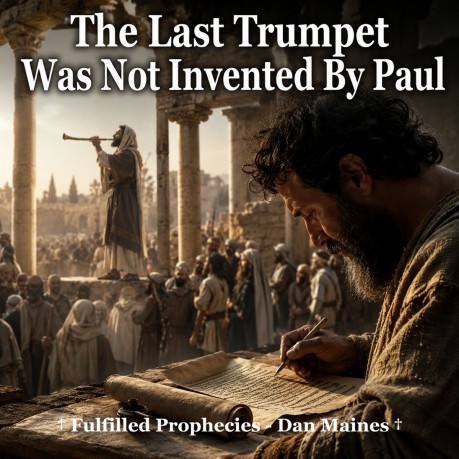
The Last Trumpet Was Not
Invented By Paul Introduction Exodus 19:16-19 Leviticus 23:23-25 Isaiah 27:12-13 Zephaniah 1:14-16 Matthew 24:29-34 1 Corinthians 15:51-54 1 Thessalonians 4:15-18 Revelation 8:1-6 Revelation 11:15-18 Historical References How It Applies To Us Today Q & A Appendix Q: Why did Jesus mention a trumpet in the Olivet
Discourse? Q: Does the word last in last trump prove Paul
expected a literal final trumpet blast at the end of planet Earth? Q: Are 1 Corinthians 15 and 1 Thessalonians 4
completely separate from Jesus' teaching? Q: Why are Revelation's seven trumpets
important? Q: What should control our interpretation of the
last trumpet? † This is the fulfilled perspective we proclaim at
Fulfilled Prophecies † Source Index
By Dan Maines
† When Paul
wrote about the last trump, he wasn't introducing a brand-new
prophetic symbol. His Jewish readers already had centuries of
Scripture teaching them what trumpets meant.
†
From Sinai onward, trumpets announced divine presence, covenant
assembly, holy days, warfare, warning, judgment, and gathering. Paul
didn't invent that vocabulary, he inherited it from Israel's
Scriptures.
† This matters because 1
Corinthians 15 and 1 Thessalonians 4 shouldn't be isolated from the
Old Testament, Jesus' teaching, and Revelation. Scripture should
define Scripture, not modern prophecy charts.
†
When we follow the trumpet theme from Moses through the prophets,
through Jesus, through Paul, and into Revelation, we find one
continuous biblical vocabulary pointing toward covenant fulfillment,
resurrection, gathering, and judgment.
So it came about on the
third day, when it was morning, that there were thunder and lightning
flashes and a thick cloud over the mountain and a very loud trumpet
sound, so that all the people who were in the camp trembled. And
Moses brought the people out of the camp to meet God, and they stood
at the foot of the mountain. Now Mount Sinai was all in smoke
because the Lord descended upon it in fire; and its smoke ascended
like the smoke of a furnace, and the entire mountain quaked
violently. When the sound of the trumpet grew louder and louder,
Moses spoke, and God answered him with thunder.
†
The Bible's trumpet imagery begins long before Paul. At Sinai the
trumpet accompanied God's covenantal descent in cloud, fire,
earthquake, and divine voice.
† Israel was
gathered to meet God when the trumpet sounded. That combination,
divine presence, cloud, trumpet, gathering, and covenant, became part
of the prophetic vocabulary later writers could use without
redefining every symbol (Hebrews 12:18-24).
†
Therefore, when Paul combined the Lord's descent, the trumpet of God,
and the gathering of God's people, his Jewish framework already
existed in the Sinai story (1 Thessalonians 4:16-17).
Again the Lord spoke to
Moses, saying, "Speak to the sons of Israel, saying, 'In the
seventh month on the first of the month you shall have a rest, a
reminder by blowing of trumpets, a holy convocation. You shall not do
any laborious work, but you shall present an offering by fire to the
Lord.'"
† Trumpets were built directly
into Israel's sacred calendar. The blowing of trumpets announced a
holy convocation, a sacred gathering of the covenant people.
†
The seventh month was especially significant because its feast cycle
moved toward the Day of Atonement and the Feast of Tabernacles.
Trumpet imagery therefore belonged naturally to themes of assembly,
atonement, harvest, and dwelling with God (Leviticus 23:27, 34).
†
Paul didn't need to invent a meaning for trumpet language.
Generations of Israelites already understood that the trumpet could
announce that God's appointed covenantal time had arrived.
On that day the Lord will
thresh from the flowing stream of the Euphrates River to the brook of
Egypt, and you will be gathered up one by one, you sons of Israel. It
will come about also on that day that a great trumpet will be blown,
and those who were perishing in the land of Assyria and who were
scattered in the land of Egypt will come and worship the Lord on the
holy mountain in Jerusalem.
† Isaiah joined
trumpet imagery directly to gathering. A great trumpet would sound,
and God's scattered people would be gathered.
†
This is crucial when we reach Jesus' Olivet Discourse. Jesus didn't
suddenly invent the combination of trumpet and gathering either. He
was speaking the established language of Israel's prophets (Matthew
24:31).
† Isaiah also placed this trumpet in
the context of God's judgment, restoration, harvest, and gathering.
Biblical trumpet language can therefore describe covenantal events
without requiring a literal brass instrument to be heard across the
planet (Isaiah 27:1, 6, 12-13).
The great day of the Lord
is near, Near and coming very quickly; Listen, the day of the Lord!
In it the warrior cries out bitterly. That day is a day of anger, A
day of trouble and distress, A day of destruction and desolation, A
day of darkness and gloom, A day of clouds and thick darkness, A day
of trumpet and battle cry Against the fortified cities And the high
corner towers.
† The prophets used trumpet
language for approaching judgment. Zephaniah connected the trumpet
with the day of the Lord, wrath, darkness, clouds, warfare, and
destruction.
† This demonstrates why
prophetic trumpet language can't automatically be forced into a
woodenly literal interpretation. The trumpet was part of the
prophetic vocabulary announcing God's intervention in history.
†
Jesus later used the same prophetic world of clouds, tribulation,
judgment, gathering, and trumpet language when describing the
judgment coming upon His generation (Matthew 24:29-34).
But immediately after the
tribulation of those days the sun will be darkened, and the moon will
not give its light, and the stars will fall from the sky, and the
powers of the heavens will be shaken. And then the sign of the Son of
Man will appear in the sky, and then all the tribes of the earth will
mourn, and they will see the Son of Man coming on the clouds of the
sky with power and great glory. And He will send forth His angels
with a great trumpet blast, and they will gather together His elect
from the four winds, from one end of the sky to the other. Now learn
the parable from the fig tree: as soon as its branch has become
tender and sprouts its leaves, you know that summer is near; so you
too, when you see all these things, recognize that He is near, right
at the door. Truly I say to you, this generation will not pass away
until all these things take place.
† Jesus
connected trumpet and gathering language exactly as Isaiah had done
centuries earlier. The prophetic foundation was already established
(Isaiah 27:13).
† Jesus also placed this
trumpet gathering within the time limitation of this generation.
Whatever interpretation we give the trumpet, we can't remove it from
the audience and timeframe Jesus Himself supplied (Matthew 24:34).
†
Notice the sequence, tribulation, cosmic judgment imagery, the Son of
Man coming on the clouds, trumpet, and gathering. These aren't
disconnected subjects. They form one prophetic announcement.
†
This becomes especially important when reading Paul. Paul was writing
after Jesus had already spoken of the coming of the Son of Man, the
trumpet, and the gathering of the elect. Paul's trumpet teaching
didn't appear in a vacuum.
Behold, I am telling
you a mystery; we will not all sleep, but we will all be changed, in
a moment, in the twinkling of an eye, at the last trumpet; for the
trumpet will sound, and the dead will be raised imperishable, and we
will be changed. For this perishable must put on the imperishable,
and this mortal must put on immortality. But when this perishable
puts on the imperishable, and this mortal puts on immortality, then
will come about the saying that is written: Death has been swallowed
up in victory.
† Paul called it the last
trump. The word last naturally assumes a trumpet framework already
understood. Paul wasn't introducing trumpet symbolism for the first
time.
† Paul connected this trumpet with
resurrection, transformation, and victory over death. His explanation
stands within the larger biblical story of covenant fulfillment
rather than an isolated end-times system created thousands of years
later.
† Paul immediately grounded his
resurrection teaching in the prophets by declaring that the
swallowing up of death fulfilled what had been written (Isaiah 25:8;
Hosea 13:14). His framework was scriptural and covenantal from
beginning to end.
† The Corinthians therefore
weren't being handed a disconnected prophecy chart. They were being
shown the climax of promises already embedded in Israel's Scriptures.
For we say this to
you by the word of the Lord, that we who are alive and remain until
the coming of the Lord will not precede those who have fallen asleep.
For the Lord Himself will descend from heaven with a shout, with the
voice of the archangel and with the trumpet of God, and the dead in
Christ will rise first. Then we who are alive, who remain, will be
caught up together with them in the clouds to meet the Lord in the
air, and so we will always be with the Lord. Therefore, comfort one
another with these words.
† Paul's language
echoes themes already established in Scripture, the Lord's descent,
divine voice, trumpet, clouds, gathering, and meeting the Lord. Sinai
and the prophets had already supplied that vocabulary (Exodus
19:16-19; Isaiah 27:13).
† Paul's statement
that we that are alive, that are left also matters. He included
living first-century believers within the expectation surrounding the
coming of the Lord.
† Jesus had already
connected His coming, clouds, trumpet, and gathering within the
timeframe of His generation. Paul shouldn't be interpreted as though
he had abandoned Jesus' timeframe and created an unrelated event
(Matthew 24:30-34).
† The purpose of Paul's
words was comfort. The dead in Christ weren't excluded from the
promised consummation, and the living saints wouldn't have an
advantage over those who had died.
When the Lamb broke the
seventh seal, there was silence in heaven for about half an hour. And
I saw the seven angels who stand before God, and seven trumpets were
given to them. Another angel came and stood at the altar, holding a
golden censer; and much incense was given to him, so that he might
add it to the prayers of all the saints on the golden altar which was
before the throne. And the smoke of the incense ascended from the
angel's hand with the prayers of the saints before God. Then the
angel took the censer and filled it with the fire of the altar, and
hurled it to the earth; and there were peals of thunder and sounds,
and flashes of lightning and an earthquake. And the seven angels who
had the seven trumpets prepared themselves to sound them.
†
Revelation makes the trumpet pattern unmistakable. Seven angels
receive seven trumpets, and those trumpets announce successive acts
of divine judgment.
† Notice the Sinai-like
imagery surrounding them, thunder, voices, lightning, and earthquake.
Revelation is drawing from the Bible's established vocabulary rather
than inventing an entirely new prophetic language (Exodus
19:16-19).
† Revelation itself announced that
its events must shortly come to pass and that the time was near
(Revelation 1:1-3; 22:6, 10). Its trumpets belong inside that stated
timeframe.
Then the seventh angel
sounded; and there were loud voices in heaven, saying, "The
kingdom of the world has become the kingdom of our Lord and of His
Christ; and He will reign forever and ever." And the twenty-four
elders, who sit on their thrones before God, fell on their faces and
worshiped God, saying, "We give You thanks, Lord God, the
Almighty, the One who is and who was, because You have taken Your
great power and have begun to reign. And the nations were enraged,
and Your wrath came, and the time came for the dead to be judged, and
the time to reward Your bond-servants the prophets and the saints and
those who fear Your name, the small and the great, and to destroy
those who destroy the earth."
† The
seventh trumpet brings the trumpet sequence to its climax. Revelation
connects it with the kingdom, divine reign, wrath, judgment of the
dead, and reward of God's servants.
† That
makes Paul's last trump language especially significant. Paul and
Revelation both associate climactic trumpet imagery with resurrection
or judgment themes, and both stand on the much older foundation of
Israel's Scriptures.
† We don't need to force
an identity between every trumpet reference to recognize the biblical
pattern. The important point is that Paul wasn't inventing the
symbolism. Sinai, Israel's feasts, and the prophets had already
established trumpet language centuries before Paul wrote.
†
The safest interpretive method is therefore to move backward into
Scripture before moving forward into speculation. Let Moses explain
the prophets, let the prophets illuminate Jesus, let Jesus provide
the timeframe, and then read Paul and Revelation within that biblical
world.
†
Josephus described trumpets as established instruments for
communicating commands among Israel and later described trumpet
signals in military settings. His writings show that trumpet sounds
naturally communicated assembly, movement, warning, and action in the
ancient world (Josephus, Antiquities of the Jews, Book 3; The Jewish
War, Book 3).
† Josephus also recorded the
catastrophic Jewish-Roman war that ended with Jerusalem and the
temple being destroyed in AD 70. That historical setting is
significant when comparing Jesus' warnings concerning Jerusalem with
the judgment imagery found throughout the New Testament (Josephus,
The Jewish War, Books 5-7).
† Tacitus
independently recorded the Roman conflict with Jerusalem and the
destruction associated with that generation, providing non-Christian
historical testimony to the first-century catastrophe surrounding
Jerusalem (Tacitus, Histories, Book 5).
†
Eusebius later preserved the early Christian tradition that believers
in Jerusalem departed before the city's destruction, connecting the
escape of the church with the crisis that overtook Jerusalem
(Eusebius, Ecclesiastical History, Book 3, Chapters 5-7).
†
We should let Scripture interpret trumpet language before allowing
modern prophecy systems to tell us what a trumpet must mean.
†
When Paul says last trump, our first question shouldn't be, What does
a modern prophecy chart say? Our first question should be, Where has
God already taught us about trumpets?
† Sinai
teaches divine presence and covenant assembly. Israel's feasts teach
sacred convocation. Isaiah teaches gathering. Zephaniah teaches
judgment. Jesus teaches coming, trumpet, and gathering within His
generation. Paul teaches resurrection and transformation. Revelation
teaches climactic covenant judgment and kingdom victory.
†
The trumpet theme isn't a collection of unrelated verses. It's a
biblical thread running through the covenant story.
†
We don't have to wait for a future trumpet to know Christ reigns. The
kingdom has been established, Christ has received His dominion, and
believers now belong to the heavenly Jerusalem and the unshakable
kingdom (Hebrews 12:22-28).
† Our hope isn't
found in watching modern headlines and trying to fit them into
ancient prophecies. Our hope is Jesus Christ and the finished
covenant work that brought God's people into His everlasting
kingdom.
† The last trumpet wasn't invented
by Paul. Paul inherited the language from the Scriptures, Jesus used
the same prophetic vocabulary, and Revelation carried that trumpet
imagery to its covenantal climax.
† Scripture
defined the trumpet long before modern prophecy charts existed. We
should allow Scripture to keep defining it today.
Q: Did
Paul invent the idea of a prophetic trumpet?
A:
No. Trumpet imagery appears throughout Israel's Scriptures centuries
before Paul, including Sinai, Israel's feast calendar, prophetic
gathering, and prophetic judgment (Exodus 19:16-19; Leviticus
23:23-25; Isaiah 27:13; Zephaniah 1:14-16).
A: Jesus was using established
prophetic language. Isaiah had already connected a great trumpet with
the gathering of God's people, and Jesus used trumpet and gathering
imagery while describing events He placed within this generation
(Isaiah 27:13; Matthew 24:29-34).
A:
No. The phrase has to be interpreted within its biblical context.
Scripture had already used trumpets symbolically and prophetically
for assembly, divine presence, warning, judgment, and gathering
(Exodus 19:16-19; Isaiah 27:13; Zephaniah 1:14-16).
A:
They shouldn't be treated that way. Jesus had already spoken of His
coming, clouds, trumpet, and gathering, and Paul later used closely
related themes when teaching the churches (Matthew 24:30-34; 1
Corinthians 15:51-54; 1 Thessalonians 4:15-18).
A: They demonstrate again that
biblical trumpets announce divine action and judgment. The seventh
trumpet reaches a climax involving the kingdom, wrath, judgment, and
reward (Revelation 8:1-6; 11:15-18).
A: Scripture itself. We should
trace the language through Moses, Israel's feasts, the prophets,
Jesus, Paul, and Revelation before importing a modern prophetic
system into the text.
© Fulfilled Prophecies - Dan
Maines.
† Exodus
19:16-19; Leviticus 23:23-25; Isaiah 27:12-13; Zephaniah 1:14-16;
Matthew 24:29-34; 1 Corinthians 15:51-54; 1 Thessalonians 4:15-18;
Revelation 8:1-6; Revelation 11:15-18
†
Josephus, Antiquities of the Jews, Book 3; Josephus, The Jewish War,
Books 3, 5-7; Tacitus, Histories, Book 5; Eusebius, Ecclesiastical
History, Book 3, Chapters 5-7
Links