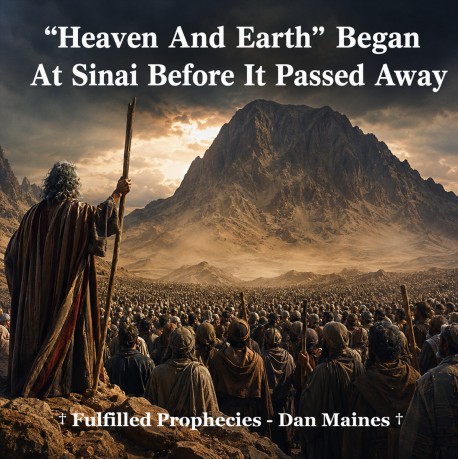
"Heaven And Earth"
Began At Sinai Before It Passed Away Introduction Deuteronomy 4:26 Deuteronomy 31:28-29 Deuteronomy 32:1 Isaiah 1:2 Isaiah 51:15-16 Isaiah 65:17-18 Matthew 5:17-18 Matthew 24:34-35 2 Peter 3:10-13 Revelation 21:1-3 Historical References How It Applies To Us Today Q & A Appendix Q: Did the physical universe begin at Sinai? Q: Why did Moses call heaven and earth as
witnesses? Q: Did Jesus say heaven and earth would pass
away? Q: Does 2 Peter 3 have to mean the physical
universe was going to be destroyed? Q: What replaced the old heaven and earth? Q: Are Christians living in that New Covenant
reality now? † This is the fulfilled perspective we proclaim at
Fulfilled Prophecies † Source Index
By Dan Maines
† When many
Christians hear "heaven and earth," they automatically
assume the Bible must be talking about the physical universe. But
Scripture itself uses heaven and earth as covenant language connected
with Israel, the Law, judgment, and the establishment of a new
covenant order.
† This language didn't
suddenly appear in Revelation. Moses used heaven and earth as
covenant witnesses over Israel, Isaiah addressed heaven and earth
while speaking directly to God's covenant people, Jesus connected the
passing of heaven and earth with the fulfillment of the Law, Peter
described new heavens and a new earth according to God's promise, and
John finally saw the first heaven and earth pass away.
†
The point isn't that the physical creation began at Mount Sinai. The
sun, moon, stars, land, and seas existed long before Moses. The point
is that Scripture developed a covenantal "heaven and earth"
order around the nation formed under the Mosaic covenant. That
covenant world could therefore be shaken, judged, dissolved, and
replaced without the physical planet being destroyed.
†
Once we follow this language from Moses through the prophets, Jesus,
Peter, and Revelation, the Bible interprets itself.
I call heaven and earth as
witnesses against you today, that you will certainly perish quickly
from the land where you are going over the Jordan to take possession
of it. You will not live long on it, but will be utterly destroyed.
†
Moses wasn't warning the physical sky and planet. He was establishing
covenant witnesses against Israel concerning the consequences of
violating God's covenant.
† Heaven and earth
were summoned in a legal covenant setting. Israel could be judged,
scattered, and removed from the land because she had violated the
covenant established through Moses (Deuteronomy 4:23-31).
†
This gives us an important biblical foundation. Heaven and earth
language can function within covenant judgment without requiring the
destruction of the physical universe.
Assemble to me all the
elders of your tribes and your officers, that I may speak these words
in their hearing and call the heavens and the earth as witnesses
against them. For I know that after my death you will behave very
corruptly and turn from the way which I have commanded you; and evil
will confront you in the latter days, because you will do that which
is evil in the sight of the Lord, provoking Him to anger with the
work of your hands.
† Notice the connection
Moses makes between heaven and earth, Israel's covenant rebellion,
and "the latter days." This is covenant language from the
beginning.
† The latter days in this passage
concern what would eventually happen to Israel because of covenant
unfaithfulness. Moses was looking forward to covenant judgment, not
the destruction of planet Earth.
† The same
covenant framework continues through the prophets and reaches its
climax in the New Testament, where Israel's last days were already
present (Hebrews 1:1-2; Acts 2:16-17; Hebrews 9:26; 1 Peter 1:20).
Listen, you heavens, and I
will speak; And let the earth hear the words of my mouth!
†
Moses begins his covenant song by addressing the heavens and the
earth. This follows immediately after he said he would call heaven
and earth as witnesses against Israel (Deuteronomy 31:28-30).
†
The Song of Moses is about Israel's covenant history, rebellion,
judgment, and God's vindication. Heaven and earth are therefore
embedded in covenant lawsuit language.
†
Revelation later uses the Song of Moses in connection with the
victory of God's people and the judgment of the old persecuting order
(Revelation 15:2-4). The Bible's ending deliberately reaches back to
Moses.
Listen, heavens, and hear, earth;
For the Lord has spoken: Sons I have raised and brought up, But they
have revolted against Me.
† Isaiah uses the
same language Moses used. He calls heaven and earth to hear God's
case, then immediately identifies the subject, God's rebellious
children.
† This isn't astronomy. It's
covenant prosecution. Judah had broken covenant, and the prophetic
lawsuit of Moses continued through Isaiah (Deuteronomy 32:1; Isaiah
1:2-4).
† When later prophets speak about
heavens shaking, earth burning, or a new heavens and new earth, we
can't ignore the covenant vocabulary already established in the Law
and the Prophets.
For I am the Lord your God,
who stirs up the sea so that its waves roar (the Lord of armies is
His name). And I have put My words in your mouth and have covered you
with the shadow of My hand, to establish the heavens, to found the
earth, and to say to Zion, 'You are My people.'
†
This passage is one of the clearest keys to covenant creation
language. God speaks of planting heavens and laying the foundations
of earth while saying to Zion, "Thou art my people."
†
The language of creation is connected directly with the establishment
and restoration of God's covenant people. God can describe covenant
ordering in creation terminology.
† This
means prophetic language about heavens and earth doesn't always
require us to interpret the words as the physical cosmos. Context
determines whether the subject is material creation or covenant
creation.
For behold, I create new
heavens and a new earth; And the former things will not be remembered
or come to mind. But be glad and rejoice forever in what I create;
For behold, I create Jerusalem for rejoicing And her people for
gladness.
† Isaiah doesn't separate the new
heavens and new earth from Jerusalem and God's people. He places them
together.
† The creation of new heavens and a
new earth describes a new order in which God's people rejoice in what
He creates. Isaiah's own context points toward covenant restoration
rather than the annihilation and replacement of the physical
universe.
† Peter later says he was expecting
new heavens and a new earth "according to his promise" (2
Peter 3:13). Isaiah is one of the foundational promises behind
Peter's expectation.
Do not presume that I came
to abolish the Law or the Prophets; I did not come to abolish, but to
fulfill. For truly I say to you, until heaven and earth pass away,
not the smallest letter or stroke of a letter shall pass from the
Law, until all is accomplished!
† Jesus
directly connects heaven and earth with the Law and its fulfillment.
He didn't say the Law would disappear without fulfillment. He said
not even the smallest part would pass until all was accomplished.
†
This creates a serious problem for anyone who says the Law has passed
but the heaven and earth Jesus spoke about haven't passed. Jesus tied
the two together.
† Either the Law remains
unfulfilled today, or the heaven and earth associated with that
covenant order passed when everything written concerning that
covenant judgment reached fulfillment (Luke 21:20-22; Luke 21:32-33).
Truly I say to you, this
generation will not pass away until all these things take place.
Heaven and earth will pass away, but My words will not pass away.
†
Jesus placed the fulfillment of "all these things" within
the lifetime of His generation. The very next statement says heaven
and earth would pass away.
† We shouldn't
detach verse 35 from verse 34. The generation would witness the
fulfillment of the things Jesus had just described concerning
Jerusalem, the temple, tribulation, judgment, and His coming (Matthew
24:1-3, 29-34).
† Jesus wasn't predicting the
destruction of the globe within that generation. He was announcing
the end of the covenant world centered on the temple, priesthood,
sacrifices, and Mosaic order.
But the day of the Lord will
come like a thief, in which the heavens will pass away with a roar
and the elements will be destroyed with intense heat, and the earth
and its works will be discovered. Since all these things are to be
destroyed in this way, what sort of people ought you to be in holy
conduct and godliness, looking for and hastening the coming of the
day of God, because of which the heavens will be destroyed by
burning, and the elements will melt with intense heat! But according
to His promise we are looking for new heavens and a new earth, in
which righteousness dwells.
† Peter doesn't
invent the language of heavens and earth. He stands inside the
prophetic tradition of Moses and Isaiah.
†
Peter specifically says the new heavens and new earth were expected
"according to his promise." That sends us backward into the
prophets, especially Isaiah's promise of new heavens and a new earth
associated with God's restored people (Isaiah 65:17-18; Isaiah
66:22).
† Peter had already told his
first-century readers that "the end of all things is at hand"
(1 Peter 4:7). His expectation wasn't presented as something
thousands of years away.
† The fiery
dissolution language fits the Old Testament pattern of prophetic
judgment language. God's covenant order with Israel was approaching
its final judicial removal, making way for the fully established New
Covenant order.
Then I saw a new heaven
and a new earth; for the first heaven and the first earth passed
away, and there is no longer any sea. And I saw the holy city, new
Jerusalem, coming down out of heaven from God, prepared as a bride
adorned for her husband. And I heard a loud voice from the throne,
saying, Behold, the tabernacle of God is among the people, and He
will dwell among them, and they shall be His people, and God Himself
will be among them,
† Revelation brings the
covenant story to its conclusion. The first heaven and earth pass
away, and New Jerusalem appears as the bride.
†
John isn't describing believers leaving Earth for another planet. New
Jerusalem comes down from God, and God's dwelling is with His
people.
† This fulfills the covenant promises
that run throughout Scripture. The old covenant world centered in
earthly Jerusalem gives way to the heavenly Jerusalem, the city of
the living God (Galatians 4:24-26; Hebrews 12:22-24).
†
The contrast is covenantal, old Jerusalem and New Jerusalem, old
covenant and New Covenant, the order that could be shaken and the
Kingdom that can't be shaken (Hebrews 12:26-28).
†
Josephus records the catastrophic destruction of Jerusalem and the
temple in AD 70. He describes the sanctuary being consumed by fire
and the city being devastated during the Roman siege (Josephus, Wars
of the Jews, Book 6, Chapter 4; Book 7, Chapter 1).
†
Josephus isn't being used to interpret biblical symbolism for us. His
value is historical. He confirms the extraordinary first-century
destruction of the temple and Jerusalem that Jesus had placed within
His generation (Matthew 24:1-2, 34).
†
Tacitus also records the Roman siege and the fall of Jerusalem, along
with reports of unusual signs associated with that period (Tacitus,
Histories, Book 5).
† Eusebius records the
tradition that believers in Jerusalem departed before the war and
later describes the destruction that overtook the Jewish nation
(Eusebius, Ecclesiastical History, Book 3, Chapters 5-7).
†
These historical writers don't prove the covenantal meaning of
"heaven and earth." Scripture establishes that meaning. The
historians provide outside testimony that the first-century judgment
Jesus predicted actually came upon Jerusalem and its temple.
†
We don't live waiting for the Mosaic heaven and earth to pass away.
That covenant order has already reached its end, and we live under
the everlasting New Covenant.
† We aren't
waiting for an earthly temple, Levitical priesthood, animal
sacrifices, or earthly Jerusalem to become the center of God's
redemptive plan again. God's people are His temple, Christ is our
High Priest, and the heavenly Jerusalem is our city (Hebrews 8:1-6;
Hebrews 12:22-24; Ephesians 2:19-22).
† The
new creation isn't merely something we're waiting to see after the
physical universe is destroyed. In Christ, new creation reality is
already present, and believers belong to the New Covenant world
established through Him (2 Corinthians 5:17; Galatians 6:15).
†
We should read prophetic language the way the Bible teaches us to
read it. Moses gives us the vocabulary, Isaiah develops it, Jesus
announces its fulfillment, Peter describes its transition, and
Revelation shows its completed covenant picture.
†
The story begins with heaven and earth standing as witnesses over
Israel's covenant and ends with the first heaven and earth passing
away as New Jerusalem is revealed.
† That's
the deeper connection. Sinai established the covenant world that
could eventually be judged and removed. Christ established the
Kingdom that can't be shaken.
Q: Does
saying "heaven and earth" is covenant language mean Genesis
1 isn't about creation?
A: No. Context controls
meaning. Genesis 1 describes God's creation of the heavens and the
earth. The point is that later Scripture can use creation language
symbolically and covenantally when describing nations, judgment,
restoration, and God's people (Deuteronomy 32:1; Isaiah 1:2; Isaiah
51:16).
A:
No. The physical creation existed long before Sinai. What began at
Sinai was Israel's formal Mosaic covenant order. Scripture then uses
heaven and earth language as covenant witnesses connected with that
order (Deuteronomy 4:26; Deuteronomy 31:28).
A: Because Israel was entering a
covenant with blessings for obedience and judgment for rebellion.
Heaven and earth functioned as witnesses against Israel concerning
that covenant (Deuteronomy 4:23-31; Deuteronomy 30:19; Deuteronomy
31:28-29).
A: Yes. He also said His generation
wouldn't pass away until all the things He had described were
accomplished (Matthew 24:34-35).
A: No.
Peter says his expectation came "according to his promise,"
directing us back to prophetic promises of new heavens and a new
earth. Those prophetic passages use covenant restoration and judgment
language (Isaiah 65:17-18; Isaiah 66:22; 2 Peter 3:13).
A:
The New Covenant creation, pictured as the new heaven and new earth
and New Jerusalem, where God dwells with His people (Revelation
21:1-3; Hebrews 12:22-24).
A: Yes. Believers have come to
Mount Zion and the heavenly Jerusalem, belong to the Kingdom that
can't be shaken, and are God's dwelling place through the Spirit
(Hebrews 12:22-28; Ephesians 2:19-22).
© Fulfilled Prophecies - Dan
Maines.
†
Deuteronomy 4:26; Deuteronomy 31:28-29; Deuteronomy 32:1; Isaiah 1:2;
Isaiah 51:15-16; Isaiah 65:17-18; Matthew 5:17-18; Matthew 24:34-35;
2 Peter 3:10-13; Revelation 21:1-3
†
Josephus, Wars of the Jews, Book 6, Chapter 4; Book 7, Chapter 1;
Tacitus, Histories, Book 5; Eusebius, Ecclesiastical History, Book 3,
Chapters 5-7
Links