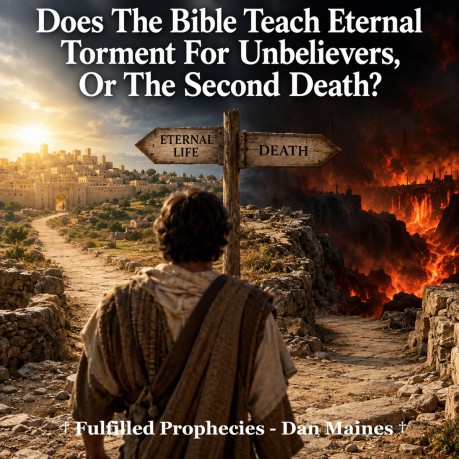
Does The Bible Teach Eternal
Torment For Unbelievers, Or The Second Death? Introduction Revelation 20:10 Revelation 20:14-15 John 3:16 Romans 6:23 Matthew 10:28 2 Thessalonians 1:8-9 Matthew 25:46 Revelation 14:10-11 Isaiah 34:9-10 Malachi 4:1 1 Timothy 6:15-16 Historical References How It Applies To Us Today Q & A Appendix Q: Doesn't Revelation 14:11 say the smoke of
their torment rises forever? Q: What about eternal punishment in Matthew
25:46? Q: Doesn't everyone have an immortal soul? Q: Then what happens to the unbeliever? Q: Does this make God's judgment less serious? Q: Why does this distinction matter? † This is the fulfilled perspective we proclaim at
Fulfilled Prophecies †
By Dan Maines
† Revelation
20:10 unquestionably uses the language of torment day and night for
ever and ever concerning the devil, the beast, and the false prophet.
We shouldn't weaken that verse or pretend it says something it
doesn't say. The real question is whether Scripture says the same
thing about every unbelieving person who is cast into the lake of
fire.
† When Revelation immediately describes
the fate of those whose names aren't found in the book of life, it
doesn't say that they will be tormented day and night for ever and
ever. It says they're cast into the lake of fire, and the passage
identifies the lake of fire as the second death (Revelation
20:14-15).
† That distinction matters. We
shouldn't take language applied to the devil, beast, and false
prophet in verse 10 and automatically insert it into verses 14-15. We
need to allow Scripture to define the fate of the unbeliever in its
own words.
† Throughout Scripture the
contrast isn't eternal life in heaven versus eternal life in torment.
The repeated contrast is life versus death, salvation versus
destruction, and eternal life versus perishing (John 3:16; Romans
6:23; Matthew 10:28).
† This doesn't minimize
God's judgment. The second death is final judgment. The question
isn't whether the judgment is serious or eternal in its consequence.
The question is whether the Bible teaches eternal conscious torment
for every unbeliever, or an irreversible death from which there is no
resurrection to life.
And the devil who deceived
them was thrown into the lake of fire and brimstone, where the beast
and the false prophet are also; and they will be tormented day and
night forever and ever.
† This is the
strongest verse for everlasting torment in Revelation, and we should
begin by admitting exactly what it says. The devil, beast, and false
prophet are described as being tormented day and night for ever and
ever.
† But notice what the verse doesn't
say. It doesn't say every unbelieving human being will be consciously
tormented forever. That conclusion has to be brought into the verse
from somewhere else.
† Revelation uses highly
symbolic judgment language throughout the book. The beast and false
prophet represent enemies of God and His people, rather than
requiring us to understand every statement as a description of
individual human beings experiencing physical conditions (Revelation
13:1-18; 19:20).
† We therefore shouldn't
make Revelation 20:10 say more than John actually wrote. The fate of
people outside the book of life is specifically addressed a few
verses later.
Then Death and Hades
were thrown into the lake of fire. This is the second death, the lake
of fire. And if anyone's name was not found written in the book of
life, he was thrown into the lake of fire.
†
Here John gives us an inspired definition. The lake of fire is the
second death. He doesn't call it eternal life in misery. He calls it
death.
† Death and Hades themselves are also
thrown into the lake of fire. That shows the imagery is communicating
complete and final judgment, because death and Hades aren't physical
people capable of being burned in literal fire (1 Corinthians 15:26,
54-55).
† Verse 15 says those not found in
the book of life are cast into that same lake. John had just defined
what that means, the second death.
† If John
intended to teach that every unbeliever would remain consciously
alive in torment forever, this would've been the clearest place to
say it. Instead, the inspired explanation is the second death.
For God so loved the world, that
He gave His only Son, so that everyone who believes in Him will not
perish, but have eternal life.
† Jesus
presents two alternatives, perish or have eternal life. He doesn't
present eternal life in joy versus eternal life in torment.
†
Those who believe receive eternal life. Those who don't believe
perish. The ordinary force of perish is destruction or loss of life,
and the same Greek verb is repeatedly used in contexts involving
actual death and destruction (Matthew 2:13; Luke 13:3; 1 Corinthians
10:9-10).
† If unbelievers remain consciously
alive forever, we have to explain why Jesus described their
alternative to eternal life as perishing.
†
Eternal life is God's gift through Christ. Scripture doesn't describe
eternal conscious existence as an inherent possession of every human
being.
For the wages of sin is death,
but the gracious gift of God is eternal life in Christ Jesus our
Lord.
† Paul gives the same contrast Jesus
gave. The wages of sin is death, while God's gift is eternal life.
†
Paul doesn't say the wages of sin is eternal life in torment. He says
death.
† Eternal life belongs to those who
are in Christ. That's why Paul's contrast is so important. One side
receives death, while the other receives life (Romans 5:17-21).
†
If the punishment for sin is everlasting conscious existence, we'd
expect Paul to describe it that way. Instead, his language
consistently contrasts death with life.
And do not be afraid of those
who kill the body but are unable to kill the soul; but rather fear
Him who is able to destroy both soul and body in hell.
†
Jesus doesn't say God merely torments the soul and body while
preserving them forever. He says God is able to destroy both.
†
The word translated hell here is Gehenna. Jesus' Jewish audience
would've recognized Gehenna as powerful judgment imagery connected
with destruction and divine judgment (Jeremiah 7:31-33).
†
The important word in Jesus' statement is destroy. Human persecutors
could kill the body, but God's judgment was greater and final.
†
This agrees with the language of perishing, death, destruction, and
the second death found elsewhere in Scripture.
in flaming fire,
dealing out retribution to those who do not know God, and to those
who do not obey the gospel of our Lord Jesus. These people will pay
the penalty of eternal destruction, away from the presence of the
Lord and from the glory of His power,
† Paul
actually uses the expression eternal destruction. That's extremely
important when considering what eternal punishment means.
†
The punishment is eternal in its result because the destruction isn't
reversed. Eternal destruction doesn't require an eternal process of
destroying that never succeeds.
† Something
can have an eternal consequence without the action producing that
consequence continuing forever. The judgment is irreversible.
†
This fits naturally with Revelation's second death. The finality of
the punishment is eternal because there is no restoration from that
judgment.
These will go away into
eternal punishment, but the righteous into eternal life.
†
This verse is often presented as decisive proof of eternal conscious
torment because both punishment and life are described as eternal.
†
But Jesus says eternal punishment, not eternal punishing. The
punishment can be eternal because its consequence is permanent.
†
Paul helps define that concept when he speaks of eternal destruction
(2 Thessalonians 1:9). Destruction can be an everlasting punishment
precisely because the person doesn't return from that destruction.
†
Eternal life is everlasting possession of life. Eternal punishment is
an everlasting judgment. The adjective describes the permanence of
each result without requiring both experiences to function in exactly
the same manner.
he also will drink of
the wine of the wrath of God, which is mixed in full strength in the
cup of His anger; and he will be tormented with fire and brimstone in
the presence of the holy angels and in the presence of the Lamb. And
the smoke of their torment ascends forever and ever; they have no
rest day and night, those who worship the beast and his image, and
whoever receives the mark of his name."
†
This passage can't simply be ignored. It speaks plainly of torment
and of the smoke of their torment ascending for ever and ever.
†
But Revelation is drawing heavily from Old Testament prophetic
judgment language. Isaiah used nearly identical language concerning
the historical judgment of Edom (Isaiah 34:9-10).
†
The point of smoke ascending forever isn't necessarily that the
people remain alive forever inside the fire. In prophetic language,
permanently ascending smoke signifies complete, irreversible
destruction.
† Revelation 14 also says they
have no rest day and night while the judgment is being described.
That emphasizes the severity and completeness of God's wrath against
the beast and those identified with its rebellion.
†
We therefore have to interpret Revelation's symbols through the
prophetic Scriptures that supplied John's imagery rather than
building an entire doctrine from the imagery while ignoring its Old
Testament background.
Its streams will be turned
into pitch, And its loose earth into brimstone, And its land will
become burning pitch. It will not be extinguished night or day; Its
smoke will go up forever. From generation to generation it will be
desolate; None will pass through it forever and ever.
†
Isaiah provides one of the clearest biblical backgrounds for
Revelation's language. Edom's smoke would go up forever, and its fire
wouldn't be quenched night or day.
† This
wasn't teaching that Edom would remain physically burning without
end. It was prophetic language describing a devastating and
irreversible judgment.
† An unquenchable fire
is a fire that can't be stopped before it accomplishes God's purpose.
Everlasting smoke testifies that the judgment was complete.
†
Revelation uses this established prophetic vocabulary when describing
covenant judgment. We shouldn't automatically convert symbolic
judgment language into a description of people possessing immortal
bodies that can never die.
"For behold, the day is
coming, burning like a furnace; and all the arrogant and every
evildoer will be chaff; and the day that is coming will set them
ablaze," says the Lord of armies, so that it will leave them
neither root nor branches.
† Malachi
describes the wicked as stubble consumed by fire. The picture isn't
of stubble remaining forever while continually burning without being
consumed.
† The fire burns them up. Neither
root nor branch remains. This is destruction language, not
preservation language.
† This prophetic
background helps us understand why fire in biblical judgment passages
doesn't automatically mean eternal conscious existence in flames.
which He will bring about
at the proper time-He who is the blessed and only Sovereign, the King
of kings and Lord of lords, who alone possesses immortality and
dwells in unapproachable light, whom no one has seen or can see. To
Him be honor and eternal dominion! Amen.
†
Scripture doesn't teach that human beings possess immortality
independently of God. Paul says God alone possesses immortality
inherently.
† Eternal life is repeatedly
described as God's gift, not something every person naturally
possesses regardless of whether they're in Christ (Romans 2:7;
6:23).
† This raises an important question
for the traditional view. If the unbeliever must consciously exist
forever and can never cease living, where does Scripture say that God
gives the unbeliever immortality for the purpose of eternal
torment?
† Scripture consistently associates
immortality and eternal life with God's saving work rather than
presenting immortality as the unavoidable destiny of everyone.
†
Josephus described the destruction of Jerusalem in AD 70 with
horrifying scenes of fire, death, famine, and devastation. His
account in Wars of the Jews records judgment that physically consumed
the city, temple, and countless lives. His testimony helps us
understand how severe first-century judgment language could
correspond to actual historical destruction.
†
Justin Martyr argued that the human soul shouldn't be regarded as
inherently immortal in the same sense as God. In Dialogue with
Trypho, he challenged the idea that souls possess life independently
and emphasized their dependence upon God.
†
Irenaeus likewise connected continued existence with God's gift of
life. In Against Heresies, he argued that life doesn't originate
within us independently but is bestowed by God.
†
Early Christian writers weren't completely uniform concerning the
final punishment of the wicked. Some language in early Christianity
was understood as conscious punishment, while other writers strongly
emphasized mortality, destruction, and life as God's gift. History
therefore shouldn't replace Scripture as our authority.
†
We don't need to soften God's judgment to reject something Scripture
doesn't clearly teach. The second death is serious precisely because
it's final.
† We also shouldn't allow one
symbolic passage in Revelation to erase the repeated biblical
contrast between life and death. Jesus said perish or eternal life.
Paul said death or eternal life. Revelation says the second death
(John 3:16; Romans 6:23; Revelation 20:14-15).
†
Revelation 20:10 must remain exactly where Scripture places it. It
describes the devil, beast, and false prophet as tormented day and
night for ever and ever. We shouldn't change that statement.
†
But we also shouldn't change Revelation 20:14-15. When John describes
those outside the book of life, he identifies their destination as
the second death.
† The Bible never calls the
fate of unbelievers eternal life in hell. Eternal life is God's gift
in Christ. The language applied to the wicked is perishing, death,
destruction, being burned up, and the second death (John 3:16; Romans
6:23; Matthew 10:28; 2 Thessalonians 1:9; Revelation 20:14-15).
†
This doesn't mean God's judgment is temporary or insignificant.
Eternal destruction is eternal because the result can't be reversed.
The second death is final.
† If you're dead,
you're dead. Scripture doesn't say God gives unbelievers everlasting
life so they can remain alive somewhere else forever. It says the
gift of God is eternal life in Christ Jesus our Lord (Romans 6:23).
†
Our hope isn't merely escape from punishment. Our hope is life in
Christ. He alone is the source of life, and everyone who believes in
Him doesn't perish but has eternal life (John 3:16).
Q:
Doesn't Revelation 20:10 plainly teach eternal torment?
A:
Yes, it plainly uses that language concerning the devil, beast, and
false prophet. But Revelation 20:14-15 describes those outside the
book of life differently. Their fate is identified as the second
death.
A: Yes, but that
language has an Old Testament prophetic background. Isaiah described
Edom's smoke as rising forever even though the point was complete and
irreversible destruction, not a land literally burning throughout
endless time (Isaiah 34:9-10).
A: Eternal punishment doesn't require an
eternal process of punishing. Paul speaks of eternal destruction,
showing that destruction can have an everlasting result (2
Thessalonians 1:9).
A:
Scripture says God alone inherently possesses immortality and
presents eternal life as God's gift through Christ (1 Timothy 6:16;
Romans 6:23). We shouldn't assume inherent human immortality and then
use that assumption to interpret the judgment passages.
A:
Scripture describes the outcome with words such as perish, death,
destroy, destruction, burned up, and second death (John 3:16; Romans
6:23; Matthew 10:28; Malachi 4:1; Revelation 20:14-15).
A:
No. Final destruction is an irreversible judgment. The second death
isn't temporary correction followed by another opportunity. Scripture
presents it as the final opposite of eternal life (Revelation
20:14-15).
A:
Because we should say exactly what Scripture says. Where Scripture
says torment, we should say torment. Where Scripture says
destruction, we should say destruction. Where Scripture says death,
we shouldn't change death into everlasting life in another location
(John 3:16; Romans 6:23; 2 Thessalonians 1:9).
© Fulfilled Prophecies - Dan
Maines.
Source Index
†
Revelation 20:10; Revelation 20:14-15; John 3:16; Romans 6:23;
Matthew 10:28; 2 Thessalonians 1:8-9; Matthew 25:46; Revelation
14:10-11; Isaiah 34:9-10; Malachi 4:1; 1 Timothy 6:15-16
†
Josephus, Wars of the Jews; Justin Martyr, Dialogue with Trypho;
Irenaeus, Against Heresies
Links