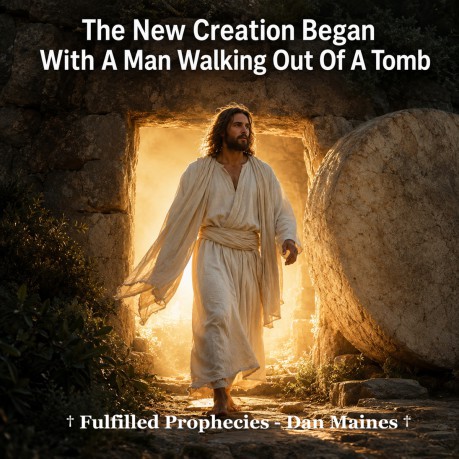
The New Creation Began With A
Man Walking Out Of A Tomb Introduction Genesis 1:1-3 John 20:1 1 Corinthians 15:20-23 Colossians 1:15-18 2 Corinthians 4:6 2 Corinthians 5:17 Ephesians 2:4-6 Romans 8:11 Galatians 6:14-15 Revelation 21:1-5 Historical References How It Applies To Us Today Q & A Appendix Q: Does New Creation require the physical
universe to be destroyed? Q: Why does resurrection belong to the New
Creation theme? Q: What does light have to do with New
Creation? Q: What role does the Holy Spirit have in New
Creation? Q: Were Christians already participating in
resurrection life before AD 70? Q: What happened when the Old Covenant age
finally passed away? Q: What does New Creation mean for believers
today? † This is the fulfilled perspective we proclaim at
Fulfilled Prophecies † Source Index
By Dan Maines
† The
Bible's story of creation doesn't end in Genesis. The same God who
commanded light to shine out of darkness began His New Creation
through Jesus Christ, the One who entered the darkness of death and
walked out of the tomb alive.
† The
resurrection wasn't merely proof that Jesus survived death. It was
the beginning of something new. Christ is called the firstfruits, the
beginning, and the firstborn from the dead because His resurrection
opened the New Creation order that would be shared by His covenant
people (1 Corinthians 15:20; Colossians 1:18).
†
This is why the New Testament repeatedly connects resurrection with
creation, light, life, the Spirit, and new creation. These aren't
unrelated doctrines. They're different parts of one redemptive
story.
† Genesis began with darkness and
God's command for light. The Gospel reaches its great turning point
when Jesus rises from the darkness of the grave on the first day of
the week. Paul then takes creation language and applies it directly
to the light of Christ shining into His people (Genesis 1:3; John
20:1; 2 Corinthians 4:6).
† The New Creation
began with the risen Christ and expanded through a Spirit-filled
people until the Old Covenant world passed away and the New Covenant
creation stood revealed in its fullness (Hebrews 8:13; Revelation
21:1-5).
In the beginning God created
the heavens and the earth. And the earth was a formless and desolate
emptiness, and darkness was over the surface of the deep, and the
Spirit of God was hovering over the surface of the waters. Then God
said, "Let there be light"; and there was light.
And
God said, Let there be light: and there was light.
†
The first creation begins with darkness, the Spirit moving, and God
bringing light where darkness had ruled.
†
These themes become foundational New Testament images for God's
redemptive work. Light, Spirit, life, and creation language appear
again when the apostles explain what God accomplished through Christ
(John 1:4-5; Romans 8:11; 2 Corinthians 4:6).
†
God didn't randomly borrow creation terminology to describe
salvation. Redemption is presented as God's creative work, bringing
life out of death and light out of darkness (Ephesians 5:8;
Colossians 1:13).
Now on the first day of the
week Mary Magdalene came early to the tomb, while it was still dark,
and saw the stone already removed from the tomb.
†
Notice John's language. It's the first day, it's still dark, and
something extraordinary has happened at a tomb. The stone has been
moved, and death hasn't been able to hold Jesus.
†
The first day of the original creation was associated with light
coming into darkness. John's resurrection account places us again on
the first day while it's still dark, but now the Light of the world
has conquered the grave (Genesis 1:3; John 8:12).
†
We shouldn't build the doctrine on the phrase "first day"
alone, but when John's language is read alongside Paul's explicit New
Creation language, the connection becomes powerful. God's New
Creation begins in the resurrection of His Son (2 Corinthians 5:17;
Colossians 1:18).
But the fact is,
Christ has been raised from the dead, the first fruits of those who
are asleep. For since by a man death came, by a Man also came the
resurrection of the dead. For as in Adam all die, so also in Christ
all will be made alive. But each in his own order: Christ the first
fruits, after that those who are Christ’s at His coming,
†
Paul doesn't present Christ's resurrection as an isolated miracle. He
calls Christ the firstfruits. Firstfruits means the beginning and
guarantee of the harvest that follows.
† Adam
stands at the head of the old humanity characterized by sin and
death. Christ stands at the head of the new humanity characterized by
righteousness and life (Romans 5:17-19).
†
Jesus walked out of the tomb as the firstfruits of resurrection life.
The resurrection story therefore moves from Christ to those who
belong to Christ. The Head rises first, then His body participates in
His resurrection life (Ephesians 1:22-23; 2:5-6).
†
This is why resurrection and New Creation can't be separated. The New
Creation isn't humanity improving Adam's world. It's humanity
receiving life in the risen Christ.
He is the image of the
invisible God, the firstborn of all creation: for by Him all things
were created, both in the heavens and on earth, visible and
invisible, whether thrones, or dominions, or rulers, or
authorities-all things have been created through Him and for Him. He
is before all things, and in Him all things hold together. He is also
the head of the body, the church; and He is the beginning, the
firstborn from the dead, so that He Himself will come to have first
place in everything.
† Paul deliberately
places creation and resurrection together. Christ is the firstborn of
all creation, and He is also the beginning and the firstborn from the
dead.
† The One through whom creation came
into existence is also the One through whom God's redemptive New
Creation comes into existence.
† Paul calls
Jesus "the beginning." That language matters. The
resurrection of Christ isn't an appendix added to God's story. It's
the beginning of the new order centered in the risen Son.
†
Christ is also identified as the Head of the church. The New Creation
therefore doesn't stop with Jesus walking out of the tomb. His
resurrection life extends to His covenant body, His people (Ephesians
2:5-6).
For God, who said, "Light
shall shine out of darkness," is the One who has shone in our
hearts to give the Light of the knowledge of the glory of God in the
face of Christ.
† Paul explicitly reaches
back to creation. The God who commanded light to shine out of
darkness in Genesis is the God who shines spiritual light into human
hearts through Jesus Christ.
† This isn't a
connection we're forcing onto the text. Paul himself connects God's
original creative command with God's redemptive work in Christ.
†
Creation language has become salvation language. Darkness gives way
to light, death gives way to life, blindness gives way to revelation,
and the old gives way to the new.
† This
prepares Paul's readers for the New Creation declaration that follows
shortly afterward (2 Corinthians 5:17).
Therefore if anyone is in
Christ, this person is a new creation; the old things passed away;
behold, new things have come.
† Here Paul
says it plainly. The person who is in Christ participates in New
Creation.
† Notice where New Creation is
found. Paul doesn't say it comes by entering a future physical
universe. He says it exists "in Christ."
†
Christ is the sphere and source of the New Creation. Because He rose,
those joined to Him share His life and become part of the new
humanity (Romans 6:4-5; Ephesians 2:10).
†
The New Creation therefore began with Christ and incorporated His
people. What happened to the Head became the defining reality of His
body.
But God, being rich in
mercy, because of His great love with which He loved us, even when we
were dead in our wrongdoings, made us alive together with Christ (by
grace you have been saved), and raised us up with Him, and seated us
with Him in the heavenly places in Christ Jesus,
†
Paul speaks to living Christians and tells them that God had already
made them alive, raised them with Christ, and seated them with Him.
†
This is resurrection language applied to God's covenant people.
Christ's resurrection life had become their resurrection life.
†
They were physically walking on earth, yet covenantally they had been
raised and seated with Christ in the heavenly places. That tells us
the apostles could use resurrection language for a present spiritual
and covenantal reality.
† The New Creation
people were already being formed before the Old Covenant age
completely disappeared (Hebrews 8:13).
But if the Spirit of Him who
raised Jesus from the dead dwells in you, He who raised Christ Jesus
from the dead will also give life to your mortal bodies through His
Spirit who dwells in you.
† The Holy Spirit
connects the resurrection of Jesus with the life of His people. The
Spirit who raised Christ was dwelling in them.
†
Genesis introduced the Spirit moving over the darkness before God's
creative word brought light. The New Testament reveals the Spirit
bringing the resurrection life of Christ into God's people (Genesis
1:2; Titus 3:5-6).
† New Creation is
therefore Trinitarian. The Father raises the Son, the Son becomes the
beginning and firstfruits, and the Spirit communicates that
resurrection life to the covenant community.
But far be it from me to
boast, except in the cross of our Lord Jesus Christ, through which
the world has been crucified to me, and I to the world. For neither
is circumcision anything, nor uncircumcision, but a new creation.
†
Paul connects New Creation directly with the passing significance of
the old covenantal distinctions represented by circumcision.
†
The controlling issue is no longer circumcision or uncircumcision.
The controlling reality is New Creation.
†
This is covenant language. God's people aren't defined by the fleshly
boundary markers of the Mosaic world but by their relationship to
Christ (Galatians 3:26-29; Philippians 3:3).
†
The cross judged the old world, the resurrection inaugurated the new,
and the Spirit formed a people whose identity was found in Christ.
Then I saw a new heaven
and a new earth; for the first heaven and the first earth passed
away, and there is no longer any sea. And I saw the holy city, new
Jerusalem, coming down out of heaven from God, prepared as a bride
adorned for her husband. And I heard a loud voice from the throne,
saying, "Behold, the tabernacle of God is among the people, and
He will dwell among them, and they shall be His people, and God
Himself will be among them, and He will wipe away every tear from
their eyes; and there will no longer be any death; there will no
longer be any mourning, or crying, or pain; the first things have
passed away." And He who sits on the throne said, "Behold,
I am making all things new." And He said, Write, for these words
are faithful and true."
† Revelation
brings the creation story to its covenantal conclusion. The Bible
begins with heavens and earth, light, life, and God's presence, and
it closes with New Heavens and New Earth, New Jerusalem, life, and
God's presence with His people.
† John isn't
describing God abandoning His creation project. He's showing God's
redemptive purpose reaching its covenantal goal, "Behold, I make
all things new."
† The New Creation that
began in the risen Christ and was already experienced by believers
reaches its covenantal fullness with the passing of the old order and
the establishment of the New Covenant world (2 Corinthians 5:17;
Hebrews 8:13).
† The Bible's New Creation
story therefore has a beautiful progression. Christ rises as
firstfruits, His people are made alive with Him, the Spirit dwells
within them, they become New Creation in Christ, and the old
covenantal world finally passes away.
†
Irenaeus, writing in Against Heresies, emphasized Christ as the One
who restores humanity by becoming the Head of a renewed humanity. His
recapitulation theme recognized that Christ reverses Adam's work and
brings humanity into a new order through Himself.
†
Justin Martyr repeatedly connected Christian hope with Christ's
resurrection and the new life produced through Him. Early Christian
proclamation centered on the risen Christ as the foundation of the
life believers possessed in Him.
† Eusebius,
in Ecclesiastical History, recorded the dramatic transition from the
apostolic church to the judgment that came upon Jerusalem. His
historical account preserves the first-century setting in which the
church grew while the old Jerusalem order approached its catastrophic
end.
† These historical writers aren't our
authority. Scripture is our authority. Their writings are useful
witnesses showing how strongly resurrection, Christ's new humanity,
the church, and Jerusalem's historical judgment remained connected in
early Christian thought.
†
We're not waiting for God to begin the New Creation. We're living in
the reality that began when Jesus Christ walked out of the tomb.
†
We're in Christ, and if anyone is in Christ, there is New Creation (2
Corinthians 5:17).
† We don't belong to
Adam's condemned covenantal world. Our identity is found in the risen
Christ, who is the beginning, the firstborn from the dead, and the
Head of His body (Colossians 1:18).
† We
don't need another temple, another earthly priesthood, another
sacrificial system, or another covenant. God's dwelling is with His
covenant people through Christ (Ephesians 2:19-22; Revelation
21:3).
† The same God who once said, "Let
there be light," has shined the knowledge of His glory in the
face of Jesus Christ into His people (2 Corinthians 4:6).
†
The empty tomb wasn't merely the place where Jesus returned to life.
It was the doorway through which God's New Creation entered
history.
† One Man walked out of a tomb, and
everything changed.
† The firstfruits
appeared.
† The beginning had come.
†
The Light had conquered the darkness.
† The
Spirit would fill God's people.
† The New
Creation had begun.
Q: When
did God's New Creation begin?
A: Its foundation
and beginning are found in the death and resurrection of Jesus
Christ. Christ is called the firstfruits, the beginning, and the
firstborn from the dead (1 Corinthians 15:20; Colossians 1:18).
A: No. Paul said
believers were already New Creation while they were physically living
in the same world around them (2 Corinthians 5:17; Galatians 6:15).
A: Because Jesus is the
firstfruits and firstborn from the dead, and believers are described
as being made alive and raised with Him (1 Corinthians 15:20;
Ephesians 2:5-6).
A: Paul directly uses God's creation
command concerning light to explain God's work through Christ. The
God who brought light from darkness shines His light into our hearts
through Jesus Christ (Genesis 1:3; 2 Corinthians 4:6).
A: The Spirit who raised Jesus gives
life to God's people and dwells within them. The New Creation isn't
merely a changed covenantal status, it's life in Christ through the
Spirit (Romans 8:11).
A: Yes. Paul
told living believers that God had already made them alive with
Christ, raised them with Him, and seated them with Him in the
heavenly places (Ephesians 2:5-6).
A: The transitional period
ended, and the New Covenant creation stood established without the
competing Old Covenant temple system that had been growing old and
ready to disappear (Hebrews 8:13; Revelation 21:1-5).
A: It means we aren't waiting for God's
promised kingdom world to begin. In Christ we're members of His New
Covenant people, living in the accomplished reality produced by His
death, resurrection, reign, and completed covenantal work (2
Corinthians 5:17; Hebrews 12:22-24).
© Fulfilled Prophecies - Dan
Maines.
† Genesis
1:1-3; John 20:1; 1 Corinthians 15:20-23; Colossians 1:15-18; 2
Corinthians 4:6; 2 Corinthians 5:17; Ephesians 2:4-6; Romans 8:11;
Galatians 6:14-15; Revelation 21:1-5
†
Historical writers: Irenaeus, Against Heresies; Justin Martyr;
Eusebius, Ecclesiastical History
Links