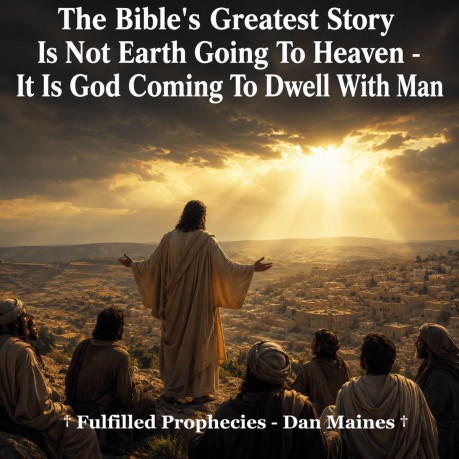
The Bible's Greatest Story Is
Not Earth Going To Heaven - It Is God Coming To Dwell With Man Introduction Genesis 3:8 Exodus 25:8 Leviticus 26:11-12 1 Kings 8:27 John 1:14 2 Corinthians 6:16 Ephesians 2:19-22 Hebrews 12:22-24 Revelation 21:1-3 Historical References How It Applies To Us Today Q & A Appendix Q: Was God's physical temple in Jerusalem
intended to be His permanent dwelling place? Q: When did God's people become His temple? Q: Why does Revelation 21 use tabernacle
language? Q: Why is there no temple in New Jerusalem? Q: Are believers waiting to enter the heavenly
Jerusalem? Q: What was ultimately restored from Eden? † This is the fulfilled perspective we proclaim at
Fulfilled Prophecies † Source Index
By Dan Maines
† The
Bible's story begins with God dwelling with humanity, and it ends
with God dwelling with humanity. The movement of Scripture isn't
ultimately about getting people off the earth and transporting them
somewhere else. It's about God restoring His presence among His
people.
† Eden introduces the pattern. God
was present with man, sin brought separation, and the rest of the
biblical story develops the way God would restore fellowship through
covenant, tabernacle, temple, Christ, and finally the New Covenant
people of God.
† This theme runs straight
through Scripture. God dwelt with Adam and Eve, placed His presence
among Israel, filled the tabernacle, identified Himself with the
temple, came among humanity in Jesus Christ, made His people His
temple, and finally announced that His tabernacle was with mankind.
†
Revelation doesn't end with redeemed humanity abandoning God's
creation. It ends with the holy city coming down from God and the
declaration that God's dwelling is with mankind (Revelation
21:2-3).
† Once we see this pattern,
Revelation 21 stops looking like an escape story and becomes the
completion of the Bible's great dwelling-place story.
Now they heard the sound of the
Lord God walking in the garden in the cool of the day, and the man
and his wife hid themselves from the presence of the Lord God among
the trees of the garden.
† The Bible's
dwelling theme is already visible in Eden. God's presence was
associated with humanity in the garden, but after sin Adam and Eve
hid from His presence (Genesis 3:8).
† The
tragedy of Eden wasn't simply that humanity lost beautiful
surroundings. Humanity experienced alienation from the presence and
fellowship of God (Genesis 3:23-24).
† From
this point forward, Scripture develops the story of God restoring
what sin disrupted, His presence among His people (Revelation 21:3).
Have them construct a sanctuary
for Me, so that I may dwell among them.
†
Notice God's stated purpose for the sanctuary. He wanted to dwell
among His people. The tabernacle wasn't merely a religious building,
it represented God's covenant presence among Israel (Exodus 25:8).
†
The tabernacle carried the Eden pattern forward. God was again
dwelling among a covenant people, although access to His presence
remained restricted under the Old Covenant (Hebrews 9:6-8).
†
This is why the tabernacle becomes so important when we reach the New
Testament. What existed in physical and symbolic form pointed toward
something greater that God would accomplish through Christ (Hebrews
8:1-5).
Moreover, I will make My
dwelling among you, and My soul will not reject you. I will also walk
among you and be your God, and you shall be My people.
†
The language deliberately brings together God's tabernacle, God's
presence, and God's covenant people. He would dwell among them, walk
among them, be their God, and they would be His people (Leviticus
26:11-12).
† This language becomes extremely
important because the New Testament applies the same dwelling promise
to the people of the New Covenant (2 Corinthians 6:16).
†
Revelation 21:3 uses this same covenant pattern, God's dwelling,
God's people, and God's presence. John wasn't introducing an
unrelated idea at the end of the Bible. He was announcing the
completion of a theme running throughout Scripture.
But will God indeed dwell on
the earth? Behold, heaven and the highest heaven cannot contain You,
how much less this house which I have built!
†
Solomon understood that no physical building could contain God. Even
at the dedication of the temple, Scripture warned us not to confuse
God's presence with a structure made by human hands (1 Kings 8:27).
†
The temple was significant, but it wasn't God's final dwelling place.
Stephen later repeated this truth, declaring that the Most High
doesn't dwell in houses made by human hands (Acts 7:48-50).
†
God's purpose was moving beyond stone buildings toward a living
temple composed of redeemed people joined together in Christ
(Ephesians 2:19-22).
And the Word became flesh, and
dwelt among us; and we saw His glory, glory as of the only Son from
the Father, full of grace and truth.
† Here
the dwelling theme reaches its decisive fulfillment in a Person. God
didn't merely send another tabernacle or construct another temple.
The Word became flesh and dwelt among humanity (John 1:14).
†
Jesus identified His own body as the true temple when He spoke of
destroying the temple and raising it in three days (John 2:19-21).
†
The presence of God was no longer centered in Jerusalem's stone
sanctuary. God had come among His people in Christ, and through
Christ the dwelling place of God would become a people rather than a
geographical building (Ephesians 2:21-22).
Or what agreement does
the temple of God have with idols? For we are the temple of the
living God; just as God said, I will dwell among them and walk among
them; And I will be their God, and they shall be My people.
†
Paul couldn't have made the transition clearer. He told living
believers, we are a temple of the living God (2 Corinthians 6:16).
†
Paul then used the language of Leviticus and applied it directly to
the church. God's ancient promise to dwell and walk among His people
was finding its New Covenant reality in people united to Christ
(Leviticus 26:11-12).
† This destroys the
idea that God's ultimate dwelling place must be another physical
temple in Jerusalem. The apostles identified God's people themselves
as His temple (1 Corinthians 3:16, Ephesians 2:21-22, 1 Peter 2:5).
So then you are no longer
strangers and foreigners, but you are fellow citizens with the
saints, and are of God’s household, having been built on the
foundation of the apostles and prophets, Christ Jesus Himself being
the cornerstone, in whom the whole building, being fitted together,
is growing into a holy temple in the Lord, in whom you also are being
built together into a dwelling of God in the Spirit.
†
Paul didn't tell believers they were waiting thousands of years to
become God's dwelling place. He said they were already being built
together into God's habitation in the Spirit (Ephesians 2:19-22).
†
Christ is the cornerstone, the apostles and prophets form the
foundation, and God's people form the living structure. This is
temple language transformed from stones into people (Ephesians
2:20-22).
† The New Covenant temple isn't
located in one earthly city where people must travel to meet God.
Jesus had already announced that worship wouldn't remain centered on
Jerusalem, because true worship would be in spirit and truth (John
4:21-24).
But you have come to Mount
Zion and to the city of the living God, the heavenly Jerusalem, and
to myriads of angels, to the general assembly and church of the
firstborn who are enrolled in heaven, and to God, the Judge of all,
and to the spirits of the righteous made perfect, and to Jesus, the
mediator of a new covenant, and to the sprinkled blood, which speaks
better than the blood of Abel.
† Hebrews
doesn't say believers will someday come to Mount Zion. It says, you
have come. The first-century saints had entered the reality toward
which the Old Covenant shadows had pointed (Hebrews 12:22).
†
Mount Zion, the heavenly Jerusalem, the church, Jesus, and the New
Covenant are joined together in one magnificent description (Hebrews
12:22-24).
† This prepares us for John's New
Jerusalem. Revelation's city isn't about humanity escaping earth for
heaven. John sees the holy city coming down out of heaven from God
(Revelation 21:2).
Then I saw a new heaven
and a new earth; for the first heaven and the first earth passed
away, and there is no longer any sea. And I saw the holy city, new
Jerusalem, coming down out of heaven from God, prepared as a bride
adorned for her husband. And I heard a loud voice from the throne,
saying, Behold, the tabernacle of God is among the people, and He
will dwell among them, and they shall be His people, and God Himself
will be among them,
† Here the Bible's
dwelling theme reaches its covenant climax. Notice the direction of
the movement. New Jerusalem comes down out of heaven from God
(Revelation 21:2).
† John's announcement
isn't, Behold, mankind has finally escaped earth and moved into
heaven. His announcement is that the tabernacle of God is with
mankind and He will dwell with them (Revelation 21:3).
†
The language reaches all the way back through Paul, Leviticus, the
tabernacle, and Eden. What sin disrupted, God's redemptive work in
Christ restored, fellowship between God and His covenant people
(Genesis 3:8, Leviticus 26:11-12, 2 Corinthians 6:16).
†
The passing of the former heaven and earth belongs to the covenant
transformation that Revelation has been developing. The old
temple-centered order passed away, while God's New Covenant dwelling
remained forever (Hebrews 8:13, Hebrews 12:26-28).
†
This also explains why John later says he saw no temple in the city.
The Lord God Almighty and the Lamb are its temple. God's presence is
no longer approached through the Old Covenant sanctuary system
(Revelation 21:22).
† The Bible begins with
God walking with humanity in a garden and ends with God's dwelling
permanently established with His people. Eden's fellowship becomes
New Jerusalem's reality.
†
Josephus recorded the catastrophic destruction of Jerusalem and its
temple in AD 70, describing the burning of the sanctuary and the
devastation that followed. That historical judgment permanently
removed the physical temple that had stood at the center of Old
Covenant worship (Josephus, Wars of the Jews, Book 6).
†
Josephus' account is historically significant because Revelation's
dwelling theme doesn't require the restoration of that destroyed
sanctuary. The New Testament had already identified Christ and His
people as God's true dwelling place before the old temple disappeared
(John 2:19-21, Ephesians 2:19-22).
† Eusebius
later recorded the tradition that believers in Jerusalem departed the
city before the war and went to Pella. He connected the devastation
of Jerusalem with the judgment that came upon that generation
(Eusebius, Ecclesiastical History, Book 3, Chapters 5-7).
†
These historical witnesses don't establish our doctrine, Scripture
does. They provide historical testimony concerning the first-century
destruction of the city and temple that stood at the center of the
Old Covenant world.
†
We don't need to travel to Jerusalem to find God's dwelling place.
God's people are His temple, and believers have access to the Father
through Christ in one Spirit (Ephesians 2:18-22).
†
We aren't waiting for another stone sanctuary to restore God's
presence. In Christ, God's dwelling is already among His covenant
people (2 Corinthians 6:16, Ephesians 2:22).
†
We don't live outside New Jerusalem waiting for it to descend
someday. Through Christ we've come to Mount Zion, the city of the
living God, the heavenly Jerusalem (Hebrews 12:22-24).
†
This changes how we tell the entire biblical story. Christianity
isn't fundamentally an evacuation plan from planet earth. It's the
story of reconciliation, restored fellowship, and God dwelling with
His redeemed people through Jesus Christ (2 Corinthians 5:18-19).
†
Eden showed us fellowship lost. The tabernacle showed us God dwelling
among a covenant people. The temple showed us His presence
symbolically centered among Israel. Jesus revealed God dwelling among
us in flesh. The church became His living temple. New Jerusalem
reveals the completed New Covenant reality, Behold, the tabernacle of
God is with men (Revelation 21:3).
† The
Bible's greatest story isn't earth going to heaven. It's God coming
to dwell with man.
Q: Does
Revelation 21 describe believers leaving earth and going to
heaven?
A: The direction described in the
passage is the opposite. John sees New Jerusalem coming down out of
heaven from God, followed by the announcement that God's tabernacle
is with mankind (Revelation 21:2-3).
A:
No. Solomon acknowledged that even heaven couldn't contain God, much
less a house built by human hands. The New Testament identifies
believers in Christ as God's temple and dwelling in the Spirit (1
Kings 8:27, Ephesians 2:19-22).
A:
The apostles already described first-century believers as God's
temple. Paul said, we are a temple of the living God, and told the
Ephesians they were being built together into a dwelling of God in
the Spirit (2 Corinthians 6:16, Ephesians 2:21-22).
A: Because Revelation is bringing the
Bible's dwelling-place theme to its climax. The promise that God
would dwell among His people runs from the tabernacle and covenant
promises into Christ, the church, and New Jerusalem (Exodus 25:8,
Leviticus 26:11-12, John 1:14, Revelation 21:3).
A:
Because the Old Covenant sanctuary isn't needed in the completed New
Covenant order. God and the Lamb are its temple, and God's presence
is directly among His covenant people (Revelation 21:22).
A: Hebrews told first-century
believers that they had already come to Mount Zion and the heavenly
Jerusalem. The language is present covenant reality, not merely a
distant geographical destination (Hebrews 12:22-24).
A:
The central restoration is fellowship with God. Eden presents
humanity hiding from God's presence after sin, while Revelation
concludes the covenant story with God dwelling among His people
(Genesis 3:8, Revelation 21:3).
© Fulfilled Prophecies - Dan
Maines.
† Genesis
3:8; Exodus 25:8; Leviticus 26:11-12; 1 Kings 8:27; John 1:14; 2
Corinthians 6:16; Ephesians 2:19-22; Hebrews 12:22-24; Revelation
21:1-3
† Josephus, Wars of the Jews, Book 6;
Eusebius, Ecclesiastical History, Book 3, Chapters 5-7
Links